



Exams Prep Master
Any substance which has mass and occupies space is matter. All substances surrounding us for instance, the milk and water we drink, the chair we sit in, the air we breathe, the clothes we wear, the bed we sleep are examples of matter. How the purity of matter is defined? Any substance either an element or a compound that consists of only one type of atom or molecule is defined as pure. For instance, the salt which we use in our kitchen is made up of only one kind of molecule- Iodine molecule or the water used for drinking is a pure substance since it is also made up of only water molecule while most other substances are termed mixtures which are a combination of two or more components. Let’s discuss the topic in-depth along with some important questions.
| Table of Content |
What are Pure Substances?
These are substances that are made up of only one kind of atom or molecule. Thus they are homogeneous in nature with a fixed composition, density and specific boiling point, and melting point. For instance, turmeric powder which we use as a daily spice in cooking is made up of only one type of molecule (turmeric). Apart from pure elements, compounds can also be sure if they contain two or more elements in fixed proportion for example; orange juice consists of orange pulp and water in a fixed proportion by weight.

What are Impure Substances?
Impure substances commonly called mixtures contain two or more components that do not have a specific proportion and do not react chemically. Being variable in composition they do not have a specific property and are formed due to physical change. These mixtures can be either homogenous or heterogeneous in nature.
Mixtures
Mixtures are formed by just mixing two or more pure substances or components in such a way that each substance retains its own chemical identity. There are two types of mixtures: homogeneous and heterogeneous mixtures.
Also check:
Homogeneous Mixture
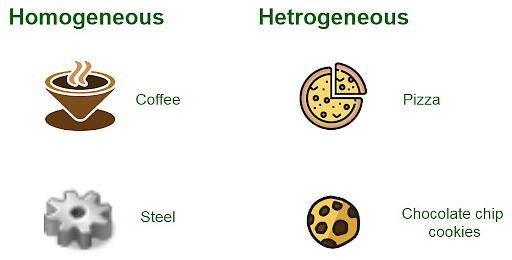
A mixture composed of two or more components that is uniform in composition throughout its mass is a homogenous mixture. For instance, saltwater, air, and all types of alloys viz. bronze, brass, steel are examples of a homogeneous mixture.
Heterogeneous Mixture
A mixture composed of two or more components with varied composition and property is a heterogeneous mixture. For instance, muddy water, polluted air, gun powder, etc are examples of a heterogeneous mixture.
Solution
A solution is a type of homogeneous mixture consisting of solute and solvent where the solvent is that component of the solution that dissolves other components whereas the solute is that component that gets dissolved in the solvent. For instance, a glass of saltwater has salt as a solute that gets dissolved in water which acts as a solvent in this case.

Characteristics of Solution
- Solutions are homogeneous in nature.
- The size of a solute particle is less than 1 nm.
- Particles of solute pass through a filter paper.
- The particles of a solution cannot be seen either through the naked eye or a high-power microscope.
- Constituents of a solution cannot be separated by filtration.
- The solute particles in a solution do not separate out on keeping.
- Properties of a solute are retained in the solution.
- A beam of light is not scattered when passing through a solution due to very small particle size.
Also check:
Types of Solutions
Though most solutions are formed by dissolving solids in liquids solutions are also created by solids in solids, liquids in gases or gases in solid, etc. Below is listed various types of solutions available by mixing solids with liquids or solids in gases and many more:
Solid in Solid: This solution is formed by dissolving solids into solids. Metal alloys are the best examples of solid in solid. For instance, brass is an alloy of copper and zinc solution.
Solid in Liquid: This is the most common type of solution formed by dissolving a solid into a liquid. For instance, iodine tincture is formed by dissolving iodine into alcohol.
Liquid in Liquid: This is a liquid into a liquid solution. For instance, vinegar is formed by dissolving ethanoic acid into water.
Gas in Liquid: This is gas dissolved in a liquid solution. For instance, soda water is formed by dissolving carbon dioxide in water.
Gas in Gas: When gas is dissolved in another gas. For instance, the air is a mixture of oxygen, carbon dioxide, argon, and water vapor.
Gas in Solid: When gas is dissolved in solid. For instance solution of hydrogen gas in palladium.
Liquid in Gas: When a liquid is dissolved in gas. For instance solution of chloroform in nitrogen gas.
Solid in Gas: When a solid is dissolved in gas. For instance cubes of camphor dissolved in nitrogen gas.
Liquid in Solid: When a liquid is dissolved in a solid. For instance, the solution of mercury in sodium.
Also read: Ideal and Non-ideal Solutions
Separating Components of a Mixture
Most heterogeneous mixtures can be separated using simple physical methods. While some mixtures require special methods to separate the constituents depending on the properties of the constituents forming the mixture. Based on the type of solution viz. Solid in Solid or Solid in Liquid or Liquid in Liquid, the method of separation differs. Below is listed the commonly employed methods for separating components of a mixture:
- Separating a Solid-Solid mixture
Common methods used to separate a solid-solid mixture are:
- Separating with a suitable solvent: This method is used when one solid component of this mixture is soluble in the liquid solvent while the other is not. From a mixture of sugar and sand, if sugar is dissolved in water, the two components can be easily separated.
- By Sublimation: In this method, heat is applied to the solution whereby one of the solids is converted into vapor and this vapor is further converted into solid on cooling. For instance, when heat is applied to a mixture of common salt and ammonium chloride, ammonium chloride is sublimed.
- By using a magnet: Magnet can be used to separate iron filings from a mixture of iron and sulfur powder whereby the magnet attracts the iron fillings.

- Separating a Solid-Liquid mixture
Common methods used to separate a solid-liquid mixture are:
- Filtration: In this method, filter paper is used to remove insoluble materials from a liquid. For instance, a solution of chalk and water is separated using filter paper.
- Centrifugation: In this method, suspended particles are removed from a liquid using a centrifuge. For instance, centrifugation is used to separate blood cells and plasma.
- Evaporation: In this method, heat is applied to this solution whereby the liquid gets transformed into vapor. For instance, evaporation is applied to a solution of common salt and water solution.
- Crystallization: In this method, heat is applied to a concentrated solution of a chemical and afterward cools down to form crystals.
- Chromatography: In this method, two or, more dissolved solids present in a liquid in very small amounts are separated using paper chromatography.
- Distillation: In this method, heat is applied to the solution whereby the vapors formed by heating are condensed to get the pure liquid component.

- Separating a Solid-Liquid mixture
Common methods used to separate a liquid-liquid mixture are:
- Fractional Distillation: This method is employed whereby the two liquids in the solution have a difference of 25º Celsius or less in their boiling point. In this method, a hot saturated solution is cooled down in a suitable solvent.
- Separating Funnel: In this method, a separating funnel is used to separate two immiscible liquids. For instance, separating a mixture of water and oil by using a separating funnel.

Things to Remember
- Matter can be pure as well as impure. Pure substances can be elements or compounds. Pure elements are made up of only one kind of atom or molecule while compounds are made of two or more elements combined in a fixed proportion.
- Impure substances or mixtures are made of two or more elements or molecules of the variable proposition. Mixtures can be both homogenous and heterogeneous in nature.
- Solutions are a type of homogenous mixture that can be separated using various methods namely distillation, chromatography, sublimation, etc.
- Homogeneous mixtures are mixtures that are composed of two or more components that are uniform in composition throughout their mass. For instance, saltwater, air, and all types of alloys viz. bronze, brass, steel are examples of a homogeneous mixture.
- A mixture composed of two or more components with varied composition and property is a heterogeneous mixture. For instance, muddy water, polluted air, gun powder, etc are examples of a heterogeneous mixture.
- A solution is a type of homogeneous mixture consisting of solute and solvent where the solvent is that component of the solution that dissolves other components whereas the solute is that component that gets dissolved in the solvent. For instance, a glass of saltwater has salt as a solute that gets dissolved in water which acts as a solvent in this case.
Sample Questions
Ques: What are the characteristics of pure substances? (3 marks)
Ans: Some of the characteristics of pure substances are:
-
Pure substances possess the following properties:
-
These are homogeneous in nature.
-
They have constant physical properties.
-
They can be categorized into solid, liquid,s and gases.
-
They possess fixed density and specific boiling and melting point.
Ques: What is a suspension? (2 marks)
Ans: A suspension is a heterogeneous mixture where solid particles are insoluble in the solvent and are thus visible to the naked eye. The solid particles in a suspension have a size greater than 1000nm, i.e., 10-6m
Ques: Why is pure oxygen considered an element? (1 mark)
Ans: Pure oxygen consists of molecules of a single type of element, unlike compounds which are composed of different types of elements.
Ques: Give some examples of pure substances? (2 marks)
Ans: Some of the pure substances are listed below:
Sugar, Oxygen, Diamond, Common Salt, Ammonia, Chlorine.
Ques: What are true solutions? (2 marks)
Ans: Solutions that consist of solute particles of very small size having a diameter < 1010m are true solutions. Copper sulfate solution, vinegar, salt solution are examples of the true solution.
Ques: What are the different ways of expressing the concentration of a solution? (3 marks)
Ans: The concentration of a solution can be expressed in the following ways:
Mass by the mass percentage of a solution = (Mass of solute/ Mass of solution) ×100
Mass by volume percentage of a solution = (Mass of solute/ volume of solution) ×100
ppm=(mass of solute/ mass of solution)× 106
ppb=(mass of solute/ mass of solution)× 109
where
ppm= parts per million & ppb= parts per billion
Ques: What is a colloidal solution? (3 marks)
Ans: A colloidal solution is a mixture with particles regularly suspended in a fluid and having particles of size ranging between 1nm and 1000nm. The component which is present in a smaller proportion is the dispersed phase while the other present in greater proportion is called dispersion medium. Fog, shaving cream, mayonnaise, etc are ideal examples of colloidal solutions.
Ques: What is Tyndall Effect? (2 marks)
Ans: Also known as Rayleigh scattering is the phenomenon of scattering of a beam of light when passing through a colloidal solution or a very fine suspension. The Tyndall Effect is evidenced when smoke or dust in a room becomes visible when a light beam enters through its window.
Ques: What type of mixtures is separated through crystallization? (2 marks)
Ans: The process of crystallization is applied to separate solids from liquid in a solid-liquid solution. In this technique, the hot solvent is applied to completely dissolve the solid components in the solution and afterward cool down to obtain the solid in crystal form.
Ques: How would you identify whether a colorless liquid is a pure water or not? (2 marks)
Ans: If the liquid starts boiling at 100°C at atmospheric pressure, then the colorless liquid must be pure water as pure substances have a fixed boiling and melting point.
Ques: Name the technique used to separate the following: (3 marks)
(a) Butter from curd.
(b) Salt from seawater
(c) Camphor from salt
Ans: (a) For separating butter from curd, a process called centrifugation is applied which is governed by the principle of density.
(b) For separating salt from seawater, distillation is applied whereby water evaporates leaving behind the solid salt.
(c) For separating camphor from salt, sublimation technique is applied whereby during phase change, camphor does not undergo change to the liquid state.
Ques: What is a saturated solution? (2 marks)
Ans: In a saturated solution consisting of a given solvent no more solute can dissolve further at a given temperature. Beverages and Carbonated water are ideal examples of a saturated solution.
Ques: What are solute and solvent in the tincture of iodine? (2 marks)
Ans: A solution of solid Iodine in alcohol is commonly called tincture of iodine. Thus iodine acts as a solute here and alcohol acts as a solvent.
Ques: 36g of sodium chloride is dissolved in 100 g of water at 293 K to prepare a saturated solution. Find the concentration of this solution at this temperature? (2 marks)
Ans: Mass of solute = 36g
Mass of solvent = 100g
Mass of solution = 100 + 36 = 136g
Since Concentration = Mass of solute/ Mass of solution x 100
Concentration = 36/136 x 100 = 26.47%
Ques: Is Tyndall Effect evidenced in solutions, colloids, and suspensions? (2 marks)
Ans: Tyndall Effect is exhibited in colloids, may or may not be exhibited in suspension, and not exhibited in solution. Milk and starch solutions are ideal examples of solution and emulsions exhibiting the Tyndall Effect.



Comments