



Content Curator
Centrifugation is the process in which a centrifugal force is applied to separate two mixtures of liquids. In this process, the denser component of the mixture moves away from the shaft and the lighter one towards the shaft. This process is too fast and more time-consuming than churning, so it is used most widely. In this process, the container containing the mixture is rotated in the middle by a rotator, so that the components of the mixture are easily separated under the pressure of the centrifugal force.
| Table of Content |
Keyterms: Centrifugation, centrifugal force, liquids, rotation, Clothes, vapors, liquid
Read More: Types of Solutions
Definition of Churning
[Click Here for Sample Questions]
The process of stirring is defined as the mixing of cream to produce butter. Previously, only manual techniques were available for this process. For example, using a conventional frothier, as shown in the figure above, where the vessel or sour cream was provided with a piston which was then agitated by rotation. The figure below shows another hand-operated device with two and movement set instead of rotation.
Also read:
What is Centrifugation?
[Click Here for Sample Questions]
For the centrifugation process, in simple words, skim milk is separated from the whole milk used to make ghee and butter. This procedure is used to separate water and clothes. Washing machines use this technique to spin clothes at high speed after the washing and rinsing process is complete to dry the clothes.
In laboratories, cells are separated from plasma in the blood by centrifugation. Chalkdust can be removed from the water by centrifugation. Centrifugation stabilizes the wine. Particles from the high-velocity air stream can be separated. The process is used to separate proteins in various purification techniques.

Fig. Centrifugation
Applications of Centrifugation
[Click Here for Sample Questions]
- It is used in dairies to separate cream and cream.
- It is used to squeeze water out of wet clothes in washing machines.
The method of separating the mixture depends on the nature of its components. In addition to churning and centrifugation, the various physical methods commonly used to separate the components of mixtures containing liquids are as follows:
Fractional Distillation
Fractional distillation is the process of separating two (or more) miscible liquids by distillation, the distillate is collected in fractions boiling at different temperatures. The more volatile (lower boiling) liquid is distilled first and the less volatile (higher boiling) is distilled water. A simple fractionation column is a tube filled with glass beads. To cool and condense again, the beads provide a surface for the vapors.

Fig. Fractional Distillation Diagram
Applications of Fractional Distillation
- Fractional distillation is used to separate mixtures of miscible liquids for example:
- Used to separate crude oil into useful fractions such as kerosene, petrol or diesel, etc.
- Used to separate gases from the air.
Separation by Separating Funnel
A mixture of two immiscible liquids can be separated with a separating funnel.
The separation of two immiscible liquids with a separating funnel depends on the difference in their density. The denser liquid forms the bottom layer, while the lighter liquid forms the top layer.
For Example, This method can be used to separate water and kerosene. Heavier water forms the bottom layer in the funnel, while kerosene forms a lighter top layer
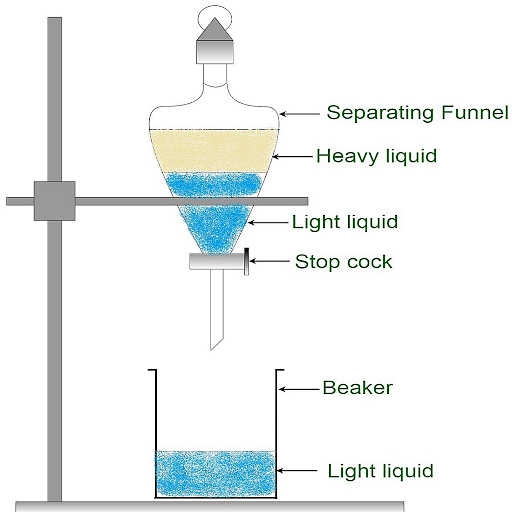
Fig. Separation by Separating Funnel
Things to Remember
- In a solution, particles whose density is higher than that of the solvent sink (sediment), and particles that are lighter than it float to the top.
- The greater the difference in density, the faster they move. If there is no difference in density (isopyknic conditions), the particles stay steady.
- To take advantage of even tiny differences in density to separate various particles in a solution, gravity can be replaced with the much more powerful “centrifugal force” provided by a centrifuge.
- Separations are a critical step in your workflow; thus it’s important to consider the centrifuge requirements and technical specifications for your applications, from selecting the appropriate speed and g-force to exploring the latest trends in centrifugation.
Also read:
Sample Questions
Ques. How useful is the principle of centrifugation in blood banks? (2 Marks)
Ans. We know that blood is a colloidal solution (neither soluble nor settled). The centrifuge is useful in blood banks. In the centrifuge, the test tube with blood samples rotated at a very high speed. Centripetal acceleration causes the heavier component to settle and the blood components to separate.
Ques. What is a centrifugal pump? (2 Marks)
Ans. A centrifugal pump is a hydraulic machine that converts mechanical energy into hydraulic energy by centrifugal force. This works on the principle that as the pressure head increases, its touch speed also increases.
Ques. What is the principle of centrifugation? (2 Marks)
Ans. The centrifuge operates on the principle of sedimentation: liquids are separated according to their density by gravitational force (g-force). Various forms of separation are known, including isopycnic, ultrafiltration, mass gradient, phase separation, and pelletization.
Ques. How does centrifuge separate mixtures? (2 Marks)
Ans. The components of the heterogeneous mixtures are separated by centrifugation. This includes liquids in liquids, solids in liquids, and gases in solids and liquids. To move large sections to the outside of the tube, centrifugation uses centrifugal energy. It allows the solids to settle more easily and completely.
Ques. What can the centrifuge be used for? (2 Marks)
Ans. A centrifuge is a laboratory instrument used to separate gases, gases, or liquids depending on their mass. By rotating the vessel carrying the material at high speed, the separation is accomplished; the centrifugal force forces heavier materials onto the outside of the vessel.
Ques. What does a centrifuge mean? (2 Marks)
Ans. A centrifuge is a system that uses a centrifugal force to separate the liquid or liquid components (and even the gases). This is done by rotating the liquid at high speed in a bottle, thereby separating liquids of different densities (e.g., milk cream) or liquids from solids.
Ques. What is sedimentation? (3 Marks)
Ans. Sedimentation is the tendency for particles in suspension to settle out of the fluid in which they are entrained and come to rest against a barrier. This is due to their motion through the fluid in response to the forces acting on them: these forces can be due to gravity, centrifugal acceleration, or electromagnetism.
Sedimentation occurs when eroded material that is being transported by water, settles out of the water column onto the surface, as the water flow slows. The sediments that form a waterway's bed, banks and floodplain have been transported from higher in the catchment and deposited there by the flow of water.
Ques. What are the types of centrifugation? (4 Marks)
Ans. Density Gradient Centrifugation
It allows separation of many or all components in a mixture and allows for measurement also. There are 2 forms of density gradient centrifugation one is rate zonal centrifugation and the second is I saw pyknic or sedimentation equilibrium centrifugation.
Differential Centrifugation
Differential centrifugation is a common procedure in microbiology and cytology useful to separate certain organelles for further analysis of specific parts of cells. In the process, a tissue temple is first homogenised generalized to break the cell membranes and mix up the cell contents. The homogenate is then subjected to repeated centrifugation, each time removed in the palate and increasing the centrifugal force.
Ultracentrifugation
Svedberg coined the term “ ultracentrifugation”. Ultra fuse was used to determine the MW and subunit structure of emo globin. The first commercial ultra fuse was produced in 1940. An important tool in biochemical research is the centrifuge, which through rapid spinning imposes hi centrifugal forces on suspended particles, or even molecules in solution, and causes separation of such matter on the basis of ultracentrifugation of differences in weight.

Fig. Types of Centrifugation
Also Read:



Comments