



Content Curator
Oleic acid is a soapy lipid molecule having a large molecular size. Although optical and electron microscopes are employed to measure the very small size of the molecules, a fascinating thin-film method can be employed for the measurement of the size of Oleic acid. In this method, 1 part by 400 oleic acid solution (in alcohol) is prepared. Then it is dropped on a water surface in a way that it creates a very thin one molecular layer of oleic acid on the water surface. By measuring the thickness of the layer, the molecular diameter of an oleic acid molecule can be measured. It is a fascinating method where no measuring instrument is required.
| Table of Content |
Key takeaways- Oleic acid, Measurement of molecule oleic acid, Thin-film method, Microscope Resolution.
Oleic Acid
[Click Here for Sample Questions]
Oleic acid is the most common naturally occurring fatty acid which generally occurs in animal and vegetable fats and oils. It is a colourless and odourless oil although often found to be yellowish in commercial samples. It is a mono-unsaturated omega-9 fatty acid, abbreviated 18:1 cis 9.
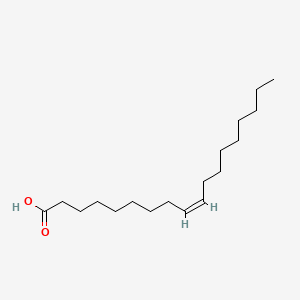
Oleic Acid
The formula of oleic acid is CH3(CH2)7CH=CH(CH2)7COOH. Oleic acid is usually a solid with a low melting point. There are two crystalline forms- α form and b- form. It is a long-chain carboxylic acid containing a double bond between C9 and C10 with a cis configuration. It is generally found in their esters, triglycerides, in the phospholipids that generally make the cellular membranes, wax esters and cholesterol esters.
Also Read:
Estimating Very Small Distances
[Click Here for Sample Questions]
To measure a very small size or a distance some special method has to be adopted. We simply cannot use a screw gauge or similar instrument to do the job. Even microscopes have certain limitations. For instance, the optical microscope uses visible light to look at the system under observation. Here the resolution to which an optical microscope can be used depends on the wavelength of the light used.

Electron Microscopy
As for visible light, the wavelength ranges between 4000 Angstrom to 7000 Angstrom, and the size of the particles smaller than this cannot be resolved by it. Electron microscopy indeed solves this problem to some extent. However, the resolution of an electron microscope is limited because of its wave behaviour. With the advancement of electron microscopy, a resolution up to a fraction of an angstrom could be reached. However, some simple processes could be applied to solve this issue.
Also Read:
Estimating Molecular Size of Oleic Acid
[Click Here for Sample Questions]
Oleic acid is a soapy liquid molecule having a large molecular size. It has a fascinating structure as a part of the structure is hydrophilic and the remaining is hydrophobic. Hydrophilic molecules are those which dissolve in the water easily and the substances that do not dissolve in the aqueous solutions or water are generally called hydrophobic substances. The structure of Oleic Acid shows both of the features.

Hydrophobic and Hydrophilic Characteristic of Oleic Acid
Now if we look at the molecular structure of the Oleic Acid molecule, the -OH is at the end of the molecule. This is how the structure looks like when it encounters water- they stand upon it with this end down. Oleic acid buoys on water due to low density. However, the parts other than -OH are hydrophobic. So, when dropped in water, the molecules are likely to stand up and support one another on end due to the attractive forces between the hydrophobic parts of the oleic acid molecules.
Also Read:
Thin-Film Method
[Click Here for Sample Questions]
Here, the idea is to form a monomolecular layer of oleic acid on the water surface. The steps that can be employed here are stated below-
Step I: 1cm3 of oleic acid is taken and dissolved in alcohol to make a solution of 20cc.
Step II: Now 1cc of this solution is taken and dissolved in 20cc of alcohol. So the concentration of the oleic acid molecule in the solution is 120X 20cc. of oleic acid/cc of solution.
Step III: A large trough is taken and water is filled in it. The water surface is sprinkled with lycopodium powder.
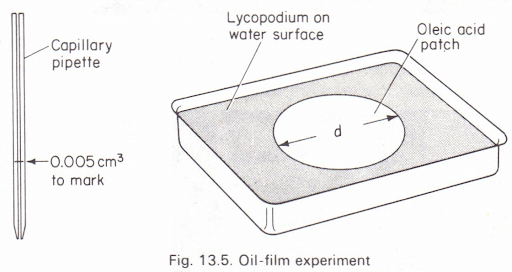
Thin-film Experiment
Step IV: Now, one drop of the oleic acid solution is put on the water surface. The oleic acid will spread into a large, thin, roughly circular, mono-molecular layer. The diameter of the thin film is noted down to measure the area.
Also Read:
Calculating Size of a Molecule
Now, let us assume that we have dropped ‘n’ drops of the oleic acid solution on the water surface.
If the volume of one drop is ‘v’cc,
Then the total volume of n number of drops in the solution will be nv cc.
Therefore, the amount of oleic acid of the solution = nv120 X 20cc
The solution of oleic acid spreads very fast on the water surface and forms a very thin layer of it.
Let us assume that the thickness of the layer is ‘t’ and the area of the layer is A sq.cm.
So,
t = Volume of the film x Area of the film
Or,
t = nv400A cm
Now, based on the assumption that it was a mono-molecular layer of oleic acid, this becomes the size or the diameter of a molecule of oleic acid. The value of the thickness turns out to be in the order of 10-9m. Taking into account the simplicity of this method it can be demonstrated and replicated with a great degree of precision.
Also Read:
Things to Remember
- Oleic acid is a naturally occurring fatty acid that is generally found in animal and vegetable fats and oils.
- To measure the molecular size of an oleic acid molecule a fascinating method can be used which does not employ any tricky machinery but concepts of physics.
- Oleic acid has both hydrophobic and hydrophilic parts.
- Oleic acid buoys on water due to low density.
- When dropped in water, due to the attractive forces between the hydrophobic parts of the oleic acid molecules, they form a thin layer on the surface of water.
- This thin layer is used to measure small measurements.
Also Read:
Sample Questions
Ques: What is a fatty acid? (2 marks)
Ans: In biochemical terms, a fatty acid is a carboxylic acid with an aliphatic chain. It is either saturated or unsaturated. The fatty acids are normally found in the vegetable oil, cellular membranes etc.
Ques: What is oleic acid? State its formula. (2 marks)
Ans: Oleic acid is a naturally occurring fatty acid which is a mono-unsaturated omega-9 fatty acid, abbreviated 18:1 cis 9.
The formula of oleic acid is CH3(CH2)7CH=CH(CH2)7COOH.
Ques: What are the uses of oleic acid? (2 marks)
Ans: Oleic acid is used in many ways. Some of its usages are stated below-
- It is a part of human food and nourishments where it is consumed as a part of animal fats and vegetable oil.
- It is also used in the pharmaceutical industry as an emulsifying and solubilizing agent in aerosol products.
- It is used in the synthesis process of nanoparticles.
Ques: Is there any harmful effect of oleic acid? (2 marks)
Ans: Oleic acid is likely to be safe when used in food amounts and used in food amounts. There is not enough reliable data on the harmful effects if it is taken.
Ques: What is resolution in a microscope? (2 marks)
Ans: The resolution of a microscope can be defined as the smallest distance between two points on a specimen that can be observed as two separate objects by the observer.
Ques: What is the working principle of an electron microscope? (2 marks)
Ans: An electron microscope uses an ‘electron beam’ to produce a detailed image of an object where the magnification is obtained by an electromagnetic field.
Ques: How a very small size or distance is measured? (2 marks)
Ans: Measuring very small sizes or distances such as the diameter of an atom or distances between two particles are relatively difficult as we cannot employ the traditional instruments to measure those. However, optical and electron microscopes are used to find out such small sizes or small distances. Apart from them, fascinating ideas such as the thin film method can also be used to measure the diameter of a molecule.
Ques. What is meant by tertiary structure of proteins? (3 marks)
Ans: The helical polypeptide molecule may fold on itself and assume a complex but specific form-spherical, rod-like or any form in between these. These geometrical shapes are known as tertiary (3°) structures of protein molecules. The coils and folds of the polypeptide molecules are arranged to hide the non-polar amino acid chains inside and to expose the polar side chains.
The tertiary structure of a protein brings distant amino acid side chains nearer to form active sites of enzymatic proteins. The tertiary structure is maintained by weak bonds such as hydrogen, ionic, disulphide and hydrophilic – hydrophobic bonds, formed between one part of a polypeptide and another. This structure is easily disrupted by pH, temperature and chemicals stopping the function of proteins.
Ques. Make a list of proteins that are used as therapeutic agents. Find other applications of proteins. (2 marks)
Ans: Proteins used as therapeutic agents are: thrombin, fibrinogen, enkephalins, antigens, antibodies, streptokinase, protein tyrosine kinase, diastase, renin, insulin, oxytocin, vasopressin etc. Proteins are also used in cosmetics, dairy industries, textile industries, research techniques, biological buffers etc.
Also Read:



Comments