



Content Curator
Migratory birds are birds that migrate from one location to another in search of a suitable area to live in. In case Migratory birds do not migrate to another location, their chances of survival decline.
- These birds usually migrate from unfavourable locations to places that have an adequate amount of food and water resources.
- Migratory birds migrate when the breeding season arrives.
- However, many birds migrate for food resources or due to seasonal changes.
| Table of Content |
Key Terms: Migration, Breeding, Temperate Zones, Seasonal Changes, Habitat, Nomadic Migration
What is Migration?
[Click Here for Sample Questions]
The term migration means moving from one place to another place in terms of settling temporarily or permanently.
- Migration of birds is when birds travel from one habitat to another due to seasonal changes, breeding, a search of food resources or to protect themselves from attackers.
- These migratory birds have the good ability to travel such long distances.
- With the movement of the earth and the season they know when to travel and return.
- Migration is known to be a regular seasonal movement among birds in larger groups.
- Migration is often seen as a difficult process because birds travel huge distances.
Read More:
| Topic Related Concepts | ||
|---|---|---|
| Mutation | Ganga action plan | Endangered Species |
| Montreal Protocol | Environment Protection Act 1986 | Homeostasis |
What are Migratory Birds?
[Click Here for Sample Questions]
The word “migratory” refers to travelling from one place to another place.
- Birds that fly from their habitat to a different place are called migratory birds.
- By the end of summer, these birds start their journey and continue to fly till they reach their destination.
- Most of them fly in groups, which is why almost none of the birds deviate from the route.
- There are many reasons why these birds migrate to other locations, but one of the primary reasons for their migration is for breeding, feeding and raising their broods.
- Migration birds are classified according to the distance, season, and habitat they accommodate.
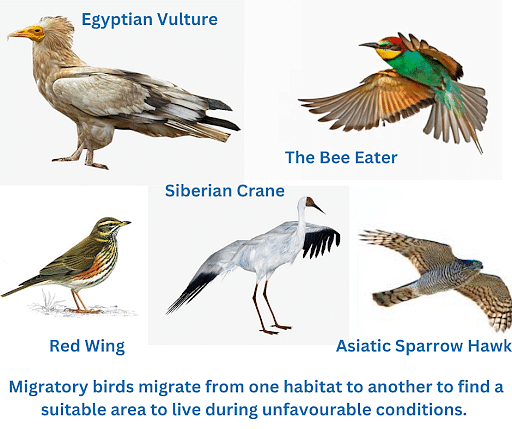
Migratory Birds
Types of Migration
[Click Here for Sample Questions]
There are several types of migration. Some of them are:
- Seasonal Migration- In this type of migration, the birds are migrating seasonally. Due to the harsh weather conditions, birds travel to other places.
- Longitudinal migration- Instead of travelling from north to south direction, these birds fly from east to west and vice versa. This type of migration is generally seen in Europe and parts of west Asia where they travel to the Atlantic coast.
- Latitudinal migration- Here, the birds fly north to south and south to north in a latitudinal pattern. These birds, unable to bear the cold winter, migrate to a warmer place. Some birds, such as the American Golden Plover, migrate from America to Argentina to avoid the cold winters of America. Siberian cranes come to India in the winter to escape the intense cold of their native land.
- Altitudinal Migration- Here, birds that breed in high mountains move to lower elevations to avoid the severe winter. In altitudinal migration, birds travel to protect themselves.
- Nomadic Migration- Unless there are sufficient food supplies, birds will migrate to a specific location during this type of migration.
- Leapfrog Migration- Birds migrate when they wish to get away from the inert urban population.
- Reverse Migration- Reverse Migration can be seen when birds become confused, thus choosing an unexpected path and moving in the opposite direction.
Features of Migratory Birds
[Click Here for Sample Questions]
Some of the important features of migratory birds include:
- Migratory birds have a good physical structure which helps them travel far distances.
- These birds store a large amount of energy by preserving food before starting their journey.
- With the position of the sun, moon and earth magnetism, migratory birds decide the time of journey.
- Most migratory birds travel to the southern hemisphere because of the less cold climate.
- These birds always travel in flocks so that they can follow the route until they reach their destination.
Name of Migratory birds
[Click Here for Sample Questions]
Some names of migratory birds are:
- Siberian Cranes and Greater Flamingo can be seen in India during the winter season.
- Asiatic Sparrow Hawk, in winter, migrates to India and Myanmar.
- Swallows migrate to Southern Africa from Southern England.
- Red Wing lives in the Himalayas or in Eurasia. However, they fly to Africa in Winter.
- Sand Martin lives in Eurasia or North America and migrates to Southern areas, depending on their zones.
- From Europe, Whinchat flies to Africa between the months of October to March.
- Common Rosefinch, from Eurasia, flies to Southern parts of Asia during winter.
Read Also:
Why Birds Migrate?
[Click Here for Sample Questions]
Migration of birds depends on many factors. The place, breeding and availability of resources make these birds travel to different places.
- Food Resources: The majority of the birds migrate for food because at some point of time these birds will face food shortage which can affect both birds and their offspring.
- Healthy Breeding: Different birds have different breeding techniques. These birds prefer milder, cooler climates where their babies will not be affected by harsh winters. They mostly breed in temperate zones and migrate to warmer climates.
- Climate Change: The present condition of climate is getting worse day by day, which makes migratory birds fly to different locations. The changing climate can affect the natural resources on which they depend most of the time.
- Protection of Progeny: These birds are now in grave danger due to unethical hunting and poaching. This is why these birds travel to defend themselves and their young.

Migration of birds
Protection of Migratory Birds
[Click Here for Sample Questions]
These birds endure numerous challenges while travelling a great distance. Birds get exhausted and famished because of the lengthy travel. It may be difficult for them to fly again if specific places lack food resources.
Threats to Migratory Birds
Some threats to migratory birds include:
- Because of anthropogenic activities such as hunting and exploitation, it is difficult for them to find secure areas to rest.
- Due to the expanding population, migratory birds face serious dangers such as hunting, poaching, climate change, pollution, and natural catastrophes.
- Such threats are the cause of the decline in migratory birds. Organisations such as the Convention on Migratory Species (CMS) attempt to save bird and marine species throughout their territories by collaborating with other conservation communities.
- There are rest areas set up for these birds so that they can rest and reproduce without being disturbed.
- However, due to increased population and agricultural practices, these stopover areas have been eliminated, resulting in bird extinction.
Conservation of Migratory Birds
Migratory birds become fatigued after a long journey. They may die or have health problems if they continue to fly without stopping for rest and nourishment.
These birds are observed in fewer numbers these days due to a lack of space and the possibility of endangerment. Therefore, all countries should implement strong preventative measures that have a good impact on the environment and birds.
In order for their conservation, CMS (or, Convention on Migratory Species) at the international level aims to protect migratory species such as territorial, avian, or marine, throughout their capable ranges. Every country is coordinating with one another for their conservation.
Things to Remember
- These migratory birds have the ability to alter their flight patterns. Some birds can fly nonstop, whereas others can only fly once a day.
- Migratory birds require extra energy to maintain their energy levels throughout their journey.
- Migratory birds shed their old feathers to make their flight easier and to arrive at their destination faster.
- Migratory birds fly in groups to avoid the risk of hunter attacks.
Sample Questions
Ques. What is Reverse Migration? (1 mark)
Ans. Reverse Migration in birds can be found when they become confused. In this case, migratory birds choose an unexpected route and move in the opposite direction.
Ques. What are migratory birds? (1 mark)
Ans. Migratory birds are those birds who travel to different locations in terms of breeding, searching for food resources, and securing places to avoid the harsh winters of their native land.
Ques. What are the names of migratory birds? (1 mark)
Ans. Some names of migratory birds are Siberian cranes, greater Flamingos, Asiatic Sparrow Hawk, Swallow, Red Wing and albatrosses.
Ques. Why do migratory birds migrate?(1 mark)
Ans. These birds spend the summer at high altitudes and then migrate to a cooler region to breed. However, when the winter is harsh, they go to a temperate zone that is warmer than the arctic region.
Ques. What are the different types of migration? (2 marks)
Ans. Birds migrate in different types. Some are migrating for long distances and some are for short distances. Here are some different types of bird migrations- Latitudinal, Longitudinal, Seasonal, Diurnal, Nocturnal, Reverse and Nomad.
Ques. How do migrating birds travel? (2 marks)
Ans. These birds have a great sense of what is happening around the earth. It is believed that these birds have a good awareness of the position of the sun and the magnetic field of the earth which helps them to understand when to migrate.
Ques. What is meant by Migration? (2 marks)
Ans. Migration is a phenomenon of moving from one habitat to another in terms of settling temporarily or permanently due to a number of reasons, including seasonal changes, protection or finding food resources.
Ques. What is Latitudinal migration? (2 marks)
Ans. In latitudinal migration, birds fly north to south and south to north in a latitudinal pattern. Unable to bear the winters, these birds migrate to warmer habitats. Some birds, such as the American Golden Plover, are seen to migrate from America to Argentina in order to avoid the cold winters of America. Siberian cranes come to India in the winter in order to escape the winters in their native land.
Check-Out:



Comments