



Content Curator
Mixtures are homogeneous or heterogeneous compositions of two or more elements. They are made by mixing many kinds of pure matter, called a substance. Mixtures are prepared and separated by physical processes. For example, salt is derived from seawater, a mixture of water and sodium chloride, by evaporation. We can use physical techniques to separate substances that contain more than one compound. However, we cannot further separate them because they have undergone chemical changes.
| Table of Content |
Read More: Collision Theory
Constituents of a Mixture
Mixtures are made up of the smallest pure substances, known as elements. The term element was firstly used by a scientist, named Robert Boyle. Antoine Laurent Lavoisier was the foremost scientist who described the element as the primary form of matter that cannot further break into smaller units.
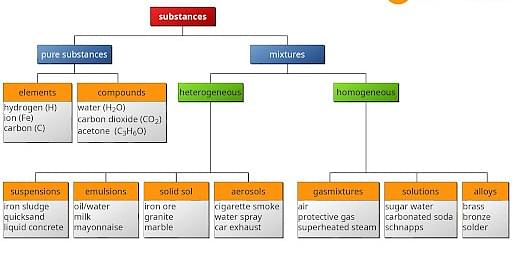
Elements are of three types – metals, non-metals, and metalloids. When two or more pure elements mix chemically, they form a compound. When two or more different elements are combined, they form a mixture. A mixture may also contain impurities like dust and dirt, which may alter its composition. The below table lists the differences between a compound and a mixture-
| Mixture | Compound |
|---|---|
| Elements are mixed without any proportion or composition. | Elements are mixed in a well-defined proportion to form new compounds. |
| It can have impurities, along with the variable composition of substances. | It is a pure mixture as the composition is fixed. |
| A mixture may have properties of its constituents. | A compound may have different properties than its individual constituents as it undergoes a chemical change. |
| Since it does not undergo a chemical change, these can be separated into individual constituents like they were earlier before making the mixture. | The substances present in a compound cannot be separated easily. They have to undergo a strong chemical change to get back to their original constituents. |
| e.g. lemon soda, cola | e.g. sodium chloride, nitrogen peroxide |
Types of Mixtures
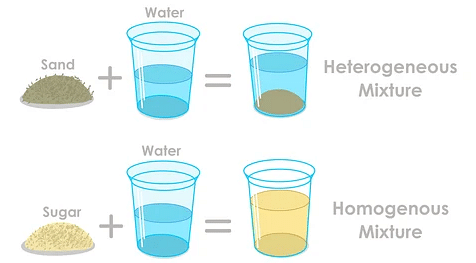
Based on the physical properties, mixtures can be of two types – homogeneous and heterogeneous. The difference between homogeneous and heterogeneous mixtures are as follows-
| Homogenous mixture | Heterogeneous mixture |
|---|---|
| A uniform composition containing more than one substance, thoroughly mixed and indistinguishable, is known as a homogenous mixture. | A non-uniform composition containing more than one compound, including impurities (if any), mixed in different proportions and remaining separate, is a heterogeneous mixture. |
| Their composition is the same throughout the mixture. | Their composition may vary according to the substances present in the mixture. |
| They are dissolved completely without creating any differentiable boundaries among the constituents. | They create differentiable boundaries that can be seen clearly with the naked eye. |
| e.g. sugar solution, alcohol and water | e.g. sand and water, blood, starch |
Classification of Mixtures
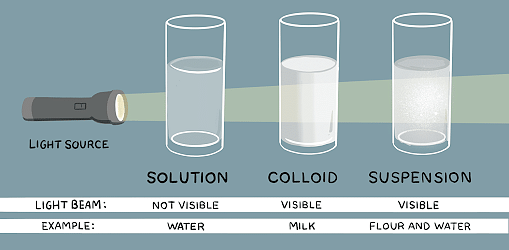
Depending upon the chemical properties, mixtures are classified as – solutions, colloids, and suspensions. The difference between these three mixtures is listed in the table below-
| Solution | Colloid | Suspension |
|---|---|---|
| A solution is a homogenous mixture containing two or more substances. Thus, homogeneity is maintained throughout the solution. | A colloid is a semi-homogeneous mixture. However, smaller particles (greater than those present in the solution) may appear homogeneous. | A suspension contains relatively larger particles than a solution and a colloid. Thus, it is a heterogeneous mixture. If not appropriately mixed, high-shear mixing techniques are used to make novel suspensions. |
| Solutions can be made by combining liquids-liquids, gases-gases or even solids-solids. For example, alloys are a mixture of metals. | They can be made by mixing solids-gases, liquids-solids, gases-solids. | They can also be made by combining liquids-gases, solids-gases, solids-liquids, but their particle size is greater than those of colloids. |
| A solution consists of a solvent and solute. The substance (usually present in less quantity) that gets dissolved is called the solute. The substance in which the solute is dissolved (typically present in larger quantities) is known as a solvent. | They contain different particles that are not visible to the naked eye. They have a disperse phase and a dispersion medium. The dispersion phase resembles the properties of a solute, and the dispersion medium corresponds to the properties of a solvent. | The particles present in a suspension can be seen clearly with a naked eye. If not visible, they can easily be seen under a microscope. With suspending agents and mechanical agitation, the internal phase (solids) are dispersed in the external phase (liquids). |
| Physical methods are insufficient to separate the constituents of a solution. Chemical processes are needed to separate them. | The particles inside them are left unsettled, due to which chemical processes can separate them. Simple physical processes, like filtration, may not separate the constituents of a colloid. However, special techniques, like centrifugation, can help separate the components. | Larger particles present in a suspension settle down due to gravitational forces. This process is known as sedimentation. Some of these particles float in the solution, while some get mixed throughout. |
| E.g. lemonade, cola, brass, bronze | E.g. milk, jelly, butter, emulsion. | E.g. sand in water, clouds, volcanogenic sulfates |
Other examples of colloids include-
| Dispersed phase | Type | Dispersing medium | Example |
|---|---|---|---|
| Solid | Solid sol | Solid | Milky glass, coloured gemstone |
| Liquid | Aerosol | Gas | Mist, fog, clouds |
| Solid | Aerosol | Gas | Smoke, automobile exhaust |
| Gas | Foam | Solid | Rubber, pumice, foam, sponge |
| Gas | Foam | Liquid | Shaving cream |
| Liquid | Emulsion | Liquid | Face cream, milk |
| Liquid | Gel | Solid | Jelly, cheese, butter |
| Solid | Sol | Liquid | Mud, Milk of magnesia |
Properties of Colloids
The two most important properties can be seen in colloids – the Tyndall effect and Brownian motion.
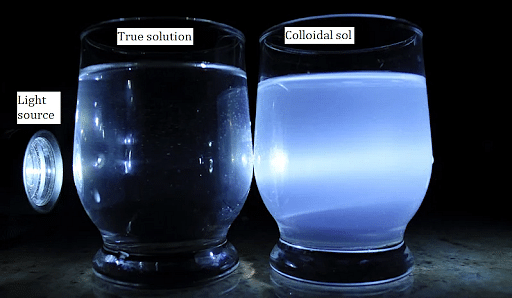
Tyndall Effect: The phenomenon by which light scatters in a colloidal solution is called the Tyndall effect. In the Tyndall effect, longer wavelengths transmit more via scattering, while the shorter wavelengths diffusely reflect more. Many live examples can be seen of the Tyndall effect every day, for example, the scattering of light through mist or smoke, sunlight scattered through a dense forest, scattering of light by water droplets in winters, etc.
Brownian Motion: It is the zig-zag movement of colloidal particles when dispersed in a medium. These motions can be seen under an electronic microscope. Brownian motion is inversely proportional to the size of the particle. The smaller the size of the particle, the more will be the Brownian motion. Common examples of Brownian motion include smoke movement coming out of the chimney, the mixture of milk in water, diffusion of the smoke of the incense stick in the room, etc.

Concentration of a Solution
Solution is made of solute dissolved in a solvent. The solute’s amount present in the solvent at room temperature denotes its solubility. The variable quantities of solutes and solvents indicate the solution’s concentration. If there is more of the solvent, then the solution is said to be dilute. If the quantity of solute is more, then the solution is said to be concentrated.

The dissolution of a solute in a solvent can be done under certain limits. When this limit is reached, the solution is said to be saturated. For example, we can dissolve sugar in water up to a specific limit. When this limit is reached, there will be no further addition of sugar, and the solution will be over-saturated. If the solute’s amount is less than the limit, then the solution is called an unsaturated solution.

Concentration of a solution is given by the solute’s quantity present in a definite amount of solvent.
Concentration of solution = weight or quantity of solute / weight or quantity of solution
= weight or quantity of solute / weight or quantity of solvent
Mass by mass percentage of a solution = (mass of solute / mass of solution) x 100
Mass by volume percentage of a solution = (mass of solute / volume of solution) x 100
Read More:
Example: A solution contains 80g of sugar in 400g of water. What is the concentration in terms of mass by mass percentage of the solution?
Solution: We know, mass by mass percentage of a solution is denoted by (mass of solute / mass of solution) x 100
Here the solute is sugar, and the solvent is water.
Mass of solution = mass of solute + mass of solvent = 80 + 400 = 480g
Therefore, mass by mass percentage of a solution = (80/480) x 100 = 16.67%
Read More:
Things to Remember
- A mixture is a composition of more than one compound in definite or indefinite proportions.
- If one, two or even more elements combine in a fixed proportion and homogeneously, the resulting product is a compound.
- Elements are the smallest units in a mixture.
- A mixture can exist in a homogeneous or heterogeneous state.
- Three types of mixture exist in nature – solution, colloids, and suspension.
- Colloids follow the Tyndall effect and Brownian motion.
- The concentration of a solution tells whether a solution is concentrated, dilute, saturated, over-saturated, or unsaturated.
Also Read:
Sample Questions
Ques. What is the evidence that air is a mixture? (2 marks)
Ans. Air is a homogeneous mixture made up of several gases. It does not have a fixed formula. Hence, it cannot be called a compound. We can separate different gases from air by applying pressure, which denotes that air is a mixture.
Ques. Is water an element or a compound? (2 marks)
Ans. Water is a pure compound made up of two hydrogen elements and one oxygen element. Water has a fixed formula H2O and can be broken down into hydrogen and oxygen elements by chemical processes.
Read More:
Ques. What is meant by a lean mixture, a rich mixture, and a correct mixture? (2 marks)
Ans. These mixtures are a type of air-fuel combination. A lean mixture is the one in which air is more than the fuel quantity. A rich mixture is the one in which fuel is more than the air quantity. A correct mixture is the one in which air and fuel are present in equal proportions.
Ques. Is table sugar a mixture or a compound? (2 marks)
Ans. Sugar is a compound. Though table sugar has some impurities, they are negligible. Hence, table sugar is termed a compound.
Read More:
Ques. What is the principle used in the separation of mixtures? (2 marks)
Ans. Different physical and chemical techniques can be used to separate mixtures, depending upon their type. For example, a solution can be separated using chemical processes, a colloid is separated using centrifugation, and a suspension can be separated using sedimentation and filtration.
Ques. Is brass a mixture? (2 marks)
Ans. Brass is a homogenous mixture of copper and zinc. It is also termed as alloy, a part of a homogenous mixture. Copper and zinc are mixed in definite proportions to prepare an alloy of metal known as brass.
Read More:
Ques. Is milk a compound or a mixture? (2 marks)
Ans. Milk is a colloidal mixture. It constitutes several micro-elements that are not visible to the naked eye. When a beam of light is subjected to pass through milk, it scatters the light. This phenomenon is known as the Tyndall effect, which is primarily seen in colloidal solutions.
Ques. What are the differences between elements, compounds, and mixtures? (2 marks)
Ans. Elements are the smallest units of matter. They are the purest form of particles occurring on earth. When two or more elements are bonded chemically, they make compounds. A compound may be refined or may have impurities. When two or more compounds are mixed in a definite or indefinite proportion, they are called mixtures. Therefore, mixtures may contain elements, compounds, or both, but the reverse does not hold.
Read More:
Ques. What are some mixtures that can be separated by chromatography? (2 marks)
Ans. Chromatography is a technique used to separate two mixtures based on their solubility. The more soluble substance remains in the solution, while the less soluble substance is separated first. Some mixtures separated using chromatography are – drugs, inks, dyes, proteins, alkaloids, etc.
Ques. What are some examples of gas and solid mixtures? (2 marks)
Ans. Common examples of gas mixed with solid particles are smoke and dust. For example, smoke coming out of industries or chemical factories is mixed with dust particles, producing a gas-solid mixture.
Ques. What is a racemic mixture? (2 marks)
Ans. A racemic mixture is a 50:50 chemical composition of two enantiomers. A racemic mixture, or a racemate, was firstly made by Louis Pasteur using tartaric acid and two enantiomeric isomers. Examples of a racemic mixture are chemical compounds like ibuprofen, salbutamol, cetirizine, thalidomide, etc.
Also Read:



Comments