



Content Curator
Monosaccharide or simple sugar is a carbohydrate that cannot be hydrolyzed into smaller carbohydrates. Like all carbohydrates, a monosaccharide consists of three chemical elements: carbon, hydrogen, and oxygen. It is the simplest type of carbohydrate molecule and often serves as the basis for forming more complex molecules.Monosaccharides include aldoses, ketoses, and their derivatives. The general chemical formula for a monosaccharide is Cn(H2)nOn or (CH2O)n. Examples of monosaccharides include the three most common forms: glucose (dextrose), fructose (levulose), and galactose.
Read More: Monomers
| Table of Content |
Key Takeaways: Monosaccharides, Glucose, Fructose, Galactose, Disaccharide, Oligosaccharide, Polysaccharide, Mannose
Properties of Monosaccharides
[Click Here for Sample Questions]
- In pure form, monosaccharides are crystalline, water-soluble, colorless solids.
- Monosaccharides have a sweet flavor because the orientation of the OH group interacts with the taste receptor on the tongue that detects sweetness via a dehydration reaction.
- Two monosaccharides can form a disaccharide, three to ten can form an oligosaccharide, and more than ten can form a polysaccharide.
Functions of Monosaccharides
[Click Here for Previous Years Questions]
Monosaccharides serve two main functions within a cell. They are used to store and produce energy. Glucose is a particularly important energy molecule. Energy is released when its chemical bonds are broken. Monosaccharides are also used as building blocks to form more complex sugars, which are important structural elements.
Structure and Nomenclature of Monosaccharides
[Click Here for Sample Questions]
The chemical formula (CH2O)n indicates a monosaccharide is a carbon hydrate. However, the chemical formula doesn't indicate the placement of the carbon atom within the molecule or the chirality of the sugar. Monosaccharides are classified based on how many carbon atoms they contain, the placement of the carbonyl group, and their stereochemistry.
The n in the chemical formula indicates the number of carbon atoms in a monosaccharide. Each simple sugar contains three or more carbon atoms. They are categorized by the number of carbons: triose (3), tetrose (4), pentose (5), hexose (6), and heptose (7). Note, all of these classes are named with the -ose ending, indicating they are carbohydrates. Glyceraldehyde is a triose sugar. Erythrose and threose are examples of tetrose sugars. Ribose and xylose are examples of pentose sugars.
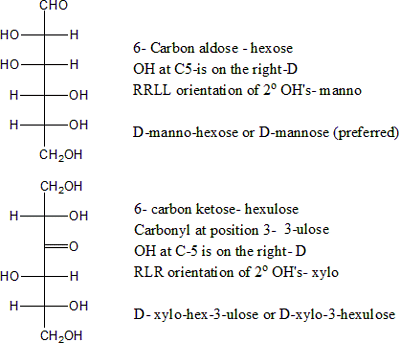
Monosaccharide Nomenclature
The most abundant simple sugars are hexose sugars. These include glucose, fructose, mannose, and galactose. Sedoheptulose and mannoheptulose are examples of heptose monosaccharides.
Aldoses have more than one hydroxyl group (-OH) and a carbonyl group (C=O) at the terminal carbon, while ketoses have the hydroxyl group and carbonyl group attached to the second carbon atom.
The classification systems may be combined to describe a simple sugar. For example, glucose is an aldohexose, while ribose is a ketohexose.
Uses of Monosaccharides
[Click Here for Previous Years Questions]
Several derivatives of monosaccharides are important for different requirements.
- Ascorbic acid (vitamin C) is derived from glucose.
- Important sugar alcohols (alditols), formed by the reduction of (i.e., in addition to hydrogen to) a monosaccharide, include sorbitol (glucitol) from glucose and mannitol from mannose; both are used as sweetening agents.
- Glycosides derived from monosaccharides are abundant and found almost everywhere, especially in plants.
Also Read:
Types & Examples of Monosaccharides
[Click Here for Sample Questions]
Monosaccharides are classified based on their functional group. If a monosaccharide contains an aldehyde group, it is known as aldose. If it has a keto group, then it is known as a ketose. Monosaccharides are also classified based on the number of carbons present in them, as shown in the table -
| Carbon atoms | General term | Aldehyde | Ketone |
|---|---|---|---|
| 3 | Triose | Aldotriose | Ketotriose |
| 4 | Tetrose | Aldotetrose | Ketotetrose |
| 5 | Pentose | Aldopentose | Ketopentose |
| 6 | Hexose | Aldohexose | Ketohexose |
| 7 | Heptose | Aldoheptose | Ketoheptose |
| 8 | Octose | Aldoctose | Ketoctose |
| 9 | Nonose | Aldononose | Ketononose |
Glucose
Glucose occurs in nature in an autonomous as well as a related fashion. It is present in sweet fruits and honey. Ripe grapes contain about 20% glucose and that is why it is also known as grape sugar. Glucose in related form is substantial in polysaccharides such as cane sugar and starch and cellulose.
Preparation of Glucose
-
From Sucrose (Cane sugar) - When sucrose is boiled in an alcoholic solution with dilute HCl or H2SO4 equal amounts of glucose and fructose are obtained.
(C6H22O11)(sucrose) + H2O → C6H12O6(glucose) + C6H12O6(fructose)
- From Starch - Glucose is produced commercially by the hydrolysis of starch by boiling it with dilute H2SO4 at 393 K under the pressure of 2–3 atm.
(C6H10O5)(starch) + nH2O → C6H12O6(glucose)
In this process, an aqueous solution of starch obtained from corn is acidified with dilute H2SO4 then it is heated in an autoclave under 2-3 atm pressure steam. When hydrolysis is complete, the liquid is neutralized with sodium carbonate to a pH of 4–5. The resulting solution glucose Xe is concentrated under reduced pressure to obtain crystals of glucose.
Structure of Glucose5
Glucose, also known as dextrose, comes under the aldehyde group. It has six carbon atoms, hence, called aldohexose. It is the most abundant organic compound present on earth. The properties of the structure of glucose are-
- It has a branch chain when it occurs in natural form. When heated with HI, it forms a linear chain.
- In the presence of the carbonyl group, glucose reacts with hydroxylamine to form oxime. It gives cyanohydrin after the addition of a hydrogen cyanide molecule.
- In the presence of mild oxidizing agents, like bromine water, glucose gets oxidized to six carbon carboxylic acid. This procedure is also an indication of the presence of an aldehydic group with a carbonyl group.

Structure of glucose
-
The presence of five OH groups can be confirmed from the acetylation of glucose with acetic anhydride. The result gives glucose pentaacetate, which ensures the presence of five OH groups. These groups have different carbons attached to them.
- The presence of a primary alcoholic group can be confirmed with the help of the oxidation process. Using nitric acid as an oxidizing agent, both glucose and gluconic acid yield dicarboxylic acid (a type of saccharic acid), which indicates the presence of a primary alcoholic group.
- Fischer gave the exact representation of spatial arrangement. Glucose, gluconic acid, saccharic acid.
- The correct name of glucose is D(+) glucose. (+) represents the dextrorotatory nature of the molecule, and D denotes the configuration. D and L have no relation with the optical activities of the compound.
Many properties of glucose can be explained by understanding its cyclic structure. Some of those are-
- Glucose does not give Schiff’s test and does not form hydrogen sulphite addition product with NaHSO3, even though it possesses the aldehyde group.
- The reaction of pentaacetate with hydroxylamine does not take place. As a result, it does not have any –CHO group.
- Glucose exists in two forms – alpha and beta. These two cyclic forms are present in equilibrium along with the open-chain structure. These two cyclic forms differ only in the configuration of the hydroxyl group, called anomeric carbon. Haworth was the scientist to figure out these cyclic structures of glucose.

Cylic structure of glucose
Importance of Glucose
- Glucose provides energy to both aerobic and anaerobic organisms.
- It is the primary source of fuel for the brain.
- It builds immunity by combining amino acids and fats.
- It is needed by muscles to grow stronger.
- It is absorbed by cells during oxidation processes.
Side effects of Glucose
-
High levels of glucose can result in diabetes.
-
The imbalance of glucose levels in the body can erode the pancreas. As a result, insulin production may level down.
- It can increase laziness in the body and confuse your brain, due to which focusing power decreases.
Fructose
Fructose is found in fruits and is called fruit sugar. It is also present in honey and sweet fruits along with glucose. In the combined state, it is also present in disaccharides (sucrose) and polysaccharides (insulin).
It is obtained by hydrolysis of cane sugar with dilute H2SO4 with glucose.
C12H22O11 + H2O → C6H12O6(D- glucose) + C6H12O6(D- fructose)
This solution containing equal molecules of D-glucose and D-fructose is called invert sugar.
Structure of Fructose
-
The molecular formula of glucose and fructose is the same. It is a laevorotatory (property to rotate left when a polarized light is passed through the compound) compound and belongs to the group D series of configuration.
-
It exists in two cyclic forms.
-
It forms a ring structure, similar to furan. Hence, it is called furanose.
- Haworth was the scientist to figure out the structure of fructose.

Structure of Fructose
Importance of Fructose
-
It has a low glycemic index, which results in less insulin release as compared to glucose and fructose.
-
It is used as fuel to power engines and motors.
- It is used in infant feeding formulas, baking items, nutrition bars and cookies, and beverages.
Side effects of Fructose
- It causes type II diabetes.
- It increases harmful cholesterol levels in the body.
- It increases body weight, obesity and hypertension.
- It results in various cardiovascular disorders.
Galactose
Galactose is known as milk sugar. It is 65% as sweet as sucrose and is used as an artificial sweetener. It is a chief compound found in glycolipids that boosts brain functioning.
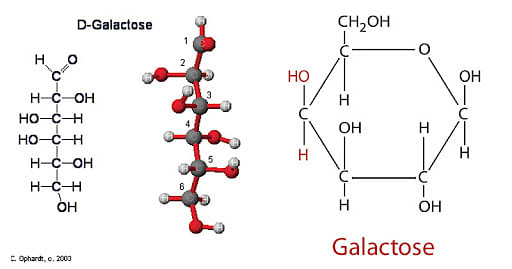
Galactose
Preparation of Galactose
Galactose is prepared by boiling lactose in sulphuric acid. For example, if 1kg of lactose is hydrolyzed in the presence of sulphuric acid by boiling it in 2-5 litres of water for two hours, we get around 27% of crude sugar, i.e., galactose. During hydrolysis, the solution is neutralized with barium carbonate, filtered and concentrated to obtain the crystalline form of galactose. Parts of ethyl and methyl alcohol are also added to get pure crystals of galactose.
Structure of Galactose
- Galactose occurs in four cyclic forms – two pyranoses (six ring compound) and two furanoses (five ring compound).
- Beta-galactose has an alcohol group in its equatorial position, whereas alpha-galactose has an alcohol group in its axial position.
Importance of Galactose
- Galactose is most important for infants to grow.
- It helps in brain development because of the presence of glycolipids, which boost nerve cells. Hence, it is commonly called brain sugar.
- It is used to treat hepatitis C, hepatic cancer, diabetic macular oedema and other diseases.
Side effects of Galactose
- Too much galactose can deteriorate kidneys, liver, eyes and brain.
- It can swell the body at different parts.
- It results in a blood disease known as galactosemia, meaning too much galactose in blood.

Fructose, Glucose, Galactose
List of some other monosaccharides and their significance
[Click Here for Previous Years Questions]
| Class | Species | Significance |
|---|---|---|
| Hexoses | d-Glucose | Major cell fuel, unbound in body fluids and tissues, building block of several polysaccharides |
| d-Fructose | Cell fuel, a constituent of sucrose | |
| d-Galactose | Cell fuel, a constituent of galactose | |
| d-Mannose | Constituent of plant cell wall polysaccharides and gums | |
| Pentoses | l-Arabinose, d-xylose | Constituent of plant cell wall polysaccharides |
| d-Ribulose, d-xylulose | Metabolite in pentose pathway | |
| d-Ribose | RNA constituent | |
| Uronic acids | d-Glucuronic, d-galacturonic | Constituent of plant cell wall polysaccharides |
| d-Mannuronic, d-guluronic | Constituent of algal polysaccharides | |
| Sugar alcohols | d-Glucitol, d-xylitol | Food ingredient |
| d-Galactitol | Metabolite of galactose | |
| Deoxy Sugars | d-Deoxyribose | DNA constituent |
| d-Desoxygalactose | Constituent of algal polysaccharides | |
| l-Fucose | Constituent of bacterial polysaccharides | |
| l-Rhamnose | Constituent of pectic plant polysaccharides | |
| Aminosugars | d-Glucosamine, d-galactosamine | Constituent of amino aminoglycans, cartilage |
Also Read:
Things to Remember
- Monosaccharides are the building blocks of carbohydrates providing energy to the human body for its function.
- They are the storehouse of energy and help during the oxidation process of cells.
- They are used as artificial sweetening agents for food.
- Glucose breaks down into three constituents – carbon dioxide, water and energy. Plants use carbon dioxide during photosynthesis. The human body absorbs water and energy for its metabolic activities.
- Monosaccharides combine with other nutrients, like amino acids, forming amino sugars, which strengthen the immune system and enhance antibiotic activities in the body.
- Monosaccharides form complex sugar compounds, which provide energy for the proper functioning of various organ systems.
Previous Year Questions
- A, B and C are three biomolecules. The results of the tests performed on them are given below (Telangana State Engineering Agriculture & Medical CET 2020)
- Which of the following is not an essential amino acid (JEE Main 2020)
- The cell membranes are mainly composed of (NEET 2005)
- Which one of the following is a peptide hormone (NEET 2006)
- During the process of digestion, the proteins present in food materials are hydrolysed to amino acids (NEET 2006)
- Which of the following is the correct statement ? (NEET 2001)
- A metal present in vitamin B12 is (KCET 2007)
- The richest source of vitamin A are (JIMPER 1998)
- Which of the following hormones is produced under the condition of stress which stimulates glycogenolysis in the liver of human beings (NEET 2014)
- Haemoglobin is (NEET 1997)
- Which of the following can possibly be used as analgesic without causing addiction and mood modification? (NEET 1997)
- The segment of DNA which acts as the instrumental manual for the synthesis of the protein is (NEET 2009)
- Which one of the following gives a positive Fehling's solution test? (NEET 2001)
- Phospholipids are esters of glycerol with (NEET 2003)
- Which of the following does not exihibit the phenomenon of mutarotation? (NEET 2010)
- Glucose contains in addition to aldehyde group (KCET 2006)
- Glycogen is (KCET 2015)
- An invert sugar is (KEAM)
Sample Questions
Ques. Write one example of monosaccharide carbohydrate? (2 Marks)
Ans: One example of a monosaccharide carbohydrate is Glucose which is of the molecular formula C6H12O6. It contains an aldehyde group hence it is also called aldohexose. It is also the most abundant monosaccharide carbohydrate. Glucose is usually present in solid-state as a monohydrate with a closed pyran ring. Whereas in aqueous solution, it is an open-chain to a small extent and is present predominantly as α- or β-pyranose. From aqueous solutions, the three known forms can be crystallized: α-glucopyranose, β-glucopyranose and β-glucopyranose hydrate. Glucose is a building block of the disaccharides lactose and sucrose.
Ques. What are monosaccharides? (2 Marks)
Ans: These are the simplest carbohydrates that cannot be hydrolysed into smaller molecules. Their general formula is (CH2O)n where n = 3 – 7 ; Example: glucose, fructose etc.
Ques. Where does the water present in the egg go after boiling the egg? (2 Marks)
Ans: Denaturation of proteins is a process that changes the physical and biological properties of proteins without affecting the chemical composition of proteins. In an egg, denaturation of protein is the coagulation of albumin present in the white of an egg. When an egg is boiled in water, the globular proteins present in it change to a rubber-like insoluble mass which absorbs all the water present in the egg by making a hydrogen bond with it.
Ques. What are the products of hydrolysis of sucrose? (2 Marks)
Ans: Invert sugar: An equimolar mixture of glucose and fructose is obtained by hydrolysis of sucrose in presence of an acid such as dil. HC1 or the enzyme invertase or sucrase and is called invert sugar.
Ques. Define a ‘Peptide linkage’? (2 Marks)
Ans: Peptide linkage: It is an amide linkage formed between – COOH group of one α-amino acid and NH2 group of the other α-amino acid by loss of a molecule of water. – CO – NH – bond is called Peptide linkage.
Ques. Name the four bases present in DNA. Which one of these is not present in RNA? (2 Marks)
Ans: The four bases present in DNA are :
(i) Adenine (A)
(ii) Guanine (G)
(iii) Cytosine (C)
(iv) Thymine (T)
In RNA, Thymine (T) is absent. It has Uracil (U) in place of Thymine.
Ques. What are essential and non-essential amino acids in human food? (4 Marks)
Ans: The PWR uses regular simple water as a coolant. The cooling water is held at very high pressure so that it does not boil. It passes through a heat exchanger, shifting heat to a secondary coolant loop, which then rotates the turbine.
The PWR uses regular simple water as a coolant. The cooling water is held at very high pressure so that it does not boil. It passes through a heat exchanger, shifting heat to a secondary coolant loop, which then rotates the turbine.
- Essential amino acids: Amino acids which the body cannot synthesize are called essential amino acids.
Example: Valine, leucine etc. Therefore they must be supplied in the diet.
- Non-essential amino acids: Amino acids which the body can synthesize are called non-essential amino acids. Therefore, they may or may not be present in the diet.
Example: Glycine, alanine etc.
Ques. Why are carbohydrates usually optically active? (2 Marks)
Ans: Carbohydrates are usually optically active because they contain one or more chiral carbon atoms.Due to the presence of one or more chiral or asymmetric carbon atoms and the absence of a plane of symmetry, carbohydrates are usually optically active.
Ques. Explain what is meant by the pyranose structure of glucose? (2 Marks)
Ans: The six-membered cyclic structure of glucose is called the pyranose structure (α or β) in analogy to pyran. Pyran is a cyclic compound consisting of one oxygen atom and five carbon atoms in the ring.
Also Read:



Comments