



Content Curator
The chemiosmotic theory states that molecules like glucose are metabolised to produce acetyl CoA in the form of an energy-rich intermediate whereas Photosynthesis is the process through which a plant converts light energy into chemical energy to create food. We will study their meanings and processes in detail.
| Table of Content |
Key Takeaways: Osmosis, Diffusion, Mitochondrial, ATP, Semipermeable membrane, electrochemical gradient, enzymes
Meaning of Photosynthesis
[Click Here for Sample Questions]
Photosynthesis is the process through which a plant converts light energy into chemical energy to create food. Plants produce food or energy in the form of sugar using water, carbon dioxide, and sunshine in the presence of chlorophyll and emit oxygen as a byproduct. This implies a synthesis or a chemical reaction that uses light energy as a catalyst. This isn't just for green plants; certain bacteria and prokaryotes use it to prepare their food as well. Synthesis takes place in the chloroplast, a key organelle in green plants and algae that contains the pigment chlorophyll. Chlorophyll is present in the leaves, stems, flowers, sepals, as well as plastids.

Also Read:
Process of Photosynthesis
As previously stated, photosynthesis takes place in the leaves, and the chloroplast is the specialised cell organelle responsible for this activity. Lamina is used so that it can take sunlight and carbon dioxide during the process of photosynthesis. Carbon dioxide enters through the stomata, while water is taken from the soil by the root hairs and transported to the leaves via the xylem vessels during photosynthesis.
- Glucose is made from hydrogen derived from water molecules and carbon dioxide taken from the air. Oxygen is also released through the leaves into the atmosphere.
- Plants use glucose as a source of energy for growth and development, with the remainder being stored in the roots, leaves, and fruits for later use.
- Another essential biological component of photosynthesis are pigments. They are the molecules that provide colour to things, and they absorb light of a certain wavelength and reflect the rest.
Also Read:
Meaning of Chemiosmotic Hypothesis
[Click Here for Sample Questions]
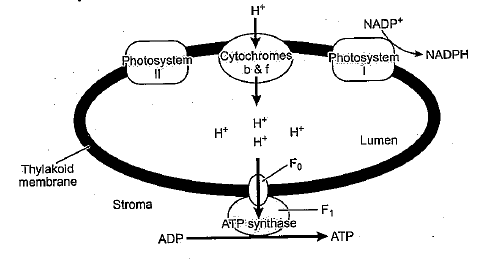
Peter Mitchell proposed the Chemiosmotic Hypothesis in 1961. It explains how ATP is synthesised in chloroplasts during photosynthesis. ATP and NADP are produced during the photochemical phase or light reaction. These are the major components that are used in the dark reaction to produce the photosynthesis' final product i.e, sugar molecules.
Also Read:
Process Of Chemiosmotic Hypothesis
The proton gradient that continues to exist around the thylakoid membrane generates ATP - Adenosine triphosphate molecules during this phase. The ATP synthase, proton gradient, and proton pump are all necessary components for the chemiosmosis process. The enzyme ATP synthase is responsible for the creation of ATP molecules.
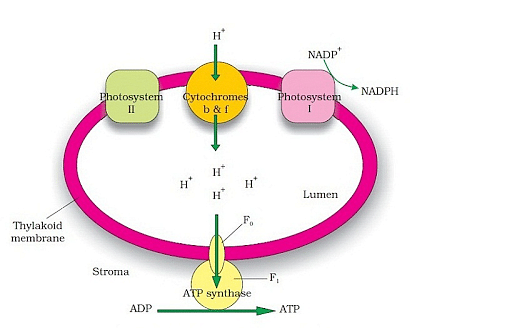
The ATP synthase enzyme is made up of two subunits: F0 and F1. The F0 subunit is involved in the transfer of protons across the whole membrane, causing changes in the F1 configuration and the activation of enzymes. The enzyme transforms ADP molecules into ATP molecules by phosphorylating them. It causes the phenomena of hydrolysis, in which water molecules are divided, resulting in the production of electrons and protons.
The photosystem uses a small amount of the resultant protons to reduce NADP+ to NADPH using electrons obtained from water photolysis. The proton gradient eventually collapses, releasing heat, energy, and protons to the stroma via the ATP synthase F0. The resultant energy causes changes in the conformation of F-1, which in turn stimulates the ATP synthase, which converts the ADP.
Also Read:
Points to Remember
Following are some important points:
- Protons are required for the reduction of NADP+ to NADPH H+, and they are removed from the stroma as well.
- When electrons move through the ETS, protons accumulate in the intermembrane space of the mitochondria, whereas when electrons move through the ETS, protons accumulate in the intermembrane space of the mitochondria.
- The hydrogen ions created by the splitting of the water molecule on the inner side of the membrane accumulate within the lumen of the thylakoids.
- The energy released from the gradient is enough to produce a conformational shift in the ATPase's F1 particle, causing the enzyme to synthesise multiple molecules of energy-dense ATP.
Sample Questions
Ques: What is the difference between ATP and ADP? (4 Marks)
Ans: The adenosine triphosphate (ATP) molecule is a nucleotide that is known in biology as the energy transfer powerhouse within cells. It is capable of storing and delivering chemical energy into the cells. ATP is a molecule that stores chemical energy generated by the breakdown of food molecules and then releases it to support and accelerate other processes within the cell.
Adenosine diphosphate is abbreviated as ADP. It is not only one of the most important molecules in the body, but it is also one of the most numerous. It is a component of DNA that is essential for muscle contraction. Despite all of these functions, ADP plays the most significant role in the conservation and release of energy within an organism.
Ques: Which is the hydrogen carrier in the chemiosmotic hypothesis? (2 Marks)
Ans: As a result, hydrogen ions (protons) are pumped from the mitochondrial matrix to the intermembrane space via hydrogen carrier proteins, while electrons are moved along the mitochondrial inner membrane's electron transport chain. In the mitochondrial matrix, acetyl CoA is properly oxidised and coupled with the reduced form of a carrier molecule, such as FAD or NAD.
Ques: What are the conditions for chemiosmosis to take place? (2 Marks)
Ans: A proton gradient, a membrane, a proton pump, and an ATP synthase enzyme responsible for the creation of ATP that must be used in the Calvin cycle are all required for chemiosmosis to occur. Ion migration through the membrane is controlled by a combination of two factors: A concentration gradient causes a diffusion force in which all particles prefer to disperse from a higher concentration to a lower concentration.
Ques: What is the role of H+ in chemiosmosis? (2 Marks)
Ans: Protons (H+) flow along a proton gradient by chemiosmosis during cellular respiration. This activates the enzyme ATP synthase, which joins a phosphate group to adenosine diphosphate (ADP) to generate ATP. In chemiosmosis, the energy stored in the gradient is utilised to produce ATP. Water is formed when oxygen receives electrons and picks up protons after the electron transport chain.
Ques: What occurs in the process of chemiosmosis? (2 Marks)
Ans: Chemiosmosis is the process of protons being pumped from the inner to the outside compartment of mitochondrial membranes through specific channels. The pumping creates a proton (H+) gradient. Protons diffuse down the gradient when the gradient is generated, thanks to a transport protein called ATP synthase.
Ques: How does chemiosmosis lead to ATP synthesis? (2 Marks)
Ans: Only a membrane protein called ATP synthase allows hydrogen ions in the matrix space to pass through the inner mitochondrial membrane. ADP is converted to ATP as protons pass through ATP synthase. The process of creating ATP in mitochondria by chemiosmosis is known as oxidative phosphorylation.
Ques: Does chemiosmosis require oxygen? (2 Marks)
Ans: Chemiosmosis is a process that uses oxidative phosphorylation in the electron transport chain to create ATP. Because oxygen is a final electron acceptor in the electron transport chain, the ETS will stop working in the absence of oxygen (for example, because a person is not breathing in enough oxygen), and no ATP will be produced by chemiosmosis.
Ques: When does the mitochondrial matrix pump hydrogen ions out in the matrix? (2 Marks)
Ans: Ion pump enzymes move ionic solutes such as sodium, potassium, hydrogen ions, and calcium across biological membranes, generating and maintaining concentration gradients. A gradient is a type of stored energy because it takes energy to generate. A chemiosmotic gradient allows hydrogen ions to flow back over the mitochondrial membrane into the matrix, where they are converted to ATP by the enzyme ATP synthase.
Ques: How much ATP does chemiosmosis produce? (2 Marks)
Ans: The Krebs cycle processes, the electron transport system, and chemiosmosis, according to most biochemists, can produce 36 molecules of ATP for each glucose molecule during cellular respiration. In addition, glycolysis produces two ATP molecules, resulting in a net yield of 38 ATP molecules.



Comments