



Content Curator
Pairs of angles are generated when two lines have a common endpoint, termed the Vertex, and an angle is formed between these two lines. There is a unique connection between angle pairs. Some of the types of angle pairings are: Complementary angles, supplementary angles, vertical angles, alternate interior angles, alternate exterior angles, corresponding angles, and adjacent angles.
Also Read: Angle Formula
| Table of Content |
Key Terms: Angles, Pairs of Angles, Complementary Angles, Supplementary Angles, Vertical Angles, Alternate Interior Angles, Alternate Exterior Angles, Corresponding Angles
Types of Angels with Examples
[Click Here for Sample Questions]
Complementary Angles
Complementary angles are formed when the total of two angles equals 90 degrees. Each angle is referred to as the complement of the other. As seen in the diagram below,
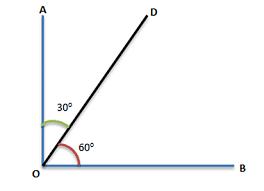
Complementary Angles
| ∠AOD + ∠BOD = 90° ⇒ 30° + 60° = 90° |
Therefore, ∠AOD and ∠BOD are complementary angles.
More Examples:
- 50° and 40° (50° + 40° = 90°)
- 75° and 15° (75° + 15° = 90°)
- 55° and 35° (55° + 35° = 90°)
Supplementary Angles
Supplementary Angles are formed by two angles whose sum equals 180 degrees.

Supplementary Angles
| ∠P + ∠R = 180° ⇒ 70° + 110° = 180° |
Therefore, ∠P and ∠R are Supplementary angles of each other.
More Examples:
- 150° and 30° (150° + 30° = 180°)
- 50° and 130° (50° + 130° = 180°)
Difference Between Complementary Angle and Supplementary Angle
Key differences between complementary and supplementary angles are tabulated below:
| Complementary Angle | Supplementary Angle |
| Sum of the angles equals 90°. | Sum of the angles equals 180°. |
| The two angles are referred to as complements of each other. | The two angles are referred to as supplements of each other |
| If one angle is y°, its complement is 90° – y°. | If one angle is y°, its supplement is 180° – y°. |
Adjacent Angles
Adjacent angles are any two angles that have a common side, a shared vertex, and do not overlap. In the figure, ∠CAD and ∠BAD are adjacent angles.

Adjacent angles
Conditions two angles need to fulfil to be Adjacent angles:
- have a common side
- Have a common vertex
- no overlap
Also Read:
Linear Pair of Angles
The adjacent angles of two intersecting lines form a linear pair. The total of linear pairs equals 180 degrees. It's worth noting that all linear pairings are supplementary since the total of supplementary angles equals 180°. However, all supplementary angles do not have to be linear pairs because the lines in linear pairs must overlap to generate adjacent angles. In the diagram below, ∠1 and ∠2 form a linear pair, and their total is 180 degrees.

Linear Pair of Angles
Vertical Angles
A pair of non-adjacent angles created by the intersection of two Straight Lines is known as a vertical angle.
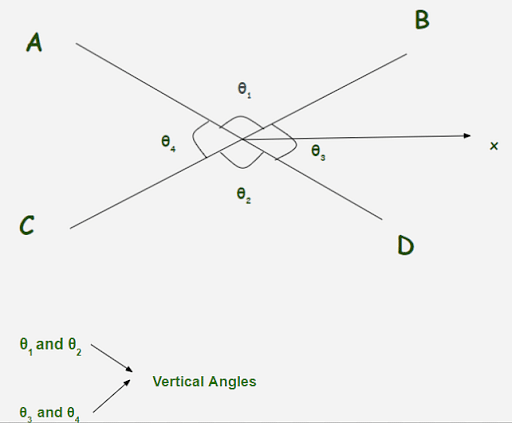
Vertical Angles
Here, line AD and line BC cross at one point, which we'll name X, resulting in four angles:
- ∠AXB = θ1
- ∠BXD = θ2
- ∠DXC = θ3
- ∠CXA = θ4
Because θ1 and θ2 are non-adjacent angles created by the intersection of lines AD and BC, they are always equal, implying that θ1 = θ2. In the same way, θ3 and θ4 are both vertical angles, hence θ3 Equals θ4.
Pairs of Angles Formed by Transveral
[Click Here for Sample Questions]
Co-interior Angles
Co-interior angles are always supplementary when a transversal connects two parallel lines. Angles that are co-interior:
- Different vertices are present.
- Lie in the middle of two lines.
- Are on the same transverse side.
∠A and ∠C are co-interior angles in the diagram below. ∠B and ∠D are co-interior angles in the same way. As a result, they serve as an add-on.

Co-interior angles
Alternate Interior Angles [Click Here for Sample Questions]
The alternate interior angles are created when a transversal meets two parallel lines. They are always equal. The angles that make up alternate-interior angles are those that:
- Different vertices are present.
- Lie on the transversal on opposite sides.
- Lie in the middle of the two lines.
In the figure below, ∠A and ∠D, ∠B and ∠C are the alternate interior angles.

Alternate Interior Angles
Also Read:
Alternate Exterior Angles
The alternate exterior angles created by a transversal intersecting two parallel lines are always equal. Angles that are opposite to the exterior are known as alternate-exterior angles.
- Different vertices are present.
- Lie on the transversal on alternate sides.
- Lie on the exterior of the lines.
In the following figure, ∠1 & ∠8, ∠2 & ∠7 are alternate exterior angles.

Alternate Exterior Angles
Corresponding Angles [Click Here for Sample Questions]
The corresponding angles created by a transversal intersecting two parallel lines are always equal. The angles that correspond to each other are:
- Have a number of vertices.
- Lie on the same side of the transversal and above (or below) of the lines.
In the following figure, ∠1 & ∠5, ∠3 & ∠7 are pairs of corresponding angles that are equal.

Corresponding Angles
Things to Remember
- Complementary angles are formed when the total of two angles equals 90 degrees. These angles don't have to be close to each other, but their sum should equal 90 degrees.
- Angles must have a common side and vertex to be considered adjacent.
- A linear pair must be supplementary, but a supplementary angle does not have to be. In either case, the sum of the angles should always be 180°.
- Linear pairings do not exist in all supplementary angles.
- Angles that are next to one another are not necessarily adjacent angles.
- If we have an x° angle, we can subtract it from 90° to obtain a complementary angle.
- If we have an x° angle, we can subtract it from 180° to find a supplementary angle.
Also read:
Sample Questions
Ques. Find the Angles. (2 Marks)
Ans. Here we see ∠BXD and b are vertically opposite angles therefore

b = ∠BXD
b = 60°
and we also see that ∠DXC and a are vertically opposite angles therefore
a = ∠DXC
a = 120°
Ques. The angles formed by two lines AB and CD intersecting at O are given below. What is the value of z if x:y = 3:7? (2 Marks)

Ans.
x and y form a linear pair
x and z are vertically opposite angles.
Since x:y = 3:7,
let x = 3k and y = 7k.
Now, we have:
∠x + ∠y = 180°
3k + 7k = 180°
10k = 180°
k = 18
Now,
Substituting the value of 'k' we have:
x = 3k = 3 × 18 = 54°
y = 7k = 7 × 18 = 126°
Therefore, ∠x = 54° and ∠y = 126°
∠x = ∠z = 54° (as vertically opposite angles).
Ques. L1 and L2 are two perpendicular lines that cross at O in the diagram below. Another straight line M is drawn across O, and various angles are generated as a result. What is the value of z if x:y = 1:5? (3 Marks)

Ans. Let x = k and y = 5k.
Since, the sum of ∠x and ∠y must be 90°,
we have:
∠x + ∠y = 90°
k + 5k = 90
6k = 90
k = 15k
∠x = 15°and ∠y = 75°.
Since ∠x and ∠z form a linear pair,
we have:
∠z = 180°− ∠x
∠z = 180° − 15°
∠z = 165°
Ques. How Many Angle Pairs Are there? (2 Marks)
Ans. Nine angles are listed below:
- Alternate Interior Angles
- Alternate Exterior Angles
- Co-interior Angles
- Complementary Angles
- Supplementary Angles
- Adjacent Angles
- Vertical Angles
- Corresponding Angles
- Linear Pair of Angles
Ques. How Many Pairs of Angles are Supplementary? (2 Marks)
Ans. When two angles add up to 180 degrees, they are termed supplementary. The angles do not have to be next to each other all of the time, but their sum should always be 180 degrees. When two angles are supplementary, one of them is referred to as the supplement of the other.
Ques. Find the value of q if the following angles form a linear pair. (2 Marks)

Ans. (7q - 46) ° + (3q + 6) ° = 180°
Or, 10q - 40 = 180°
Or, 10q = 180° + 40 = 220°
Or, q = 220° / 10 = 22°
Ques.Two angles are supplementary. The larger angle is 30? more than the smaller angle. Find the measure of both angles. (2 Marks)

Ans. Let a= measure of smaller angle
a+30= measure of larger angle
(a+30)+a=180
2a=150
a=75
Therefore, a+30=105
The angles are 75 degrees & 105 degrees.
Ques: The complement of an angle is five times it. Determine the measure of it. (2 Marks)
Ans. Let the given angle be x degrees.
Then, its complement is (90−x).
It is given that Angle =5× complement of the angle.
∴ x=5(90–x)
⇒ x=450−5x
⇒ 6x=450
⇒ x=75
Hence, the measure of the given angle is 75°.



Comments