



Content Curator
Centroid of a triangle is defined as the point of intersection of all the three medians in a triangle which connect the vertices with the midpoints of opposite sides. A triangle has four points of concurrencies. Centroid of a triangle is one of them. It is specifically the coordinate where the three medians of a triangle intersect. We can find the centroids of different two-dimensional geometric shapes.
What is Centroid of a Triangle?
[Click Here for Sample Questions]Centroid of a triangle is a point inside a triangle where all its medians converge or intersect. The medians are straight lines that are constructed from a vertex to its opposite side, dividing the opposite side into two equal halves. A median also divides the triangle into smaller triangles having equal areas. A triangle has four points of concurrencies namely,
- Orthocentre
- Incentre
- Circumcentre
- Centroid
The centroid of a triangle is always located inside the periphery of a triangle.
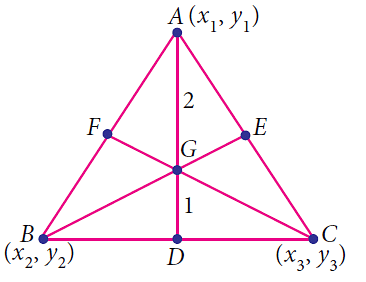
Centroid of a Triangle
Let us observe the following triangle. Here the point G represents the centroid of the triangle. Just like the incentre of a triangle, the centroid of a triangle always lies inside the periphery of the triangle. The section formula of coordinate geometry is applied to get the coordinates of the centroid. Since the centroid of a triangle is the concurrent point of its medians, it always lies on a median and divides it in the ratio of 2: 1. This is called the centroid theorem.
D, E, and F are the respective midpoints of the sides of the triangle. G is the centroid of the triangle ABC.
The video below explains this:
Coordinate Geometry Detailed Video Explanation:
Read more:
Properties of Centroid of a Triangle
[Click Here for Sample Questions]The properties of the centroid of a triangle are discussed as follows:
- The centroid of a triangle is the point of concurrency or convergence of all its three medians.
- At the centroid the medians get divided in the ratio 2: 1. This is also defined as the centroid theorem.
- The centroid of a triangle is the most common point of concurrency inside a triangle. Its physical and mathematical importance arises from the fact that it is the geometrical centre of the triangle.
- As it is the intersection point of all three medians, the coordinates of the centroid also satisfy the straight-line equations for the three medians.
- It is always located inside the periphery of a triangle.
Centroid of a Triangle Formula
[Click Here for Sample Questions]Let us consider the triangle shown below.

The coordinates of the three vertices of the triangle ABC are A(x1, y1), B(x2, y2) and C(x3, y3). D, E and F are the respective midpoints of the sides BC, AC and AB. G is the centroid.
Then the coordinates of the centroid of the triangle ABC are given as :
Centroid =(\(\frac{x_1 + x_2 + x_3}{3}\)) , (\(\frac{y_1 + y_2 + y_3}{3}\))
Read more:
Derivation of Centroid of Triangle Formula
[Click Here for Sample Questions]Considering the same triangle ABC as shown above. D, E and F are the respective midpoints of sides BC, AC and AB.
Applying the mid-point formula of coordinate geometry, the coordinates of the point D (midpoint of side BC of the triangle) can be calculated as :
D = (\(\frac{x_2 + x_3}{2}\) , \(\frac{y_2 + y_3}{2}\) )
We know according to the centroid theorem that the centroid G of a triangle divides any median in the ratio of 2: 1. Hence applying the section formula of coordinate geometry to get the coordinates of G we get :
G = ( \(\frac{[2 \frac{x_2 + x_3}{2} + 1(x_1)]}{2+1}\) ) , ( \(\frac{[2 \frac{y_2 + y_3}{2} + 1(y_1)]}{2+1}\) )
G = (\(\frac{x_1 + x_2 + x_3}{3}\)) , (\(\frac{y_1 + y_2 + y_3}{3}\))
Read more: Pythagoras Theorem
Centroid Theorem
[Click Here for Sample Questions]According to the centroid theorem, the centroid of a triangle lies exactly at 1/3 rd of a median’s length. It implies that the centroid point also divides the median in the ratio of 2:1. This theorem is helpful in applying the section formula to find the coordinates of the centroid inside a triangle.
Let us observe the following triangle ABC having its centroid G.
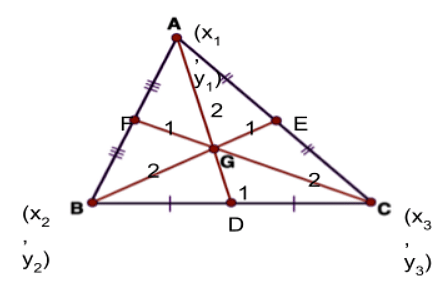
According to the theorem AG = 2/3 AD ; BG = 2/3 BE ; CG = 2/3 CF .
Read more:
Difference between Orthocentre and Centroid
[Click Here for Sample Questions]The differences between orthocenter and centroid are tabulated below.
| Centroid | Orthocentre |
|---|---|
| A centroid is the point of concurrency or intersection of all the medians of a triangle. | An orthocentre is the point of concurrency or intersection of all the altitudes of a triangle. |
| A centroid of a triangle always lies inside the periphery of the triangle. | An orthocentre may be located inside or outside of the triangle. |
| The centroid theorem implies that a centroid always lies on the medians and divides them in the ratio of 2 :1. | The orthocentre does not divide the altitudes in any fixed ratio. |
Difference between Incentre and Centroid
[Click Here for Sample Questions]The differences between centroid and Incentre are tabulated below.
| Centroid | Incentre |
|---|---|
| A centroid is the point of concurrency or intersection of all the medians of a triangle. | Incentre is the point of concurrency or intersection of all the angle bisectors of the internal angles of a triangle. |
| A centroid of a triangle always lies inside the periphery of the triangle. | It always lies inside the periphery of the triangle. |
| The centroid theorem implies that a centroid always lies on the medians and divides them in the ratio of 2 :1. | The incentre does not divide the angle bisectors in any such fixed proportion. |
Difference between Circumcentre and Centroid
[Click Here for Sample Questions]The differences between circumcentre and centroid are tabulated below.
| Centroid | Circumcentre |
|---|---|
| A centroid is the point of concurrency or intersection of all the medians of a triangle. | The circumcentre is the point of concurrency or intersection of all the perpendicular bisectors of sides of a triangle. |
| A centroid of a triangle always lies inside the periphery of the triangle. | A circumcentre may lie inside or outside the periphery of a triangle. |
| The centroid theorem implies that a centroid always lies on the medians and divides them in the ratio of 2 :1. | The circumcentre does not divide the perpendicular bisectors in any given fixed proportion. |
Important Topics for JEE MainAs per JEE Main 2024 Session 1, important topics included in the chapter Centroid of a Triangle are as follows:
Some memory based important questions asked in JEE Main 2024 Session 1 include: 1. The vertices of a triangle ABC are A(1,2), B(-3, 4) and C(5,8), then the orthocentre of ABC is? |
Things to Remember
- Centroid of a triangle is defined as the point of intersection of all the three medians in a triangle which connect the vertices with the midpoints of opposite sides.
- At the centroid, the medians get divided in the ratio of 2:1. This is also defined as the centroid theorem.
- The circumcentre is the point of concurrency or intersection of all the perpendicular bisectors of sides of a triangle.
- A triangle has four points of concurrencies - the orthocentre, the incentre, the circumcentre and the centroid.
- Incentre is the point of concurrency or intersection of all the angle bisectors of the internal angles of a triangle.
- An orthocentre is the point of concurrency or intersection of all the altitudes of a triangle.
- The coordinates of the centroid of a triangle ABC having the coordinates of the vertices as (x1, y1) , (x2, y2) and (x3, y3) is given as Centroid =(\(\frac{x_1 + x_2 + x_3}{3}\)), (\(\frac{y_1 + y_2 + y_3}{3}\) )
- The section formula of coordinate geometry is applied to find the coordinates of the centroid of a triangle.
- The differences arise between the different points of concurrencies on the basis of the type of triangles they are located in.
- The centroid is the geometrical centre of a 2-Dimensional shape. It can be found for different 2-Dimensional shapes.
Read more:
Sample Questions
Ques. Find the coordinates of the point of intersection of the medians of triangle ABC; given A = (-2, 3), B = (6, 7) and C = (4, 1). (3 Marks)
Ans. Here, (x1 = -2, y1 = 3), (x2 = 6, y2 = 7) and (x3 = 4, y3 = 1),
Let G (x, y) be the centroid of the triangle ABC. Then,
x =( x1+x2+x3)/3 = (−2+6+4)/3 = 8/3
y = (y1+y2+y3)/3 = (3+7+1)/3 = 11/3
Therefore, the coordinates of the centroid G of the triangle ABC are (8/3, 11/3)
Thus, the coordinates of the point of intersection of the medians of the triangle are (8/3, 11/3).
Ques. The three vertices of the triangle ABC are (1, -4), (-2, 2) and (4, 5) respectively. Find the centroid and the length of the median through the vertex A. (3 Marks)
Ans. Here (x1 = 1 , y1 = -4) , (x2= -2 , y2 = 2) and (x3= 4 , y3= 5)
Let G (x, y) be the centroid of the triangle ABC. Then,
X = (x1 + x2 + x3)/3 = (1+(-2) + 4)/3 = 3/3 = 1.
Y = (y1 + y2 + y3)/3 = (-4+2+5)/3 = 3/3 = 1.
Hence the coordinates of the centroid G of the triangle ABC are (1,1).
Let D be the mid point of the side BC of the triangle ABC .
Therefore the coordinates of midpoint D are (-2+4)/2 , (2+5)/2 = (1, 7/2).
Therefore the length of the median AD is = [ (1-1)2 + (-4 - 3.5)2 ]½ = 15/2 units = 7.5 units.
Ques. Two vertices of a triangle are (1, 4) and (3, 1). If the centroid of the triangle is the origin, find the third vertex. (3 Marks)
Ans. Let the coordinates of the third vertex are (h, k).
Therefore, the coordinates of the centroid of the triangle (1+3+h)/3 , (4+1+k)/3
According to the problem we know that the centroid of the given triangle is (0, 0)
Therefore,
(1+3+h)/3 = 0 ; h = -4
(4+1+k)/3 = 0 ; k = -5
Therefore, the coordinates of the third vertex of the given triangle is (-4, -5).
Ques. Two vertices of a triangle are (9, 8) and (7, 6). If the centroid of the triangle is (6,6), find the third vertex. (3 Marks)
Ans. Let us assume the coordinates of the third vertex are (h, k).
By applying the centroid formula we get the coordinates of the centroid as - (x1+x2+x3)/3, (y1+y2+y3)/3 and putting the values in the formula, we get-
Centroid of the triangle= (9+7+h)/3, (8+6+k)/3
It has already been given in the question that the coordinates of the centroid are (6,6).
therefore, 6= 16+h/3, 6=14+k/3
h= -2, k= -4.
Hence the third vertex is (-2,-4).
Ques. Point A is the midpoint of a side of the triangle and Point B is the centroid of the triangle pictured below. If the length of BC is 12 units, what is the length of AB ? (3 Marks)

Ans. We know that according to the centroid theorem, the centroid of a triangle divides the medians in the ratio of 2: 1.
Let the length of AB be x.
Therefore , applying this rule we get :
2/1 = 12/x ; x = 12/2 = 6.
The length of AB is 6 units.
Ques. Determine the coordinates of the centroid of a triangle whose vertices are (-1, -3), (2, 1) and (8, -4). (3 Marks)
Ans. Given,
The coordinates of the vertices are (-1, -3), (2, 1) and (8, -4)
From this, we can write the x- coordinates
x1 = -1, x2 = 2, x3 = 8
Similarly, for the y-coordinates;
y1 = -3, y2 = 1, y3 = -4
We know by applying the section formula the coordinates of the centroid of a triangle is
G = ((x1+x2+x3)/3 , (y1+y2+y3)/3 )
Substitute the values, G = ((-1+2+8)/3 , (-3+1-4)/3)
G =( 9/3 , -6/3)
G = (3, -2)
Therefore, the centroid of a triangle, G = (3, -2).
Ques. State the centroid theorem. What are the properties of the centroid of a triangle? (4 Marks)
Ans. According to the centroid theorem, the centroid of a triangle lies exactly at ? rd of a median’s length. It implies that the centroid point also divides the median in the ratio of 2 : 1. This theorem is helpful in applying the section formula to find the coordinates of the centroid inside a triangle.
The properties of centroid of a triangle are given as follows:
- The centroid of a triangle is the point of concurrency or convergence of all its three medians.
- At the centroid the medians get divided in the ratio 2: 1. This is also defined as the centroid theorem.
- The centroid of a triangle is the most common point of concurrency inside a triangle. Its physical and mathematical importance arises from the fact that it is the geometrical centre of the triangle.
- As it is the intersection point of all three medians, the coordinates of the centroid also satisfy the straight-line equations for the three medians.
- It is always located inside the periphery of a triangle.
Ques. For an equilateral triangle ABC the centroid is located at G . Find the length of AG , if the length of AB is 10 cm. (3 Marks)

Ans.
Given, G is the centroid of the triangle ABC. AB = 10 cm .
AB = BC = AC = 10 cm .
Here AD is the median, D is the midpoint of side BC.
BD = CD = BC/2 = 5 cm.
In an equilateral triangle, the medians are perpendicular to the respective sides. So,
AD⊥BC.
Now by using the Pythagoras theorem,
In triangle ADB ; AD2 = AB2 - BD2
Solving the equation by putting the values AB and BD we get AD = 53 cm.
We also know that the centroid G will divide the median AD in the ratio 2 :1 .
So we can write AG = ? AD = (10\(\sqrt{3}\))/3 cm.
Hence the value of AG is (10\(\sqrt{3}\))/3 cm.
Ques. Let P (6, -3) be the middle point of the line segment AB, where A has the coordinates (-2, 0). Find the coordinate of B. (3 Marks)
Ans. Let the coordinates of B be (m,n). According to the midpoint formula, the coordinates of the point P on AB are (-2 + m )/2, (0+n)/2.
But according to the question, the coordinates of the point P are (6, -3).
So , (-2+m)/2 = 6 , m= 14.
And n/2 = -3 , n = -6.
Therefore the coordinates of the point B are (14,-6).
Ques. The centroid of a triangle is located as (-1, -2). The coordinates of its two vertices are (4,6) and (-8,-12) . Find the coordinates of its third vertex. (3 Marks)
Ans. Let the coordinates of the third vertex be (x,y).
Given that G = (-1,-2).
Using the centroid formula we get:
G = (X1+X2+X3)/3 , (Y1+Y2+Y3)/3
(-1,-2) = (4-8+X)/3 , (6-12+Y)/3
On solving the above equations we get x = 1 and y = 0.
Hence the coordinates of the third vertex of the triangle are (1,0).
Ques. Find the coordinates of the point on the x-axis which are at a distance of 5 units from the point (6, -3). (3 Marks)
Ans. Let the coordinates of the point on the x axis be (x,0).
We know according to the distance formula the distance between two points is given as
[(x2 - x1)2 + (y2 - y1)2]½
Putting the values of the coordinates given in the question into the above equation we get:
(5)2 = (x-6)2 + (0+3)2
Squaring both sides we get
25 = (x-6)2 + 9
25 = x2 - 12x + 36 + 9
25 = x2 - 12x + 45
x2 - 12x + 45 - 25 = 0
x2 -12x + 20 = 0
(x-2)(x-10) = 0
Therefore x has two values in this case i.e. 2 and 10.
So the required points on the x-axis are (2,0) and (10,0).
Read more:
| Arithmetic Progressions | ||
| Quadratic Equations | ||
| Nature of roots of quadratic equations | Basic Proportionality Theorem | Cevas Theorem |
Class 10 Maths Study Guides:



Comments