



Exams Prep Master
A perpendicular bisector is a line or a line segment that intersects with another line or line segment perpendicularly and divides that line into two parts of equal measurement. A perpendicular bisector can be drawn by using a ruler, a compass and a pencil. Similarly, two lines are said to be perpendicular to each other when they intersect each other at 90 degrees. And, a bisector is a line that divides another line into two equal parts. Thus, a perpendicular bisector of a given line segment BC implies that it intersects BC at a right angle and cuts the line segment into two equal parts.
| Table of Content |
Key Takeaways: Perpendicular Bisector, line segment, arcs, right angle, Perpendicular Bisector of a Triangle, Points of intersection, circumcenter
What is a Perpendicular Bisector?
[Click Here for Sample Questions]
A perpendicular bisector can be defined as a line segment that bisects another line segment at 90 degrees or at a right angle, through the intersection point. Thus, we can say that a perpendicular bisector always divides a line segment into two equal halves through its midpoint as the term bisect itself means dividing equally.
Construction of a Perpendicular Bisector
[Click Here for Sample Questions]
To construct a perpendicular bisector, one will require a ruler, a compass and a pencil. There are certain steps that need to be followed to construct a perpendicular bisector of a given line segment. The steps are mentioned below:
- Step 1: Draw a line segment, suppose XY of any length.
- Step 2: Take a compass and then adjust it with a length of a little more than half of the length of XY.
- Step 3: Place the compass pointer at point X and draw arcs above and below the line segment.
- Step 4: Repeat step 2 and 3 by placing the compass pointer now at point Y and draw arcs above and below the line segment.
- Step 5: Mark the points of intersection as `P’ and `Q’.
- Step 6: Using a ruler, join the points `P’ and `Q’.
The perpendicular bisector bisects XY at a point `O’. Thus, the length of XO is equal to OY and the angle between the two line segments is 90 degree.
Also Read: Introduction to Constructions
Perpendicular Bisector of a Triangle
[Click Here for Sample Questions]
The perpendicular bisector of a triangle can be defined as a line segment that bisects the sides of a triangle and is perpendicular to the sides. It is necessary that the line segment should pass through the midpoint of the sides of a triangle. There can be a total of three perpendicular bisectors for a triangle (one for each side). The point at which all the three perpendicular bisectors of a triangle meet is called the circumcenter of a triangle.
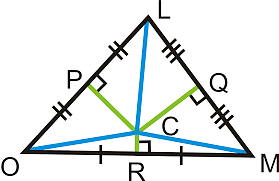
Perpendicular Bisector of a Triangle
Properties of a Perpendicular Bisector
[Click Here for Sample Questions]
- It divides a line or a line segment into two equal halves.
- It makes a right angle with the line that is being bisected.
- They divide the line segment through its midpoint.
- Every point in the perpendicular bisector is equidistant from the given points.
- It divides the sides of a triangle into equal parts.
- The point of intersection of the perpendicular bisectors in a triangle is called the circumcenter of a triangle.
Applications of a Perpendicular Bisector
[Click Here for Sample Questions]
Perpendicular bisectors are often used in geometry to proof theorems and do constructions.
- Perpendicular bisectors are used to construct an isosceles triangle.
- They are also used to find the circumcenter of a triangle.
Points to Remember
- A perpendicular bisector is a line that bisects another given line segment at a right angle and divides that line into two equal parts through the intersection point.
- Perpendicular bisector on a line segment can be constructed easily by using a ruler, a compass and a pencil.
- The perpendicular bisector of a triangle can be defined as a line segment that bisects the sides of a triangle and is perpendicular to the sides.
- There can be a total of three perpendicular bisectors for a triangle (one for each side of a triangle).
- The intersection point at which all the three perpendicular bisectors of a triangle meet is called the circumcenter of a triangle.
Sample Questions
Ques: Draw a line segment of given length 6.6cm. Draw the perpendicular bisector and measure the length of each part. [4 Marks]
Ans: The steps for construction are mentioned below as follows:
- Step 1: Draw a line segment AB of given length = 6.6cm.
- Step 2: Take a compass and then adjust it with a length of a little more than half of the length of AB.
- Step 3: Place the compass pointer at point A and draw arcs above and below the line segment.
- Step 4: Repeat step 2 and 3 by placing the compass pointer now at point B and draw arcs above and below the line segment.
- Step 5: Mark the points of intersection as `E’ and `F’.
- Step 6: Using a ruler, join the points `E’ and `F’.
The perpendicular bisector bisects AB at a point `M’. Thus, the length of AM is equal to MB. Therefore, AM = MB = 3.3cm
Ques: Draw a triangle ABC with given measurements as BC = 3.2 cm, AB = 3.6 cm and ∠ =1200. [4 Marks]
Ans: The steps for construction with the figure of the required triangle are shown below as follows:
- Step 1: Draw ∠XBY which measures 1200.
- Step 2: Now, from ray BX, cut off the line segment BC which is of length 3.2 cm.
- Step 3: Then, from ray BY, cut off the line segment BA which is of length 3.6 cm.
- Step 4: Now, join CA to obtain the required triangle.
Ques: State the Perpendicular Bisector Theorem. [2 Marks]
Ans: The perpendicular bisector theorem states that any point on the perpendicular bisector is equidistant from both the endpoints of the line segment on which it is drawn.
Ques: What is the point called at which all the three perpendicular bisectors of a triangle meet? [1 Mark]
Ans: The point at which all the three perpendicular bisectors of a triangle meet is called the circumcenter of a triangle.
Ques: Where do the points of intersection of all the perpendicular bisectors for different types of triangles meet? [2 Marks]
Ans: In an acute triangle, the points of intersection meet inside a triangle. In an obtuse angled triangle, the points of intersection meet outside a triangle and in right triangles; the points of intersection meet at the hypotenuse.
Ques: Write the steps of how to construct a perpendicular bisector of a triangle. [5 Marks]
Ans: The steps to construct a perpendicular bisector of a triangle are mentioned below as follows:
- Step 1: Draw a triangle with the help of a ruler and mark the vertices as A, B, and C.
- Step 2: Take a compass and then adjust it with a length of a little more than half of BC as radius.
- Step 3: Place the compass pointer at point B and draw arcs above and below the line segment.
- Step 4: Repeat step 2 and 3 by placing the compass pointer now at point C and draw arcs above and below the line segment without changing the radius.
- Step 5: Mark the points of intersection as `X’ and `Y’.
- Step 6: Using a ruler, join the points `X’ and `Y’.
This is the perpendicular bisector for one side of the triangle, i.e., BC.
- Step 7: Now, repeat the same from step 2 to step 6 for sides AB and AC. All the three perpendicular bisectors drawn are seen to make an angle of 900 at the midpoint of each side.
Ques: Proof that the points of intersection of all the perpendicular bisectors for an obtuse angle triangle PQR with measurements given as follows; PQ = 5 units, QR = 8 units, and PR = 9 units lies outside the triangle? [5 Marks]
Ans: Before doing the construction, we know that in a triangle, there are a total of three perpendicular bisectors that can be drawn from each side of a triangle. Also, that the perpendicular bisector of any triangle bisects the sides at its midpoint.
The steps to find the perpendicular bisectors of a triangle with the given measurements are shown below as follows:
- Step 1: Draw a line segment PQ of given length = 5 units.
- Step 2: Take a compass and then adjust it with a length of a little more than half of the length of PQ.
- Step 3: Place the compass pointer at point P and draw arcs above and below the line segment PQ.
- Step 4: Repeat step 2 and 3 by placing the compass pointer now at point Q and draw arcs above and below the line segment.
- Step 5: Join the points of intersection with the help of a ruler.
- Step 6: Now, repeat the same from step 2 to step 5 and draw perpendicular bisectors for the sides QR and PR..
Ques: The diameter of a circle whose radius is given 4 units. Draw a perpendicular bisector. [5 Marks]
Ans: Given,
Radius of a circle = 4 units
Diameter = 2 × radius
= 2 × 4
= 8 units
The steps to construct a perpendicular bisector on a diameter of a circle are shown below as follows:
- Step 1: Draw a line segment XY of length = 8 units.
- Step 2: Take a compass and then adjust it with a length of a little more than 4 units.
- Step 3: Place the compass pointer at point X and draw arcs above and below the line segment XY.
- Step 4: Repeat step 2 and 3 by placing the compass pointer now at point Y and draw arcs above and below the line segment.
- Step 5: Mark the points of intersection as `P’ and `Q’.
- Step 6: Using a ruler, join the points `P’ and `Q’.
The line PQ is the perpendicular bisector for the diameter of the circle.
- Step 7: Mark the point of intersection as `O’.
Check-Out:



Comments