



Education Journalist | Study Abroad Lead
Phaeophyceae or Brown Algae is a group of algae that are aquatic in nature. Brown algae are primarily found in marine habitats with few exceptions that grow in freshwater. They possess chlorophyll a, chlorophyll c, carotenoids and xanthophylls in the chromoplasts that give them their characteristic brown to olive green colour. They can reproduce via the vegetative, sexual and asexual modes of reproduction. Here, we will discuss more about characteristics, classification, modes of reproduction of Brown Algae in detail.
Read Also: Cysteine
| Table of Content |
Key Terms: Phaeophyceae, Brown Algae, Asexual Reproduction, Sexual Reproduction, Species, Algae, Fragmentation, Zoospores, Vegetative Propagation
What is Phaeophyceae?
[Click Here for Sample Questions]
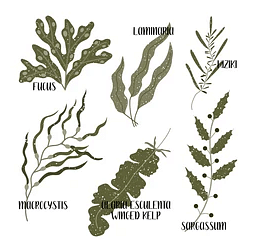
Phaeophyceae are a group of algae commonly known as Brown algae. They are mostly found in marine habitats, with a few exceptions that can grow in freshwater habitats. Brown algae vary from olive green to brown in colour. The characteristic colour of Phaeophyceae is due to pigments like xanthophyll, fucoxanthin, carotenoids, and chlorophyll a and c. the shade of brown in Phaeophyceae is determined by the amount of xanthophyll and fucoxanthin present in their chromoplasts.
Brown algae consist of 240 genera with over 1500 species. Other than Phaeophyceae, there are two other groups of algae, namely, Chlorophyceae and Rhodophyceae.
Check Important Notes for Serine Amino Acids Structure and Uses
Characteristics of Phaeophyceae
[Click Here for Sample Questions]
Some of the important characteristics of Brown Algae are:
- Habitat: Brown algae most commonly are found in marine, temperate climates. They are found in the coastal areas. They live either attached to a substratum like rock or as free-floating algae.
- Phaeophyceae is an immobile, multicellular, filamentous branched structure. The size of the plant body varies from a few millimetres to 90 metres in length.
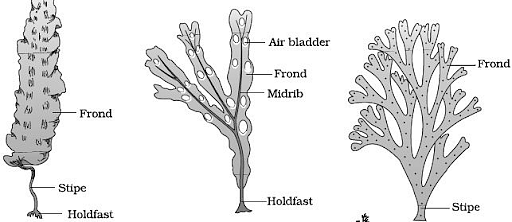
- Morphology: The morphology of brown algae varies greatly from microscopic filamentous structures to filamentous structures up to 70 to 90 metres. The general plant body of brown algae is divided into a holdfast (root-like structure), stipe (stem-like structure), and a frond or blade (resembles leaf).
- Holdfast: It is a root-like structure at the bottom of the algae body that holds the plant body to its substratum. Unlike true roots, it does not take up any nutrients from the substratum.
- Stipe: Stipe is the long extended stalk-like structure of the algal body. Differentiated stipe has three distinct layers: pith, cortex, and outer epidermis. The function of pith is similar to the phloem of the vascular system of higher plants.
- Frond: Frond is the leaf-like flattened photosynthetic organ. It is often covered with slime to prevent epiphytes from attaching.
Read More: Fertilization in Plants
- Brown algae are photosynthetic organisms containing chlorophyll a and c. They also contain carotenoids and xanthophylls.
- Some species of brown algae have a gas-filled structure called pneumatocysts. It helps the plant body float near the water surface for photosynthesis.
- Fucoxanthin is the main xanthophyll pigment found in Phaeophyceae and is responsible for its characteristic brown colour. It also contains other xanthophylls like lutein, flavoxanthin, and violaxanthin.
- The cell wall of Phaeophyceae has two layers; the innermost layer is made up of cellulose, and the outer layer is made of alginic acid and succinic acid.
- The carbon storage in brown algae is in the form of laminarin or mannitol. Apart from acting as the major carbon storage, it also acts as an osmoprotectant, and antioxidant. It protects the algae from the harsh environment.
- They can reproduce via all three modes of reproduction: vegetative propagation, asexual, and sexual reproduction.
- Phaeophyceae reproduce via vegetative mode by fragmentation.
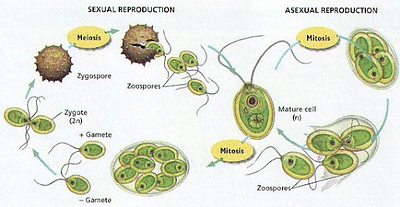
- Asexual reproduction takes place by the formation of motile zoospores.
- Sexual reproduction can be either isogamous, oogamous, or anisogamous. Sexual reproduction takes place by external fertilization or within oogonium (oogamous species). The pear-shaped gametes have two laterally attached flagella that help them to move.
Also Read: Hypogeal Germination
Reproduction in Phaeophyceae
[Click Here for Sample Questions]
Phaeophyceae feature diverse modes of reproduction. They can reproduce via all three modes of reproduction; vegetative, sexual, and asexual reproduction. Different species of brown algae have their characteristic mode of reproduction, some can reproduce via more than one kind of reproduction.
Vegetative Reproduction in Phaeophyceae
Certain species of Phaeophyceae reproduce via the vegetative mode of reproduction by fragmentation of the thallus. The fragmented part gets detached from the parent body and floats around to give rise to a new plant body. Certain species show the development of specialised branches called propagula, that separate from the main plant body and develop into a new plant body.
Asexual Reproduction in Phaeophyceae
Asexual reproduction in Phaeophyceae occurs by the formation of zoospores. The zoospores are borne within the diploid sporophyte. The zoospores are formed within either the unilocular sporangia or the plurilocular sporangia. The ones formed within the unilocular sporangia are haploid and give rise to haploid thallus (gametophyte). And the ones formed within the plurilocular sporangia are diploid and give rise to diploid thallus.
Sexual Reproduction in Phaeophyceae
Sexual reproduction in Phaeophyceae can be either isogamy, oogamy, or anisogamy.
- Isogamy: fertilisation between two identical gametes
- Oogamy: fertilisation between one non-motile, non-flagellated gamete (egg) and a motile, flagellated gamete (antherozoid). The male sex organ in such plants is called antheridium and the female sex organ is known as oogonium.
- Anisogamy: fertilisation between two gametes of unequal size. The fertilisation gives rise to a diploid zygote that eventually develops into a diploid thallus called sporophyte.
Read More: Reproduction in Plants
Classification of Phaeophyceae
[Click Here for Sample Questions]
Phaeophyceae is one of three classes of Algae, namely, Chlorophyceae, Phaeophyceae, and Rhodophyceae. Phaeophyceae can be further divided into nine orders as mentioned below. This classification of Phaeophyceae was done by Fritsch (1935, 45).
- Ectocarpales
- Tilopteridales
- Cutleriales
- Sporochnales
- Desmarestiales
- Laminariales
- Sphacelariales
- Dictyotales
- Fucales
Read Further: Micropropagation
Importance and Uses of Phaeophyceae
[Click Here for Sample Questions]
Brown algae have found various commercial uses over the years since their discovery. They are rich in various rare nutrients hence used as edibles. They are also used in other industries like soap, fertiliser, the baking industry, etc.
Following are some of the most popular uses of brown algae (Phaeophyceae) :
- Brown algae are very popular as edible seaweeds. For eg. Sargassum, Kelp, etc.
- They are rich in alginic acid which is extracted commercially and used as a thickening agent in various packaged food items across the world.
- Brown algae are very popularly used in the baking industry and making ice cream. It is used as a stabilising agent.
- The cell walls of brown algae are rich in alginic acid. They are extracted commercially and used to make battery anode to stabilise. Brown algae are a rich source of alginic acid.
- Brown algae were used as a natural source of iodine and potash. It was used to treat goitre.
- A brown alga, called Kelp, is used to produce soda ash.
- Kelp ash is rich in iodine and alkali. It is often used to manufacture glass and soap.
- Used in other things like fertiliser, surgical thread, soap, etc.
Also Check:
Things to Remember
[Click Here for Sample Questions]
- Phaeophyceae is a class of algae, commonly known as Brown algae.
- They live in marine aquatic habitats, with a few exceptions, that grow in freshwater.
- Brown algae vary greatly in size and shape. They can range from a few millimetres to up to 90 metres (such as in Kelps).
- The photosynthetic pigments present in Phaeophyceae species are chlorophyll a and c. Other than that, carotenoids and xanthophyll are present.
- The major xanthophyll in brown algae is fucoxanthin, which gives it its characteristic brown colour.
- The main plant body is differentiated into a holdfast, a stipe and a frond. The holdfast anchors the plant body to the substratum, the stipe is a stem-like structure, and the frond is a flattened leaf-like photosynthesis organ.
- The fronds of many species of Phaeophyceae have gas-filled structures called pneumatocysts. They help the plant body to float.
- All three modes of reproduction are observed in the class Phaeophyceae; vegetative reproduction occurs by fragmentation; asexual reproduction occurs by formation of motile zoospores; sexual reproduction takes place by the formation of gametes (either isogamous, oogamous, or anisogamous).
Check Also: Difference between Flagella and Cilia
Sample Questions
Ques. What are the classes of algae? Name the pigments for each class that causes their characteristic colour.(4 marks)
Click here for the answer
Ans. Algae has three classes: Chlorophyceae, Phaeophyceae, and Rhodophyceae.
- Chlorophyceae is commonly called green algae due to their green colour plant body. The green colour in Chlorophyceae species is due to dominant pigments chlorophyll a and b. These are photosynthetic pigments and impart an overall green colour to the plant body.
- Phaeophyceae is also known as brown algae. It has two photosynthetic pigments, chlorophyll a and c. The chromoplast has carotenoids and xanthophyll pigments as well. Fucoxanthin is the predominant xanthophyll pigment that causes the brown colour in brown algae.
- Rhodophyceae is the third class of algae, commonly known as red algae. The red colour in red algae is due to the predominance of phycoerythrin, a red pigment. Apart from phycoerythrin, they contain chlorophyll a and d as photosynthetic pigments.
Ques. What is the function of Pneumatocysts?(3 marks)
Click here for the answer
Ans. Phaeophyceae are autotrophic aquatic organisms. So, they have to perform photosynthesis even under water, where sunlight is scanty. To adapt to this, several brown algae have gas-filled bladders called pneumatocysts. They float on water due to the gas present inside. These are present on the frond or leaf-like structure of brown algae. It helps the frond to float on the water surface and hence is exposed to more sunlight for photosynthesis.
Ques. What are the specialised conductive cells in Brown algae? What is this analogous to? (3 marks)
Click here for the answer
Ans. As brown algae are exclusively multicellular, they require a specialised system to transport the photosynthates to all parts of the plant body from the source. The stem-like structure or stipe of Phaeophyceae species have specialised conductive cells called Trumpet Hyphae. These are elongated cells, joined end to end to transport the photosynthates produced by the fronds. These are analogous to sieve elements in the phloem of higher plants. They have similar functions, but not similar structures. This is an example of convergent evolution.
Ques. Draw the sexual lifecycle of any representative species of brown algae.(5 marks)
Click here for the answer
Ans. The sexual lifecycle of Laminaria starts from a mature sporophyte that undergoes meiosis and produces haploid zoospores. These zoospores germinate to give rise to male and female gametophytes. The gametophytes then produce oogonium and sperm. These then fertilise to give rise to diploid zygote The zygote undergoes mitosis (cell division) to give rise to a mature sporophyte.
Ques. Among Chlorophyceae, Phaeophyceae, and Rhodophyceae, which one do you think can survive in the deepest water?(3 marks)
Click here for the answer
Ans. All three are autotrophic algae, meaning they made their food from photosynthesis. So, to survive in the deepest of water, it has to absorb whatever little sunlight that reaches the deep waters. Sunlight has a broad spectrum of wavelengths, of which blue light has the highest energy and lowest wavelength. So only blue light can penetrate to reach the deep waters. To survive deep underwater, the plant must be able to absorb the blue light and utilise it to perform photosynthesis.
Among green algae, brown algae, and red algae, red algae have the pigment called phycoerythrin. Phycoerythrin can absorb the blue light and use it for photosynthesis. So, only red algae, or Rhodophyceae can survive in the deepest of waters.
Ques. Differentiate between Red algae and brown algae.(5 marks)
Click here for the answer
Ans. Tabulated below is the difference:
| Red Algae | Brown Algae |
|---|---|
| Red algae belong to the class Rhodophyceae. | Brown algae belong to the class Phaeophyceae. |
| The stored food in Red algae is in the form of floridean starch. | The stored food in brown algae is in the form of either mannitol or laminarin. |
| The photosynthetic pigments in red algae are chlorophylls a and d, and phycoerythrin. | The photosynthetic pigments in brown algae are chlorophylls a and c, and fucoxanthin. |
| The cell walls of red algae are composed of cellulose, pectin, and phycocolloids. | The cell walls of brown algae are composed of algin and cellulose. |
| Flagella are absent in red algae. | Brown algae are flagellated. |
Ques. Write a brief note on the following terms: (4 marks)
i) Oogamy
ii) Sporangium
iii) Pneumatocysts
iv) Trumpet hyphae
Click here for the answer
Ans. Mentioned below are the details:
- Oogamy: Oogamy is the fusion of gametes where one of the gametes is motile, flagellated, and smaller in size, these are called antherozoid (male gamete) and the other gamete is non-motile, non flagellated, and larger in size called ovum (female gamete).
- Sporangium: It is a structure on the plant body that produces and bears haploid spores. These haploid spores later germinate and give rise to a new plant body.
- Pneumatocysts: Pneumatocysts are specialised gas-filled bladders found on the lamina or leaf-like structure of certain brown algae species. They help the plant body to float on water and enable it to get access to more sunlight than otherwise present under water.
- Trumpet Hyphae: Certain brown algae have developed elongated filament-like cells that help them to transport photosynthates from the lamina to the rest of the plant body. These elongated cells are called Trumpet Hyphae. These are analogous to phloem in higher plants.
Biology Related Links:



Comments