



Education Journalist | Study Abroad Lead
Hypogeal germination is the kind of germination that occurs for both monocot and dicot seeds, where the cotyledons stay inside the soil only. The process by which a plant grows from a seed is known as seed germination. In other words, seed germination is an active growing process. Under suitable conditions and the presence of water, oxygen, temperature, and sometimes light, the embryo causes the seed coat to rupture and the emergence of a new young plant takes place. There are two types of germination process that take place: epigeal germination and hypogeal germination. While in epigeal germination, the cotyledons emerge on the surface of the soil, in hypogeal germination, they stay below the soil surface. In this article, we will have a look at Hypogeal germination, its process, and related pros and cons.
| Table of Content |
Key Terms: Epigeal germination, plumule, Seed, Germination, Cotyledons, Plant, Soil, hypogeum, aerobic respiration, angiosperm
What is Germination?
Germination is defined as the emergence and development of the seed embryo to produce a normal plant under favorable conditions for the type of seeds one has. The sprouting of a seedling from the seed of a gymnosperm or through double fertilization in angiosperm is a basic example of seed germination. Water is necessary for seed germination, along with oxygen which is used as an active participant of aerobic respiration. Based on their growing conditions and the fate of the cotyledons, the process of germination is classified into two main types:
- Germination on the epigeal surface or Epigeal Germination
- Germination in the hypogeum or Hypogeal Germination

Also Read: Plant Breeding
What is Hypogeal Germination?
The term "Hypogeal Germination" comes from an ancient Greek phrase that means "below ground." Hypogeal Germination is a type of seed germination that mostly happens in monocot and dicot seeds. The cotyledons remain in the soil due to the epicotyl's length, which allows for faster growth and development.
When it comes to hypogeal germination, there are a few things to be kept in mind:
- The cotyledons, a large component of a seed embryo, are left in the soil.
- Plumule, the basic shoot tip emerging from the seed embryo, emerges above ground.
- The plumule pushes its way to the surface by pressing upward.
- Epicotyl, the seedling stem above the cotyledon, continues this process by quickly elongating its structure.
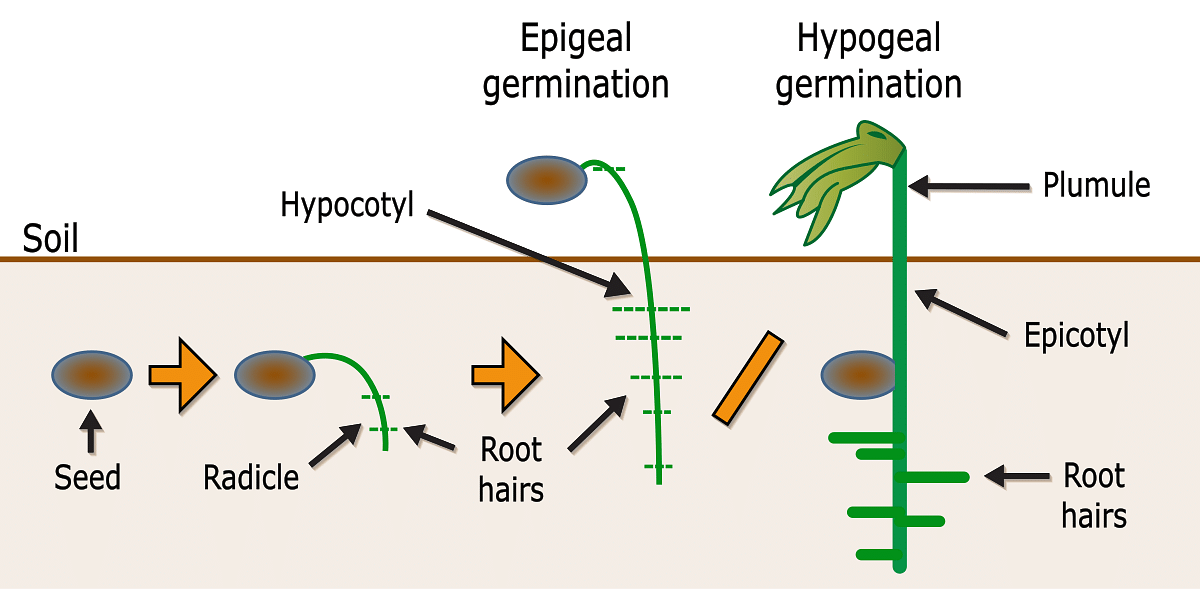
Hypogeal and Epigeal Germination
Read More:
| Related Topics | ||
|---|---|---|
| movement due to growth | growth and development | Seed |
| phenolic acid | Plant - Growth and Development | Seed germination |
Process of Hypogeal Germination
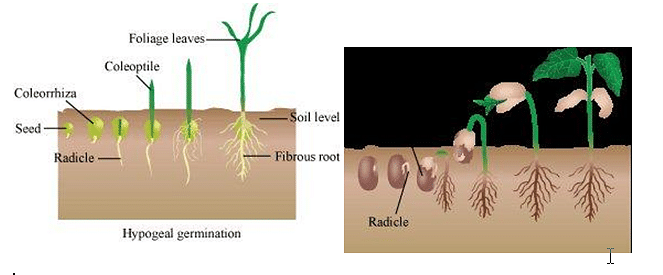
The cotyledons of seeds remain below the soil surface during hypogeal germination. This is owing to the epicotyl's fast development and elongation. The epicotyl grows, then elongates before curling up and forming a curved shape. As a result, the plumule erupts above the Earth’s surface early in its development. The cotyledons remain below the soil surface. In the case of hypogeal germination, the plumule elongates quickly, ruptures the coleoptiles, and continues to expand. The root system replaces the broken plumule as it extends to the radicle.

Hypogeal Germination
The following are the main characteristics of hypogeal germination:
- The cotyledons remain in the soil during this sort of in-situ seed germination.
- The root system grows from the radicle.
- The plumule eventually becomes the shoot system.
Read More: Radicle
Examples of Hypogeal Germination
Some examples of hypogeal germination are:
- Gram, pea, and groundnut are some of the most well-known dicotyledons.
- Maize, coconut, rice, and wheat are some examples of monocotyledons.
Pros and Cons of Hypogeal Germination
The pros and cons of hypogeal germination are as listed below:
- Pros: Hypogeal germination has the advantage of protecting the plant or the seedling from early grazing. The seeds arrive in a suitable environment.
- Cons: The plant can't start photosynthesizing until its actual leaves grow, which is a disadvantage.
Do Check out :
| Chapter Related Topics | ||
|---|---|---|
| Plant Growth Regulators | Auxins | Gibberellins |
| Ethylene | Photoperiodism | Vernalisation |
| Seed Dormancy | Senescence | plant roots |
Key Points related to Hypogeal Germination
- Hypogeal germination is a type of germination in which the seed leaves or cotyledons remain beneath the soil surface during the germination process.
- The epicotyl's terminal section remains bent in this position to reduce damage to the plumule caused by dirt particle friction.
- Hypocotyls do not lengthen during hypogeal germination. Instead, the epicotyl grows while the plumule remains above the soil.
- In the process of the epicotyls elongating, the plumule emerges from the seed coat.
- The endosperm provides the majority of the energy for growth in this germination.
- In plants that display hypogeal germination, the epicotyl is considerably more prolonged.
- During photosynthesis, cotyledons do not appear to play a substantial function.
- The cotyledons do not always keep the plumule enclosed and sheltered until it emerges from the soil.
- Monocot seeds are the ones that exhibit hypogeal germination the most.
- Maize, water lily, gram, pea, and coconut are among some of the plants that have hypogeal germination.
Check out: Why are Plants Green?
Things to Remember
- Hypogeal germination is a type of seed germination that mostly happens in monocot and dicot seeds.
- The cotyledons remain in the soil due to the epicotyl's length, which allows for faster growth and development.
- Monocot seeds, such as coconut, maize, water lily, arum, and pea, are known to have hypogeal germination.
- The hypocotyl remains the same during hypogeal germination, but the epicotyl (the section of the stem above the cotyledons) swells, keeping the seed and hence the cotyledons below ground.
- Plants that exhibit hypogeal germination require relatively little external nutrients to thrive, hence they are more common in nutrient-deficient soils.
- Plants with hypogeal germination grow slowly, particularly in the early stages.
Read more : tropic movements in plants
Previous Years Questions
- A few normal seedlings of tomato were kept in...[NEET 2014]
- One set of a plant was grown at 12 hours day and 12 hours night period cycles….[NEET 2004]
- Treatment of seed at low temperature under moist ….[NEET 2006]
- Abscisic acid controls...[NEET 1990]
- Hormone connected with cell division...[NEET 1991]
- Auxin can be bioassayed by...[NEET 2015]
- Coiling of garden pea tendrils around any support….[NEET 2010]
- Cytokinins are known to….[NEET 1992]
- Dwarfness can be controlled by treating the plant...[NEET 1980]
- Flowering dependent on cold treatment is...[NEET 1992]
- Fruit and leaf drop at early stages can be….[NEET 2017]
- Gibberellins promote...[NEET 1988]
- If the apical bud has been removed observe...[NEET 2000]
- If the growing plant is decapitated….[NEET 1994]
Sample Questions
Ques. During hypogeal germination, what occurs to cotyledons? (2 marks)
Ans. The cotyledons of seeds remain below the soil surface during hypogeal germination. This is owing to the epicotyl's fast development and elongation. The epicotyl grows, then elongates before curling up and forming a curved shape.
Ques. How can a seed be defined? (1 mark)
a) fertilized ovary
b) embryo
c) gynoecium
d) ripened ovule
Ans. d) The seed can be defined as a ripened ovule.
Ques. Is Rice a hypogeal or epigeal plant? (1 mark)
Ans. Hypogeal germination occurs in all monocotyledons, including maize, rice, wheat, and coconut. Some dicotyledons, such as peanut, pea, and gram, do, nevertheless, go through hypogeal germination.
Ques. In hypogeal germination, which part of the seeds pushes the cotyledons into the soil: (1 mark)
a) Plumule
b) Radical
c) Epicotyl
d) Hypocotyl
Ans. c) Epicotyl pushes the cotyledons into the soil in hypogeal germination.
Ques. What is the advantage of hypogeal germination? (2 marks)
Ans. Hypogeal germination has the advantage of protecting the plant or seedlings from early grazing throughout the process. The downside of hypogeal germination, on the other hand, is that the plant cannot begin to manufacture its food or photosynthesize until the actual leaves have fully emerged.
Ques. Name the component of the seed that pushes the cotyledons into the soil in hypogeal germination. (1 mark)
Ans. Epicotyl is the component of the seed that pushes the cotyledons into the soil in hypogeal germination
Ques. Which mechanism plays an important role in transportation of water in plants? (2 marks, 2011)
(a) During daytime
(b) At night
Ans. a) Transpiration pull
b) Water deficit of daytime and afterwards root pressure.
Ques. What is the definition of germination? What is Hypogeal Germination, and how does it work? (5 marks)
Ans. Germination is the process by which an organism develops from a seed-like structure. This also refers to seedlings emerging from gymnosperm or angiosperm seeds, sporting growth from a spore-like fern, bacterium, and fungus, and pollen tube growth from any seed plant's pollen grain. It begins with water imbibitions from any dry seed, entering the seed coat and reaching the embryo's part.
The epicotyl portion of the hypocotyl develops in length while the hypocotyl retains the same length during hypogeal germination. As a result of this procedure, the cotyledons remain underground. Here are a few key aspects to remember about hypogeal germination:
- The cotyledons persist inside the soil surface during hypogeal germination.
- The epicotyls lengthen when the plumule rises above the earth in this type of germination.
- The epicotyls' terminal section is bent during this phase to protect the plumule from frictional impacts.
- The endosperm is the principal source of energy.
- In this case, the cotyledons play no significant role in the photosynthesis process.
Ques. Sweet potato is a modified: (1 mark, 2018)
a) Rhizome
b) Tap root
c) Stem
d)Adventitious root
Ans. d) Adventitious root
Ques. The ability of the mature seeds to germinate is referred to as: (1 mark)
a) Seed Dormancy
b) Viability
c) Epigeal
d) None of the above
Ans. b) Viability is the ability of mature seeds to germinate.
Ques. Functional megaspore in an angiosperm develops into: (1 mark, 2017)
a) Ovule
b) Embryo
c) Embryo Sac
d) Endoderm
Ans. c) Embryo sac
Ques. Explain how epigeal and hypogeal germination differ and how they are similar. (5 marks)
Ans. Differences:
- The length of the epicotyls elongate and become curled during hypogeal germination, bringing the plume above the earth.
In epigeal germination, on the other hand, the hypocotyls actively develop and become curled as the seed rises above the earth.
- The cotyledons stay underground during hypogeal germination.
In epigeal germination, however, the hypocotyls rise above the soil surface before straightening.
- Gram, pea, and other legumes are examples of hypogeal germination.
Groundnut, bean, and other legumes are examples of epigeal germination.
Similarities:
- The relative locations of the cotyledons to the soil during the germination process are used to describe both hypogeal and epigeal germinations.
- There are two basic types of germination, both of which require the presence of water.
- Epicotyls curve during hypogeal and epigeal germination to protect the plumule from injury.
- With the extension of the hypocotyls-epigeal germination, the plumule emerges from the seed coat.
Ques. What are the conditions required for seed germination? (3 marks)
Ans. The conditions necessary for seed germination are:
- Moisture: The availability of water or moisture is the most crucial requirement for seed and grain germination. At very low moisture content, the protoplasm of the seed's cells stays almost inactive or dormant. The vital activity of the soil is accelerated when the moisture content is raised.
- Oxygen: Oxygen is required for the growth and respiration of cells. Respiration aids in the release of a significant amount of energy essential for the embryo's many growth stages.
- Temperature: During seed germination, a variety of physiological activities take place within the seed. As a result, germination requires a consistent temperature. Respiration and other critical activities are slowed or stopped at extremely low or extremely high temperatures.
Ques. Seed formation without fertilization in flowering plants involves the process of: (1 mark, 2016)
a) Apomixis
b) Budding
c) Somatic Hybridization
d) Sporulation
Ans. a) Apomixis
Ques. What do you mean by seed quiescence? (3 marks)
Ans. Due to dormancy, germination may not always be prevented. Seeds that are capable of germination may fail to germinate due to a lack of enough moisture or temperature. This is known as the seed's quiescence condition, and the seed and embryo are referred to as quiescent seed and quiescent embryo.
The term "seed quiescence" usually refers to a state of embryo development inhibition caused by external influences outside the seeds.
Ques. Explain the process of seed germination. (3 marks)
Ans. The process of seed germination takes place in the following way:
- In the initial stage, the seeds consume the water quickly which makes the seed coat soft and swollen at an optimum temperature. The seed starts to respire and metabolizes the stored food by producing proteins.
- The radicle then forms the primary root by rupturing the seed coat. The shoot then starts to grow upwards.
- Finally, the seed cells are active, they divide and elongate and resulting in a seedling.
Ques. Name three life processes which are essential for maintaining life. (1 mark, 2016)
Ans. Nutrition, respiration, and exchange of materials are the three life processes that are essential to maintain life.
Ques. What is seed dormancy? (3 marks)
Ans. Seeds of the plant are germinated under favorable conditions. However, when the seed does not receive these suitable conditions such as oxygen, optimum temperature, and water, the germination of seeds is delayed. Seed dormancy refers to the condition of a seed when it does not germinate even in suitable conditions. This can occur mainly due to two reasons which are:
- Imposed Dormancy: This occurs due to low temperature and low moisture.
- Innate Dormancy: Innate dormancy is due to the properties of the seed itself.
Do Check Out:



Comments