



Education Journalist | Study Abroad Lead
Xanthophylls are planted in the loftiest volume in the leaves of utmost green plants and help in photosynthesis by landing light. Xanthophylls plant in the bodies of numerous creatures including humans, and salutary beast products, are eventually deduced from factory sources in the diet. The amount of oxygen causes xanthophylls to be more polar (in molecular structure) as compared to carotenes, which causes their separation from carotenes in numerous types of chromatography.
Key Terms: Xanthophylls, Lutein, Zeaxanthin, Cryptoxanthin, xanthophyll cycle, violaxanthin cycle, diadinoxanthin cycle, Function of Xanthophylls
What are Xanthophylls?
[Click Here for Sample Questions]
Xanthophylls refer to the light-harvesting accessory colors, which work coordinately with chlorophyll-a. It can absorb light of a wavelength in a range of 425-475 nm. Xanthophylls are primarily of three types, videlicet lutein, zeaxanthin, and cryptoxanthin. They're largely antioxygenic motes, which cover the cell from damage and aging.
Xanthophylls reduce the threat of eye cataracts and macular degeneration. Xanthophylls or Phylloxanthins are the unheroic color naturally present in the plants. A xanthophyll can be insulated from the factory excerpt.
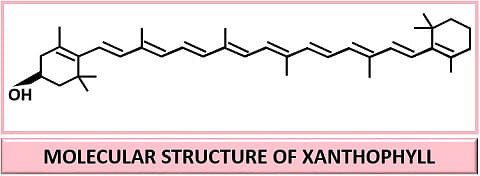
Xanthophyll
Xanthophyll is the primary accessory color. It consists of C-40 terpenoid composites, which form as a result of condensation between the isoprene units. The molecular structure of xanthophyll and carotene (another accessory color) is nearly the same except for the presence of an oxygen snippet. In xanthophyll, there's an oxygen snippet present as the hydroxyl group, whereas carotene lacks an oxygen snippet and exists as a pure hydrocarbon.
Types of Xanthophylls
[Click Here for Sample Questions]
Xanthophylls substantially include appurtenant colors like Lutein, Zeaxanthin, and Cryptoxanthin.
- Lutein is the most common xanthophyll, which is synthesized by the green plants themselves. Spinach, kale, kiwi, green apples, egg thralldom, sludge, etc. are the sources of lutein. Lutein is a lipophilic patch ( undoable in polar detergent-like water). In plants, lutein is present as adipose acid esters, in which one or two adipose acids attach with the two – OH groups. Lutein substantially absorbs blue light, and thereby it protects the eye from the blue light that leads to an eye impairment.

Chemical Structure of Lutein
- Zeaxanthin simply refers to carotenoid alcohols, which can be synthesized naturally by plants and certain microorganisms. It acts as a non-photochemical quenching agent. Zeaxanthin is an appurtenant color, which gives distinct color to the sludge, wolfberries, etc. It consists of two chiral centers. Kale, spinach, turnip flora, mustard flora, etc. are the sources.

Chemical Structure of Zeaxanthin
- Cryptoxanthin Its molecular structure is relatively analogous to the β-carotene, but a hydroxyl group is present in addition. Cryptoxanthin is a plant as red crystalline solid in its pure form. It also refers to provitamin-A, as during the xanthophyll cycle, cryptoxanthin converts into vitamin A (retinol).

Chemical Structure of Cryptoxanthin
Also Read:
| Related Topics | |
|---|---|
| Mycorrhiza | Chromoplasts |
| Receptors | Five Kingdom Classification |
Xanthophyll Cycle
[Click Here for Sample Questions]
The xanthophyll cycle occurs inside the thylakoid membrane of the chloroplast. The Xanthophyll cycle facilitates the interconversion of oxygenated carotenoids. There are numerous types of xanthophyll cycle, but the violaxanthin and Diadinoxanthin cycles are the most common.
Violaxanthin Cycle
[Click Here for Sample Questions]
Originally, violaxanthin (which has two epoxide groups) converts into antheraxanthol (which has one epoxide group). Antheraxanthol further turns into Zeaxanthin (has no epoxide group). VDE, i.e. violaxanthin-epoxidase catalyzes the conversion of violaxanthin to zeaxanthin as a result of the de-epoxidation response.
ZE, i.e. zeaxanthin epoxidase is an enzyme, which catalyzes the conversion of zeaxanthin and violaxanthin as a result of epoxidation response. The epoxidation response will do at a low pH<5.8 under low light, whereas epoxidation response occurs at a high pH of7.5 under a high light source.

Violaxanthin Cycle
Diadinoxanthin Cycle
[Click Here for Sample Questions]
The diadinoxanthin cycle is another type of xanthophyll cycle generally planted in diatoms and eukaryotic algae. It's a reversible diadinoxanthin cycle, which can convert diadinoxanthin into diatoxanthin and vice versa. DEP, i.e. diadinoxanthin epoxidase catalyzes the conversion of diadinoxanthin into diatoxanthin. DDE, i.e. diatoxanthinde-epoxidase, catalyzes the conversion of diatoxanthin into diadinoxanthin. Some algae make use of both violaxanthin and diadinoxanthin cycle.
Functions of Xanthophylls
[Click Here for Sample Questions]
Xanthophylls perform two central places
Harvesting of light Xanthophylls is the appurtenant colors, which act as a photosynthetic light-harvesting complex of algae and vascular plants.
Dispersion of energy as heat Xanthophyll helps in photoprotection, i.e. it protects the photosynthetic outfit from the print-oxidative damage in the condition of inordinate light by dissipating energy.
Insulation of Xanthophyll
A xanthophyll can be insulated by the system of chromatography. Chlorophyll moves the shortest distance and appears as a “ Green band”. Xanthophyll being less polar will move a shorter distance and appear as an “ Unheroic band”. Carotene being non-polar will attract further explosively to the non-polar detergent and move on with it. Therefore, carotene will move the longest distance and appear as an “ Orange band”.
Things to Remember
- There are about 1100 given carotenoids, these are distributed into two orders.
- Xanthophylls These contain oxygen.
- Carotenes are purely hydrocarbons and contain no oxygen.
- The term"Xanthos" In Greek means unheroic and"phyllon" means splint. These are oxygen-containing, unheroic multicolored colors. The xanthophylls include lutein, zeaxanthin, neoxanthin, violaxanthin, flavoxanthin, and α-and β-cryptoxanthin.
- Xanthophylls present their oxygen either as hydroxyl groups and/ or as hydrogen titles substituted by oxygen titles when acting as a ground to form epoxides. Examples of other rich sources include peaches, papaya, prunes, and squash, which contain lutein diesters.
- Tetraterpenes are terpenes conforming to eight isoprene units and have the molecular formula C40H64. Tetraterpenoids ( including numerous carotenoids) are tetraterpenes that have been chemically modified, as indicated by the presence of oxygen-containing functional groups.
- Xanthophylls are planted in the loftiest volume in the leaves of utmost green plants and help in photosynthesis by landing light.
- The xanthophylls plant in the bodies of numerous creatures including humans, and salutary beast products, are eventually deduced from factory sources in the diet. For illustration, the unheroic color of funk egg thralldom, skin, and fat comes from ingested xanthophyll, primarily lutein, which is generally added to funk feed for this purpose.
Also Read:
| Related Topics | |
|---|---|
| Synapse | Bones |
| Hypothalamus | Cyanobacteria |
Sample Questions
Ques. Which plant derived motes have antioxidant eventuality? (1 Mark)
Ans. Numerous plants produced colorful classes of composites similar to polyphenols (phenolic acids, flavonoids, anthocyanins, lignans, and stilbenes), carotenoids (xanthophylls and carotenes), and vitamins (vitamin E and C) which have potent antioxidant exertion.
Ques. What are Pigments? (3 Marks)
Ans. Pigments are defined as the set of composites that have a violet pigment and are used in the pigmenting of other accouterments. These pigmenting substances are also called Biological Pigments or Biochromes, which substantially refer to the true pigments. These natural pigments are undoable in water and are applied as ground patches in solid form with the liquids. We can find the pigment types of Biological pigments in both plants as well as creatures.
The pigments are produced by the living organisms and have a pigment, which results from the pigment immersion ways. There are two different types of pigments and are classified based on their sources.
Ques. What are the types of pigments in plants? (3 Marks)
Ans. Plants have a unique point of landing the light energy and converting it into sugars through the process called photosynthesis. The process begins with the immersion of light energy by some technical form of organic motes, called pigments. Photosynthesis, a natural process, requires green pigmented pigment called chlorophyll along with other forms of unheroic and red-pigmented pigments.
Other essential factory pigments include anthocyanins, betalains, carotenoids, porphyrins, and much further. All these pigments stimulate the process of chemical responses by reflecting the wavelengths.
Ques. What are Inorganic pigments? (3 Marks)
Ans. The inorganic pigments, also called synthetic pigments are deduced from the coal seamen and some of the other forms of petrochemicals. In some rare cases, these pigments can also be synthesized by a simpler form of chemical response called oxidation.
Pigments are chemical substances, which parade wavelengths of visible light, making them appear various. Plants, flowers, algae, certain photosynthetic bacteria, and indeed the skin of creatures have a particular type of pigments, which give pigments and also have the capability to absorb some wavelengths.
For Latest Updates on Upcoming Board Exams, Click Here: https://t.me/class_10_12_board_updates
Check-Out:



Comments