



Content Curator
Bacteria are single-celled microscopic organisms that belong to the kingdom of prokaryotes. They are extremely small, so they cannot be seen individually unless viewed under a microscope. When grown on agar, bacteria grow in colonies that contain many single cells. Colonies appear as spots of different sizes, shapes and colors, depending on the organism.
| Table of Content |
Read More: Phylum Platyhelminthes
What is Bacteria?
[Click Here for Sample Questions]
Bacteria, a single-celled organism, can thrive in a multitude of environments, even the most extreme. From the human gut to the ocean to the ground, they permeate almost every part of our environment. They are believed to have been around for 4 billion years and are considered the first living organisms on Earth, as some of the oldest fossils contain bacteria-like organisms.
Bacteria also play an important role in human health, and the new interest in gut microbes has led to a lot of interesting and important information about them. Humans seem to have a complex relationship with bacteria. On the one hand they are beneficial and help digestion and on the other hand they can also lead to diseases such as pneumonia and MRSA. Although we use bacteria to curdle yogurt, bacteria could also be the cause of harmful neurological disorders.
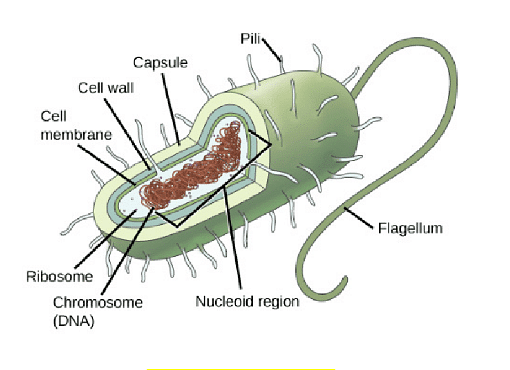
Fig. Bacteria Diagram
Structure of Bacteria
Bacteria are microscopic and have a single cell with a simple internal structure. They are classified as a group of prokaryotic organisms. They have no nucleus, and their DNA floats freely in a mass that looks like twisted strands called nucleoids or exists as separate circular pieces called plasmids.
Its cell contains ribosomes which are spherical units in which proteins are stored by various amino acids. In most bacteria there is an inner cell membrane and an outer protective wall which forms 2 protective layers. In some bacteria such as mycoplasmas there is no inner cell membrane and some of them may have a third outer layer called a capsule.
Also Read:
Classification and Types of Bacteria
[Click Here for Sample Questions]
Bacteria are classified according to certain parameters such as cell wall type, shape, genetic makeup.
Classification Based on Cell Walls
There are 2 types based on this parameter:
- Gram Positive Bacteria- These have a thick cell wall made up of several layers of peptidoglycan that do not have an outer membrane. Streptococcus pneumonia is a gram-positive bacteria that causes pneumonia.
- Gram Negative Bacteria- This type has a thin layer of a peptidoglycan cell wall and has an outer lipopolysaccharide membrane.
Also Read:
Classification Based on Shape
There are mainly 2 categories of bacteria according to their shape:
- Round bacteria called cocci.
- Cylindrical capsule-shaped form called bacilli.
Their forms are reflected in their names such as Lactobacillus acidophilus which is used in curdling of milk. However, some bacteria have different shapes such as a square, a star, or a rod.
Also Read:
Classification Based on Diet
Bacteria need large amounts of carbon, nitrogen and water to survive, as well as phosphorus, iron and many other molecules. According to this, they have 2 main types:
- Autotrophs - They use external energy sources such as light and chemical compounds to produce their own food.
- Heterotrophs - They take ready-made foods from living or dead organic substances.
Also Read:
Classification Based on Mode of Respiration
The way in which nutrients are broken down in bacteria by respiration separates them into 2 parts:
- Aerobic bacteria - This respiration requires oxygen to break down glucose into energy.
- Anaerobic Bacteria - Energy production from respiration occurs in these bacteria without oxygen.
Also Read:
Reproduction in Bacteria
[Click Here for Sample Questions]
Bacteria can reproduce quickly, in the right kind of environment an E Coli bacteria can create colonies of hundreds of bacteria within hours. Since they have only one cell and there are no male and female versions, they reproduce asexually by creating their carbon to copy genetically.
Also Read:
There are 2 ways in which reproduction occurs in bacteria:
Binary Fission: A single bacteria replicates its DNA and doubles its cellular content in this process to grow larger. This bacteria is called the "parent". This enlarged cell then divides and expels the extracellular contents in the form of 2 "child" bacteria.How quickly and when a bacteria reproduces depends on the temperature and the amount of nutrients it has.
DNA Exchange: Not all bacteria are parent clones and can acquire new DNA:
- Conjugation- DNA passes through an extension on the surface of one bacterium to another.
- Transformation- Bacteria take DNA from their environment
- Transduction- If a virus infects a bacteria, it transmits DNA from one bacteria to another.
Also Read:
Useful and Harmful Bacteria
[Click Here for Sample Questions]
Not all bacteria are harmful to humans. Some bacteria are beneficial in different ways. Some of the benefits of bacteria are listed below:
Conversion of milk to curd - Lactobacilli or lactic acid bacteria
Fermentation of food products - Streptococcus and Bacillus
Aids in digestion and improves the body's immune system - Actinobacteria , Bacteroidetes, Firmicutes, Proteobacteria
Production of antibiotics, which are used in the treatment and prevention of bacterial infections - soil bacteria.
There are bacteria that can cause a multitude of diseases. They are responsible for many infectious diseases such as pneumonia, tuberculosis, diphtheria, syphilis, caries. Their effects can be corrected by taking antibiotics and prescribed medication.
However, precaution is much more effective. Most of these pathogenic bacteria can be eliminated by sterilizing or disinfecting exposed surfaces, tools, instruments and other utilities. These methods include the application of heat, disinfectants, UV radiation, pasteurization, boiling, etc.
Also Read:
Things to Remember
- Bacteria can be classified according to their shape, including bacilli (rods), cocci (spheres), and spirillae (spirals)
- Bacteria resemble eukaryotic cells in that they have cytoplasm, ribosomes, and a plasma membrane.
- The characteristics that distinguish a bacterial cell from a eukaryotic cell include circular nucleoid DNA, absence of membrane-bound organelles, peptidoglycan cell wall, and flagella.
Also Read:
Sample Questions
Ques. How do you define bacteria? (2 Marks)
Ans. Bacteria are single-celled prokaryotic organisms. They have a relatively simple cellular structure compared to eukaryotic cells. They also do not have membrane-bound organelles like a nucleus. However, they do have genetic material (DNA or RNA) in the intracellular space called the nucleoid.
Ques. Explain the Reproduction of Bacteria. (2 Marks)
Ans. Bacteria reproduce by a process called binary fission. In this process, a single bacteria divides into two daughter cells. These daughter cells are identical to the mother cell and to each other. Bacteria can reproduce quickly, in the right kind of environment an E Coli bacteria can create colonies of hundreds of bacteria within hours.
Ques. What are flagella and pili? (2 Marks)
Ans. The pili and flagella exert crucial actions on the surface of bacterial cells such as the motility, adhesion, absorption and excretion of proteins and DNA. These structures can grow to several times the size of cells, resist and generate high forces, and quickly form and disassemble in response to environmental signals.
Ques. What are the differences between Gram-positive and Gram-negative bacteria? (3 Marks)
Ans. Gram-positive and Gram-negative bacteria are classified according to their ability to retain Gram stain. Gram-positive bacteria would retain the Gram stain and observe a purple color after application of iodine (as a mordant) and alcohol (ethanol).
In return, the Gram-negative bacteria would be stained by the counterstain (safranin), because they are stained due to washing with alcohol. Hence, they appear pink under the microscope.
Ques. Briefly Explain 4 Types of Bacteria. (3 Marks)
Ans. There are four common forms of bacteria coccus, bacillus, spirillo, and vibrio.
- Coccus Form: These are spherical bacteria. Streptococcus pneumoniae, bacteria that causes pneumonia in humans, is a coccus bacteria.
- Bacillus Form: These are rod-shaped bacteria. They occur alone and in long chains.
- Spirilla Form: These are individually occurring spiral shaped bacteria.
- Vibrio Form: These are comma shaped bacteria. Vibrio cholerae, which causes cholera, is one of these bacteria.
Ques. What are the characteristics of bacteria? (3 Marks)
Ans. Bacteria are individual living cells. Bacterial cells are similar to your cells in many ways; however, they also have distinct differences. Bacteria have many unique adaptations that allow them to live in many different environments.
Bacteria are the best performing organisms on the planet. They lived on this planet for two billion years before the first eukaryotes, and during that time it evolved into millions of different species.
Ques. Name 2 useful and Harmful bacteria. (3 Marks)
Ans. Useful bacteria:
- Rhizobium- This provides nutrition to the soil growing plants by supplying ammonia.
- Lactobacillus Acidophilus- Used in making curd from milk
Harmful Bacteria:
- Salmonellae- This can be passed to humans if food is not cooked properly and causes fever, abdominal pain, diarrhea, and nausea leading to vomiting.
- Helicobacter Pylon- It is present in the stomach lining and if it flares up it can cause stomach ulcers.
Ques. What is bacteria spread by? (2 Marks)
Ans. Most germs are spread through the air through sneezing, coughing, or even breathing. Germs can also be spread in sweat, saliva (sputum) and blood. Some go person-to-person touching something contaminated, such as shaking the hand of a person with a cold and then touching their nose.
Also Read:



Comments