



Education Journalist | Study Abroad Lead
Phylum Platyhelminthes is commonly known as flatworms or tapeworms. The term Platyhelminthes is derived from the Greek words - platys means flat and helminth means worms. Phylum Platyhelminthes belongs to the kingdom Animalia.
- Platyhelminthes are one of the largest animal phyla (classification) after arthropods, mollusks, and chordates.
- It includes more than 20,000 species, more than half of which are parasitic flatworms.
- Due to the flattened body in Platyhelminthes, the body cavity is absent between the body wall and gut, that is why it is called acoelomate.
- Some flatworms live freely, while others live inside other animals (known as parasites).
- The parasitic ones don't have regular sense organs. Their digestive system is not complete and has only one opening, the mouth.
Characteristics of Phylum Platyhelminthes
- Platyhelminthes comprises flatworms characterized by dorsoventrally compressed bodies and bilateral symmetry.
- They exhibit a wide variety of body shapes and sizes, ranging from microscopic to up to 10-15 meters in length.
- Coloration in flatworms ranges from white or colorless to vividly colored, with some deriving color from ingested food.
- The anterior end of the body is specialized into a head.
- The ventral surface, containing the mouth and genital pores, is well-defined in turbellarians but less evident in trematodes and cestodes.
- Platyhelminthes possess various adhesive secretions and attachment organs such as hooks and suckers.
- The body wall comprises cellular, syncytial, one-layered, and partly ciliated epidermis. In parasitic trematodes and cestodes, the epidermis is absent, and the body is covered by a cuticle.
- Both exoskeleton and endoskeleton are completely absent, resulting in a generally soft body. However, some species may have hard parts like cuticle, spines, thorns, hooks, or teeth.
- They are acoelomates, lacking a true coelom.
- Mesenchyme (parenchyma), fills the body cavity between various organs.
- The digestive system is absent in acoelomates and tapeworms, while in other flatworms, it consists of a mouth, pharynx, and blind intestine, with the anus being absent.
- Respiratory and circulatory systems are absent.
- Protonephridia, either single or paired, with flame cells or bulbs, distinguish the excretory system.
- The nervous system is of a primitive type, consisting of a pair of cerebral ganglia or brain and one to three pairs of longitudinal nerve cords connected by transverse commissures, known as a ladder-type nervous system.
- Sense organs are predominantly present in Turbellaria but are significantly reduced in parasitic forms.
- Platyhelminthes are hermaphrodites, with few exceptions where the sexes are not separated.
- The reproductive system is highly evolved and complex in most forms.
- Asexual reproduction occurs through fission, as seen in freshwater Turbellarians.
- Eggs are usually devoid of yolk but have special yolk cells and are covered by an eggshell.
- Fertilization is internal, with cross-fertilization common in trematodes and self-fertilization prevalent in cestodes.
- The life cycle is complex, involving one or more hosts.
- Parthenogenesis and polyembryony are common reproductive strategies.
- Flatworms can be free-living, ecto- or endo-commensals, or parasites.
Read More: Taxonomic Hierarchy of Plants and Animals
Classification of Phylum Platyhelminthes
The classification of Platyhelminthes is done in three classes:
- Class 1 - Turbellaria (In Latin, turbella means a little string)
The characteristics of phylum Platyhelminthes - class 1 Turbellaria are mentioned in the table below:
| Characteristics | Platyhelminthes - Turbellaria |
|---|---|
| Nature | They are free-living flatworms but some are ectoparasitic and endoparasitic. |
| Body Structure | No segmented body. |
| Body covered with a cellular or syncytial epidermis usually with mucous cells and partly ciliated. | |
| Abundant adhesive organs are present | |
| Digestive System | It consists of mouth, pharynx and intestine as the digestive system and anus not found. |
| Excretory System | Flame cells (protonephridia) act as an excretory system. |
| Sensory Organs | Tango receptors and chemoreceptors. |
| Reproductive Characteristics | Sexes are united. |
| Reproduction sexual, asexual and by regeneration. | |
| Platyhelminthes Examples | Planaria, Otoplana |
- Class 2 - Trematoda (In Greek, trematodes means having pores)
The characteristics of phylum Platyhelminthes - class 2 Trematoda are mentioned in the following table:
| Characteristics | Platyhelminthes - Trematoda |
|---|---|
| Parasitic Nature | Ectoparasitic or endoparasitic forms, commonly called flukes. |
| Body Structure | Body is dorsoventrally flattened and usually leaf-like. |
| Epidermis and cilia are absent in the body wall. | |
| Body is covered with a cuticle and is not divided. | |
| Well-developed suckers are present. | |
| Digestive System | Alimentary canal is incomplete which consists of mouth, pharynx and two forked or many branched intestines. Anus is absent. |
| Excretory System | Flame cells (protonephridia) act as an excretory system. |
| Reproductive Characteristics | Mostly hermaphrodite (monoecious). |
| Single ovaries, two or more testes are found. | |
| Life History | Simple or complicated kind of life history. |
| Platyhelminthes Examples | Fasciola hepatica, Diplozoon |
- Class 3 - Cestoda (In Greek, kestos means girdle and eidos means form):
The characteristics of phylum Platyhelminthes - class 3 Cestoda is provided below:
| Characteristics | Platyhelminthes - Cestoda |
|---|---|
| Parasitic Nature | Lives as an endoparasite in the intestine of vertebrates. |
| Common Name | Commonly called tapeworms. |
| Body Structure | Body without epidermis and cilia but covered with cuticle. |
| Body usually divided into segments called proglottids, rarely undivided. | |
| Anterior End | Scolex, an anterior end is provided with adhesive structures like hooks and suckers except in Cestodaria. |
| Digestive System | Mouth and digestive tract completely absent. |
| Excretory System | Excretory system consists of protonephridia with typical terminal flame bulbs. |
| Nervous System | Nervous system includes a pair of ganglia and two lateral longitudinal nerve cords. |
| Reproductive Characteristics | Each segment, proglottis contains one or two sets of complete hermaphroditic reproductive system. |
| Life Cycle | Life cycle is complicated and usually involving two or more hosts. |
| Embryonic Features | Embryos possess hooks. |
| Platyhelminthes Examples | Taenia spp., Convoluta |
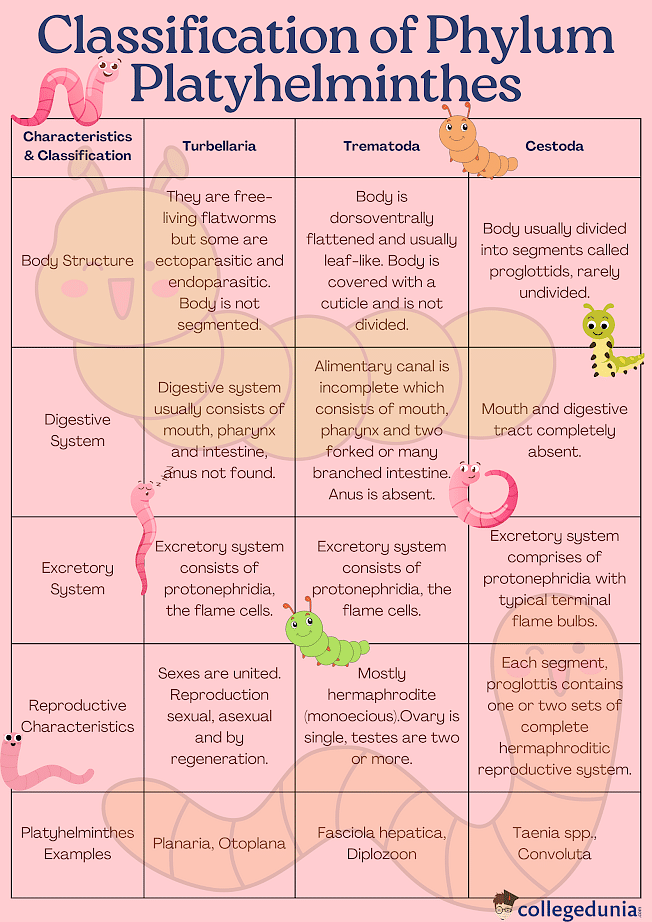
Classification of Phylum Platyhelminthes
Examples of Phylum Platyhelminthes
- Dugesia: It is an example of Turbellarians. Normally found in freshwater streams.
- Phagocata: It is an example of Turbellarians and has up to 20 pharynxes each with a mouth
- Terricola: It is a land planarian and an example of Turbellarians. The fraction of an inch to almost 1’ long. They are also called the creatures of dark or dim light. They have either no eyes, 2 eyes or 100’s of eyes. This category is also called hunters and scavengers; some terrestrial planarians are fast enough to catch fruit flies (Drosophila).
Things to Remember
- Phylum Platyhelminthes belongs to the kingdom Animalia.
- The classification includes more than 20,000 species.
- Platyhelminthes are mostly known as flatworms.
- Some flatworms are free-living but some are parasites.
- Platyhelminthes can be found in different range of sizes.
- The digestive System and Excretory System are absent in some classes of Platyhelminthes.
- Platyhelminthes are classified into three classes: Turbellaria, Trematoda & Cestoda
Sample Questions
Ques. What do you mean by the dorsoventrally flattened body? (1 mark)
Ans. When the lower and upper parts of the body are flattened, then it is called the dorsoventrally flattened body. This type of body is found in tapeworms or flatworms.
Ques. In which class of Phylum Platyhelminthes, the digestive system is absent? (1 mark)
Ans. The digestive system is absent in the Cestoda classification of Phylum Platyhelminthes.
Ques. What is a flame cell? (1 mark)
Ans. A flame cell is an excretory organ in the flatworms except turbellarian order Acoela. Flame cells act as kidneys and remove waste materials from the body.
Ques. What role do Platyhelminthes play in the ecosystem? (2 marks)
Ans. Platyhelminthes contribute to nutrient recycling in ecosystems by feeding on decaying organic matter. Some species serve as intermediate hosts for parasites, maintaining complex life cycles in ecosystems.
Ques. How do Platyhelminthes affect humans? (5 marks)
Ans. Platyhelminthes, particularly parasitic species, can affect humans in several ways:
- Certain flatworms, such as tapeworms (cestodes) and flukes (trematodes), can infect humans through contaminated water or food. These parasites can cause diseases such as schistosomiasis, cysticercosis, and liver fluke infection.
- Intestinal parasites like tapeworms can compete with the human host for nutrients, potentially leading to malnutrition and nutrient deficiencies.
- Parasitic flatworms may invade various tissues and organs in the human body, causing damage and inflammation. For example, liver flukes can infect the liver, leading to tissue scarring and dysfunction.
- Infestations by intestinal parasites can result in symptoms such as abdominal pain, diarrhea, nausea, and vomiting.
- Certain parasitic flatworms, such as the pork tapeworm (Taenia solium), can lead to neurocysticercosis, a condition where cysts form in the brain and other tissues, causing seizures, headaches, and neurological symptoms.
- Parasitic infections can have significant economic and social consequences, particularly in regions with poor sanitation and limited access to healthcare.
Ques. What are some examples of parasitic Platyhelminthes? (1 mark)
Ans. Parasitic flatworms include tapeworms (cestodes) and flukes (trematodes). They can infect humans and other animals, causing diseases such as schistosomiasis and cysticercosis.
Ques. What is the reproductive system of Platyhelminthes? (1 mark)
Ans. Platyhelminthes exhibit various reproductive strategies. Some species are hermaphroditic, possessing both male and female reproductive organs. Others reproduce sexually through cross-fertilization.
Ques. How do Platyhelminthes feed? (2 marks)
Ans. Flatworms exhibit diverse feeding habits. Some are free-living scavengers, while others are predators. Many species are parasitic, feeding on the tissues and bodily fluids of their hosts.
Ques. Where are Platyhelminthes found? (3 marks)
Ans. Flatworms can be found in a variety of environments -
- Marine: Many species inhabit the ocean, from shallow tidal zones to deep seafloor environments.
- Freshwater: Some species live in lakes, ponds, and rivers.
- Soil: Several types of flatworms can be found in moist soil, often associated with decaying organic matter.
- Parasites: A significant portion of flatworms are parasitic, living inside or on other animals, including humans.
Ques. What are some interesting facts about Platyhelminthes? (2 marks)
Ans. Some flatworms can regenerate lost body parts.
- Some parasitic flatworms can change their gender depending on the needs of their host.
- The human brain has a structure called the "hippocampus" which translates to "sea horse" in Latin, named after it resembles a type of flatworm.
Ques. What are the distinguishing characteristics of Platyhelminthes? (5 marks)
Ans. The distinguishing characteristic of Platyhelminthes are -
- Bilateral symmetry: They have a left and right side that are mirror images of each other.
- Acoelomate: They lack a coelom, a fluid-filled body cavity found in many animals.
- Triploblastic: They have three germ layers (ectoderm, mesoderm, endoderm), which allow for the development of specialized tissues and organs.
- Soft-bodied: They lack a skeleton or other internal hard structures.
- Hermaphroditic: Most flatworms are hermaphrodites, meaning they have both male and female reproductive organs.
Check-Out:
| Biology Study Guides | ||
|---|---|---|
| Biology MCQs | Comparison Topics in Biology | Biology Study Notes |



Comments