



Content Curator
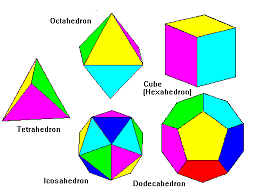
Platonic solids, also known as regular polyhedra or regular solids having an equivalent face made out of congruent convex types of polygons. The five platonic solids found in nature are thought to represent the five elements: earth, air, fire, water, and the universe. The five platonic solids include Tetrahedron, Cube, Octahedron, Dodecahedron, and lcosahedron. They all are convex regular polyhedra, These five platonic solids have different formulas
| Table of Content |
Key Takeaways: Platonic Solids, polygons, Tetrahedron, Cube, Octahedron, Dodecahedron, and lcosahedron
Definition of Platonic Solid
[Click Here for Sample Questions]
A platonic solid is a 3D form with the same number of faces as a regular polygon and the same number of faces meeting at each vertex as a regular polygon. The tetrahedral was identified with fire, the cube with earth, the icosahedron with water, the octahedron with air, and the dodecahedron with the universe, according to Plato.
Uses of Platonic Solid
[Click Here for Sample Questions]
Aside from their natural beauty, Platonic solids have a plethora of exciting technological applications. Tetrahedrons, for example, are frequently used in electronics, whereas icosahedrons are valuable in geophysical modelling. Although the dodecahedral type looks to be more developed as omnidirectional sound sources in room acoustics evaluations.
Properties of Platonic Solid
[Click Here for Sample Questions]
Properties are listed below:
- All of the faces are regular and congruent.
- Convex polyhedrons are Platonic shapes.
- Except at their edges, the faces of a platonic solid do not intersect.
- At each vertex, the same number of faces meet.
- The shapes of Platonic solids are three-dimensional, convex, and regular solids.
Types and Formula of Platonic Solid
[Click Here for Sample Questions]
There are five different varieties of platonic solids. Let’s take a closer look at the five types:
Tetrahedran
In geometry, a tetrahedron is known as a triangular pyramid. The tetrahedron has four triangular faces, six straight edges, and four vertex corners. All of the faces of a normal tetrahedron are equilateral triangles.
Volume - √2/12a3
Surface Area- √3a3

Cube
A cube or cuboid is a 3D solid object with six square faces and all of its sides are the same length. A cube has 12 sides, 6 faces, and 8 vertices.
Surface area- 4a2
Volume- a3
Diagonal- √3a

Octahedron
An octahedron is a polyhedron having 8 faces, 12 edges, and 6 vertices, with four edges crossing at each vertex.
Surface area- 2√3a2
Volume- √2/3a3

Dodecahedron
A dodecahedron has 12 pentagonal sides, 30 edges, and 20 vertices, with three edges meeting at each vertex. There are 160 diagonals in the platonic solid.
Surface area- 30 × a × ap
Volume- ¼ [15+ 7 √5] a3

Icosahedron
An icosahedron is a platonic solid having 20 faces. The icosahedron is made up of 20 faces, 30 edges, and 12 vertices.
Surface area- 5 √3a2
Volume- 5/12[ 3+ √5a3]

proof of Existence of 5 Platonic Solid
[Click Here for Sample Questions]
There are only five solid shapes regarded to be Platonic solids. The following are the reasons why there are only five shapes and not more:
- Tetrahedron 3 regular triangles meet
Internal angles = 60°
60 × 3 = 180°
- Cube 3 squares meet
Internal angles = 90°
90 × 3 = 270°
- Octahedron 4 regular triangles meet
Internal angles = 60°
60 × 4 = 240°
- Dodecahedron 3 pentagons meet
Internal angles = 108°
108 × 3 = 324°
- Icosahedron 5 regular triangles meet
Internal angles = 60°
60 × 5 = 300°
Euler's Formula for Proof of Platonic Solid
[Click Here for Sample Questions]
According to Euler's formula, the Number of Faces plus the Number of Vertices (corner points) minus the Number of Edges always equals 2 for any convex polyhedron. F + V - E = 2 is written as F + V - E = 2. Let's try it on one of the platonic solids, the icosahedron. F + V - E = 20 + 12 - 30 = 2 because the icosahedron has 20 faces, 30 edges, and 12 vertices.
Points to Remember
Following are some important points:
- A platonic solid is a 3D form with the same number of faces as a regular polygon and the same number of faces.
- A platonic solid is a regular, convex polyhedron with identical faces made up of congruent convex regular polygons,
- Earth, air, fire, water, and the universe were considered to be represented by the five Platonic Solids.
- The Euler's Formula is the formula F + V – E = 2. The formula also applies to any polyhedra, not simply Platonic solids.
Sample Questions
Ques: How are Platonic solids calculated? (2 Marks)
Ans: F - E + V = 2 = Euler's Formula is a means to classify different sorts of polyhedrons for all Platonic solids, and it holds true for almost all polyhedrons.
Cube 3 squares meet
Internal angles = 90°
90 × 3 = 270°
Ques: If the Schlafe symbol of the Platonic solid P is {p, q}, use Euler’s formula V − E + F = 2 to show that V = 4p 4 − (p − 2)(q − 2), E = 2pq 4 − (p − 2)(q − 2), F = 4q 4 − (p − 2)(q − 2), where V, E and F are the number of vertices, edges and faces respectively of P. (2 Marks)
Ans: By definition, there are p faces meeting at each vertex, each of which is a q-gon. Therefore, each vertex has p edges connected to it and every edge connects 2 vertices implying that 2E = pV. Similarly, each face has q edges and every edge belongs to 2 faces. Therefore 2E = qF. This gives us three equations V − E + F = 2, 2E = pV, 2E = qF. Solving for V, E and F gives the required equaticon.
Ques: Recall from the first lecture that a reflection an R n is an orthogonal transformation s ∈ O(R, n) such that dim FixRn (s) = n − 1 and s 2 = id. (a) Show that FixRn (s) = Ker(id − s). (b) Prove that s is diagonalizable. What are the eigenvalues of s? (c) Deduce that det(s) = −1. (d) choose α such that FixRn (s) = Hα. Derive the formula sα(x) = x − 2(x, α) (α, α) α for a reflection (3 Marks)
Ans: (a) Recall that FixRn (s) = {v ∈ R n | s(v) = v}. But s(v) = v if and only if (id − s)(v) = 0 i.e. if and only if v ∈ Ker(id − s).
(b) If α ∈ H⊥ then (y, s(α)) = (s(y), s(α)) = (y, α) = 0 for all y ∈ H. This implies that s(α) ∈ H⊥. Hence s acts on H⊥. Now H ∩ H⊥ = 0 and dim H + dim H⊥ = n. Therefore, H⊥ is a line perpendicular H. This means that s(α) = λα for same λ.
(c) The determinant of s is just the product of its eigenvalues, which is clearly −1. (d) The reflection s is the unique orthogonal map R n → R n such that s(x) = x for all x ∈ H = {x ∈ R n | (x, α) = 0} and s maps α to its negative. Therefore it suffices to check that the map L(x) = x − 2(x,α) (α,α) α has both of these properties. This is clear.
Ques: There is a purely topological proof of the fact that there are only five Platonic solids. The key topological fact is that Euler’s formula holds: V − E + F = 2. Using this, together with the relations oF = 2E = qV , show that 1 p + 1 q = 1 2 + 1 E . Deduce that there are only five Platonic solids. (2 Marks)
Ans: First divide V − E + F = 2 through by 2E and then substitute in pF = 2E = qV to get the equation. Since 1 E > 0, we deduce that 1 p + 1 q > 1 2 .
Therefore, we are taking pairs {p, q}, with p, q ≥ 3 (clear p or q equal to 2 cannot produce a Platonic solid) such that the inequality (1) holds.
Listing small examples quickly shows that this only happens for {p, q} = {3, 3}, {3, 4}, {3, 5}, {4, 3} or {5, 3}.
Ques: Using the fact that g ∈ W(P) is a reflection if and only if it has one eigenvalue equal to −1 and two eigenvalues equal to 1, count the number of reflections in W(H) and W(D). (2 Marks)
Ans: For both the cube H and the dodecahedron D, we have seen that W(P) = W0(P)× {±Id}. Therefore, since W0(P) consists of rotations, each reflection must be of the form (r, −1) for same rotation. Moreover, we have seen in exercise 2. that a reflection has one eigenvalue which is −1 and two that equal 1. Thus, r must be a rotation with eigenvalues 1, −1, −1 i.e. r must be a rotation of Order 2 (or a rotation of π about its axis of rotation).
Ques: Which of the following cannot be true for a polyhedron? (3 Marks)
(a) V = 4, F = 4, E = 6
(b) V = 6, F = 8,E = 12
(c) V = 20,F = 12, E = 30
(d) V = 4, F = 6, E = 6
Ans: (d) We know that, Euler’s formula for on polyhedron is F + V - E = 2 where, F = faces, V = vertices and E = edges.

Ques: Using Euler's formula find the unknown. (3 Marks)
Ans:

(i) Here, V = 6 and E = 12
Since F + V – E = 2
∴F + 6 – 12 = 2
or F – 6 = 2
or F = 2 + 6 = 8
(ii) Here, F = 5 and E = 9
Since F + V – E = 2
or 5 + V – 9 = 2
or V – 4 = 2
or V = 2 + 4 = 6
(iii) Here F = 20, V = 12
Since, F + V – E = 2
∴20 + 12 – E = 2
or 20 + 12 – E = 2
32 – E = 2
or E = 32 – 2 = 30
Ques: Can polyhedron have 10 faces, 20 edges and 15 vertices?(2 Marks)
Ans: Here, F = 10, E = 20 and V = 15
We have: F + V – E = 2
10 + 15 – 20 = 2
or 25 – 20 = 2
or 5 = 2 which is not true
i.e. F + V – E = 2
Thus, such a polyhedron is not possible.
Ques: A polyhedron has 7 faces and 10 vertices. How many edges does the polyhedron have? (2 Marks)
Ans: For any polyhedron,
F + V – E = 2
Given here, F = 7, V = 10, E = ?
Substituting the values, we get;
7 + 10 – E = 2
17 – E = 2
E = 17 – 2
E = 15
Also Read:



Comments