



Education Journalist | Study Abroad Lead
Solid bodies usually arrive with closely packed constituent particles, gradually resulting in bare minimum gaps. Crystalline solids are bifurcated in accordance with their space lattices, and the packing of their atoms.
| Table of Content |
Key Terms: Crystalline Solids, Void, Packing, Atoms, Tetrahedral void, Spheres, octahedral, octahedron
Tetrahedral Void
[Click Here for Sample Questions]
Tetrahedral void comes with a particular type of alignment, as much like a triangular-shaped void. It can be simply defined as a triangular void that has been enclosed by four spheres. Crucially, tetrahedral voids can be found on the edges of the unit cell, which is why the tetrahedral voids can be rather quantified as “2n.” Which is to say, there are especially two tetrahedral voids attached per sphere.
Considering the amount of closely packed atoms is N, the number of tetrahedral voids would essentially be 2N. The void, however, is acutely smaller than the sphere itself, which leads it to have a considerably smaller volume.

Also Read:
| Related Articles | ||
|---|---|---|
| Classification Of Crystalline Solids | Frenkel Defect | Point defects |
| Impurity Defects | Packing Efficiency | Conductors |
Octahedral Void
[Click Here for Sample Questions]
Octahedral voids can be usually found in elements that have an octahedral arrangement in their crystal cell. Simply, the atom present in the octahedral void is elementally attached with six atoms situated at six corners of an octahedron.
Unlike tetrahedral voids that are triangular in shape, octahedral voids are a combination of two voids from two completely different layers. This is to say, when the tetrahedral void of the first layer aligns with the second layer of the same void, then begins forming an octahedral void.
Considering the amount of closely packed atoms is N, the number of octahedral voids would still relatively be N.
In a nutshell, this void begins forming at the center of six spheres. An octahedral vacuum has a coordination number of six. Most essentially, octahedral arrangements can be found in the center of the unit cell.
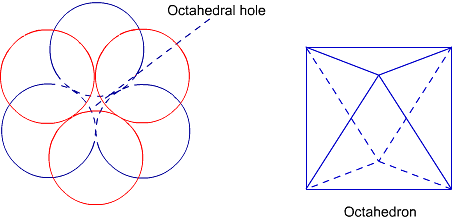
Difference Between Tetrahedral Void and Octahedral Void
[Click Here for Sample Questions]
Let’s get a brief picture about the differences between the two voids.
| Tetrahedral Void | Octahedral Void |
|---|---|
| Tetrahedral voids are vacant gaps that are encompassed by four spheres, or simply, cells. | Octahedral voids, on the other hand, are basically a combination of the first layer of the tetrahedral void with the second. |
| A tetrahedral void has four coordination numbers. | An octahedral vacuum, on the other hand, has a coordination number of six. |
| Considering the amount of closely packed atoms is N, then the number of tetrahedral voids would essentially be 2N. | Considering the amount of closely packed atoms is N, then the number of octahedral voids would still relatively be N. |
| The volume of the void is much smaller than even a spherical element. | The volume of the void present in an octahedral void is relatively larger. |
| Considering R as the radius of a constituent spherical element, the radius of a tetrahedral void is 0.225 R. | Considering R as the radius of a constituent spherical element, the radius of an octahedral void is 0.414 R. |
| A tetrahedral void is usually formed when a triangular-shaped void from the first layer (coplanar atoms) merges with the second layer of the void (the fourth atom above or below it nonetheless). | An octahedral void is generally formed when two separate sets of equilateral triangles point away from each other, to opposite directions, with six spheres. |
Things to Remember
- Crystal lattices are usually closely packed, the packing commonly takes place at different levels: one dimension, two dimensions, three-dimension; as per their structures. Now, what is rather essential for you to know is that these constituent particles come with a spherical shape in Tetrahedral and Octahedral voids.
- The unit cells of a crystal lattice, on the contrary, are in the shape of a cube. The gaps that are left unoccupied after the atoms are closely packed are further termed voids.
- A tetrahedral void is formed when a sphere of the second layer is located above the first layer, as per Tetrahedral and Octahedral voids.
- An octahedral void is given rise when the voids are partly covered by the spheres of the other layers.
Also Read:
Sample Questions
Ques: Consider a compound being created by two elements, namely, X and Y. The atoms of the element Y (as anions) now form ccp, but the atoms of the element X (as cations) now tend to fill all of the octahedral vacancies. What is the formula of the chemical created in light of this fact? (2 Marks)
Ans: The ccp lattice, in Tetrahedral and Octahedral voids, is given rise to by the element Y. As a result, the number of octahedral voids created equals the number of Y atoms present. Because all of the octahedral gaps are occupied by X atoms, their total number must be equal to the number of Y atoms. This is the reason why the atoms of elements X and Y are present in equal numbers or 1:1 ratio. The formula, in a nutshell, of the compound is XY.
Ques: The atoms of element B form the hcp lattice and the element structure in A occupy 2/3rd of the tetrahedral voids. What is the formula of the compound that will supposedly form by aligning the elements A and B? (2 Marks)
Ans: The number of tetrahedral voids that form is about equal to double the number of atoms of element B, with the atoms of element A occupying just 2/3rd of them. That clearly means the ratio of the number of atoms of A and B is 2 × (2/3):1 or 4:3 and the formula of the compound is A4B3.
Ques: A compound begins forming a hexagonal close-packed structure. How many vacancies are there in 0.5 mol of the substance? After finding the same, determine the number of tetrahedral voids present in it? (3 Marks)
Ans: Number of atoms in close proximity = 0.5 mol
One of them has 6.022 × 10²³ particles
Total number of close-packed particles = 0.5 × 6.022×1023 = 3.011 × 10²³
Total number of tetrahedral voids = 2 × number of atoms in close packaging
Therefore, when combining the values together,
Total number of tetrahedral voids = 2 × 3.011×1023 = 6.022×10²³
Total number of octahedral voids = number of atoms in close packaging
Hence, the number of octahedral voids = 3.011 × 10²³
Total number of voids present = Tetrahedral void + octahedral void = 6.022×10²³ + 3.011×1023 = 9.03 × 10²³
Ques. A and B form a solid, and the arrangement of atoms is as follows:
i. Atoms A have a ccp arrangement
ii. Atoms B have occupied all the octahedral voids and half the tetrahedral voids
Estimate the formula of the compound. (2 Marks)
Ans: Since the structure is close packed, the no. of octahedral voids equals the no. of atoms & the no. of tetrahedral voids is twice of the no. of atoms.
Since all the octahedral voids and half the tetrahedral voids are filled there will be one atom of B in tetrahedral void and one atom in octahedral void corresponding to each A. Thus, there will be two atoms of B corresponding to each A.
Hence, formula of the solid is AB2
Ques: What is meant by tetrahedral voids? (1 Mark)
Ans: Tetrahedral voids are particular vacant gaps that are encircled by four spheres, or as simply as cells. It also comes as a triangular-shaped void. It is rather formed when a sphere of the second layer is located above the first.
Ques. In LiI Crystal, I– ions have a cubical closest packed arrangement and Li+ ions occupy octahedral holes. What is the relationship between the edge-length of the unit cells and the radii of the I– ions? Calculate the limiting ionic radii of Li+ and I– if a = 600pm. (4 Marks)
Ans: From the question, we have:
2r+ + 2r– = 600 pm
So, r+ + r– = 300 pm ………… (i)
Since, Li+ ions occupy octahedral hole.
So, for octahedral hole
\(\frac{r^+}{r^-} = 0.414 \) ………… (ii)
From equation (i) and equation (ii)
\(\begin{aligned} &r^{-}\left(\frac{r^{+}}{r^{-}}+1\right)=300 \\ &\Rightarrow r^- \times(0.414+1)=300 \\ &\Rightarrow r^-=\frac{300}{1.414}=212.164\left(\because \frac{r^{+}}{r^{-}}=0.414\right) \\ &\therefore r^{+}=212.164 \times 0.414=r^{+}=87.84 \mathrm{pm} \end{aligned}\)
Ques: What are the general formulae used for both Tetrahedral Voids and Octahedral Voids? (2 Marks)
Ans: If the amount of closely packed atoms is considered “N”, then the number of tetrahedral voids would be 2N. While, on the other hand, if the amount of closely packed atoms is N in the case of an octahedral void, then the number of voids would relatively only be “N.”
For Latest Updates on Upcoming Board Exams, Click Here: https://t.me/class_10_12_board_updates
Check-Out:



Comments