



Education Journalist | Study Abroad Lead
Profit and loss Percentage are the concepts that are used to refer to the amount of profit or loss that has been incurred in terms of percentage. Profit and loss is a concept that has evolved from many applications to real-life difficulties that occur virtually every day in our lives. A profit is made when a product is repurchased at a higher price. Similarly, there is a loss if the item is purchased at a lower price. When a good is sold, one can either gain a profit or bear a loss, which is usually calculated in terms of percentage. Every firm and organisation is based on the profit and loss principle.
Read Also: Selling Price Formula
| Table of Content |
Key Takeaways: Profit, Loss, Cost Price, Selling Price, Loss Percentage, Profit Percentage, Marked Price, Discount
What is Profit Loss Percentage?
[Click Here for Sample Questions]
The term "profit and loss percentage" refers to the amount of profit or loss that has been incurred in percentage terms. Profit percentage is used to express profit generated as a percentage, while Loss percentage is used to express loss generated as a percentage. Whether it is a profit or a loss percentage, the cost price is more distinctive. Another well-known example is the purchase and sale of things.
It's important to know that using the percentage is one of the ways for comparing two data. Every day, we are faced with a variety of situations in which we must compute or compare something in per cent. Hence in order to calculate profit or loss on an item, one must do so in percentages.
Profit Loss Percentage: Some Terminologies Along with Formulas
[Click Here for Sample Questions]
We need to familiarise ourselves with a few phrases that are commonly used in sales/purchasing of commodities before we go through profit and loss per cent.
- Cost Price: The cost price of an item is the price at which it is purchased. For example, if Neil paid Rs. 8 for an umbrella, this is the umbrella's cost price. The abbreviation is C.P.
- Selling Price: The selling price of an item refers to the price at which it is purchased. For example, if Neil sold the identical umbrella for Rs 10, the umbrella's selling price is Rs 10. The abbreviation is S.P.
- Profit: When the selling price exceeds the cost price in a transaction, we have made a profit. According to the example above, Neil made a profit of Rs. 2.
Profit = Selling Price - Cost Price
Because the umbrella's cost price was Rs. 8 and its selling price was Rs. 10 in the example above, the profit he made may be computed using the formula: Profit = Selling price - Cost price. We get Profit = 10 - 8 = 2 by substituting the data. As a result, he makes an Rs.2 profit.
- Loss: When the cost price is higher than the selling price in a transaction, we lose money. For example, if a bag costs Rs. 20 and is sold for Rs. 17, we have lost Rs. 3 on this transaction. The formula for calculating loss is
Loss = Cost Price - Selling Price
In the same example, the bag's Cost price is Rs. 20 and its Selling price is Rs. 17, hence the loss can be determined using the following formula: Loss = Cost price - Selling price. We get Loss = 20 - 17 = 3 by substituting the variables. As a result, the sale results in an Rs. 3 loss.

Profit Loss Percentage Formula
[Click Here for Sample Questions]
Follow the steps to learn how to calculate the percentage of profit and loss:
- Take note of a product's selling price and cost price first.
- Calculate the profit and loss using the formulas- Profit = S.P – C.P and Loss = C.P – S.P.
- Enter the obtained Profit and Loss in the profit and loss percentage formulas.
Profit Percentage = (Profit/Cost Price)*100
Loss Percentage = (Loss/Cost Price)*100
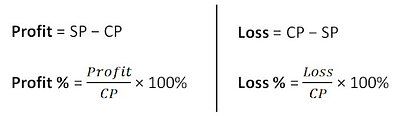
Let us understand the concept with the help of some examples:
Example 1: For Rs. 22500, a second-hand car dealer purchased a vehicle. It was sold for Rs. 27000 a week later. Calculate the profit on the car's sale and represent it as a percentage of the purchase price.
Solution: The cost price of the car = Rs. 22500
Selling price of the car = Rs. 27000
Selling price > Cost price
Profit = 27000-22500
Profit = Rs. 4500
Profit % = (4500/22500)x100%
= 20%
So, the required profit is 20%.
Example 2: For Rs. 1.20 each, a news agent purchases 120 magazines. Determine if the newsagent made a profit or a loss if only 72 magazines were sold for Rs 1.95 each. As a proportion of the cost price, calculate the profit or loss percentage.
Solution: The number of magazines the newsagent bought = Rs.120
Number of magazines sold out = Rs. 72
Cost price of one magazine = Rs. 1.20
Selling price of one magazine = Rs.1.95
Amount He Invested = 120(1.20)
Cost price = Rs. 144
Selling price = Rs. 72(1.95)
= Rs. 140.4
Loss = Rs. (144 - 140.4)
= Rs. 3.6
Loss % = (3.6/144) x 100%
= 2.5%
So, 2.5% loss happened.
Read More: Ratio to Percentage Formula and Conversion
Things to Remember
[Click Here for Sample Questions]
- When a product or service is sold for a price higher than its cost price, the seller makes a profit.
- When a product or service is sold at a lower selling price than its cost price, the seller suffers a loss.
- When the selling price (SP) and cost price (CP) are given, profit (P) is determined using the formula Profit (P)= Selling Price (SP) - Cost Price (CP).
- When both the selling price (SP) and the cost price (CP) are known, Loss (L)= Cost Price (CP)-Selling Price (SP) is determined.
- Profit percentages are used to express profit as a percentage, whereas loss percentages are used to convey loss as a percentage. Hence, Profit percentage = (Profit/Cost Price)*100, and Loss percentage = (Loss/Cost Price)*100.
Sample Questions
Ques. Pavan makes a profit of Rs. 15 when he buys rose apples for Rs. 45. How do you figure out the profit percentage? (3 Marks)
Ans. Given a selling price of 45 rupees for rose apples and a profit of 15 rupees.
Profit = Selling Price – Cost Price
15 = 45 – Cost Price, according to the formula.
45-15 = Cost Price
Price per unit = 30
Profit percent = (Profit/Cost Price) * 100
= (15 / 30)*100
= 50 %
As a result, pavan gains a 50% profit.
Ques. Ryan paid Rs. 720 for a calculator and lost 6% on it when he sold it. How much did he get for it? (3 Marks)
Ans. Given CP = Rs. 720 and Loss = 6%, we will compute the calculator's selling price using the profit and loss calculations.
If the loss is 6%, it means that an Rs. 100 cost price will result in an Rs. 6 loss.
SP = Rs. 94 if CP = Rs. 100.
SP = (94/100) * 720 = Rs. 676.8 if CP is Rs. 720.
The selling price for Ryan's calculator was Rs. 676.8.
Ques. Raj paid Rs. 75000 for a bike and sold it for Rs. 55000. Is it a profit or loss situation? Find out what percentage of profit or loss he made. (3 Marks)
Ans. The cost price of the bike (CP) = Rs. 75000
Selling price of the bike (SP) = Rs.55000
As SP < CP, hence it is a loss.
Net Loss will be = CP – SP = 75000 – 55000 = Rs. 20000
Now, Raj’s loss % will be-
= (20000/75000) * 100 = 80/3 %
=26.667%
∴ Loss percent of Raj will be 26.667%.
Ques. Mukesh bought two watches for the same price and made a 20% profit on one and a 22.5 per cent profit on the other. What is the cost price of each watch if the selling price difference is Rs 150? (3 Marks)
Ans. Increase the price of the watches by 100x.
The first watch's selling price is 120x, and the second watch's selling price is 122.5x.
The difference in selling prices is calculated as 150.
So, 122.5x - 120x = 150
2.5x = 150
x= 150 2.5
Therefore, x= 375
We get 100x = 100 (375) = Rs.37500 by substituting the x value in the original cost price.
As a result, each watch costs Rs. 37500.
Ques. Jane loses 6% when she sells a table for Rs.987. Determine the price at which she purchased using the profit and loss formulae. (3 Marks)
Ans. Given a loss of 6%, and an SP of Rs.987, we have to find CP.
If the loss is 6%, it means that an Rs.100 cost price will result in an Rs.6 loss.
SP equals Rs.94 if CP is Rs.100.
CP = Rs. 100 when SP = Rs. 94.
When the SP is Rs. 987, CP will be (100/94) * 987 = Rs. 1,050
Hence, CP = Rs 1050.
Ques. The original price of a shirt is Rs. 200, but it is sold for Rs. 350 by a merchant. Calculate how much money the shopkeeper makes. (3 Marks)
Ans. The shirt's original/actual price is Rs. 200.
The shirt's cost price (CP) is Rs. 200.
In addition, the merchant sells the clothing to a buyer for Rs. 350.
The shirt's selling price (SP) is Rs. 350.
When the selling price (SP) and cost price (CP) are supplied, profit is determined using the formula Profit (P)= Selling Price (SP) - Cost Price (CP).
As a result, Profit (P) = 350-200.
P (profit) =150
As a result, the shopkeeper makes a profit of Rs. 150.
Ques. A man buys a fan for Rs. 1000 and subsequently sells it for Rs. 1500, making a 15% loss on the sale. What is the range of the fan's selling price? (3 Marks)
Ans. The cost price of the fan is Rs. 1000.
Losses account for 15% of the total.
Loss percentage = (Loss/Cost Price) × 100, as we know.
(Loss/1000) x 100 = 15.
As a result, Loss = 150 rupees.
We are all aware that Cost Price – Selling Price = Loss,
As a result, Selling Price = Cost Price - Loss.
= 1000 - 150 = Rs. 850
Ques. Calculate the percentage of loss when a shopkeeper loses Rs. 200 and his merchandise sells for Rs. 100. (3 Marks)
Ans. The product was sold for Rs. 100 by the merchant.
Rs. 100 is the selling price (SP).
In addition, provided that Loss = Rs. 200,
In this situation, the cost price (CP) is computed using the formula,
Selling Price (SP) + Loss (L) = Cost Price (CP)
As a result, the Cost Price (CP) = Rs (100 + 200)
CP (Cost Price) = 300
When given a loss (L) and a cost price (CP), the formula for computing the percentage loss is as follows:
Loss Percentage (%) = (Loss(L)/Cost Price (CP)) * 100
As a result, Loss Percentage (%) = (200/300) * 100.
Hence, Loss Percentage =66.67%



Comments