



Content Curator
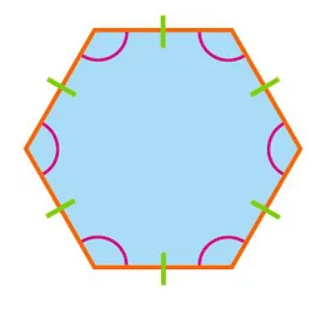
Regular hexagon has six equal sides, six equal angles and has a closed shape. In a regular polygon, all the sides and angles of a polygon are equal. For example, a heptagon has 7 equal sides and a regular decagon has 10 equal sides. Any other closed figure or shape with curved lines are not considered as polygons; they are irregularly shaped figures. If we arrange six equilateral triangles, then a regular hexagon is formed and the area of the regular hexagon which is formed by the three equilateral triangles will be equal to six times the area of the same triangle.
| Table of Content |
Keywords Takeaways: Polygon, Quadrilateral, Triangle, Area, Perimeter
Types Of Hexagon
[Click Here for Sample Questions]
There are 4 types of Hexagon, which are explained below.
Regular Hexagon: They are those closed shaped hexagons whose all sides and angles are equal.
Irregular Hexagon: They are those closed shaped figures whose sides and angles are not equal or those hexagons that are not regular.
Concave Hexagon: They are those hexagons whose interior angles i:e one interior angle or more than one interior angle is greater than 180 degrees.
Convex Hexagons: They are those hexagons which have no interior angles greater than 180 degree.

Types of Hexagons
Read More:
Properties Of Regular Hexagon
[Click Here for Sample Questions]
- Regular Hexagon has 6 equal sides.
- Regular Hexagon has 6 equal angles.
- A regular hexagon has 6 vertices.
- Sum of interior angles of a hexagon is equal to 720 degrees.
- A regular Hexagon is made of 6 equilateral triangles.
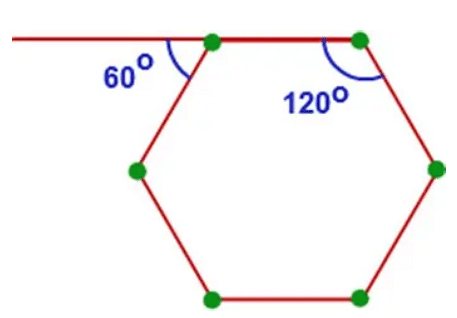
- Interior Angle of a regular hexagon is equal to 120 degrees.
- The External angle of a regular hexagon is equal to 60 degrees.
- A regular hexagon has 9 diagonals.
Properties of Hexagon
Read More:
| Isosceles Triangle Theorems | Difference between Sequence and Series |
| Differential Equation | Differentiation and Integration Formula |
Area Of Regular Hexagon
[Click Here for Sample Questions]
Area of a regular hexagon can be defined as the total amount of space covered inside a regular hexagon. Area of regular hexagon can be calculated by using the below given formula:
Area of Regular Hexagon = A = 3\(?3/2\) × a2
A = 2.59807 a2
Where ‘a’ is the length of the side of a regular hexagon.
Read More:
Perimeter Of Regular Hexagon
[Click Here for Sample Questions]
Perimeter of a regular hexagon can be defined as the sum of all sides of a hexagon. Its Perimeter can be calculated by using the below given formula:
Perimeter P = 6a
Where ‘a’ is the length of a regular hexagon.
Read More:
Angles Of Regular Hexagon
[Click Here for Sample Questions]
Sum of all 6 interior angles of a regular hexagon is 720 degrees. So, to find the interior and the exterior angle of a regular hexagon can be calculated as follows:-
Interior Angle of a regular hexagon = 720°/ 6
Interior Angle of a regular hexagon = 120°
Exterior Angle of a regular hexagon = 180°- interior angle
Exterior Angle of a regular hexagon = 180°-120°
Exterior Angle of a regular hexagon = 60°
Read Also:
Things To Remember
[Click Here for Sample Questions]
- A regular hexagon has six equal sides and six equal angles and a regular hexagon has a closed shape.
- Interior Angle of a regular hexagon = 120°
- Exterior Angle of a regular hexagon = 60°
- Area of Regular Hexagon = A = 3√3/2 × a2
A = 2.59807 a2
- Perimeter of Regular Hexagon:- P = 6a
- Regular hexagon has 9 diagonals.
- Regular hexagons have 6 vertices.
Also Read:
Sample Questions
Ques: Find the Area and the Perimeter of a regular hexagon whose all sides are equal to 8cm. (2 marks)
Ans: Let ‘a’ be the length of the hexagon
Given that a = 8 cm
By applying the area and perimeter formula,
Area of a regular hexagon = 2.59807 a2
A = 2.59807 ( 8*8)
A = 166.27 Sq. cm
Perimeter = 6a
Perimeter = 6* 8
Perimeter = 48
Ques: Find the length of the side of a regular hexagon if its perimeter is given as 48cm. (3 marks)
Ans: It is given that the perimeter of a regular hexagon is 48 cm
Let the length of the side of a hexagon be ‘l’
Now we know that the formula for finding the perimeter is
Perimeter of a hexagon = 6 l
Therefore, substituting the values in the above formula we get,
Perimeter = 6*l
48 = 6 * l
L = 48 / 6
L = 8 cm
Hence the length of the regular hexagon is equal to 8 cm
Ques: Write down the five properties of a regular hexagon. (3 marks)
Ans: Five properties of a regular hexagon are as follows:-
- Regular Hexagons have all 6 equal sides and 6 angles.
- Sum of interior angles of a hexagon is equal to 720 degrees.
- A regular Hexagon is made of 6 equilateral triangles.
- Interior Angle of a regular hexagon is equal to 120 degrees.
- The External angle of a regular hexagon is equal to 60 degrees.
Ques: The Area of a regular hexagon is 93.5 sq. cm, find the length of the regular hexagon. (3 marks)
Ans. It is given that the AREA of a regular hexagon is 93.5 sq cm
Let the length of the side of a hexagon be ‘ L’
Now we know that the formula for finding the AREA is
Area of a hexagon = 2.59807 a2
Therefore, substituting the values in the above formula we get,
93.5 = 2.59807 L2
L = √ 93.5 / 2.59807
L = 5.9
OR, L = 6 CM
Hence, the length of the regular hexagon is 6 cm
Ques: Find the number of sides of a regular polygon whose measure of each exterior angle is 60 degrees? (2 marks)
Ans: Total measure of exterior angles = 360 degrees
Measure of each exterior angle = 60 degrees
hence , the no of exterior angle = 360 / 60
the no of exterior angle = 6
Therefore, no of sides of a polygon = 6
Hence the required polygon is a Hexagon with 6 sides.
Ques: Find the Area and the Perimeter of a regular hexagon whose all sides are equal to 17 cm. (3 marks)
Ans: Let ‘a’ be the length of the hexagon
Given that a = 17 cm
By applying the area and perimeter formula,
Area of a regular hexagon = 2.59807 a2
A = 2.59807 ( 17*17 )
A = 750.84 Sq. cm
Perimeter = 6a
Perimeter = 6* 17
Perimeter = 102
Ques: Write down the different types of hexagon? (2 marks)
Ans: There are 4 types of Hexagon, let's have a look at them one by one
- Regular Hexagon:- They are those closed shaped hexagons whose all sides and angles are equal are classified as Regular Hexagon.
- Irregular Hexagon:- They are those closed shaped figures whose sides and angles are not equal or those hexagons which are not regular are known as Irregular hexagons.
- Concave Hexagon:- They are those hexagons whose interior angles i:e one interior angle or more than one interior angle is greater than 180 degree are known as concave hexagons.
- Convex Hexagons:- They are those hexagons which have no interior angles greater than 180 degree are classified as convex hexagons.
Ques: Find the number of sides of a regular polygon whose measure of each interior angle is 120 degrees? (2 marks)
Ans: Total measure of exterior angles = 720 degrees
Measure of each exterior angle = 120 degrees
hence , the no of exterior angle = 720 / 120
the no of exterior angle = 6
Therefore, no of sides of a polygon = 6
Hence the required polygon is a Hexagon with 6 sides.
Read Also:



Comments