



Content Curator
Resonance structure can be depicted through the Lewis structures are used to represent the chemical bonds by showing the electrons of the valence shell in an atom. However, these representations cannot always explain certain bonding formations such as Ozone and Benzene. This is because of fractional bonds and partial charges and in such cases, Resonance structures are used to explain the delocalization of electrons showcased by a molecule or a polyatomic ion.
| Table of Content |
Key Takeaways: Resonance structures, Double bond, Lewis dot structures, Electrons, Atoms and Ions
Resonance Structure
[Click Here for Sample Questions]
Resonance which is also known as mesomerism helps in understanding certain molecular or ion bonding through the amalgamation of various resonance structures into a resonance hybrid in the valence bond theory. It contains a certain value for representing the displacement of electrons within a specific molecule or polyatomic ion where a particular Lewis structure fails to express the bonding. Resonance depicts a number of possible formations also known as canonical structures and resonance hybrids.

The video below explains this:
Resonance Structures Detailed Video Explanation:
Different Resonance Structures
-
Nitrite Ion (NO2-)
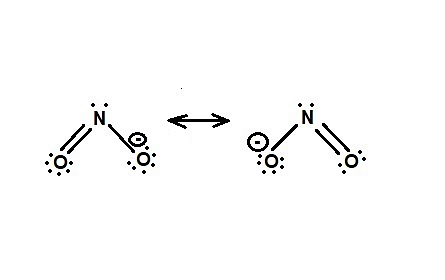
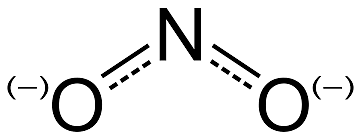
The nitrogen-oxygen bond lengths of nitrite ions are equal. The Lewis dot structure on the other hand shows the different bond order of the two N-O bonds. The resonance hybrid is able to elucidate the equal bond lengths as shown in the image:
Nitrate Ion
According to the resonance hybrid of nitrite ions, each oxygen atom has a partial charge of -½ and the N-O bond length is shown to be 125 pm.
-
Nitrate Ion (NO3-)
In the case of a nitrate ion, the central atom is that of nitrogen. This nitrogen atom has single bonds to two oxygen atoms. It also is doubly bonded to an oxygen atom. The single bonded oxygen atoms carry a charge of -1 (so as to satisfy the configuration of octet) while the nitrogen atom at the centre holds a +1 charge. The nitrate ion as a whole carries a charge of -1.

In case of resonance hybrid derived from the set of lewis structures, the partial charge of each oxygen atom will be -(2/3) and the net charge of the central atom will be +1.

Resonance Hybrid
-
Ozone (O3)
In the three oxygen atoms of an ozone molecule, the central oxygen atom forms a single bond with one oxygen atom and has a double bond with the other. While there is no overall net charge for this molecule, it is depicted in the lewis structure that the central oxygen atom has +1 charge while the single-bonded oxygen atom has a -1 charge.

Ozone
-
Carbonate Ion (CO3²-)
This is a polyatomic ion consisting of 24 electrons of which 2 results in -2 charge. This could be the result of electron donation from sodium or calcium which resulted in the formation of a cation which in turn donated electrons to the carbonate anion. In order to satisfy the rule of octet, the electrons have to form a double bond with carbon.

Carbonate ion
-
Nitrobenzene
Nitrobenzene has less electron density in its aromatic ring. This is due the electron-withdrawing group present which has a double bond adjacent to the phenyl ring.

Nitrobenzene
In comparison to benzene, the phenyl ring of nitrobenzene is less nucleophilic. As shown in the resonance structure, the ortho and para positions are positive. In the case of an electrophilic aromatic substitution reaction, the electrophile will react at meta position instead of these. Thus showing a double bond in conjugation with the phenyl ring.
-
Benzene
In organic chemistry, benzene is one of the most important aromatic hydrocarbons. The chemical formula of benzene is C6H6. The molecules are arranged in a cyclic structure with double and single bonds alternating between the adjacent atoms of carbon. Each carbon atom also holds a bond to a single hydrogen atom. The resonance structures of benzene are illustrated below

Benzene
In a benzene molecule that has been stabilized due to resonance, there are pi electrons delocalized around the ring. This delocalization results in the carbon-carbon bond having a bond order of 1.5, which is stronger than the sigma bond of c-c. The resonance hybrid of benzene depicts the delocalization of pi electrons in the form of the circular ring within the hexagonal ring.
Things to Remember
- The arrangement of electrons and atoms both differ in isomers but in resonance structures, it is only the electrons.
- Resonance structures provide a better representation of Lewis Dot Structures.
- The more the resonance structure, the more stable the molecule becomes.
- Any input present at or near the resonance structure can amplify through response and blow up the product.
- The resonance hybrid is said o be more stable than its canonical forms since the resonance hybrid is at a lower energy state.
Read about:
Sample Questions
Ques. Explain the need for resonance structure. (1 mark)
Ans. Resonance structure depicts how canonical structures combine to form resonance hybrids in the case of valence bond theory that is applicable to certain ions and molecules.
Ques. What is resonance in chemistry? (1 mark)
Ans. Group of lewis structures that are used to represent the electronic bonding of a single polyatomic species which includes fractional charges and fractional bonds are called resonance structures.
Ques. What does Kekule say about benzene? (2 marks)
Ans. According to Kekule, there are two cyclohexatriene Kekule structures that were taken together in benzene. These were constituting the general structure as contributing structure. The three double bonds are replaced by the hexagon in the hybrid area that depicts 6 electrons as a collection of 3 molecular orbitals that have a nodal plane in the molecule plane.
Ques. Elaborate on the CO2? molecule. (3 marks)
Ans. In CO2, it is experimentally proved that the carbon-oxygen bond length is 115 pm. For the normal carbon to oxygen double bond, it is 122 pm and 110 pm in the case of a triple bond. In CO?, the value of carbon to oxygen bond length lies between that of double and triple bonds. Since a single Lewis structure is not enough, it would be best described as a hybrid.

Ques. Explain the formation of a chemical bond. (2 marks)
Ans. According to the laws of Kossel and Lewis, the atoms combine with each other in order to fulfill their own octets so that their inert gas configuration becomes stable. This can take place in either of two ways, one by transferring a single or more electron from one atom to the other or by sharing electrons between two or multiple number of atoms.
Ques. Write the Lewis Dot Symbols for atoms of the following elements: Mg, Na, B, O, N, Br. (5 marks)
Ans. The lewis dot structures are:

Also Read:



Comments