



Content Curator
The VSEPR theory or the Valence Shell Electron Pair Repulsion theory is used in chemistry to predict the geometry of molecules from the number of electron pairs surrounding the central atom. This theory is based on the repulsive interactions of electron pairs in the valence shell of an atom.
Read More: Tetravalency
| Table of Content |
Key Terms: VSEPR, postulates, shape, geometry, limitations
What is VSEPR Theory?
[Click Here for Sample Questions]
VSEPR or the Valence Shell Electron Pair Repulsion theory is based on the basic idea of minimizing the repulsion between valence shell electrons by increasing the distance between them so that the stability of the molecule is increased. This helps in determining the molecular geometry. Electron-electron repulsion is a greater deciding factor than electrostatic repulsion in the determination of molecular geometry.
3D Arrangement of molecules
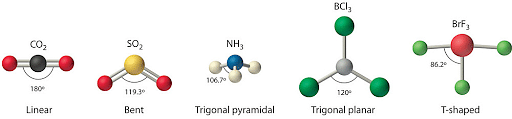
Lewis electron dot diagrams gave the 2-D model of the molecule. The VSEPR theory gives the 3-D arrangement of the molecules. Electron-electron repulsion in molecules having central atoms with zero lone pairs results in 5 basic geometries or shapes. The molecules having central atoms with lone pairs have compressed bond angles due to lone pair-bond pair repulsion.
Read Also:
Postulates of The VSEPR Theory
[Click Here for Sample Questions]
The following list of points forms the basis of the VSEPR theory:
- The shape of molecules is decided by the total number of bond pairs and lone pair valence shell electron pairs that are present around a central atom.
- Both the lone pair and bond pair valence shell electrons repel each other. Lone pair- Lone pair repulsion is stronger than bond pair-bond pair repulsion.

Bond length and angle
- Minimum energy → Maximum stability. The electron pairs arrange themselves in a fashion that tends to reduce the repulsion forces between them i.e they tend to align far apart from each other.
- The entire arrangement of the lone pair and bond pair electrons, in a manner that reduces repulsion to achieve stability of the molecule, is considered to be the valence shell.

Molecular Bonding
- The single super pair: In the case of multiple bonds i.e double or triple bonds where more than one pair of electrons are involved, all the bond pairs are taken as one single pair or super pair.
- A lone pair-lone pair repulsion is strongest followed by lone pair-bond pair. Bond pair-bond pair repulsion is the weakest.
- VSEPR theory is applicable to any existing resonating structure of a molecule, in case it has 2 or three resonating structures.
Read More: Cisplatin
Steps to Use The VSEPR theory To Predict the Shape of Molecules
[Click Here for Sample Questions]
Step 1: First, draw the lewis electron dot arrangement for a given ion or molecule.
Step 2: The least electronegative atom is taken as the central atom in the structure.
Step 3: Count the total number of bonded pairs and valence shell electrons by analyzing the atoms bonded with the central atom.

Shapes of Molecules
Step 4: Determine a stable arrangement of electron pairs around the central atom so that they experience the least repulsion.
Step 5: Observe and find the lone pair-lone pair interaction, lone pair-bond pair interaction and bond pair-bond pair interaction. This is useful in determining the bond angles.
VSEPR Number
The VSEPR number helps in determining the shape of the molecule. VSEPR numbers 2,3,4,5,6 represent Linear, Trigonal Planar, Tetrahedral, Trigonal Bipyramidal and Octahedral shapes respectively.
Read More: Thermochemistry
Geometry of the Molecules Using The VSEPR theory
[Click Here for Sample Questions]
The VSEPR theory gives the 3D arrangement of the molecules. Electron-electron repulsion in molecules having central atoms with zero lone pairs results in 5 basic geometries or shapes. The molecules having central atoms with lone pairs have compressed bond angles due to lone pair-bond pair repulsion.
The molecules where the central atom has no lone pair of electrons are represented by 5 types of geometric shapes as given below:
| Number of Outer Atoms | General Formula | Molecular geometry | Electron pair geometry |
|---|---|---|---|
| 2 | AB2 |  | Linear |
| 3 | AB3 |  | Trigonal Planar |
4 | AB4 |  | Tetrahedral |
| 5 | AB5 |  | Trigonal Bipyramidal |
6 | AB6 |  | Octahedral |
In the above table, A is the central atom and B is the outer atom.
Now let us have a look at the geometrical shape of molecules in which the central atoms have lone pairs. Here A is the central atom, B is the outer atom and E represents the number of lone pair electrons.
| Original shape without Lone Pairs | Number of outer atoms | Number of lone pairs | General Formula | Molecular Geometry | Name |
|---|---|---|---|---|---|
 | 2 | 1 | AB2E |  | Bent or Angular |
 | 3 3 | 1 2 | AB3E AB2E2 |
| Trigonal Pyramidal Bent or Angular |
 | 4 3 2 | 1 2 3 | AB4E AB3E2 AB2E3 |  | See-saw T-shaped Linear |
 | 5 4 | 1 2 | AB5E AB4E2 |  | Square Pyramidal Square Planar |


On the basis of lone pair and bond pair arrangement in the valence shell the above tables classified the different shapes of molecules.
Linear Shape
- The central atom is connected to two outer atoms
- Valence shell has two places
- The best possible arrangement to have minimum repulsion outer atoms have an angle of 1800 between them.
- Example: BeF2 , BeH2 , ZnCl2 , BeCl2

Linear
Trigonal-Planar Shape
- The central atom is linked with three outer atoms.
- To reduce the repulsive interaction the outer atoms are arranged at corners of an equilateral triangle having 1200 angles with each other.
- Examples: BF3, AlCl3

Trigonal Planar
Tetrahedral Shape
- The central atom is joined to four outer atoms.
- Each outer atom is separated by 109.50.
- Example: CH4 ,SiH4 , SiF4

Tetrahedral
Trigonal Bipyramidal Shape
- The central atom has a connection with 5 outer atoms.
- Three outer atoms are at equatorial corners of a planar triangle, while the rest two are axially located above and below the central atom forming 900 with equatorial corner atoms.
- Example: PF5, SbCl5

Trigonal Bipyramidal
Octahedral Shape
- The central atom is connected with 6 outer atoms.
- All the outer atoms have 900 separations in between.
- Example : SF6 , TeF6

Octahedral
Limitations of The VSEPR Theory
[Click Here for Sample Questions]
- The VSEPR theory is unable to predict the geometrical shapes of the transition metals.
- The VSEPR theory fails in the case of isoelectronic elements i.e. elements with an identical number of electrons.
- The VSEPR theory does not account for the inactive lone pairs.
- The VSEPR theory also ignores the orbital movement of electrons that is bound to affect the overall molecular shape.
- The VSEPR theory fails in providing exact bond angles, hence the geometrical shapes according to the theory are not the actual shapes of the molecule.
Things To Remember
- The VSEPR theory predicts the geometrical shapes of molecules based on the lone pair-lone pair, bond pair-bond pair and lone pair-bond pair interactions.
- The main basis of the theory is that electrons present in the valence shell of an atom arrange themselves in a fashion which ultimately leads to the maximum separation between them so that the overall energy of the molecule gets minimized and the compound attains a stable state. This is used to predict geometrical shapes.
- When central atoms do not possess lone pairs of electrons in their valence shells, they show different geometry as compared to central atoms with lone pairs in their valence shells. Further, if bond pair-lone pair interaction gives rise to changing bond angles.
- The VSEPR theory does not take into consideration the orbiting movement and interactions of electrons in the valence shell of the central atoms. Thus it ignores a big factor in deciding the actual shape of the molecule.
- The VSEPR number helps in determining the shape of the molecule. VSEPR numbers 2,3,4,5,6 represent Linear, Trigonal Planar, Tetrahedral, Trigonal Bipyramidal and Octahedral shapes respectively.
Read More: Difference between Cations and Anions
Sample Questions
Ques. Explain the geometrical shape of the CH4 molecule. Why is a square planar shape not predicted for CH4? (3 marks)
Ans. The central atom carbon has 4 valence electrons .( Z=1s22s22p2 ) .All four valence electrons are bonded to four hydrogen atoms. Hence 4 bond pairs are formed(8 electrons involved).
Now the basic concept of the VSEPR theory tells us that these 4 bond pairs (experiencing bond pair-bond pair repulsion) will arrange themselves in a way so as to minimise this repulsion.
So they adopt the tetrahedral form. All H-C-H bond angles are 109.5o.

The square planar shape is not predicted because in that shape the bond angle is only 90o. As a result, the repulsive forces will be more and it will violate the basic premise of the VSEPR theory.
Ques. Explain the process of using the VSEPR theory to predict the shape of molecules. What is the VSEPR number? (5 marks)
Ans. Following steps are applied to predict the shape of the molecules with active lone pairs and bond pairs:
STEP 1. First, draw the lewis electron dot arrangement for a given ion or molecule.
STEP 2. The least electronegative atom is taken as the central atom in the structure.
STEP 3. Count the total number of bonded pairs and valence shell electrons by analyzing the atoms bonded with the central atom.
STEP 4. Determine a stable arrangement of electron pairs around the central atom so that they
experience the least repulsion.
STEP 5. Observe and find the lone pair-lone pair interaction, lone pair-bond pair interaction and bond pair-bond pair interaction. This is useful in determining the bond angles.
VSEPR number:
The VSEPR number helps in determining the shape of the molecule.VSEPR numbers 2,3,4,5,6 represent Linear, Trigonal Planar, Tetrahedral, Trigonal Bipyramidal and Octahedral shapes respectively.
Ques. Draw the lewis electron dot arrangement for the molecule BeCl2. Find the steric number. Find the VSEPR shape of the molecule and predict the bond angle for minimum electron-electron repulsion. (3 marks)
Ans. The Lewis structure for BeCl2 is given below:

Steric number = number of outer atoms + number of lone pairs = 2 + 0 = 2 .
Now the VSEPR arrangement displaying the maximum distance between two atoms is given below:

Both the chlorines outer atoms are put at 1800 separation. This is a linear geometrical shape.
As is clear from the VSEPR model the bond angle for the BeCl2 molecule is 1800.
Ques. What are the main postulates of the VSEPR theory? (5 marks)
Ans. The following points cover the basic concept behind the VSEPR theory:
- The shape of molecules is decided by the total number of bond pairs and lone pair valence shell electron pairs that are present around a central atom.
- Both the lone pair and bond pair valence shell electrons repel each other. Lone pair-lone pair repulsion is stronger than bond pair-bond pair repulsion.
- Minimum energy→Maximum stability. The electron pairs arrange themselves in a fashion that tends to reduce the repulsion forces between them i.e they tend to align far apart from each other.
- The entire arrangement of the lone pair and bond pair electrons in a manner that reduces repulsion to achieve stability of the molecule, is considered to be the valence shell.
- The single super pair: In the case of multiple bonds i.e double or triple bonds where more than one pair of electrons are involved, all the bond pairs are taken as one single pair or super pair.
- A lone pair-lone pair repulsion is strongest followed by lone pair-bond pair. Bond pair-bond pair repulsion is the weakest.
- VSEPR theory is applicable to any existing resonating structure of a molecule, in case it has 2 or three resonating structures.
Ques. What are the limitations of the VSEPR theory? Why is it preferred over the Lewis dot structures? (5 marks)
Ans. Limitations:
- The VSEPR theory is unable to predict the geometrical shapes of the transition metals.
- The VSEPR theory fails in the case of isoelectronic elements i.e. elements with an identical number of electrons.
- The VSEPR theory does not account for the inactive lone pairs.
- The VSEPR theory also ignores the orbital movement of electrons that is bound to affect the overall molecular shape.
- The VSEPR theory fails in providing exact bond angles, hence the geometrical shapes according to the theory are not the actual shapes of the molecule.
The Lewis Dot structures or electron dot structures as they are popularly known as do not help in predicting the geometrical shape of the molecule under consideration. They were only restricted to the knowledge of valence shell electrons, Whereas the VSEPR theory taking into account the electron-electron repulsive forces gave a way to predict the molecular geometry of molecules on the basis of the lone pair and bond pair arrangement.
Ques. Describe the shape of the molecule if the VSEPR number is 5. Also, give examples of molecules that follow such a configuration. (3 marks)
Ans. We know that the VSEPR number 5 corresponds to the trigonal bipyramidal molecular geometry.
In this configuration
- The central atom has a connection with 5 outer atoms.
- Three outer atoms are at equatorial corners of a planar triangle, while the rest two are axially located above and below the central atom forming 900 with equatorial corner atoms.
- Example: PF5, SbCl5

A PCl5 molecule shows two Cl atoms in axial positions and the other three Cl atoms positioned at the corners of a planar triangle.
Ques. BeF2 is linear while SF2 is angular though both the molecules are triatomic. Explain. (2 marks)
Ans. In BeF2, Be is surrounded by 2 electron bond pairs, hence the molecule is linear.
On the other hand in SF2 the central atom S is surrounded by 2 bond pairs and 2 lone pair electrons. Since it is surrounded by 4 electron pairs the geometrical shape is predicted to be tetrahedral in nature with a bond angle of 109.50.
Thus we can say that due to electronic repulsions between bond pair and lone pair the resultant molecule is angular with a bond angle of 109.50.

Ques. The bond angle in PH4+ is higher than that in PH3. Explain the reasons using the VSEPR theory. (2 marks)
Ans. Both PH4+ and PH3 involve sp3 hybridization of the P atom. In the PH4+ all the four orbitals are bonded whereas in PH3 there is a lone pair of electrons on the P atom.
In PH4+ the HPH bond angle is tetrahedral 109.50. But in the case of PH3 lone pair-bond pair repulsion is more leading to shrinkage in the bond angle. The bond angle reduces from 109.50 to 93.60

Ques. Calculate the total number of bond pairs and lone pairs and hence predict the shape of the ClF3 molecule. (2 marks)
Ans. Number of valence electrons on the central Cl atom = 7
Number of atoms contributed by F atoms = 3
Therefore the total number of electron pairs around the central C atom = (7+3)/2 = 5.
Number of bond pairs = Number of atoms linked to Cl atom= 3
Number of lone pairs = 5-3 =2
Thus the molecule has a trigonal bipyramidal shape with a T shaped structure

Ques. Calculate the total number of bond pairs and lone pairs and hence predict the shape of the SF4 molecule. (2 marks)
Ans. Number of valence electrons = 6
Number of single bonds = 4
Electron pairs = (6+4)/2 = 5
So bond pairs= 4
Lone pairs = 5-4 = 1
Since it has 5 electron pairs, the shape will be pentagonal bipyramidal with one position occupied by a lone pair. Hence its shape is See-Saw.

Read Also:
Chemistry Related Links:



Comments