



Content Curator
Rotation in geometry is defined as an object's rotation around a center or axis. Any rotation is defined as a movement of a given space that stops at least one point. In actual life, the earth spins on its axis, which is another example of rotation. There are four primary types of transformations in geometry. They really are Rotation, Reflection, Translation, Resizing.
| Table of Content |
Key Terms: Rotation, Reflection, Translation, Geometry, Surface Area, Lateral Surface Area, Curved Surface Area
Also read: Isosceles Triangle Theorems
Definition of Rotation
[Click Here for Sample Questions]
In mathematics, rotation is a transformation that revolves around a figure around a fixed point called the center of rotation. There is a definite center point in the rotation, and everything else revolves around that point. To put it another way, rotation is the motion of a rigid body around a fixed point. The size and form of the item and its rotation are the same. As a result, the figures may be rotated in any direction. A rotation might be clockwise or anti-clockwise in general. A clockwise rotation has a negative magnitude, whereas a counterclockwise rotation has a positive magnitude.
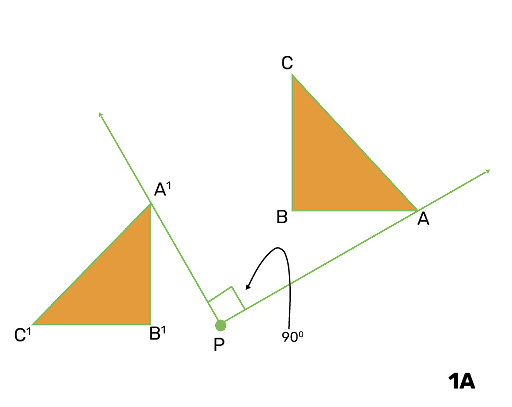
In other words, a rotation is a shape that is described by the direction of the turn, the angle of rotation, and the center of rotation, which is a point around which a shape rotates. Each point in the shape must remain at the same distance from the rotational axis.
Rotations in the Coordinate Plane
[Click Here for Sample Questions]
Unless otherwise noted, rotations on the coordinate planes are assumed counterclockwise. Consider the following examples:
Rotation 90 Degree
Draw a counterclockwise rotation of 90 degree centered at the origin, starting with ABC. Assume point B is on the red arrow to 'observe' that this rotation is 90 degrees. The arrow is then rotated 90 degrees (identify the 90 angles shown by the two red arrows). After then, examine point B's new location, which is denoted by the letter B'. For all three vertices, the same rotation mechanism may be applied.

Rotation 180 Degree
As in the previous case, begin with ABC and draw a counterclockwise 180-degree rotation centered at the origin. Assume, as we did with 90 degrees, that point B is connected to the red arrow from the center marking (0,0). The arrow has now been rotated 180 degrees, making a straight line. Determine the new position of point B, which is denoted by the letter B's.

Rotation 270 Degree
Draw a counterclockwise 270-degree rotation starting with quadrilateral ABCD and centered at the origin. Assume point A is linked to the red arrow from the center, as in the previous two cases (0,0). The arrow has now been rotated counterclockwise by 270 degrees. Take note of the altered location of A, denoted by the letter A'. It's worth noting that A' will be "on" the axis in the same way as A was or is.

From the examples above, we can deduce that rotation refers to an object's circular movement around a center and that objects of various forms can be rotated by an angle around the center. Furthermore, an item can be rotated around an endless number of imaginary lines or rotational axes. The principal rotations are those that revolve around the x, y, and z axes, and they may be conducted around any axis by rotating around the x-axis, then the y-axis, and lastly the z-axis.
Also read: First Order Differential Equation
Rotation Formula
[Click Here for Sample Questions]
Rotation may surely be done in both clockwise and counterclockwise directions. The rotation formula revolves around three common angles: 90, 180, and 270 degrees.
Following these, certain rules for rotation in coordinate planes are:
| Types of Rotation | Point on the Image Before Rotation | Point on the Image After Rotation |
|---|---|---|
| Clockwise Rotation of 90o | (x, y) | (y, -x) |
| Counterclockwise Rotation of 90o | (x, y) | (-y, x) |
| Clockwise Rotation of 180o | (x, y) | (-x, -y) |
| Counterclockwise Rotation of 180o | (x, y) | (-x, -y) |
| Clockwise Rotation of 270o | (x, y) | (-y, x) |
Rotation Matrix
[Click Here for Sample Questions]
A rotation matrix in Euclidean geometry is a matrix that is used to carry out a rotation in a Euclidean space. Let's look at an example of a two-dimensional cartesian plane method, in which the matrix R rotates the points in the XY plane counterclockwise by an angle around the origin. The matrix R will be given in this example by:
R = cosθ − sinθ
sinθ cosθ
The location of every point in the plane is given by a column vector "v," which contains the coordinate point when employing the rotation matrix R to accomplish the rotation. Finally, by multiplying matrix Rv, the rotated vector may be obtained.
Rotational Symmetry
[Click Here for Sample Questions]
Many forms in geometry, such as circles, rectangles, and squares, exhibit rotational symmetry. In addition, we may state that all regular polygons are accessible with rotational symmetry. If a figure appears precisely the same after being rotated about its center, it is said to exhibit rotational symmetry. However, calculating the number of times the objects coincide with themselves while rotating around 360 degrees may be used to compute the order of symmetry.
Also read: Calculus Formula
Things To Remember
- A two-dimensional object revolves around a rotational center (or point). An axis is a line that a three-dimensional object revolves around.
- The body is said to rotate onto itself, or spin, if the axis of rotation is within the body, implying relative speed and maybe free movement with angular momentum.
- A motion that maintains the origin is equivalent to a linear operator on vectors that maintains the same geometric structure but in terms of vectors.
- A Euclidean space's motion is the same as its isometry: following the transformation, the distance between any two points remains unaltered.
Also read: Quadrilateral Formula
Sample Questions
Ques. Find the position of the point K(5, 7) after the rotation of 90°(CCW) using the rotation formula. (3 marks)
Ans. Using the rotation formula,
After rotation of 90°(CCW), coordinates of the point (x, y) becomes: (-y, x)
Hence point K(5, 7) will have the new position at (-7, 5)
Therefore, the coordinates of the image are (-7, 5).
Ques. Find the position of point A, if the coordinates of the images of the point after the rotation of 270°(CW) is (-9, -7), using the rotation formula. (3 marks)
Ans. Using the rotation formula,
After rotation of 270°(CW), coordinates of the point (x, y) becomes: (-y, x)
Hence point A(x, y) will have the new position at (-9, -7) if the point was initially at (7, -9)
Therefore, the coordinates of point A are (7, -9).
Ques. Rotate the following points by 180 degrees: (i) A(3,4) (ii) B(2,-7) (iii) C(-5, -1). (3 marks)
Ans. To find: Rotate the given points by 180 degrees.
Given: A(3,4), B(2.-7), C(-5,-1)
Using formula for 180 degree rotation,
R(x,y) ⇒ R'(-x,-y)
(i). A(3,4) ⇒ A’(-3,-4)
(ii). B(2,-7) ⇒ B’(-2,7)
(iii).C(-5,-1) ⇒ C’(5,1)
A’(-3,-4), B’(-2,7), and C’(5,1) are the 180 degrees rotated points of A(3,4), B(2.-7), and C(-5,-1)
Ques. Rotate a line AB having ends as A(4,5) and B(-1,2) by 180 degrees. To find: Rotate a line AB by 180 degrees. (3 marks)
Ans. Given
Line AB, A(4,5), B(-1,2)
Using the formula for 180-degree rotation,
R(x,y) ⇒ R'(-x,-y)
For A(4,5) ⇒ A’(-4,-5)
For B(-1,2) ⇒ B’(1,-2)
The coordinates of the new line A’B’ is A’(-4,-5) and B’(1,-2)
Ques. A point A(1, 3) is translated 4 units to the right. What are the coordinates of the transformed image? (3 marks)
Ans. Let A be the preimage.
A' be the image.
If the pre-image is to be moved right, then the x-coordinate undergoes a change of 4 units.
A→ A' = (1,3)→ ((1+4),3)
A → A' = (1,3) → (5,3)
The coordinates of the transformed image = (5,3)
Ques. What do the following transformations do to the graph? (3 marks)
(i) f(x) → f(x) - 2
(ii) f(x) → f(x-2)
Ans. f(x) → f(x) - 2
The y-coordinate undergoes the change.
Thus, the transformation here is translation 2 units down.
f(x) → f(x-2)
The x-coordinate undergoes the change.
Thus, the transformation here is translation 2 units right.
i) Translation is 2 units down ii)Translation is 2 units right.
Ques. After rotating by 60° about a center, a figure looks exactly the same as its original position. At what other angles will this happen for the figure? (2 marks)
Ans. 120°, 180°, 240°, 300°, and 360° are the other angles.
As a result, the figure has rotational symmetry at the same angle as the first. As a result, when the figure is rotated 60 degrees from its previous location, it will seem precisely the same.
Also Read:



Comments