



Content Curator
Rotation is the field of mathematics and physics. It is based on rotation or motion of objects around the centre of the axis. In real life, earth rotates around its own axis and also revolves around the sun. Rotation is based on the formulas of rotation and degree of rotation. Rotations in terms of degrees are called degree of rotations. These formulas are based on four quadrants and four degrees of reactions 90, 180, 270 and 360 degrees of rotations either clockwise or counter/counter clockwise.
| Table of Content |
Key Takeaways: Rotation, centre of axis, degree of rotation, quadrants, clockwise, counter clockwise.
Rotation Formula
[Click Here for Sample Questions]
In geometry, rotation is a change in orientation. Rotation does not change in size or not reflect. We are going to reference two directions for rotation: clockwise and counterclockwise.
Rotation is either clockwise or counter clockwise direction. The common degrees of rotations are 90, 180, 270 and 360 degrees. The rules for rotations of these angles are different. The rules (x, y) are as follows.
| Rotation angle | Points coordinates (x,y) | Points coordinates (After rotation) |
|---|---|---|
| 90o Clockwise | (x,y) | ( y , -x ) |
| 90oCounterclockwise | (x,y) | ( -y , x ) |
| 180o Clockwise | (x,y) | ( -x , -y ) |
| 180o Counterclockwise | (x,y) | ( -x , -y ) |
| 270o Clockwise | (x,y) | ( -y , x ) |
| 270o Counterclockwise | (x,y) | ( y , -x ) |
| 360o Clockwise | (x,y) | ( x , y ) |
| 360o Counterclockwise | (x,y) | ( -x , -y ) |
Quadrants
[Click Here for Sample Questions]
Rotation rules are based on quadrants. There are a total of four quadrants. In the first quadrant, signs are always (positive, positive). In the second quadrant (negative, positive). In the third quadrant (negative, negative) and in the fourth quadrant (positive, negative). The coordinates are (x,y) it means sign of x – ordinates placed first i.e. In the third quadrant x ordinates are negative and y is also negative, it would be mentioned like (-x, -y) x-axis of the third quadrant is negative.
| Quadrant (s) | x and y ordinates |
|---|---|
| 1 | ( + x , + y ) |
| 2 | ( -x , +y ) |
| 3 | ( -x ,-y ) |
| 4 | ( + x , -y ) |

Suppose we take x = 3 and y = 4
First quadrant- (3, 4)
Second quadrant (-3, 4)
Third quadrant ( -3, -4 )
Fourth quadrant (3, -4 )
Also Read:
Rotation Symmetry
[Click Here for Sample Questions]
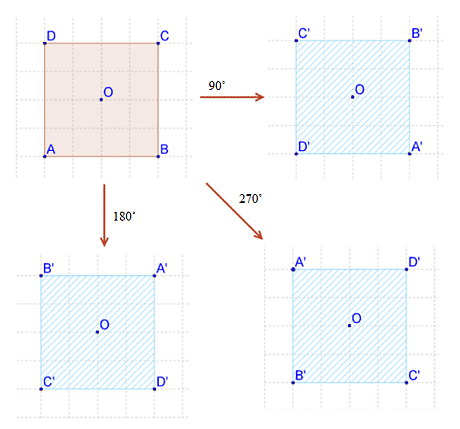
Rotation symmetry exists only when rotation of shape is less than 360?
The following example is about square, and its rotation is counterclockwise (or clockwise) 90?, 180? and 270? respectively.
Difference between Rotation and revolution
[Click Here for Sample Questions]
In rotation, an object spinning motion in its own axis. In revolution, orbital motion takes place around another object. Ex. Earth revolves around the sun.

Rotation of Matrix
[Click Here for Sample Questions]
The rotation matrix is use to calculate the coordinates of a point when applying a 2D rotation of a set angle θ
Here is the 2D rotation matrix
[x' y' ] = Cosθ -Sinθ Sinθ Cosθ [x y ]
The multiplication of matrix technique is use to solve the problems
The following two equations results x and y are the Cartesian coordinates of a point before applying the rotation. After applying the rotation the Cartesian coordinates will be x’ and y’, θ is the angle of rotation. The values with signs either negative or positive of x and y also determine the quadrants.
x’ = x. cosθ – y. sinθ
y’ = x.sinθ + y.cosθ
Points to Remember
Following are some important points:
- The rotation 90? for Clockwise is (y , -x) and Counterclockwise is (-y , x ).
- The rotation of 180? for Clockwise and counterclockwise notations are the same which is ( -x, -y ).
- The rotation of 270? for Clockwise is ( -y , x ) and Counter clockwise is ( y, -x ).
- The rotation of 360? for Clockwise is (x,y) and Counter clockwise is (-x , -y ).
- The 2D rotation matrix is [x' y' ] = Cosθ -Sinθ Sinθ Cosθ [x y ]
Sample Questions
Ques: Rotate the following figure 90? clockwise about the origin. (3 Marks)
Ans:

A (2, -1), B (4,-3), C (2, -4)
90? clockwise (x, y) = (y, -x)
A’ (-1, -2) , B’ (-3,-4) , C’ (-4 , -1)
New location will be:


Ques: Rotate the following figure 180? clockwise about the origin. (3 Marks)
Ans:

A (2, -1), B (4,-3), C (2, -4)
180? clockwise (x, y) = ( -x , -y )
A’ ( -2 , 1 ) , B’ (-4 , 3 ) , C’ (-2 , 4)

Ques: Rotate the following figure 90? clockwise about the point (-1 , 2 ). (3 Marks)
Ans:

Let us consider P ( -1, 2)
P (-1, 2) is our origin and we have to rotate the triangle with respect to P

The new coordinates of triangle with respect to P

With respect to P
P is the origin now (0 , 0)
A (2 , -1)
B (3 ,1)
C (4, -2)
90? clockwise means (x, y) = (y, -x)
A’ (-1 , -2)
B’ (1 , -3)
C’ (-2, -4)

Ques: Figure B (2, -1) , A (5, -3 ) , D (1, -4) rotated 90? counterclockwise around the point C (1,1). (3 Marks)
Ans:

Draw the fake XY axis from C (1,1)
The new coordinates of triangle BAD will be
B (1, -2)
A (4, -4)
D (0, -5)
90? counterclockwise means
( x , y) = (-y , x)
B’ (2,1)
A’ (4,4)
D’ (5,0)

Ques: Figure B (2, -1) , A (5, -3 ) , D (1, -4) rotated 270? counterclockwise around the point C (1,1). (3 Marks)
Ans:

Draw the fake XY axis from C (1,1).
The new coordinates of triangle BAD will be:
B (1, -2)
A (4, -4)
D (0, -5)
270? counterclockwise means
(x , y) = (y , -x)
B’ (-2 , -1)
A’ (-4 , -4)
D’ (-5 , 0)

Ques: Figure S (1,4) , Q (3,2) , U (6,5) , A (4,7) rotated 180? counterclockwise around the point C (0,1). (3 Marks)
Ans: 180? counterclockwise
(x , y) = (-x, -y)
A new co ordinates will be according to origin C (0,1)
S (1 , 3) U (6 , 4)
Q (3 , 1) A (4 , 6)

A new coordinates after counterclockwise rotation of 180?
S’ (-1,-3)
Q’ (-3,-1)
U’ (-6, -4)
A’ (-4, -6)

Ques: Figure S (1,4) , Q (3,2) , U (6,5) , A (4,7) rotated 270? counterclockwise around the point C (0,1).(3 Marks)
Ans: 270? counterclockwise
( x , y) = ( y, -x )
A new co ordinates will be according to origin C (0,1)
S (1 , 3) U (6 , 4)
Q (3 , 1) A (4 , 6)
A new coordinates after counterclockwise rotation of 180?
A new coordinates after counterclockwise rotation of 180?

A new coordinates after counterclockwise rotation of 270?
S’ ( 3,-1)
Q’ (1, -3)
U’ (4, -6)
A’ (6, -4)

Ques: Take the point (2,1) and rotate counter clockwise by 90? or ?/2. (3 Marks)
Ans: [x' y' ] = Cosθ -Sinθ Sinθ Cosθ [x y ]
[x' y' ] = Cos90 -Sin90 Sin90 Cos90 [2 1 ]
[x' y' ] = 0 -1 1 0 [2 1 ]
By using matrix multiplication we get
[-1 2 ]
The x is negative and y is positive t.e. points lie in the second quadrant.
Ques: What is the rotation? What is the importance of it? (2 Marks)
Ans: Rotation is the field of mathematics and physics. It is based on rotation of objects around the center of the axis. In real life, the earth rotates around its own axis and also revolves around the sun. Rotation is based on the formulas of rotation and degree of rotation. Rotations in terms of degrees are called degrees of rotations. Rotation is either clockwise or counter clockwise direction. The common degrees of rotations are 90, 180, 270 and 360 degrees. The rules for rotations of these angles are different.
Ques: If x=3 and y= 4 , what are the points after rotation of 90? clockwise and counterclockwise? (2 Marks)
Ans: The rules for 90 degree clockwise and counterclockwise:
| Clockwise | (x,y) | ( y , -x ) |
| Counter clockwise | (x,y) | ( -y , x ) |
Clockwise = (4, -3)
Counter clockwise = (-4, 3)
Also Read:



Comments