



Education Journalist | Study Abroad Lead
Rotational Inertia can be defined as the property of any object/anything that can be rotated. Rotational Inertia can be described as a scalar value that indicates how difficult it is to adjust an object's rotational velocity around a specific rotational axis. It is used to calculate angular momentum and to explain how rotational changes as the mass distribution shifts motion. Torque must be supplied to a body that is free to rotate around an axis in order to modify its angular momentum. The moment of inertia of the body is proportional to the amount of torque required to induce any given angular acceleration (rate of change in angular velocity).
| Table of Content |
Key Terms: Rotational Inertia, Moment of Inertia, Torque, Rotation, Axis, Angular Momentum, Rotational Motion, Axis of Rotation, Acceleration, Velocity
What is Rotational Inertia?
[Click Here for Sample Questions]
Rotational Inertia can be defined as the property of any object which can rotate along some axis. The rotational inertia of an extended rigid body is just the total of all the little pieces of mass multiplied by the square of their distances from the rotating axis. This summation can provide a simple formula that depends on the dimensions, shape, and total mass of an extended body with a regular shape and homogeneous density.
The moment of inertia, in rotational kinetics, serves the same purpose as mass (inertia) in linear kinetics, both describe a body's resistance to changes in motion. The rotational inertia is determined by how mass is distributed around a rotating axis, and it varies depending on the axis used. The rotational inertia about some axis for a point-like mass is given by mr2, where r is the distance between the point and the axis and m is the mass.
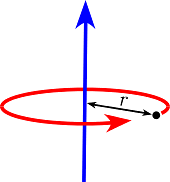
Rotational Inertia
Read More: Relation between Moment of Inertia and Torque
Rotational Inertia Formula
[Click Here for Sample Questions]
It is expressed as I = m × r2
where
I = Rotational inertia, m = Sum of the product of the mass, r = Distance from the axis of the rotation.
In linear motion, the role of the moment of inertia, also known as rotational inertia, is the same as the role of mass. It's a measurement of a body's resistance to a change in rotational motion. It is constant for a rigid frame with a defined rotational axis.
Moment of inertia, I = ∑mi ri2. . . . . (1)
Kinetic Energy, K = ½ I ω2 . . . . . . . . (2)
Read More: Rotational Kinetic Energy
Factors Affecting Rotational Inertia
[Click Here for Sample Questions]
The following factors influence the rotational inertia of a body:
- Body mass
- Body size and shape
- Mass distribution around the axis of rotation
- Axis of rotation position and orientation with regard to the body
Calculation of Rotational Inertia
[Click Here for Sample Questions]
Rotational Inertia of a Uniform Rod about a Perpendicular Bisector

Consider a homogeneous rod with mass M and length L, and determine the rotational inertia about the bisector AB. The origin is set to zero.
From the origin, the mass element 'dm' is between x and x + dx.
The mass per unit length (linear mass density) of the rod remains constant since it is uniform.
∴ M/L = dm/dx
dm = (M/L) dx
Moment of inertia of dm,
dI = dm x2
dI = (M/L) x2.dx

Read More: Angular Displacement
Things to Remember
- The rotational inertia of an object is a determining metric for a rigid body rotating around a fixed axis. It determines how difficult it would be to modify the rotational speed of an object.
- It can be determined by how mass is distributed around a rotating axis, and it varies depending on the axis used.
- The rotational inertia about some axis for a point-like mass is given by mr2, where r is the distance between the point and the axis and m is the mass.
- Thus, I = m * r2 is the formula for rotational inertia.
- The factors that influence the rotational inertia of a body are body mass, body size and shape, mass distribution around the axis of rotation and axis of rotation position and orientation with regard to the body.
Sample Questions
Ques. Calculate the rotational inertia of a 20 kg item revolving around a 7m radius circular path. (3 Marks)
Ans. Here, m = 20 kg, r = 7 m
Rotational inertia Formula is I = mr²
= 20 ×times 7²
= 980 kg m²
Ques. A 3 kg item is revolving in a circular direction. It has rotating inertia of 300 kg per square metre. Calculate the circular path's radius.(3 Marks)
Ans. Here, m = 3kg, I = 300 kg m2
So, Rotational inertia Formula: I = mr2
Now, by rearranging the formula to compute the radius of the path,
r = √I/M
r = √300/3
2 = √100
r =10m.
Ques. Each ball weighs 200 g and is attached by a rope. The cord measures 80 centimetres in length and 40 centimetres in width. What is the moment of inertia of the balls about the rotation axis (ignoring the mass of the cord)? (5 Marks)

Ans. Mass of ball = m1 = m2 = m3 = m4 = 200 gram = 0.2kg
Distance between first ball and the axis of rotation (r1) = 40cm = 0.4 m
Distance between second ball and the axis of rotation (r2) = 40 cm = 0.4 m
Distance between third ball and the axis of rotation (r3) = 40 cm = 0.4 m
Distance between fourth ball and the axis of rotation (r4) = 40 cm = 0.4 m
I = m1 r12 + m2 r22 + m3 r32 + m4 r42
I = (0.2) × (0.4)2 + (0.2) × (0.4)2 + (0.2) × (0.4)2 + (0.2) × (0.4)2
I = 0.032 + 0.032 + 0.032 + 0.032
I = 0.128 kg m2
The rotational inertia of the balls about the axis is o.128 kg m2
Ques. Two balls are connected by a rod as shown in the figure below (Ignore rod’s mass). Find the rotational inertia (3 Marks)

Ans. mX = 300 grams = 0.3 kg
mY = 500 grams = 0.5 kg
rX = 0cm = 0m
rY = 30cm = 0.3m
Solution:
I = mX rX2 + mY rY2
I = (0.3)× (0)2 + (0.5)× (0.3)2
I = 0 + 0.045
I = 0.045 kg m2
Thus, the moment of inertia of the system is 0.045kg m2
Ques. Describe the physical importance of Rotational Inertia. (5 Marks)
Ans. The physical relevance of a body's Rotational Inertia about an axis is the distribution of the body's mass in space around the axis. The moment of inertia is proportional to the amount of mass concentrated away from the axis. Take, for example, a baseball team. When you rotate it by gripping the handle, you must exert more effort than if you rotate it by holding the hitting end.
In rotating motion, the rotational inertia serves the same purpose as mass does in translational motion. Because it performs a similar role in rotational motion as mass does in translational motion, the moment of inertia in rotational motion is comparable to mass in translational motion.
Ques. Determine the moment of inertia of a sphere about a tangent to the sphere, given that the moment of inertia of the sphere about any of its diameters is 2 MR2/5, where M is the sphere's mass and R is its radius. (3 Marks)
Ans. As per the theorem of parallel axes, the moment of inertia of a body about any axis is equal to the sum of the moment of inertia of the body about a parallel axis passing through its centre of mass and the product of its mass and the square of the distance between the two parallel axes.
Moment of Inertia about a tangent of the sphere =2MR2 /5+MR2 =7MR2/5
Ques. Find the moment of inertia about an axis normal to the disc passing through a point on its edge, given the moment of inertia of a disc of mass M and radius R about any of its diameters to be 1/4 MR2. (3 Marks)
Ans. Moment of inertia of the disc about any of its diameters = 1/4 MR2
Using the theorem of perpendicular axes, a moment of inertia of the disc passing through a point = 2 x 1/4 MR2 = 1/2 MR2
Using theorem axes, the disc's moment of inertia while passing through a location on its edge that is normal to the dies = 1/2 MR2+ MR2 = 3/2 MR2
Ques. Discuss three practical examples of the moment of inertia. (3 Marks)
Ans. Here are the practical examples of the moment of inertia:
- The flywheel of an automobile is a large mass positioned on the engine's crankshaft. The MOI of the flywheel is extremely high, which aids in energy storage.
- When compared to a solid shaft, a hollow shaft transmits greater power (both of the same mass). When compared to a solid shaft, the hollow shaft has a higher MOI.
- The moment of inertia has a significant impact on shipbuilding. A ship can sink if it rolls, but it will never sink if it pitches.
Ques. Many molecules have a dumbbell-shaped diatomic structure. Find the rotational inertia along four axes. The bodies are treated as point particles with masses m1 and m2 of 3 kg and 5 kg, respectively. In the diagram, d1 equals 1 m and d2 equals 2 m. (3 Marks)

Ans. Here is the solution:
Axis A: IA = m1d12 + m2d22 = (3 kg)(1 m)2 + (5 kg)(2m)2 = 23 kgm2
Axis B: IB = m1(0) + m2(d1 + d2)2 = 45 kg m2
Axis C: IC = m1(d1 + d2)2 + m2(0) = 27 kg m2
Axis D: ID = 0
Because we considered the masses as point particles, so ID is zero, and perpendicular distances are also zero.
Ques. As illustrated in the image, four-point masses are located at the corners of a rectangle with sides measuring 3 m and 4 m. Calculate the moment of inertia for each diagonal. Assume M is 1 Kg. (3 Marks)

Ans. We require the perpendicular distance between each mass and the axis for each mass. Two masses do not contribute to the moment of inertia for each axis. The other two are around the same distance apart.
3 sin53o = 2.4 m
IA = (4 kg)(2.4 m)2 + (2 kg)(2.4 m)2 = 34.6 kg m2
IB = (1 kg)(2.4 m)2 + (3 kg)(2.4 m)2 = 23. 0 kg m2
Also Read:



Comments