



Education Journalist | Study Abroad Lead
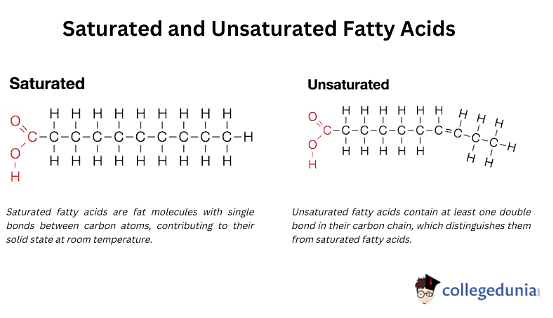
Saturated fatty acids (SFAs) are a type of fat characterized by single bonds between all the carbon atoms in their fatty acid chains.
- This "saturation" with hydrogen atoms gives them a straight, rigid structure.
- SFAs, unlike UFAs (unsaturated fatty acids) with double bonds, are solid at room temperature due to the absence of double bonds, which prevents kinks in the chain.
- Found in animal fats, processed foods, and certain plant oils like coconut and palm kernel oils.
- Excessive consumption of saturated fats can increase LDL cholesterol levels and contribute to heart disease.
- Plant and fish fats, known as unsaturated fats, are healthier alternatives to saturated fats.
Download PDF: Saturated Fatty Acids Frequently Asked Questions
Saturated Fatty Acids
Sources of Saturated Fatty Acids
Saturated fats are found naturally in various animal-based foods, including:
- Saturated fats are abundant in animal products such as beef, pork, lamb, poultry with skin, and fatty cuts of meat.
- Whole milk, cheese, butter, cream, and full-fat yoghurt are rich sources of saturated fats.
- Many processed and packaged foods contain high levels of saturated fats, including fast food, fried foods, pastries, cakes, cookies, and commercially baked goods.
- Coconut oil and palm oil are plant-based sources of saturated fats commonly used in cooking and food processing.
- Rendered animal fats like lard (from pork) and tallow (from beef).
- Sausages, hot dogs, bacon, and other processed meats.
- While most plant oils are unsaturated, some, like cocoa butter and shea butter, contain high levels of saturated fats.
Functions of Saturated Fatty Acids
SFAs play various roles in the body, including:
- They serve as a concentrated source of energy in the body, providing more energy per gram compared to carbohydrates and proteins.
- They contribute to the structure and stability of cell membranes.
- They are involved in the production of certain hormones, including steroid hormones like testosterone, estrogen, and cortisol.
- Saturated fats help to insulate and protect vital organs in the body by forming a layer of adipose tissue.
- Saturated fats aid in the absorption of fat-soluble vitamins such as vitamins A, D, E, and K, important for various physiological processes.
- Saturated fats contribute to the flavour, texture, and mouthfeel of foods, enhancing their palatability and satiety.

Functions of Saturated Fatty Acids
Examples of Saturated Fatty Acids
| Common Name | Sources | Number of Carbon Atoms |
|---|---|---|
| Butyric acid | Butter, cheese, milk | 4 |
| Caproic acid | Milk, coconut oil | 6 |
| Capric acid | Coconut oil, palm kernel oil | 10 |
| Lauric acid | Coconut oil, palm kernel oil | 12 |
| Myristic acid | Dairy products, meat | 14 |
| Palmitic acid | Meat, dairy products, plant-based oils like palm oil | 16 |
Health Implications of Saturated Fatty Acids - Associated Diseases
The relationship between Saturated Fatty Acids and health is complex.
- Moderate intake: While some studies suggest potential benefits like supporting cell function and hormone production, it's recommended to consume SFAs in moderation as part of a balanced diet.
- Excessive intake: Excessive consumption of SFAs, particularly from animal sources, has been linked to an increased risk of health issues like:
- Heart disease
- Stroke
- Type 2 diabetes
- Certain types of cancer
| Health Concern | Description |
|---|---|
| Cardiovascular Disease | - High intake linked to increased risk. - WHO recommends less than 10% of daily calories from saturated fats. - Replacing saturated fats with unsaturated fats may reduce risk. |
| Dyslipidemia | - Caused by high saturated fat intake.- Involves abnormal blood lipid levels, including: - High total cholesterol - High triglycerides - Low HDL (good cholesterol)- High LDL (bad cholesterol) - Increases risk of heart disease and stroke. |
| Cancer | - Studies suggest a link between high saturated fat consumption and Breast cancer and Prostate cancer |
Saturated fatty acids are a type of fat present in both animal and some plant-based foods. They play various roles in the body, but it's crucial to consume them in moderation as part of a healthy dietary pattern.
Things to Remember
- Saturated fatty acids (SFAs) lack double bonds between carbon atoms in their hydrocarbon chains.
- SFAs are typically solid at room temperature due to their molecular structure.
- Common dietary sources include animal fats like butter, cheese, and fatty meats, as well as certain plant oils like coconut oil and palm oil.
- High intake of SFAs is associated with an increased risk of cardiovascular diseases, dyslipidemia, and certain cancers.
- SFAs can raise levels of total cholesterol, LDL (bad) cholesterol, and triglycerides, contributing to atherosclerosis and heart disease.
- World Health Organization (WHO) advises limiting SFAs to less than 10% of daily caloric intake to reduce the risk of chronic diseases.
- SFAs are often used in food processing due to their stability and longer shelf life, but excessive consumption should be avoided for health reasons.
Sample Questions
Ques. Why are Saturated Fatty Acids solid at room temperature? (5 marks)
Ans. Saturated fatty acids (SFAs) are solid at room temperature due to their chemical structure and how their molecules interact with each other.
- SFA molecules have single bonds between all the carbon atoms in their chains.
This results in a straight and rigid structure compared to unsaturated fatty acids (UFAs) which have at least one double bond, causing kinks in the chain.
- Intermolecular forces
The straight structure of SFAs allows them to pack closely together. This close packing facilitates stronger intermolecular forces between individual molecules. These forces, primarily van der Waals forces, act like weak attractions, holding the individual SFA molecules tightly together.
The rigid structure and stronger intermolecular forces due to the absence of double bonds are the key reasons why saturated fatty acids are solid at room temperature.
Ques. What are the health effects of consuming too much-saturated fat? (3 marks)
Ans. Excessive consumption of saturated fat has been linked to several health concerns, including:
- Increased risk of cardiovascular disease: This includes high blood pressure, heart disease, and stroke.
- Dyslipidemia: This refers to abnormal blood lipid levels, including high total cholesterol, triglycerides, and LDL (bad cholesterol), and low HDL (good cholesterol).
- Increased risk of certain cancers: Some studies suggest a possible link between high saturated fat intake and breast and prostate cancer.
Ques. What are some healthier alternatives to saturated fats? (5 marks)
Ans. Healthier alternatives to saturated fats include:
- Unsaturated fats: These fats can be found in foods like avocados, nuts, seeds, and olive oil. They are known to help lower bad cholesterol levels and reduce the risk of heart disease when consumed in moderation.
- Omega-3 fatty acids: Found in fatty fish such as salmon, mackerel, and trout, as well as in flaxseeds, chia seeds, and walnuts, omega-3 fatty acids are beneficial for heart health and can help lower triglyceride levels.
- Plant-based oils: Opt for oils such as canola, soybean, and sunflower oil, which are high in monounsaturated and polyunsaturated fats. These oils can be used for cooking, baking, and salad dressings.
- Lean proteins: Choose lean sources of protein like poultry without the skin, fish, beans, and legumes instead of fatty cuts of meat and processed meats, which are high in saturated fats.
- Low-fat dairy: Select low-fat or fat-free dairy products such as skim milk, low-fat yogurt, and reduced-fat cheese to reduce saturated fat intake while still getting essential nutrients like calcium and vitamin D.
Ques. Are all saturated fats created equal? (3 marks)
Ans. No, not all saturated fats are created equal in terms of their potential health impact.
- There are various types of SFAs, categorized based on their chain length (number of carbon atoms).
- Some studies suggest that medium-chain triglycerides (MCTs), found in coconut oil, might have different effects compared to long-chain triglycerides (LCTs) typically found in animal sources.
Ques. What is the difference between saturated and unsaturated fat? (5 marks)
Ans. The differences between saturated and unsaturated fats are as follows -
| Saturated Fat | Unsaturated Fat |
|---|---|
| Contains only single bonds between carbon atoms | Contains one or more double bonds between carbons |
| Solid state at room temperature. | Liquid state at room temperature. |
| Animal products like butter, meat, and dairy | Plant-based oils like olive oil, avocado, and nuts |
| Can increase LDL ("bad") cholesterol levels | Can lower LDL cholesterol levels |
| Associated with higher risk of heart disease | Associated with lower risk of heart disease |
| Straight chain | Bent or kinked chain |
| Limit intake to reduce the risk of cardiovascular disease | Encouraged as part of a healthy diet |
| Butter, lard, cheese, fatty meats | Olive oil, avocado, nuts, seeds |
Ques. Which is better saturated and unsaturated fats? (1 mark)
Ans. Unsaturated fats are generally considered better for health compared to saturated fats due to their association with lower LDL cholesterol levels and reduced risk of heart disease.
Ques. Is ghee saturated or unsaturated? (1 mark)
Ans. Ghee is primarily composed of saturated fats, although it also contains small amounts of unsaturated fats. Therefore, it is classified as a saturated fat.
Ques. What are the dietary sources of Saturated Fatty Acids? (3 marks)
Ans. Dietary sources of saturated fatty acids include
- Animal products such as fatty cuts of meat, poultry with skin, and high-fat dairy products like cheese, butter, and cream.
- Processed foods like pastries, cookies, cakes, and fried foods often contain saturated fats from sources like palm oil and coconut oil.
- Certain plant-based sources like coconut oil, palm oil, and cocoa butter also contain saturated fats, although they may also have other types of fats.
Check-Out:
| Biology Study Guides | ||
|---|---|---|
| Biology MCQs | Comparison Topics in Biology | Biology Study Notes |



Comments