



Content Curator
Brown tree snakes are slender, minimally poisonous, mostly arboreal snakes belonging to the Colubridae family, which is regarded as one of the world's most aggressive invasive species. The brown tree snake is endemic to the islands west of Wallace's Line, New Guinea, and Australia's northern and eastern coastlines. However, its geographic range has increased, and it now includes Guam, Saipan, and other western Pacific islands.
| Table of Content |
Key Takeaways: Brown Tree Snake, Biodiversity, Binomial Nomenclature, Scientific Name, Taxonomy, Animalia, Species
Nomenclature of Brown Tree Snake
[Click Here for Sample Questions]
Nomenclature is a standard system of assigning names to living organisms such that they are known by the same name all over the world. Nomenclature or naming is only feasible when the organism is accurately defined, and the name is assigned to the correct organism. This is what we call identification. Binomial nomenclature is a system for naming species using Latin forms. Binomial nomenclature, or binomen, is another term for a scientific name. There are two terms in this phrase: species and genus name.
Boiga irregularis is the scientific name for the brown tree snake.
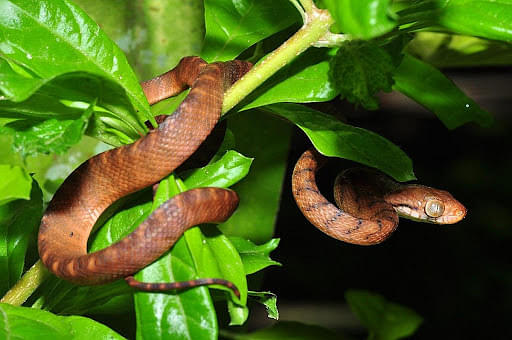
Brown Tree Snake
Taxonomy Categorisation of Brown Tree Snake
The taxonomy categorisation of brown tree snake is as follows.
Also Read:
Distinctive Features of Brown Tree Snake
The brown tree snake has a variety of distinguishing characteristics, which are listed below.
- The snake's head is larger than its body, and each of its enormous eyes has a huge vertical pupil that opens wide at night to aid hunting.
- It can climb trees, vines, and rocks and conceal them in tight areas because of its long, thin body. Because it is an excellent climber, it may readily relocate to new locations.
- Brown tree snakes are ferocious scavengers and predators with few natural adversaries. It can also survive for several months without eating anything.
- On the body, markings appear as a black pattern on a brownish-yellow background but certain Australian populations have blue or red bands on a white background.
Things of Remember
- Brown tree snakes are also known as brown cat snakes or culepla. Their scientific name is Boiga irregularis.
- Brown Tree Snakes are members of the Colubridae family, which includes other snakes such as boomslangs. Australia, Papua New Guinea, and Indonesia are home to the snake.
- When compared to other snakes, brown tree snakes climb trees in a unique way. It wriggles and wraps its tail around the tree to force itself forward.
- The fangs of the brown tree snake are located near the back of its mouth. Because of this, the snake will have a tough time envenoming a human.
- Furthermore, adult humans are unaffected by the poison, rendering the species harmless. On the other hand, children are believed to be more vulnerable to its venom due to their smaller body mass.
Also Read:
Sample Questions
Ques: What are brown tree snakes? (2 marks)
Ans: Brown tree snakes which are also known as catsnake or culepla is a slender looking snake. They are not very venomous and mostly arboreal snakes belonging to the Colubridae family, which is regarded as one of the world's most aggressive invasive species. The brown tree snake is endemic to the islands west of Wallace's Line, New Guinea, and Australia's northern and eastern coastlines. However, its geographic range has increased, and it now includes Guam, Saipan, and other western Pacific islands.
Ques. What is the reproduction procedure of a brown tree snake?(2 marks)
Ans. It is said that brown tree snakes reproduce by laying eggs throughout the year whereas others believe that reproduction may take place only in the colder seasons of the year. In many cases reproduction does not take place soon after mating as these snakes can store the sperm upto several years until it's time. The eggs may be laid in a dark and humid area to avoid drying such as a cave, between rocks, holes, etc. The eggs are between 42 to 47 mm long and 18 to 22 mm wide. When it's time, the outer leathery covering of the shell hardens and cracks open to allow the baby snakes to come out.
Ques. How does the brown tree snake prey? (2 marks)
Ans. The snakes wrap the victim’s body with its own and bites and hold on to the victim until it is immobilized. The snake then starts chewing the victim and injects venom through grooved teeth present at the back of its mouth. The venom is said to be mild and less effective on mammals rather than on vertebrates.
Ques. What are the animals that the brown tree snakes prey on?(2 marks)
Ans. The brown tree snakes are recorded to prey on quite a number of small animals. The small brown tree snakes prey on small birds, amphibians, small lizards and other types of smaller reptiles whereas the matured brown tree snakes prey on bigger birds and lizards along with small mammals such as bats and rodents.
Ques: List the universal nomenclature rules. (4 marks)
Ans: The following are some more universal nomenclature rules:
- Biological names are usually written in italics and written in Latin. Regardless of their origin, they are Latinized or derived from Latin.
- In a biological name, the first component identifies the genus, whereas the second component specifies the specific epithet.
- Of handwriting, both words in a biological name are highlighted or typed in italics to reflect their Latin origin.
- The genus name begins with a capital letter, but the epithet begins with a tiny letter. The example of Boiga irregularis.
Ques: What exactly is a taxon? Give a few instances. What exactly is ICBN? (3 marks)
Ans: A taxon is a collection of organisms at any level of the hierarchical categorization system with certain common traits. For example, all insects belong to the phylum Arthropoda. Kingdom, phylum, class, order, family, and genus come under taxa.
The International Code of Botanical Naming (ICBN) is a collection of regulations used in plant nomenclature that are mostly based on international standards. Carl Linnaeus, a Swedish botanist, and biologist proposed these guidelines.
Ques: What are the benefits of giving organisms scientific names? (2 marks)
Ans: The following are some of the benefits of giving organisms scientific names:
- Scientific names are recognised throughout the globe since they are founded on universal principles.
- A scientific name has an advantage in terms of relationship and comparability to other names.
Ques: How does a scientist go about identifying, nomenclature, and classifying a plant that he believes to be a new species? (2 marks)
Ans: A new plant species can be discovered using taxonomic keys, monographs, herbaria, and conserved plant specimens. The plant's morphological and anatomical structures are examined, and its distinguishing characteristics are compared to similar information found in the scientific literature. The plant's systematic location is then determined, and it is named using binomial nomenclature standards.
Ques: What is the Binomial nomenclature system? Who was the one who proposed this system? Why is binomial nomenclature the preferred system for naming organisms? (4 marks)
Ans: The binomial system of nomenclature refers to assigning names to plants, and animals using their generic, and their species names. Carolus Linnaeus developed this scientific technique for naming species. He named a species with two names, generic name, and specific name.
Binomial nomenclature is internationally recognised all over the globe since it is written according to international nomenclature guidelines specified by the ICBN, ICZN, and ICNPC, among others. It is separated into two sections: generic and species names, each preceded by the scientist's shortened name which is Latin or Latin-derived.
It must be a binomial equation. The genus is preceded by capital letters, whereas the species is preceded by tiny letters. The highlighted handwritten name shows a link with other species in the same genus.
Ques: What is the purpose of classifying living organisms? (2 marks)
Ans: There are many diverse types of life, each with its shape, size, and colour. Biological diversity refers to the variety of life which exists in the natural world. The evolution and development of adaptations to overcome competition among living forms owing to limited resources lead to a variety.
Ques: How do you write the right order of taxonomic categories? (2 marks)
Answer: The correct sequence of taxonomic categories is
Species——> Genus——> Family——> Order——> Class——> Phylum——>Kingdom



Comments