



Content Curator
Genus comprises a group of related species and it has more characters in common when compared to species of other genera. The genera are a family of closely related species. To understand this let's take an example. Potato and Brinjal are two different species but they belong to the same genus i.e. Solanum. There is a universal rule of nomenclature which has to be followed where the first word denoting the Genus starts with a capital letter whereas the specific epithet always starts with a small letter.
Also Read: Living Organisms
| Table of Content |
Key Takeaways: Biodiversity, Taxonomy, Genus, Species
Diversity in the Living World
[Click Here for Sample Questions]
The world consists of various types of living organisms whether it is plants, birds, insects, animals, or any other creature. In simple terms, we can say that there is diversity in the living World. We can be able to see the much greater number and all kinds of living organisms in nature. Every organism possesses different species. The number of species and their described range between 1.7-1.8 million. This is called biodiversity or the number and types of organisms present on earth.

Earthquake
So many scientists have followed the procedures of assigning a scientific name to each known organism. Each organism should be called by its particular name according to its characteristics. Carolus Linnaeus was the first scientist who applied the naming system.
Also Read:
Classification
[Click Here for Sample Questions]
The scientific name always contains two components. They are as follows.
- Generic name
- Specific Epithet
This system of providing a name with two components is called binomial nomenclature. Now moving towards the process of classification. As it is impossible to study all the living organisms so it is necessary to classify them in groups to make it easier to study.

Binomial Nomenclature
Classification is the process of dividing an organism into convenient categories based on observable characteristics. Let's understand this with an example- we easily recognize the groups of living organisms like plants, animals and other organisms. This is because whenever we use these terms our mind associates certain characters related to them.
Read More: Taxonomic Hierarchy of Plants and Animals
Based on these characteristics, they are divided into different taxa. The process is called taxonomy.
Classification includes a hierarchy of steps in which each step represents a rank. Each category is a unit of classification. They are termed taxon.
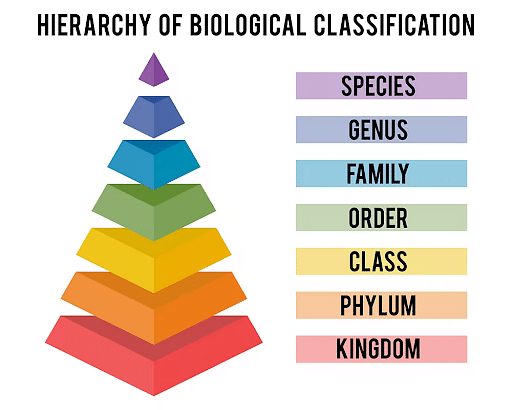
Taxonomic categories showing the hierarchical arrangement
Also Read:
Genus
[Click Here for Sample Questions]
Genus can be defined as the group of related species having more characters in common in comparison to species of other categories. It can be said that genera are aggregates of closely related species. It is important to know the scientific name of an organism because its local names can vary from place to place. In reality, genus is the very first part of the scientific name of the organism. The scientific name consists of two components. The first one is a generic name or genus and the second one is a specific epithet. There are several rules which have to be followed for the scientific name.
-
- The biological name should be written in Latin and italics because they are derived from Latin.
- The first word in the scientific name represents the genus and the second one is a specific epithet.
- The names should be underlined or printed in italics format to indicate their Latin origin.
- The genus name should be always written in capital letters whereas the specific epithet starts with a small letter.
The example for the above is Mangifera indica.

Mangifera indica (Mango)
Also Read:
Things To Remember
-
- Biologists have evolved some particular principles and rules for identification, nomenclature, and the classification of organisms. These processes have made it easy for us to recognize them properly.
- The term nomenclature means the process of giving names to living organisms according to their characteristics and species. This is known as nomenclature. This process is only possible when the organism is properly described.
- The scientific names of plants are provided in (ICBN). The full form is International Code for Botanical Nomenclature.
- The scientific names of animals are provided by (ICZN). The full form is International Code for Zoological Nomenclature.
- The organisms are divided into different categories based on their characteristics including internally and externally. The classification process possesses a hierarchy of steps in which each step represents a category.
Also Read:
Sample Questions
Ques. Why are living organisms classified? (3 Marks)
Ans. There are millions of organisms present all over the world. They are different from each other. We cannot consider the theme at every level. That's why the organisms are classified to identify them properly. This could be only possible when they are classified properly. Biologists have classified living organisms into different kingdoms, phyla, classes, etc. They are classified according to their sizes, colors, habitats, internal and external features.
Ques. What do you mean by classification?(2 Marks)
Ans. Classification is the process of categorizing organisms into convenient groups based on some of the common observable characteristics. The main aim of the process of classification is to avoid confusion regarding the different organisms. As because they are similar or dissimilar in so many ways.
Ques. Who provides the scientific names for plants as well as animals?(2 Marks)
Ans. For the plants, their scientific names are given (ICBN). ICBN stands for International Code for Botanical Nomenclature. They provide it based on some criteria and agreed principles. Whereas the scientific names for animals are being provided by (ICZN) International Code for Zoological Nomenclature.
Ques. What are the two components in the scientific name?(2 Marks)
Ans. The two components in a scientific name are given. The first component is the generic name and the second component is a specific epithet. So these two components together are called binomial nomenclature. The generic name is always written in capital letters whereas the specific epithet is in small letters.
Ques. Give the scientific names of onion, mango, buffalo, dog, rat, wheat, lion, and cat. (3 Marks)
Ans. Onion - Allium separate
Mango - Mangifera indica
Buffalo - Bubalus bubalis
Dog - Canis lupus familiaris
Rat - Rattus rattus
Wheat - Triticum aestivum
Lion - Panthera leo
Cat - Felies catus
Ques. What are the seven hierarchical classifications of taxonomy?(3 Marks)
Ans. The seven classifications of taxonomy are given below.
- Kingdom
- Phylum or Division
- Class
- Order
- Family
- Genus
- Species
Ques. What is the difference between genus and species?(2 Marks)
Ans. Genus is a taxonomic category whereas species are also a part of the taxonomic category. We can say that species are a group of closely related organisms. In this, the organisms are produced by the interbreeding of two organisms of similar characteristics. Whereas we can say that genus are those having various species of closely-related groups. This can be said that they are divided rank by rank in the biological classification.
Ques. What are the advantages of the classification of organisms? (3 Marks)
Ans. There are some important advantages of classifying organisms.
- By this process, we get to know about an organism's species, characteristics, and other important information.
- We can study different types of organisms and their common characteristics.
- The taxonomic classification of organisms shows the interrelationship between different organisms.
- This is a simple way of making concepts about the evolution of organisms.
Ques. Is Yeast a fungi? Which kingdom does yeast belong to? (2 Marks)
Ans. Yes. Yeast is a fungi. Yeast can neither be classified under plant kingdom nor animal kingdom. Therefore it is classified as a separate kingdom called Kingdom fungi.
Read More:



Comments