



Education Journalist | Study Abroad Lead
Scientific Notation is a way of expressing numbers that are either too large or too little to be expressed in decimal form. The usual form when writing in scientific notation is N x 10m . A scientific notation is a method of writing a number, an equation, or an expression in a way that adheres to a set of rules. While expressing the number in Scientific Notation, the exponent is positive if the number is very large and it is negative if the number is very small. When expressing huge numbers in scientific notation, we utilize positive exponents for base 10. We utilize negative exponents for base 10 when expressing any little values in scientific notation.
| Table of Contents |
Key Terms: Scientific Notation, Exponents, Decimals, Negative Exponents, Standard Form, Integers, Power, Scientific Form, Positive Exponents
What is Scientific Notation?
[Click Here for Sample Questions]
Scientific Notation can be defined as a method through which we express numbers that are either too large or too little to be expressed in decimal form. In the United Kingdom, it is also known as 'Scientific Form,' and it is often used by scientists, mathematicians, and engineers for difficult computations involving large numbers. It's generally referred to as "SCI" display mode on scientific calculators.
All numbers in scientific notation are written in the generic form as N x 10m
Where N is an integer between 1 and 10, but not 10 itself, and m is any positive integer between 1 and 10. (positive or negative number). The order of magnitude is the integer m, and the significand is the real number N. In scientific notation, the digit term denotes the number of significant figures in the number. Only the exponential term places the decimal point.
Read More: Uses of Exponents to Express Small Numbers in Standard Form
- Example 1: 4.66 x 106 = 4660000
There are only three major figures in this number. The zeros are only placeholders and have no significance.
- Example 2: 5.3 x 10-4 = 0.00053
There are two key figures in this number. The zeros are just placeholders for the rest of the numbers.
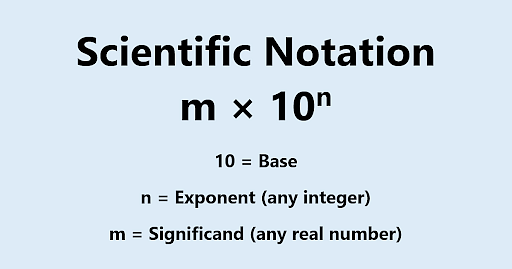
Scientific Notation
Formula for Scientific Notation
[Click Here for Sample Questions]
Writing a high number in its number form, such as 8.6 billion, is not only ambiguous but also time-consuming, and there is a probability that we will write a few zeros less or more when doing so. We utilize scientific notation to represent very large or very small numbers in a straightforward manner. The following is a general representation of scientific notation or a scientific notation formula:
a × 10b ; 1 ≤ a < 10
1 x a x 10b;
'a' stands for any number from 0 to 10 (higher than 0 and less than 10)
Read More: Difference Between Power And Exponent
Rules for Scientific Notation
[Click Here for Sample Questions]
When writing numbers in scientific notation, we must adhere to the following guidelines:
- The scientific notation is divided into two parts: the first is merely the digits, with the decimal point after the first digit, and the second is multiplication with 10 to a power number of the decimal point, which places the decimal point where it belongs.
- The decimal point must move to the left if the given number is higher than 1 and multiples of 10, and the power of 10 will be positive.
For example, the scientific notation for 8000 is 8 x 10³.
If the provided number is less than one in decimal form, the decimal point must be moved to the right, and the power of ten becomes negative.
For instance, the scientific notation for 0.008 is 8 x 0.001 or 8 x 10⁻³.
Read More: Integers as Exponents
Standard Form to Scientific Notation
[Click Here for Sample Questions]
Here are some examples that illustrate how to express a number in standard form to scientific notation.
Example 1: Express 412,000,000,000 in scientific notation.
- Step 1: To make a new number from 1 to 10, move the decimal position to the left.
Because 412,000,000,000 is a whole number, the decimal point will be appended at the end: 412,000,000,000. So, N = 3.12 is obtained.
- Step 2: Determine the exponent, which is the number of times the decimal has been moved.
The decimal was shifted 11 times, and the exponent is positive since the decimal was moved to the left. As a result, m = 11 and you get 1011.
- Step 3: Now, you have to substitute the value of N and m in the general form of scientific notation
N x 10m
3.12 x 10¹¹
Hence 3.12 x 10¹¹ is in scientific form

Standard Form & Scientific Notation
Example 2: Write 0.00000041 in scientific notation.
- Step 1: The first step involves moving the decimal place to the right to create a new number from 1 up to 10.
So we get N = 4.1.
- Step 2: Now, determine the exponent, it will be the number of times you moved the decimal.
Here, the decimal is moved 7 times and because you moved the decimal to the right, the exponent is negative. Hence, m = –7, and we get 10-7
- Step 3: The last step involves substituting the value of N and m in the general form of scientific notation
N x 10m
4.1 x 10⁻⁷
As a result, 4.1 is scientific.
Read More: Powers and Negative Exponents
Positive and Negative Exponents
[Click Here for Sample Questions]
When expressing huge numbers in scientific notation, we utilize positive exponents for base 10.
5000000, for example, equals 5 x 10⁶, where 6 is the positive exponent.
We utilize negative exponents for base 10 when expressing any little values in scientific notation.
0.00004 = 4 x 10⁻⁵, where the negative exponent is -5.
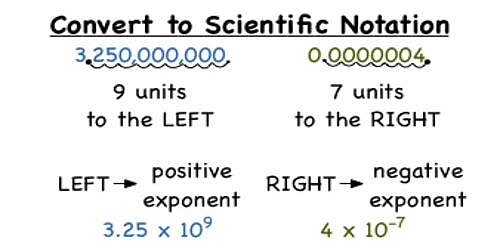
Positive and Negative Exponents
Things to Remember
- Scientific Notation is the method of expressing numbers that are either too large or too little to be expressed in decimal form.
- All numbers in scientific notation are written in the generic form as N x 10m
- A general representation of scientific notation, or a scientific notation formula: a × 10b; 1 ≤ a < 10
- The scientific notation is divided into two parts: the first is merely the digits, with the decimal point after the first digit, and the second is multiplication with 10 to a power number of the decimal point, which places the decimal point where it belongs.
- When expressing huge numbers in scientific notation, we utilize positive exponents for base 10. 5000000, for example, equals 5 x 10⁶, where 6 is the positive exponent.
- We utilize negative exponents for base 10 when expressing any little values in scientific notation. 0.00004 = 4 x 10⁻⁵, where the negative exponent is -5
Solved Questions
Ques. Using the scientific notation formula, convert 0.00000084 to scientific notation. (3 Marks)
To make the number 8.4, the decimal point was moved 8 places to the right.
We use a negative exponent here since the values are less than 10 and the decimal is pushed to the right.
0.000000084 = 8.4 x 10⁻⁸
Ques. Can you assist Zoe with writing 7.56 x 10¹¹ in conventional notation? (3 Marks)
Ans. 7.56 is 756 in this case. Zoe must now move the decimal point 11 places to the right and add zeroes in the appropriate places.
The conventional notation for 7.56×10¹¹ is 756,000,000,000.
Ques. Change the scientific notation to 1.86 x 10⁷ in standard form. (3 Marks)
Ans. Assume 1.86 x 10⁷ is written in scientific notation.
Exponent m Equals 7 in this case.
Because the exponent is positive, the decimal point must be moved 7 places to the right.
As a result, 1.86 x 107 = 1.86 x 10000000 = 1,86,00,000.
Ques. Convert this into scientific notation: 0.0000078. (3 Marks)
Ans. Given the fact that 0.0000078 is a standard value,
Use the general form to translate it to scientific notation.
10m x N
Move the decimal point up to 6 positions to the right of 0.0000078.
N = 7.8 is the result.
We employ a negative exponent here since the values are fewer than 10, therefore we move the decimal point to the right.
0.0000078 = 7.8 x 10⁻⁶
m = 10-6
The scientific notation is 7.8 x 10⁻⁶.
Ques. What are the five scientific notation rules? (5 Marks)
Ans. The following are the five rules of scientific notation:
- The basis should always be ten.
- The exponent has to be a non-zero integer, which might be positive or negative.
- The coefficient's absolute value is more than or equal to one, but less than ten.
- Positive and negative values, including whole and decimal integers, can be used as coefficients.
- The remainder of the number's significant digits is carried by the mantissa.
Ques. What are the three elements that make up a scientific notation? (2 Marks)
Ans. The three main components of scientific notation are as follows:
- Coefficient
- Base
- Exponent
Ques. In scientific notation, how do you write 75? (2 Marks)
Ans. 75 is written as 7.5 x 101 = 7.5 x 10 in scientific notation.
Here, the coefficient is 7.5, the base is 10, and the exponent is 1.
Ques. In scientific notation, how do you write 0.00001? (2 Marks)
Ans. 0.0001 is 1 × 10⁻⁴ is the scientific notation for 0.0001.
Here, the coefficient is 1 and the base is 10. The exponent is -4.
Ques. What is the best way to standardize scientific notation? (3 Marks)
Ans. If the exponent of 10 is negative, we should move the decimal point (if any) to the left to convert a number from scientific notation to standard form; otherwise, we should go to the right. So that there are no powers of 10 in the final representation, we must relocate the decimal point as many times as the exponent indicates in power.
Ques. What do you mean by Scientific Notation and what is its use? (3 Marks)
Ans. The main benefit of changing numbers to scientific notation is that it makes calculations with exceptionally large or small numbers easier. Because zeros are no longer required to set the decimal point in scientific notation, all of the digits in a number are significant.
Read Also:



Comments