



Exams Prep Master
A sound is a form of energy that flows through the air or any other medium as vibrations. Vibration is defined as a quick to and fro or up and down movement about a mean position is defined as vibration. Vibrations pass through a medium such as air to our ears, where they are converted into sound by the brain. Humans have the ability to produce a sound that begins in the larynx or voice box in the neck. Vocal cords, tiny membranous structures that run across the larynx, govern the sound produced. A stretched animal hide (as in drums and tables), stretched strings (as in guitar and sitar), or air columns can all be used as the vibrating body (as in flute or pipes). Let’s learn how sound is produced by vibrating objects and discuss some important questions.
| Table of Content |
Key Terms: Vibration, Amplitude, Wavelength, Intensity, Frequency, Distance
Also check: Potential Energy
Characteristics Of Sound
[Click Here for Sample Questions]
Sound can be characterized by its Loudness, Pitch, Quality, and Intensity.

Loudness
- The loudness of a sound can be determined by looking at its amplitude. When the amplitude is large, a loud sound is produced, and when the amplitude is low, a gentle sound is produced.
- The amplitude is related to the square of the loudness. This means that doubling the amplitude will raise the loudness by four times.
Pitch
- The shrillness or flatness of a sound is defined by pitch. The volume of the sound can be loud or low.
- The pitch of a woman's voice is normally higher than that of a man's. This is due to the fact that a woman's voice has a higher frequency.
Quality
- The quality of a sound is defined as the property that allows two sounds of the same pitch and loudness produced by two different musical instruments or individuals to be recognized.
- Example: In a dark room with no light and 100 people present, we can readily detect our friend's voice among them due to its distinct quality.
Intensity
- It's the number of sound waves that pass through a 1-meter square region in one second. It is determined by the square of the amplitude.
- Sound can travel through solids, liquids, and gases in all three states of matter.
- The density (measured as mass per unit volume) of the medium determines the speed of sound (it increases with an increase in density of mediums).
Read also: Difference Between Equinox and Solstice
Sound Waves
[Click Here for Sample Questions]
Longitudinal waves are sound waves. The medium particles vibrate parallel to the wave's propagation direction in longitudinal waves. In longitudinal waves, the wavelength (l) is the distance between two consecutive compressions or rarefactions. In longitudinal waves, the time period (T) is the interval between two consecutive compressions or rarefactions.
Features of Sound Waves
The major features of sound waves are as follows:
Wavelength:
- The distance between two consecutive compressions (C) or rarefactions (R) is measured in wavelength (R)
- The Greek letter stands for wavelength (lambda).
- The wavelength of a louder sound is shorter, while the wavelength of a softer sound is longer.
- Meter is the SI unit for wavelength (m).
Amplitude:
- The amplitude (A) of the wave is the magnitude of the highest disturbance in the medium on either side of the mean value.
Time Period:
- The time it takes for one complete oscillation is measured in the time period (t).
- The time period is defined as the amount of time it takes for a wave to travel a distance equal to its wavelength.
- Example: t = 1/v
Frequency:
- The frequency of oscillation is defined as the number of complete oscillations per second.
- The SI unit for frequency is Hz (Hertz), which is denoted by v. (mhu).
Velocity (Speed):
- The velocity of a sound wave is the distance it travels in one unit of time.

Musical Sounds and Noise
[Click Here for Sample Questions]
There are two types of sounds: Musical sounds and Noise.
Music: A tuning fork, violin, veena, flute, and piano produce musical sounds that are appealing to the ear. They are created by periodic, regular vibrations. Musical instruments are categorized into three types: Stringed instruments, wind instruments, and percussion instruments.
Noise: Certain sounds are unpleasant to hear, such as thunder, the rattling of wheels on a rough road, or a large group of people chatting at the same time inside a room. Noise is the term for these sounds, which are created by irregular and non-periodic vibrations.
Read also:
Examples of Sound Produced by Vibrations
[Click Here for Sample Questions]
In order to understand how sound is produced by vibrations in physics, we must take an example. One of the best examples of sound produced by the vibration of objects is the guitar. In the guitar, we can observe some parallel strings. Here the air is the medium, which helps to produce sound when we create vibration among the strings.
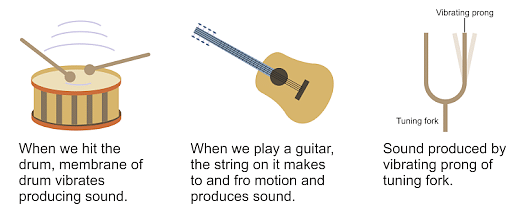
Another very common example is the tuning fork, which also explains how sound can be produced with vibrating objects. The tuning fork exhibits the handle with the two tunes. If we hit the tuning fork with the rubber hammer, as the air molecules surrounded by the tuning fork get disturbed, it creates vibration among the two tines and undergo compression or expansion. If we hit the rubber hammer multiple times, they keep on undergoing either compression or expansion, and this results in the formation of multiple waves. These waves lead to the propagation of sound. This is how the sound can be produced by the vibrating objects whenever we can apply some force on the medium or object.
Sound Produced by Man
Man's voice is created by the larynx, which is made up of two flap-like ligaments called vocal cords separated by a thin slit. Air is forced out when we talk (exhaled). This expelled air causes the vocal cords to vibrate, resulting in sound. Males have a 20mm vocal cord, whereas females have a 15mm vocal cord. Females and males have different noises because of this.
Sound Produced by Animals
Animals make a broad variety of noises. The noises of a sparrow, a lion, and an elephant, for example, are all different. Many animals utilize their lungs to blow air into their vocal cords, causing them to vibrate and emit sound. Lower organisms make buzzing sounds using their wings. Fish use air-bladder to produce sound.
Read also:
| Fun Facts! |
| Sound travels at a speed of roughly 1,230 kilometers per hour (or 767 miles per hour). |
| The loud noise you make when you crack a whip is caused by the tip moving so quickly that it exceeds the speed of sound! |
Things to Remember
-
Sound is a type of wave that provides us the ability to hear.
-
A vibrating body generates sound. Sound is produced by a vibrating item.
-
The amplitude is related to the square of the loudness. This means that doubling the amplitude will raise the loudness by four times.
-
The shrillness or flatness of a sound is defined by pitch. The volume of the sound can be loud or low.
-
The distance between two consecutive compressions (C) or rarefactions (R) is measured in wavelength (R)
-
Males have a 20mm vocal cord, whereas females have a 15mm vocal cord. Females and males have different noises because of this.
Also check:
Sample Questions
Ques: How is the sound produced? (1 mark)
Ans: Sound is produced by rapid to-and-fro movements called vibrations.
Ques: Why do women have shriller voices than men? (2 marks)
Ans: Women have shorter vocal cords (about 15 mm long) than men (about 20 mm long). Thus, the frequency of women's voice is higher than that of men and their voice is found to be shrill.
Ques: In what way does the loudness of sound depend on amplitude? If the amplitude is increased three times, by how much does the loudness increase? (3 marks)
Ans: If we strike a drum softly, it produces a soft sound. If you strike it hard, its skin vibrates with greater amplitude and a louder sound is produced. This shows that the loudness of the sound produced by a vibrating object depends on the amplitude of vibration. Loudness is proportional to the square of the amplitude. Thus, if the amplitude is increased by three times, the loudness increases by nine times.
Ques: How is the sound produced by our throat? (2 marks)
Ans: Humans produce sound in the larynx due to vibrations in the vocal cords. Vocal cords are folds of tissues with a slit-like opening between them. When we speak, air passes through the opening and the vocal cords vibrate to produce sound.
Ques: Explain what do you mean by quality of sound? What is it determined by? (3 marks)
Ans: The characteristic of sound that helps us to distinguish between two or more sounds similar pitch and loudness. If the vibrating strings of a sitar and a guitar are adjusted to give the same pitch and loudness, we can still distinguish their sound from one another. This is due to its quality. It is due to the fact that most vibrating objects simultaneously generate sounds of other frequencies. The quality of a sound is determined by frequencies present in it and its relative loudness.
Ques: Distinguish between infrasonic and ultrasonic. (2 marks)
Ans: The difference is as follows:
| Infrasonic | Ultrasonic |
|---|---|
| They are sounds that are created at a frequency of only 20 Hz and that humans are unable to hear. | They are sounds created by 20,000 Hz that we are unable to hear. |
| Our bones and muscles produce sounds below 20 Hz, which is why we are unable to hear them. | Ultrasonic is used to study the growth of a fetus in a woman's uterus. |
Ques: Ramesh measured the time gap between lightning and thunder and found that it was 3 seconds. Assuming light covers the distance instantly, what is the distance of the cloud from Ramesh. (2 marks)
Ans: We know that sound takes about 3 seconds to travel 1 km. Thus, assuming light covers the distance instantly, the distance of the clouds from Ramesh is 1 km.
Ques: Describe an experiment to show that sound can travel through liquid? (3 marks)
Ans: Experiment to show that sound can travel through liquids:
· Let us take a tub filled with water. Hold a bell in one hand and dip it in water.
· Keep one of your ears (caution: water should not enter your ear) gently on the surface of the water and ring the bell inside the water.
· We will be able to hear the sound clearly. This shows that sound can travel through liquids also.
Also check:



Comments