



Content Curator
Speed of Sound varies depending upon the medium in which it travels. Formula of Speed of sound is, v = √(γ × P/ρ). Sound travels from one point to another in the form of waves and vibrations. These waves are audible mechanical waves, which are known as sound waves. The particles of the medium in which these sound waves travel, oscillate forward and backwards in the direction of propagation.
Read More: Simple harmonic motion
| Table of Content |
Key Terms: Sound, Sound waves, Speed of sound, Elasticity, Density, Bulk modulus, Pressure, Young’s Modulus, Speed
What is Speed of Sound?
[Click Here for Sample Questions]
Speed of Sound is defined as the distance covered by a point in the sound wave per unit time. Sound wave, in other words, is the pressure disturbance which travels via medium through particle-to-particle interaction.
| Speed of sound refers to the speed of the longitudinal waves of sound. Sound travels fastest in solids, then in liquids, and then the slowest in gases. |
The speed of sound depends on two factors:
- Density of the given medium (inversely proportional)
- Elasticity of the given medium (directly proportional)
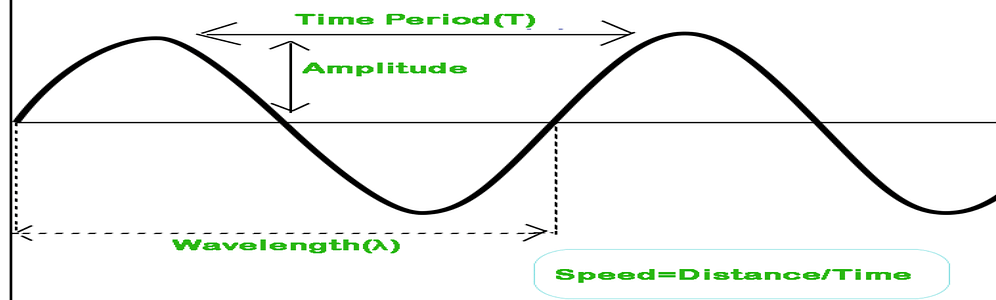
Speed of Sound Diagram
The formula of the speed of sound is given by:
| v = √(γ×P/ρ) |
where,
- v → Speed of sound
- P → Pressure
- ρ → Density of the medium
-
γ → Ratio of specific heat
Frequently Asked Questions About Speed of SoundQues. What is Shearing in Speed of Sound? (2 marks) Ans. Sound waves can also be produced by means of compression or by tearing of the solid. This process is known as Shearing. These waves basically exhibit several properties from one another and travel at different speeds. This effect can also be seen in cases of Earthquakes. Ques. What are P-waves and S-waves? (2 marks) Ans. Compression waves generally travel faster than tearing waves, which is why Earthquakes are often seen to start with an up-and-down motion followed by a side-to-side motion. In terms of Seismic, Compression waves are called P-waves and the tearing waves are called S-waves. Ques. What is Speed of Sound in Vacuum? Give suitable reasons. (3 marks) Ans. Zero meters per second is the speed of sound in vacuum, since there are no particles in the vacuum. Generally, sound waves can only travel through a medium if there are particles that help the propagation of sound waves. Because the vacuum is considered as an empty space, the propagation of sound waves is not possible. |
Speed of Sound in Solids
[Click Here for Previous year's Questions]
Speed of sound is dependent on the elasticity of the medium. The speed of sound in solids is 6000 m/s. The elastic property that determines the stress in the case of solids is the longitudinal strain, which is denoted by Young's modulus of the medium.
So, the speed of sound in the solids can be calculated as:
| v =√(Y/ρ) |
where,
- v → Speed of sound in the solid
- Y → Young's modulus of the solid
- ρ → Density of the solid
Read Also:
Speed of Sound on Liquids
[Click Here for Sample Questions]
The elastic property that determines the stress in the case of liquids is the compressional strain, which is denoted by the bulk modulus of the medium. Speed of sound in water, which is a liquid, is 1480 m/s. So, the speed of sound in the solids can be calculated as:
| v =√(B/ρ) |
where,
- v → Speed of sound in the liquid
- B → Bulk modulus of the liquid
- ρ → Density of the liquid
This formula can be used not only for liquids but for all fluids.
Also Check: Standing Wave Normal Mode
Speed of Sound in Gases
[Click Here for Previous year's Questions]
Gases too are fluids, so we can use the same formula used for liquids to find the speed of sound in gases:
| v =√(B/ρ) |
where,
- v → Speed of sound in the gas
- B → Bulk modulus of the gas
- ρ → Density of the gas
In an ideal gas, the relation between pressure can be established for an isothermal change as follows:
⇒ VΔP + PΔV = 0
− (ΔP)/ (ΔV/V) = P
We can say that, B = P
So, for an ideal gas, the speed of sound can be given by:
⇒ v =√(P/ρ)
where,
- v → Speed of sound in the ideal gas
- P → Pressure of the ideal gas
- ρ → Density of the ideal gas
For an adiabatic change in the gas, the speed of sound can be given by:
⇒ v = √(γ × R × TM)
where,
- γ → Adiabatic index of the gas
- R → Universal gas constant = 8.314 J/mol - k
- T → Absolute temperature
- M → Molecular mass
Read Also:
Speed of Sound in Different Mediums
[Click Here for Sample Questions]
Speed of sounds depends on the medium it passes through. In other words, the proportional variation of speed with density is different as per the medium. The speed of sound in different mediums are:
| Material | Density (g/cm3) | Speed (m/s) |
|---|---|---|
| Water | 1.00 | 1496 |
| Air | 0.00139 | 331.45 |
| Fat | 0.95 | 1450 |
| Skull Bone | 1.91 | 4080 |
| Muscle | 1.07 | 1580 |
| Helium | 0.000178 | 965 |
| Ethanol | 0.79 | 1207 |
| Copper | 8.90 | 6420 |
| Steel | 7.86 | 5940 |
| Aluminium | 2.58 | 6420 |
| Beryllium | 1.93 | 12890 |
Read Also: Electromagnetic Spectrum
Previous Year Questions
- The tension in piano wire is 10 kg … [JIPMER 1996]
- Oxygen is 16 times heavier than hydrogen … [KCET 2004]
- Two tuning forks with natural frequencies … [BITSAT 2015]
- Velocity of sound waves in air is … [NEET 1990]
- A hollow cylinder with both sides open generates a frequency f in air … [WBJEE 2008]
- If the amplitude of sound is doubled and the frequency… [NEET 1989]
- A wave travelling along a string is described by the equation … [MHT CET 2008]
- In a hall, a person receives direct sound waves … [BHU UET]
- Which of the following electromagnetic radiations have the … [NEET 1989]
- A transverse wave propagating along x-axis … [NEET 2006]
- Two sound waves with wavelengths … [NEET 2006]
- Two vibrating tuning forks produce waves given … [NEET 2006]
- A point source emits sound equally in all directions in a non-absorbing … [NEET 2005]
- A source of sound gives 5 beats per second … [NEET 1995]
Things to Remember
- Speed of Sound varies depending upon the medium in which it travels.
- Sound cannot travel in a vacuum.
- The particles of the medium in which these sound waves travel, oscillate forward and backwards in the direction of propagation.
- The speed of sound in the solids can be calculated as v =√(Y/ρ)
- The speed of sound in the solids and gases can be calculated as v =√(B/ρ)
- For an ideal gas, the speed of sound can be given by v =√(P/ρ)
Read Also:
Sample Questions
Ques. The sound waves travel in the air with a density of 0.056 kg/m³ and pressure of 3000 Pa with a temperature of 5°C. Calculate the speed of the sound. [2 marks]
Ans. As given here:
Temperature, T = 5° C
Density, ρ = 0.056 kg/m³ and, pressure, P = 3000 Pa
As we know that specific heat ratio in the air is, γ=1.4
Now the speed of the sound formula is given by:
c =√(γ×P/ρ)
c =√(1.4×3000/0.056)
c= √(75000)
c = 273.86
Therefore, the speed of sound = 273.86 m/s.
Ques. Find out the pressure if sound travels through a medium having a density of 0.04 KPa and the speed of sound is 500 m/s. [2 marks]
Ans. As given in the problem,
Density, ρ = 0.04 KPa,
Speed of sound, c = 500 m/s
Also, γ = 1.4 at room temperature for gases.
Now the speed of the sound formula is:
c =√(γ×P/ρ)
Rearranging the formula,
P = c2×ρ/γ
P = 5002×0.04/1.4
P= 250000×0.04/1.4
P= 7142.75 Pa
Therefore, the Pressure will be 14000 Pa.
Ques. The Bulk modulus of water is 2.1 x 10⁹ Pa and its density is 1000kg/m3. Find the speed of sound in water. [2 marks]
Ans. As given in the problem,
Bulk modulus, B = 2.1x10⁹ Pa
Density, ρ = 1000kg/m3
We know that,
v =√(B/ρ)
v = √(2.1 x 10⁹/1000)
v = √2.1 x 10⁶
v = 1449.13 m/s
So, the speed of sound in water is 1449.13m/s.
Ques. Find the speed of sound in steel if it’s Young's modulus is 1.9x10¹¹ Pa and its density is 8000kg/m3. [2 marks]
Ans. As given in the problem,
Young's modulus, Y = 1.9x10¹¹ Pa
Density, ρ = 8000kg/m3
We know that,
v =√(Y/ρ)
v = √(1.9 x 10¹¹/8000)
v = √0.2375 x 10⁸
v = 4873.39 m/s
So, the speed of sound in steel is 4873.39m/s.
Ques. The pressure of gas in a soft drink is found to be 3 bar, and its density is 0.97g/cc. Find the speed of sound through the gas in the soft drink. [2 marks]
Ans. As given in the problem,
Pressure, P= 3 bar = 300000 Pa
Density, ρ = 0.97g/cc = 970 kg/m3
We know that,
v =√(P/ρ)
v = √(300000/970)
v = √10000x0.031
v = 17.58
So, the speed of sound in steel is 17.58 m/s.
Ques. On what factors does the speed of sound depend upon? [2 marks]
Ans. The speed of sound depends on the density and the elasticity of the medium in which it is travelling. It is directly proportional to the elasticity and inversely proportional to the density of the given medium.
Ques. What is the difference between wave velocity and particle velocity? [2 marks]
Ans. Wave velocity always remains constant for a particular medium. whereas, particle velocity changes harmonically with time. At the mean position, it is maximum, and at the extreme position, it is zero.
Ques. Which wave property determines: (a) loudness, (b) pitch? [CBSE 2011] [2 marks]
Ans. Loundness and Pitch determines the following respectively:
- The amplitude of the wave determines the loudness. The more the amplitude of a wave, the more is the loudness produced.
- The pitch is determined by the frequency of the wave. The higher the frequency of a wave, the more is its pitch and shriller is the sound.
Read Also: Photoelectric Effect
Ques. Give two practical applications of reflection of sound waves. [2 marks]
Ans. Two practical applications of reflection of sound waves are:
- Megaphones are designed to send sound waves in a particular direction and are based on the reflection of sound.
- In a stethoscope, the sound of the patient’s heartbeat reaches the doctor’s ears by multiple reflections in the tubes.
Ques. What is reverberation? How can it be reduced? [2 marks]
Ans. Reverberation is the repeated multiple reflections of sound in any big enclosed space. It can be reduced by covering the ceiling and walls of the enclosed space with some absorbing materials like fibreboard, loose woollens etc.
Read Also:
Ques. Explain how defects in a metal block can be detected using ultrasound. [2 marks]
Ans. The ultrasound waves are allowed to pass through the metal blocks to which detectors are fitted. If there is a small defect in the metal block like an air bubble or a crack, then the ultrasound waves are reflected from such spots. Metal block if defective is indicated by the reflected ultrasonic waves.
Ques. Distinguish between transverse and longitudinal waves. [CBSE 2014] [2 marks]
Ans. Transverse waves
- Particles in the medium vibrate at right angles.
- Alternating crests and troughs formed. E.g: water waves
Longitudinal waves
- Particles vibrate parallel to the direction of waves.
- Alternative compressions, rarefaction formed. E.g: sound waves.
Read More:



Comments