



Education Journalist | Study Abroad Lead
Celestial bodies are objects such as the stars, the moon, and the planet that are present in the sky. The branch of science that studies celestial bodies and their associated phenomenon is known as astronomy. The shape of the moon changes each day in phases. Full moon day is the day on which the entire moon disc is visible. Whereas the day on which only a small portion of the moon is visible is known as the new moon day. The phases of the moon are seen as we can only see the part of the moon that reflects the light of the Sun towards us. Stars And The Solar System Class 8 Notes Chapter 17 is given in this article.
Read More: Motion of Celestial Bodies
Key Terms: Moon, Plants, Stars, Constellation, Solar System, Phases of moon, astronomy, Earth, meteors, comets
Phases of the moon
[Click Here for Sample Questions]
The different shapes of the illuminated part of the moon that can be seen from the earth are known as the phases of the moon. The moon cycle is about 29 days, in which it goes from a full moon to a new moon and back to a full moon.
The moon reflects sunlight as it does not produce its own light. As the moon revolves around the earth, different parts of the moon’s surface get illuminated by sunlight and thus we see a different shape each day.
- During the new moon, the moon doesn’t receive any light from the sun. Therefore, it appears dark.
- During a full moon, the rays of the sun directly fall on part of the moon that faces the Earth, hence moon is seen as a full disc of light.
- Gibbous means the brighter part of the moon is greater than the semicircle.
- The time period between one full moon to the next is slightly longer than 29 days. In many calendars, this period is regarded as a month.
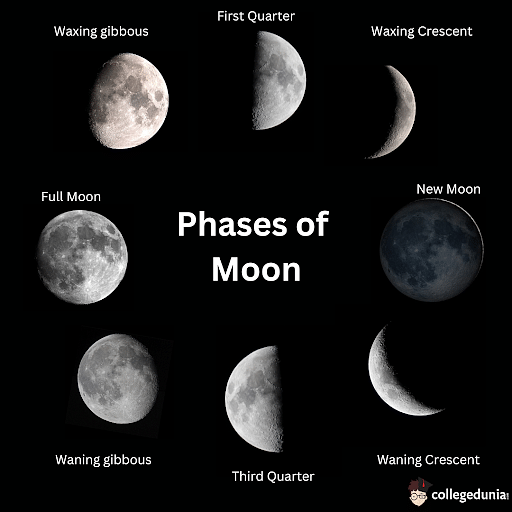
Phases of the Moon
Read More: Why does not the moon fall back into the Earth?
Dark Side of the moon
The part of the moon that is always faced away from the earth is known as the dark side of the moon.
The time period of the moon for rotation (movement on its own axis) and revolution (movement around the Earth) is approximately the same i.e. 27.3 days. Hence, an observer on Earth sees the same face of the moon always.
Also Check: Black hole
Surface of the Moon
The surface of the moon is dusty and barren as it is devoid of water. It has high mountains and many large craters.
The gravity of the moon is 6 times weaker than the earth’s gravity. The moon’s gravity is so weak that it does not have any atmosphere. Therefore, we cannot hear anything on the surface of the moon.
Also Read: Value of g on moon
Stars
[Click Here for Sample Questions]
Stars are celestial bodies emitting their own heat and light. For example - our sun.
- Stars are always present in the sky, however at night time due to the absence of light from the sun, they become visible.
- Stars appear as points located millions of kilometres away from our Earth.
- As the light from the stars gets refracted into the atmosphere, they appear to twinkle.
- Although stars are always present in the sky but are only visible at night due to the absence of sunlight.
- Due to the movement of Earth, the positions of stars from their surface keep on changing except for the position of the pole star which is fixed.
Read More: Stars and Planets
Pole star
[Click Here for Sample Questions]
The Pole star, also known as Polaris, is a star with fixed positions. All other stars seem to move around the Pole Star.
The pole star can be traced in the sky using the Ursa Major constellation.

Pole Star
Read More: Life Cycle of Stars
Light year
[Click Here for Sample Questions]
Light year is a measure of the distance of celestial objects that measures the distance traveled by light in one year.
Speed of light = 3 x 10⁸ m/s
1 light year = 9.46 x 10¹² km
- The sun is 8 light minutes away from the surface of the earth.
- Alpha Centauri is 4.3 light years away.
Read More: Galaxies
Constellations
[Click Here for Sample Questions]
A group of stars forming a recognizable shape in the night sky is regarded as a constellation. Constellations were devised by ancient men for the purposes of navigation.
Some examples of constellations are Orion, Ursa Major (Great Bear), Leo major, etc.
- Ursa Major: Also known as saptrishi, this constellation is seen during summer-time in the early part of the night. Ursa Major has a group of seven stars. Three stars form the handle of the dipper and the remaining four stars form its bowl.
- Orion: Orion can be seen during winter in the late evening sky. Orion is also known as the Hunter or Kalpurush. The three middle stars of the constellation represent the belt of the Hunter. The four bright stars are arranged in the form of a quadrilateral. The brightest star that is located close to the Orion constellation is called Sirius.
- Cassiopeia: This constellation is visible in the northern sky during winters. It looks like a distorted letter M or W.
Read More: Advanced sunsets and delayed sunrise
Introduction to the Solar System
[Click Here for Sample Questions]
The sun and all other celestial bodies revolving around it are known called as the solar system. Our solar system has 8 planets and an asteroid belt. Pluto is considered a dwarf planet.
- All planets in our solar system revolve around the sun in their fixed orbits.
- Planets that are closer to the sun revolve around faster than the ones that are away from the sun.
The Sun
The sun is the nearest star to the earth that continuously emits heat and light. All planets in our solar system get their heat and light energy from the sun.
The Planets
Planets are celestial bodies that can not emit heat or light of their own.
- They revolve around the stars in fixed paths known as their orbits.
- The time a planet takes to go around the sun is called the period of revolution of the planet.
- A planet also rotates around its own axis known as rotation.
Read More: Dwarf Planets
Mercury
The nearest planet to the sun in our solar system is known as mercury. It is also the smallest planet.
It can only be seen just before sunrise or just after sunset as it is usually hidden by the glare of the sun.
Venus
Venus is the closest planet to the Earth and the brightest planet in our night sky.
It is known as the morning star or evening star as it appears before sunrise in the eastern sky and after sunset in the western sky.
The Earth
The Earth is the only planet in our solar system that supports life.
- It is habitable due to several optimal conditions such as the presence of atmosphere and water.
- Life exists on Earth also because it is the appropriate distance away from the sun so as not to be too hot or too cold.
- The axis of rotation of the Earth is tilted causing various seasonal variations.
- From outer space, the earth appears bluish-green as the light from the water bodies and landmass gets reflected.
- The moon is the only natural satellite of the Earth.
Read Also: Difference Between Equinox and Solstice
Mars
Often regarded as the ‘Red Planet’, Mars is the 4th planet from the sun. It is called so as the reddish iron oxide present on the surface of mars gives it a reddish colour. The planet has 2 natural satellites.
Jupiter
Jupiter is the largest planet in our solar system. It is so big that it can accommodate about 1300 earth. Jupiter is 318 times heavier than earth and has at least 67 moons.
Jupiter has a big red spot (twice as wide as earth) on it which is a gigantic storm that has been swirling for many years.
Saturn
Saturn is the second largest planet in our solar system besides Jupiter. It is unique because of its thousands of beautiful rings. Saturn also has a large number of moons.
Uranus and Neptune
Uranus is the 7th planet that rotates on its axis from west to east. Its axis has a huge tilt which makes it look like it's spinning on its side.
Neptune is the farthest planet in our solar system. It has really powerful winds than any other planet in the solar system.
Check out: Variable Star
Asteroids
[Click Here for Sample Questions]
The large number of small celestial objects existing between the orbits of Mars and Jupiter are known as asteroids.
They revolve around the sun in their orbit. Together they form a belt.
Also Check: Natural phenomena due to sunlight
Comets
[Click Here for Sample Questions]
Comets are celestial bodies revolving around the sun in long elliptical orbits. They are made up of ice, dust, and gasses and have a very long tails directed away from the sun.
The comet spews out jet gas and forms a glowing head as it gets closer to the sun and heats up. Example - Halleys Comet

Comets
Read More: Asteroids and Comets
Meteors and Meteorites
[Click Here for Sample Questions]
Meteors are small objects that are leftovers of broken asteroids entering the atmosphere of the earth at high speeds.
- Meteors burn due to the friction between the atmosphere and itself. Therefore, it evaporates even before it reaches the surface of the Earth.
- This is why meteors appear as bright streaks of light in the sky.
Sometimes a meteor is extremely large and does not evaporate in the atmosphere, so it strikes the surface of the Earth. This is known as a meteorite.
Artificial Satellites
[Click Here for Sample Questions]
Artificial satellites are man-made objects that revolve around the earth closer than natural satellites. They are launched from the Earth for various purposes such as weather forecasting, transmitting signals, remote sensing, etc. Some examples of artificial satellites are Sputnik-1, INSAT, IRS, etc.
Read More: Satellite Communication
Things to Remember
- Celestial objects are objects present in the sky such as planets, stars, moon, etc.
- Moon is visible in different shapes known as the phases of the moon which include the full moon and new moon.
- Only a part of the moon reflects the sunlight towards us is visible from Earth.
- The stars in the night sky appear to move from east to west due to the rotation of the earth.
- Constellation is a group of stars forming a recognizable shape.
- Our solar system consists of 8 plants - Mercury, Venus, Earth, Mars, Jupiter, Saturn, Uranus, and Neptune.
- Meteors are small leftovers of broken asteroids that enter the surface of the Earth.
Sample Questions
Ques: Write in brief about Ursa Major. (2 marks)
Ans: It is one of the constellations that are visible in the sky during the night. There are seven stars in this constellation and hence it is also known as Saptarishi. Pole stars can be located using this constellation.
Ques: Define the Period of Revolution and Orbit. (2 marks)
Ans: A period of Revolution is defined as the time taken by a planet to complete one revolution.
Orbit: A definite path of a planet in which the planet revolves around the sun.
Ques: Name 4 Indian artificial satellites. (2 marks)
Ans: The Indian artificial satellites are:
- INSAT-2DT (1992)
- Mars Orbiter Mission (2013)
- Chandrayaan-2 (2019)
- IRS-1B (1991)
Ques: Write down the characteristics of Earth. (5 marks)
Ans: The characteristics of Earth are as follows:
- Earth is the third planet in the solar system from the sun.
- Moon is the only natural satellite of Earth.
- Due to the presence of water, the earth is also known as the blue planet.
- Earth rotates on its axis for a period of 24 hours.
- Earth completes its one revolution around the sun in 365 days and 4 hours.
Ques: Define constellations and give 2 examples of the same. (2 marks)
Ans: A group of stars that can be easily recognized due to their shape is known as a constellation.
Example: Orion, Ursa Major
Ques: What is a light year? (2 marks)
Ans: The earth is very far from the stars and this distance can not be expressed in kilometres. The unit to express such distances is known as Light year. If a star is 9 light years away, this means that the light emitted by that star will reach earth in 9 years.
1 light year= 9.46 x 10¹² km
Ques: The radius of the earth is 1/11 times that of Jupiter. What is the ratio of the volumes of Jupiter and earth? (5 marks)
Ans: Suppose, the radius of the earth= r units,
We have, the radius of Jupiter= 11r
Now, the volume of the earth = 4/3\(\pi\)r3
Volume of Jupiter = 4/3\(\pi\)(11r)3
= 1331 (4/3\(\pi\)r3)
We get, Volume of Jupiter / Volume of Earth = 1331(4/3\(\pi\)r3) / (4/3\(\pi\)r3) = 1331
Volume of Jupiter = 1331 Volume of Earth
Ques: Write the difference between Meteor and a comet. (2 marks)
Ans: The difference between a meteor and a comet is as follows -
| Meteor | Comet |
|---|---|
| Pieces of rocks that float in space and when they enter earth’s atmosphere, they get heated up | Heavenly bodies that revolve in an elliptical path around the sun |
| Meteors don’t have a tail | They have an illuminating tail |
Ques: List a few characteristics of Mars and Uranus. (5 marks)
Ans: Characteristics of Uranus are:
- The planet rotates from the East to the west direction.
- The axis of rotation is highly tilted.
Characteristics of Mars are
- There are two natural satellites of this planet known as Deimos and Phobos
- The diameter of Mars is half that of the earth.
- This is the fourth planet from the sun
- Due to the presence of red dust, it is known as a Red planet
- The planet is colder than earth.
Ques: Give a few examples of terrestrial planets. (2 marks)
Ans: The planets that have a rocky structure like earth are called Terrestrial planets. For example - Mercury, Venus, Earth, and Mars.
Read More:



Comments