



Education Journalist | Study Abroad Lead
A celestial body is an object that exists in space like the moon, sun, stars, and planets. They exist far away from Earth as a vital part of this vast universe. The fascinating celestial objects adorn the night sky and are viewed the best with the help of a telescope. Not all celestial bodies are accessible to the human eye, which is why telescopes are preferred to view them. Celestial bodies are tightly bound entities that have a complicated structure containing thousands of sub-objects within them. Celestial bodies are also known as heavenly bodies. These objects are very far away from Earth in space.
Also read: Which is the nearest planet to the sun?
Key Terms: Heavenly Bodies, Sun, Moon, Stars, Asteroid, Comets, Meteors, Meteoroid, Celestial Bodies, Galaxy, Earth
What are Celestial Bodies?
[Click Here for Sample Questions]
Celestial Bodies or Heavenly Bodies refer to the natural objects existing in space such as the moon, star, planets, etc. Mainly, any natural object lying outside the Earth's atmosphere is known as a celestial body. Many celestial bodies exist in the Kuiper Belt.
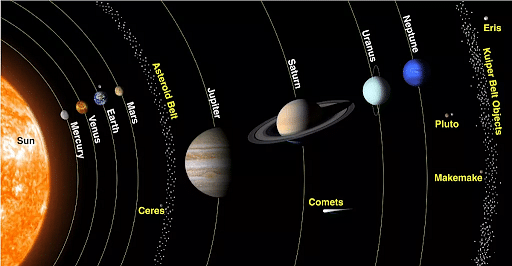
Solar System
Interesting Facts About Celestial Bodies
Here are some interesting facts about Celestial or Heavenly Bodies:
- The galaxy has around 400 billion stars and the Universe contains up to 500 billion galaxies.
- The Milky Way galaxy is 105,700 light-years wide.
- Due to its unique tilt, a season in Uranus is equivalent to 21 earth years.
- Only 5% of the universe is visible from the earth.
- Space is completely silent. That's because there is no medium for sound to travel.
Also Read:
| Related Links | ||
|---|---|---|
| Difference Between Stars and Planets | Why do Stars Twinkle | Difference between Asteroid and Comet |
Classification of Celestial Bodies
[Click Here for Previous Year's Questions]
Celestial bodies can mainly be classified into various categories such as:
Stars
Stars are giant balls of hot gases that produce light of their own. The stars are of gigantic size. The life of a star begins with the collapse of a gaseous nebula which is mainly composed of hydrogen and helium material along with smaller amounts of other heavy elements. When the core of the star becomes thick enough, the hydrogen in it is gradually converted into Helium through nuclear fusion. This, in turn, releases energy.
- Due to their size, stars have immense gravitational attraction.
- Sun is a medium-sized star that provides us with energy and makes life possible on Earth. The Sun is our nearest star.
- Stars appear as fixed luminous points in the night sky.
- The most noticeable stars from the surface of the Earth were identified and grouped into clusters, known as constellations.
- Stars are celestial bodies that are composed of a shining spheroid of plasma held together by the gravity of the star itself.
- The brightest star from the earth is known as Sirius.
- When the hydrogen fuel at the core of the star gets exhausted, a star that is as massive as 0.4 times the mass of the sun will eventually expand to transform into a red star.

Stars
Satellites
Satellites are the celestial bodies that revolve around the planets. There are two types of satellites - Natural satellites and Artificial/man-made satellites.
- Satellites exist either naturally in space or are sent by humans.
- The moon is the natural satellite of our Earth. It is kept in its orbit through the Gravitational pull of Earth.
- For communication purposes, humans have also sent man-made satellites around the Earth and other planets in order to study them.
Types of satellites
- Natural satellite - For example – Earth and moon. The Earth rotates around the Sun and the Moon rotates around the Earth.
- Man Made satellite - For example – Hubble Space Telescope and the International Space Station.
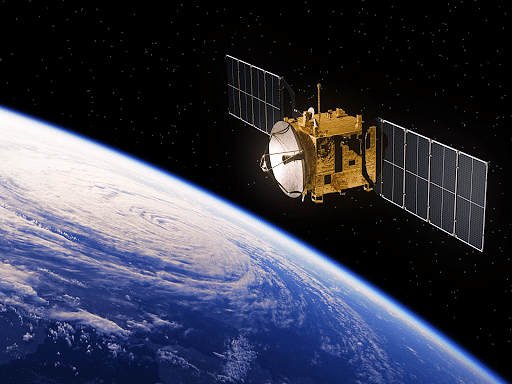
Satellites
Planets
Planets are large celestial bodies that revolve around the sun or any other star and are almost spherical in shape.
- The planets may be formed of gases such as nitrogen, hydrogen, methane, metals, or rocks.
- Planets move around the sun in their fixed orbits.
- Our solar system comprises 7 planets.
- Our Earth is also one such planet that is widely popular in the universe due to its ability to support and sustain life.
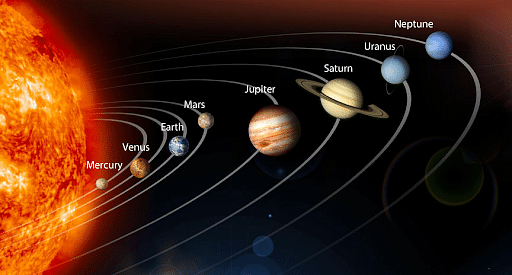
Planets in our solar system
Asteroids
Asteroids refer to small rocks that are irregularly shaped. These celestial bodies are formed of minerals or metals which orbit around the sun. Asteroids are different from meteoroids and comets. While asteroids are majorly formed of rock and minerals, comets are formed from dust and ice.
- Most of the Asteroids or planetoids in our solar system are found between Jupiter and Mars, this area is known as the asteroid belt.
- Many asteroids are formed from the leftovers of planets and other celestial bodies after collisions.
- These rocks never grow massive enough in order to be called planets.
- The majority of these asteroids lie between the orbits of planets Mars and Jupiter. Asteroids vary greatly in size.
- The largest known asteroid, Ceres, is over almost 1000 km or 625 miles across.
- While asteroids are formed somewhere closer to the sun, this prevents the progress of the formation of cometary ice.
- Asteroids and meteoroids mainly differ in terms of size.
- Asteroids have a radius that is more than one meter. However, meteoroids generally have a radius of just one meter or even less.
- Meteoroids are formed of materials of either comets or asteroids.

Asteroids
Comets
Comets are referred to the small chunks of rock and ice that come originally from the outer edge of our solar system.
- The core of a comet ranges from a few hundred meters to over ten kilometres across.
- These celestial bodies are formed of loose dust, rocks, and ice particles.
- The coma of the comet can be up to 15 times the diameter of the Earth.
- The dead comets that have passed by the sun multiple times, lose almost all their volatile dust and ices and therefore might start resembling asteroids.
How are comets formed?
- When the orbits of the comets bring them closer to the sun, the ice present in them vaporizes and releases gases through the outgassing phenomenon.
- The outgassing effect creates a beautiful tail or a coma behind these comets.
- This happens because of the effects of the solar wind and the solar radiation that acts upon the core of any comet.

Comets
Meteors and Meteorites
Meteors and meteorites are celestial bodies in space that enter the inner atmosphere of the Earth when they are pulled in by the gravity of the Earth. If the meteors are large enough, they can reach the ground to form a crater. These objects are known as meteorites.
- Meteors and meteorites are usually smaller in size and as they enter the Earth, they burn up in the atmosphere.
- The burning of meteors forms streaks in the sky and looks like a falling star. Due to this, they are popularly known as shooting stars.
- Over billions of meteors daily enter the atmosphere of the Earth.
- Most of the meteoroids result in meteors that are about the size of a sand particle i.e. millimetre-sized or even smaller than that.
- The size of a meteoroid can be measured using its density and mass.

Meteors
Galaxies
Galaxies are large clusters of stars that are held together by the force of gravity. These celestial bodies are composed of a system of stars, stellar fragments, interstellar gas, dark matter, and dust. Many of the galaxies have a massive black hole towards their core. The black hole at the centre of our Milky Way is known as Sagittarius A. It is about four million times greater than the star, the sun.
- Our solar system and our sun are part of the Milky Way Galaxy.
- The word ‘galaxy’ is derived from a Greek word that translates to "milky" which is a reference to our Milky way galaxy.
- The Milky Way is a part of the local group of galaxies that are ruled by our nearest neighbour, the Andromeda galaxy, and is a part of the Virgo superclusters of galaxies.
- We can observe other galaxies in the night sky. However, due to their distance from us, they just look like the stars in the night sky.
- On a clear night, we can easily observe the Andromeda Galaxy and the Large Magellanic Cloud through our naked eye.
- Small galaxies have around a hundred million stars whereas large galaxies have over a hundred trillion stars.
- The space present in between the galaxies is filled up with an intergalactic medium that has an average mass which is less than an atom per cubic meter.
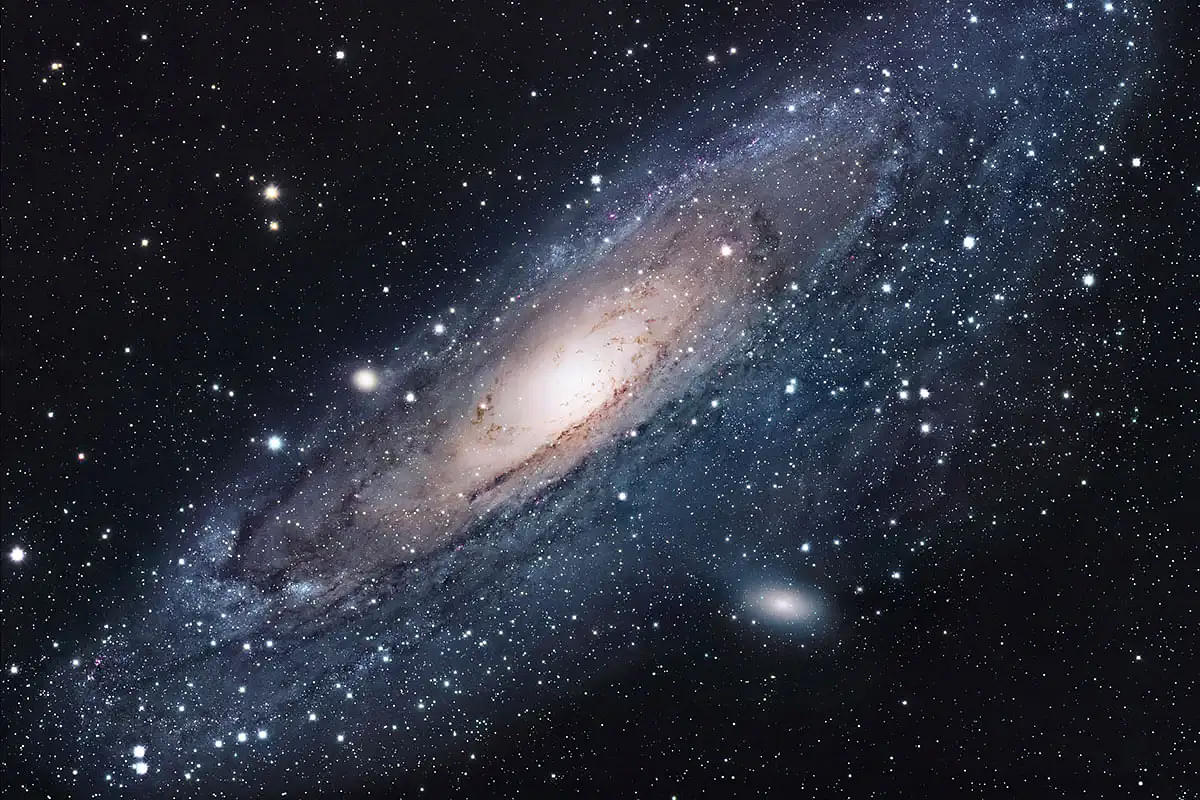
Andromeda Galaxy
What is Planetary Geology?
[Click Here for Sample Questions]
Planetary Geology refers to the study of solid matter which constitutes celestial bodies like planets, moons, asteroids, and comets. This study focuses on the materials which are making up these celestial bodies.
- A planet is a large celestial body that revolves around a star.
- A moon is also a type of celestial body that revolves around a planet.
- The Earth has only one moon while other planets have multiple moons.
- Planets and moons are the larger celestial bodies that exist in our solar system.
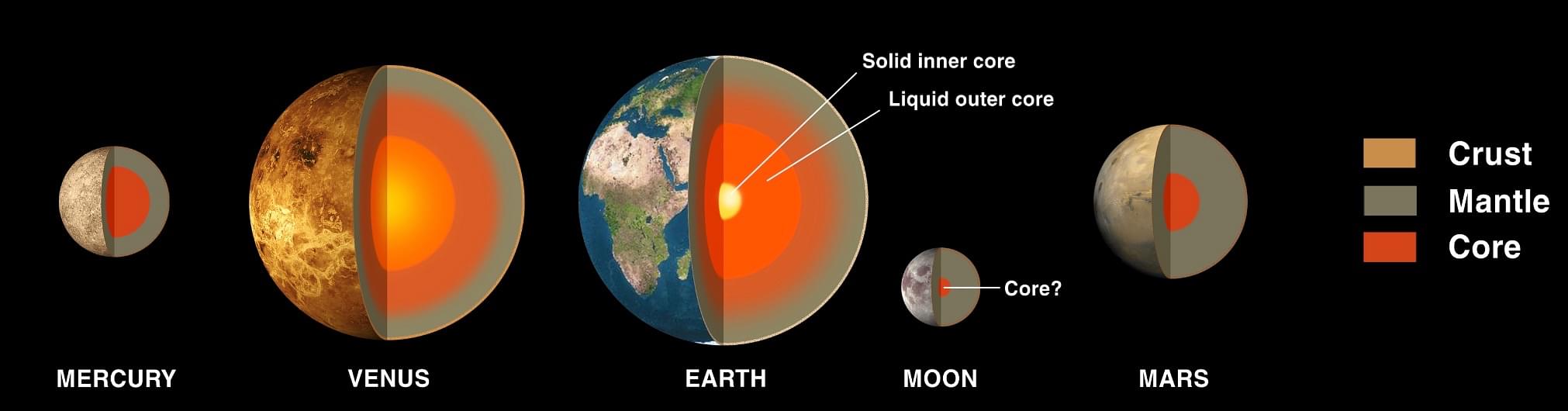
Planetary Geology
The celestial bodies include the entire known and unknown universe. A celestial body is a natural body existing outside of the Earth’s atmosphere. Some of the examples include the moon, sun, and different other planets. Many celestial bodies are identified in the Kuiper belt. They are also known as heavenly bodies and are components of the vast cosmos we are a part of.
Check out:
| Chapter Related Topics | ||
|---|---|---|
| Variable Star | Halleys Comet | Life Cycle of Stars |
| Dwarf Planet | Dark Side of the Moon | Motion of Celestial Bodies in Space |
Things to Remember
- Celestial bodies, also known as heavenly bodies, are the objects that exist in space such as the moon, sun, stars, and planets.
- The giant balls formed from hot gases which are responsible for producing light of their own are known as stars.
- Satellites are objects that revolve around the planets.
- Asteroids are small rocks that are irregularly shaped and are formed of minerals or metals which orbit around the sun.
- Comets are small chunks of rock and ice that come originally from the outer edge of our solar system.
- Meteors and meteorites are celestial bodies in space that enter the inner atmosphere of the Earth when they are pulled in by the gravity of the Earth.
- The large cluster of stars that are held together by the force of gravity is known as galaxies.
- Galaxies vary in size from small galaxies which have just a few hundred million stars (108) to colossal galaxies with over a hundred trillion (1014) stars.
Previous Year Questions
- A planet in a distant solar system is 10 times more massive than the earth…
- A planet is revolving around the Sun as shown in the figure… [AP EAPCET]
- The distance of two planets from the sun are… [NEET 1994]
- Assuming the sun to have a spherical outer surface of radius r… [NEET 2007]
- If the mass of the Sun were ten times smaller and the universal gravitational… [NEET 2018]
- A planet moving around the sun sweeps the area… [KCET 2012]
- A comet orbits around Sun in an elliptical orbit… [KEAM]
- Earth is revolving around the sun. If the distance of the earth…
- A satellite in force-free space sweeps stationary interplanetary… [NEET 1994]
- For a satellite moving in an orbit around the earth…
- A satellite in a circular orbit of radius R has a period of 4 hours… [KCET 1996]
- What is a period of revolution of earth satellite… [KCET 2014]
- A satellite is launched in a circular orbit of radius R around the earth… [KEAM]
- A small satellite is revolving near the earth's surface…
- A satellite is revolving in a circular orbit at a height… [JEE Main 2016]
- A satellite of mass M is in a circular orbit of radius R about the centre of… [JEE Main 2019]
- The orbit of a geostationary satellite is circular, and the time period of the satellite… [BITSAT 2008]
Sample Questions
Ques. Differentiate between stars and planets (3 marks)
Ans. The differences between stars and planets are as follows:
| Stars | Planets |
|---|---|
| Stars refer to those celestial bodies that are formed of gases. They are huge in size and have high temperatures. | Planets refer to celestial bodies that don't have their own light and heat. |
| Stars have their own heat and they emit it in larger amounts. | Planets get their light from the stars. |
| For example, the Sun is a star. | For example, our Earth is a planet. |
Ques. State the differences between comets and meteors. (3 marks)
Ans. The differences between comets and meteors are as stated below:
| Comets | Meteors |
|---|---|
| Comets are those celestial bodies that revolve in an elliptical orbit around the sun. | Meteors are small pieces of rock that revolve around the sun. |
| Comets are generally formed from ice, dust particles, and gases. | Meteors enter the atmosphere of the Earth with a greater velocity. |
| Most comets have a nucleus, a tail, and a head. When these comets approach the Sun, the gases in them get heated and they vaporize. Due to this, the comets start to glow. | Due to the friction of the atmosphere, meteors get heated up. Hence, meteors start to glow. |
| An example of a comet is Halley's comet. | Leonid is an example of a meteor. |
Ques. State the conditions that are ideal on Earth in order to make life possible on this planet. (5 marks)
Ans. Earth is the only known planet to sustain life. The reasons behind this are as follows:
- Earth is situated at just the right distance from the sun such that it is neither too cold nor too hot.
- Hence, Earth has an ideal temperature to sustain living beings.
- Water is present on the surface of the Earth, which is a huge contributing factor to the sustenance of life.
- The atmosphere that exists around the Earth is suitable.
- Earth is surrounded by a blanket of the ozone layer which protects it from harmful ultraviolet radiation from the sun.
Ques. Name the farthest planet from the sun in our solar system. (3 marks)
Ans. The farthest planet from the sun in our solar system is Neptune. The average distance of Neptune from the sun is around 4501000000 km. Out of all the giant planets, it is the smallest one with a diameter of just 49245 km. It is an ice giant and is the last planet that was discovered in our solar system. Earlier, the farthest planet from the Sun was Pluto, however, it has now been recognized as a dwarf planet.
Ques. What is referred to as a supernova? (5 marks)
Ans. Supernova basically refers to the death of a star. The process occurs in the following way:
- When the nuclear fusion processes occurring at the core of the star stops, the star starts to die.
- In a star, the heaviest element that can be formed is known as iron.
- However, a star does not have enough energy to result in a combination of iron atoms.
- Once a star reaches this point, the core of the star starts to contract. The outer parts of the star will then explode. This sends out a shockwave in the universe.
- It is this explosion of the death of a star that is known as a supernova.
- The supernovas are very bright, they can be over a billion times brighter than the original star.
Ques. Write a brief note on constellations. Name some major constellations. (5 marks)
Ans. Constellations refer to the cluster of stars that we can observe in the night sky in a certain shape or form. Till now, we have over eighty-eight (88) officially recognized constellations in our galaxy, the Milky Way. Most of the constellations get their names from ancient Gods and Goddesses. A few of the major constellations are :
- The Ursa Major: Ursa Major constellation is also known as the Big Dipper or the Great Bear. It is located in the northern hemisphere and is the largest constellation to be visible in the northern night sky. Overall, in the sky also it is the third-largest constellation.
- The Ursa Minor: The Ursa Minor Constellation is known as the little bear. It was identified by Ptolemy along with 48 other constellations in the 2nd century. It is best visible in the month of June and has been popularly used by mariners to navigate along the sea.
- Orion: Orion constellation, also known as the hunter, is visible in the northern hemisphere of the night sky. It is also referred to as the “light of the heavens”. It has numerous bright stars. The belt of the hunter of the Orion constellation is formed of three bright stars aligned in a straight line.
- Gemini: The Gemini Constellations can be easily identified with the help of Orion. It is famously referred to as the “twins” due to its shape as it looks like 2 twin stick figures touching each other through their outstretched arms.
Ques. Write a brief note on the celestial body and planets. (3 marks)
Ans. Plants are those celestial bodies that do not have heat or light of their own. The word planet literally means “wanderer”. All planets except the Earth are named after Roman and Greek mythology. International Astronomical Unit (IAU) redefined the word planet in the year 2006. According to the IAU, a planet in a solar system refers to any celestial body that:
- Orbits around the sun.
- Has a sufficient mass so that it can assume a hydrostatic equilibrium shape.
- Has removed the debris from around its orbit or ‘cleared its neighbourhood’.
Also Read:



Comments