



Content Curator
Sulphur hexafluoride, in chemistry, is a sulphur and fluorine-based inorganic gas. One of the most stable gases known is sulphur hexafluoride. Since sulphur hexafluoride is such a thick gas, it exists only in the lowest levels of the atmosphere. The majority of the exposure is occupational.
| Table of Content |
Key Takeaways: Sulphur Hexafluoride, Sulphur, Hexafluoride, Global warming, Greenhouse gas, SF6
Read More: Dalton’s atomic theory
Meaning of Sulfur Hexafluoride
[Click Here for Sample Questions]
Sulfur hexafluoride is a weaker element than carbon dioxide, and its purity is difficult to find. It has good arc-quenching capabilities and a high dielectric strength. Sulfur hexafluoride is a powerful greenhouse gas with a CO2 comparable contribution to global warming potential due to its great heat absorption capabilities.
Read More: Diatomic
Structure of Sulfur Hexafluoride
[Click Here for Sample Questions]
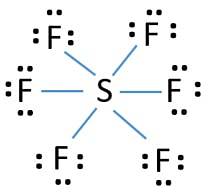
Structure of Sulfur Hexafluoride is as follows:
Properties of Sulfur Hexafluoride
[Click Here for Sample Questions]
It's a non-combustible gas that's colourless, odourless, and tasteless. When it is transported to another site, its vapour pressure causes it to liquefy. Frostbite can occur if you come into contact with the gas. When exposed to fire or heat for a lengthy period of time, the container has a chance of bursting with a loud bang. The lifespan of SF6 is expected to be between 800-3200 years.
Physical Properties of Sulfur Hexafluoride
| Other name | hexafluoro-λ6-sulfane |
| SF6 | Sulfur Hexafluoride |
| Density | 6.17 kg/m3 |
| Molecular weight / Molecular mass | 146.06 g/mol |
| Boiling point | −50.8 °C |
| Melting point | −64 °C |
| Chemical formula | SF6 |
Chemical Properties of Sulfur Hexafluoride
The atomic number of sulphur is 16. The sulphur atom has an electronic configuration of 2, 8, 6, i.e. 1S2 2S2 2P6 3S2 3P4. The atomic number of fluorine is 9. Fluorine has the electrical structure 1S2 2S2 2P5. In the SF6 molecule, each sulphur atom forms a covalent link with six fluorine atoms. Each sulphur atom receives a total of six covalent bonds, i.e. six pairs of electrons in its outer shell, whereas each fluorine atom receives eight electrons in its outermost shell.
When sulphur hexafluoride dissolves in water, sulfuric acid and hydrogen sulphide are produced. The chemical formula is shown below.
SF6 + 4H2O → H2SO4 + 6HF
When sulphur hexafluoride interacts with a base such as sodium hydroxide, sodium sulphate, sodium fluoride, and water are formed. Below is the chemical formula.
SF6 + 8NaOH → Na2SO4 + 6NaF + 4H2O
General Properties of Sulphur Hexafluoride
Atomic structure
First, we'll go over the structure of the SF6 molecule. One sulphur atom is surrounded by six fluorine atoms in this gas molecule. Look at the image below.

Stability
Under certain storage circumstances, sulphur hexafluoride is stable and has a two-year shelf life. The compound's physical and chemical stability is around 6 hours after reconstitution. It is advised that it be utilised right away in microbiological experiments.
Chemical and Thermal Inert
At room temperature, this is an unreactive chemical that is unaffected by acids, bases, or water. At red hot temperatures, it is also unaffected by copper, carbon, or magnesium. At 400 degrees Celsius, it interacts with hydrogen or sulphur vapour.
In the presence of an electrical discharge, it decomposed into lesser fluorides of sulphur.
Potent Greenhouse Gas
This is the most powerful greenhouse gas ever discovered, having a global warming capability 23900 times greater than Carbon Dioxide over a 100 year period. The SF6 mixing ratio is lower than the Carbon Dioxide mixing ratio. It was around 4 parts per trillion (ppt) in 1990, whereas CO2 had a mixing ratio of 365 ppm.
Read More: Cisplatin
Major Application Areas of Sulfur Hexafluoride
[Click Here for Sample Questions]
Following are the Major Application Areas of Sulfur Hexafluoride
- SF6 is a gaseous dielectric medium used in the electrical industry to replace oil-filled circuit breakers (OCBs) that can contain dangerous polychlorinated.
- For ultrasound imaging, SF6 is used as a contrast agent. Sulfur hexafluoride microbubbles are injected into a peripheral vein in a solution form.
- To avoid oxidation during casting, the magnesium industry employs SF 6 as an inert "cover gas."
- Consumption has decreased dramatically as a result of capture and recycling.
- In the semiconductor industry, SF6 plasma is utilised as an etchant in techniques like deep reactive-ion etching.
- In the plasma, a little amount of SF 6 breaks down into sulphur and fluorine, with the fluorine ions reacting chemically with silicon.
Uses of Sulfur Hexafluoride
[Click Here for Sample Questions]
Following are the Uses of Sulfur Hexafluoride:
- Sulfur Hexafluoride is a harmless gas that is mostly used as a test gas in respiratory physiology.
- It is also used as a tracer in measuring the dispersion and deposition of air contaminants, as well as in vitreoretinal surgery to reconstruct the vitreous chamber.
- The principal insulation for high voltage coaxial lines that may transport electricity above ground, underground, or underwater is sulphur hexafluoride.Sulfur hexafluoride is primarily utilised as an insulating medium in high-voltage electrical and electronic equipment.
- The Navy uses sulphur hexafluoride for shipboard targeting radar, torpedo propulsion systems, and undersea warfare acoustic countermeasures.
- It is used in the insulation of X-ray equipment, microwave and radar equipment, and many more.
Points to Remember
Following are some important points:
- Sulfur Hexafluoride is Colourless and odourless.
- Sulfur Hexafluoride is 5 times heavier than air.
- Sulfur Hexafluoride is Chemically stable and Non-toxic.
- Sulfur Hexafluoride is Temperature-resistant up to 500 °C.
- In medium- and high-voltage T&D applications, Sulfur Hexafluoride is commonly employed as an electrical and heat insulator.
Read More: Number of Moles Formula
Sample Questions
Ques: Is Inhaling Sulfur Hexafluoride Harmful? Is It Harmful to the Environment? (2 Marks)
Ans: Sulfur Hexafluoride is non-toxic and inert by nature. It's commonly used in conjunction with ultrasonography as a heart imaging agent. Suffocation will result if you are forced to inhale it only as Carbon dioxide or Nitrogen.
It has a high risk of causing global warming. Its share of the earth's atmosphere is rapidly increasing. During the working cycle, it decomposes under electrical stress and releases hazardous bi-products, posing a serious health risk to those exposed to the working environment.
Ques: Where can sulfur hexafluoride be found? (2 Marks)
Ans: On Earth, sulphur hexafluoride is mostly found as a man-made industrial gas, although it has also been discovered to occur naturally.
Exposing S8 to F2 gives us SF6. In 1901, the discoverers Henri Moissan and Paul Lebeau utilised the same procedure. Other sulphur fluorides are produced, however these are eliminated by heating the mixture to reduce any S2F10 (which is extremely poisonous) and then cleaning the result with NaOH to destroy any residual SF4.
Ques: Why is SF6 gas such a good dielectric medium? (2 Marks)
Ans: To begin, dielectricity is the capacity to carry electricity without conductivity, while dielectric strength is the ability to endure high voltage without breaking down. The capacity to acquire free electrons is known as electronegativity, and fluorine is the most electronegative element on the planet. Six fluorine molecules in SF6 are capable of breaking away from sulphur, capturing electrons during an arc, and then returning to their original condition. The gas's strong dielectric strength and electronegativity make it a preferred insulating gas for use in power T&D equipment.
Ques: In what other industries are SF6 gas used? (2 Marks)
Ans: SF6 is often found in radiological instruments, particle accelerators, semiconductor production equipment, and magnesium and aluminium casting, in addition to electrical T&D applications. It's also used as a tracer gas in mining and as sound insulation in windows.
Ques: Why is SF6 the preferred insulator for breakers and switchgears? (2 Marks)
Ans: When switching or opening electrical circuits, SF6 is particularly effective in quenching the arc created. It also has a high thermal conductivity, particularly at high temperatures, and hence conducts heat far more efficiently than air, nitrogen, helium, or other gases. Additionally, SF6-insulated equipment produces less noise, does not generate hot gases, and requires minimum maintenance.
Ques: What is SF6 gas? (2 Marks)
Ans: The chemical sulphur hexafluoride is an octahedral molecule with eight faces and six vertices. Six fluorine atoms circle a sulphur atom in this compound. Although the chemical can be found in nature, the majority of SF6 gas is generated. In 1900, scientists in Paris were the first to synthesise SF6. In the 1950s, large-scale production of this gas began in the United States.
The electrical and thermal insulating qualities of sulphur hexafluoride (SF6) are exceptional. As a result, it is widely employed in the transmission and distribution of medium- and high-voltage electrical power. However, it must be handled with caution.
Ques: Why is SF6 used in Gas Insulated Substation? (2 Marks)
Ans: This is utilised in Gas Insulated Substations (GIS) with absolute pressures ranging from 400 to 600 kPa. Sulfur Hexafluoride does not condense even at the lowest temperature that the instruments encounter in general, hence this pressure range was chosen with care. And its insulating capacity is double or triple that of air, with the same pressure for both. SF6 is nearly a hundred times better than air at interrupting arcs. This decomposes in an electric arc at high temperatures and recombines into SF6 without replenishing.
Ques: What does sulfur hexafluoride do to your voice? (2 Marks)
Ans: The non-combustible gas sulphur hexafluoride is six times heavier than the air humans breathe. The lighter Helium makes us sound higher, while the heavier SF6 makes us sound deeper. Our voice will sound deeper and slower since sound travels slower through heavy gases.
Also Read:



Comments