



Education Journalist | Study Abroad Lead
Ideal Gas and Real Gas are the two types of Gases that exist in the environment. Solids, liquids, and gases are the three states of matter that can be distinguished by their properties. Because of the strong molecular attraction, solids have a defined mass and shape. Because the molecules in liquids move, they take on the shape of the container. The molecules in gases are free to move about in the container. There are two types of gases. There are two types of gas: real gas and ideal gas. Because the particle size of an ideal gas is incredibly small, the mass is virtually zero, and there is no volume, the particle size is exceedingly small. A point mass is also referred to as an ideal gas. Even though they are minuscule particles, real gas molecules take up space and have volume.
| Table of Contents |
Key Terms: Ideal Gas, Real Gas, Gases, Mass, Volume, Molecules, Particles, Shape, States of Matter, Temperature, Air, Matter
Ideal Gas Law
[Click Here for Sample Questions]
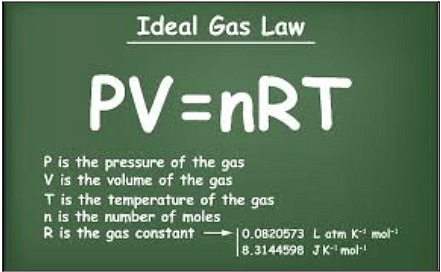
According to the Ideal Gas Law, the product of the pressure and the volume of one gram molecule of an ideal gas is equal to the product of the absolute temperature of the gas and the universal gas constant.
Given below is the Ideal Gas Law:
PV = nRT
P stands for pressure, V stands for volume, n stands for the number of moles of gas, R stands for the gas constant, and T stands for absolute temperature.
Regardless of their chemical identity, the ideal gas law applies to all ideal gases. However, it is a state equation that only applies in particular circumstances. It is assumed that particles collide completely elastically, have no volume, and don't interact with one another except to collide. To put it another way, the gas follows the kinetic molecular theory of gases.
Ideal Gas Law
Read More: States of Matter
Ideal Gas VS Real Gas
[Click Here for Sample Questions]
The difference between an Ideal gas and a Real gas is that the former is a hypothetical gas, while the latter exists in the present. Real gas obeys the rules of gas under some situations, whereas ideal gas obeys them always. The two gases also differ in terms of the volume occupied by their molecules, how they interact, and so on.
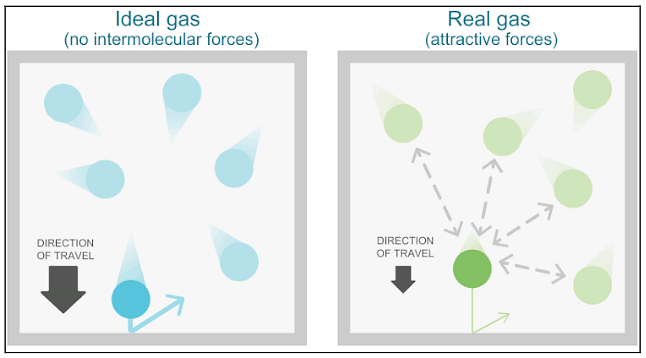
Ideal Gas is a hypothetical gas that does not exist in the real world. It follows the gas laws at all pressure and temperature circumstances. Because there is no interparticle connection in an ideal gas, many minute particles travel randomly in all directions.
Real gas, on the other hand, is found in our surroundings. Only at high temperatures and low pressures do real gases obey gas laws. Because these gases' molecules interact with one another, they do not behave like an ideal gas.
Ideal Gas VS Real Gas
Read More: Vaporization
Difference Between Ideal Gas and Real Gas
[Click Here for Sample Questions]
The main distinctions between Real Gas and Ideal gas are tabulated below:
| Ideal Gas | Real Gas |
|---|---|
| Under all pressure and temperature circumstances, an ideal gas obeys all of the gas laws. | The gas laws only apply to real gases when the pressure is low and the temperature is high. |
| In an ideal gas, molecules are free to flow and do not interact with other particles. | Interparticle contact occurs when molecules in a real gas clash with one another. |
| About the entire volume, the volume filled by an ideal gas is insignificant. | When compared to the entire volume, the volume occupied by a genuine gas is significant. |
| The pressure of an ideal gas is very high. | A real gas's actual pressure is lower than an ideal gas's pressure. |
| In a perfect gas, there are no intermolecular forces of attraction. | In a genuine gas, the forces are either attractive or repulsive. |
| PV = nRT is the formula for an ideal gas. | (P + (an2/V2)) (V-nb) = nRT is the formula for real gases. |
Difference Between Ideal Gas and Real Gas
Read More: Daltons Law of Partial Pressure
Similarities Between Real Gas and Ideal Gas
[Click Here for Sample Questions]
Real and ideal gases Gases have the following characteristics:
- Mass: Real and ideal gas particles both have mass.
- Low density: Gases have a lower density than liquids or solids. In both an ideal and a real gas, gas particles are generally far away from one another.
- Low particle volume: Since gases are not dense, the size or volume of gas particles is quite small in comparison to the distance between particles.
- Motion: Kinetic energy exists in both ideal and real gas particles. Gas particles move at random, along a straight line between impacts. The ideal gas law is particularly important because many real gases behave like ideal gases under two conditions:
- Low pressure: Many of the gases we come into contact with daily are at relatively low pressure. When pressure is high enough to drive particles into close contact, it becomes a factor.
- High temperature: A high temperature in the context of gases is any temperature that is much higher than the vaporization temperature. As a result, even at room temperature, real gas particles have enough kinetic energy to behave like an ideal gas.
Check More: Difference Between An Atom And A Molecule
Things to Remember
- Real gas exists in nature around us, whereas an ideal gas is a fictional gas.
- Real gases, on the other hand, obey the gas laws in conditions of low pressure and high temperature, but ideal gases do not.
- When a real gas is cooled to its boiling point, it does not condense, but an ideal gas does not.
- When compared to the whole volume, an ideal gas has a small volume, whereas a real gas has a substantially bigger volume than the ideal gas.
- The term "ideal gas" does not exist, but real gas examples include oxygen, hydrogen, carbon dioxide, and others.
- In a perfect gas, there are no intermolecular forces. Intermolecular forces in a real gas, on the other hand, can be either repulsive or attractive.
Read More: Real Gas
Sample Questions
Ques. What is Real gas? Give Examples. (3 Marks)
Ans. Real gases are those that do not follow the ideal gas laws exactly at all temperature and pressure conditions. Real Gas occupies a given amount of space and has the ability to interact with each other.
The common examples of Real Gas are as follows:
- Nitrogen
- Oxygen
- Hydrogen
- Carbon Dioxide
- Helium
Ques. What is an ideal gas? What is the Ideal Gas Law? (3 Marks)
Ans. Perfect gas, also known as an ideal gas, is a hypothetical gas that obeys the gas law exactly under all temperature and pressure conditions.
According to the Ideal Gas Law, PV = nRT, which means the product of the pressure and the volume of one gram molecule of an ideal gas is equal to the product of the absolute temperature of the gas and the universal gas constant.
Ques. What is the primary distinction between an Ideal and a Real gas? (3 Marks)
Ans. The following are the primary differences between Ideal and Real gas:
- An ideal gas is a hypothetical gas that obeys the gas law exactly under all temperature and pressure conditions, whereas real gas is a gas that deviates from the assumptions made by the kinetic–molecular theory.
- Real gas exists in nature around us, whereas an ideal gas is a fictional gas.
Real gases, on the other hand, obey the gas laws in conditions of low pressure and high temperature, but ideal gases do not.
Ques. Give some similarities between Real Gas and Ideal Gas. (3 Marks)
Ans. Some of the salient similarities between Real Gas and Ideal Gas are as follows:
- Real and ideal gas particles both have mass.
- Gas particles in both an ideal and a real gas are generally far away from one another.
- Kinetic energy exists in both ideal and real gas particles.
Ques. The ideal gas law makes which of the following assumptions? (3 Marks)
a) The forces of van der Waals are insignificant.
b) At all times, the molecules follow Newton's rules of motion.
c) The Coulomb model of electric repulsion governs intermolecular interactions.
d) The molecules are a fraction of the container's size.
e) The molecules move in a random pattern.
Ans. Option 'c' is the correct answer.
We assume that the interactions between the molecules are relatively short and that the forces involved are minimal in the ideal gas law. It is not required to assume that molecules obey Coulomb's law while interacting with one another; rather, an ideal gas must ignore Coulomb's law.
The ideal gas law is based only on Newtonian physics, with no consideration for intermolecular or electromagnetic forces.
Ques. Which of the following reasons does not account for why real-world gas measurements differ from ideal values? (3 Marks)
b) The total volume of the gas particles
c) Forces between molecules
d) All of these factors will cause values to deviate from the ideal.
Ans. Option 'a' is the correct answer.
Because intermolecular interactions and the volume of the particles themselves are not taken into account for ideal gases, measurements of real gases differ from ideal gas predictions. For perfect gases, the volume of the space between particles is taken into account, but it has no bearing on deviation from ideal gas behaviour.
Real pressure is somewhat less than ideal pressure due to molecule attraction, while real volume is slightly more than ideal volume due to gas-particle volume.
Ques. How many different types of an ideal gas are there? (3 Marks)
a) 2
b) 3
c) 4
d) 5
Ans. Option 'b' is the correct answer.
The three primary types of Ideal Gas are as follows:
- Classical or Maxwell–Boltzmann Ideal Gas,
- Ideal Quantum Bose Gas which is made of bosons
- Ideal Quantum Fermi Gas which composed of fermions
Ques. What is the definition of a real molecule? (1 Mark)
Ans. The real molecules are finite in size and do not overlap, resulting in a strong, short-ranged repulsion. The strong, short-ranged repulsion has its origin in the Pauli exclusion of the electrons in the outer orbitals.
Ques. What is the Z compression factor, and what does it mean? (1 Mark)
Ans. The compression factor Z is the ratio of observed molar volume Vm to ideal molar volume V m ideal (= RT/p) as a function of pressure and temperature at a constant temperature.
Ques. Which of the following statements is incorrect? (1 Mark)
a) As long as a gas's temperature remains constant, its density remains constant.
b) Gases have no limit to their expansion.
c) When gases are mixed in the same container, they diffuse into each other and combine almost instantly.
d) A gaseous compound's molecular weight is a constant amount.
e) To restrict a gas sample, pressure must be applied to it.
Ans. Option 'a' is the correct answer.
Ques. What does R stand for in pV=nRT? (1 Mark)
a) solid constant
b) gas constant
c) liquid constant
d) absolute temperature
Ans. Option 'b' is the correct answer.
(0.08206 L•atm•K1•mol1) is the gas constant.
Ques. Which of the following statements about a polytropic process is correct? (1 Mark)
a) The term p(vn) is used to describe the procedure.
b) It isn't adiabatic at all.
c) It isn't adiabatic in any way.
d) All of the above
Ans. Option 'd' is the correct answer.
An adiabatic process has these characteristics.
Read More:



Comments