



Exams Prep Master
For any given triangle, according to the triangle inequality theorem, the sum of two sides of a triangle is always greater than the third side. Triangle is a polygon bounded by three line-segments, and is the smallest possible polygon. A triangle has three sides, three vertices, and three interior angles. A triangle is the smallest polygon that has three sides and three vertices. It also has three angles. Inequality is a non-equal comparison between two sides of a triangle where one value is less than, greater than, or equal to the value on the other side of the equation. Here, we will be discussing the topic in detail along with some important questions.
| Table of Content |
Also read: First Order Differential Equation
What is Triangle Inequality?
[Click Here for Sample Questions]
According to Euclidean geometry, Triangle Inequality is the theorem in which the sum of any two sides of a triangle is greater than, or equal to the third side of the triangle.
Ex. a+b ≥ c

In other words, the inequality theorem is applicable for all types of triangles such as equilateral triangles, isosceles triangles, and scalene triangles.
Also Read: Relation between Mean, Mode, and Median
Triangle Inequality Theorem
[Click Here for Sample Questions]
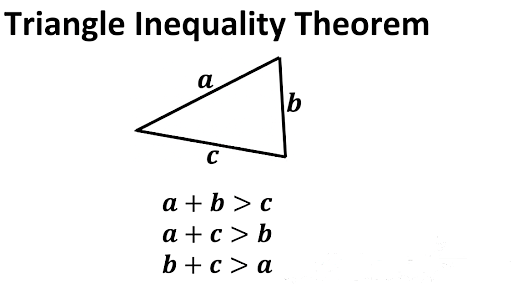
The Triangle Inequality theorem as the name suggests defines the relationship between the three sides of the triangle. It is one of the important mathematical expressions that help to calculate the unknown length of the sides of a triangle and provide a rough figure of various dimensions.

According to the Triangle Inequality theorem,
- AB + BC should be greater than the third side AC
- AB + BC ≥ AC
- AB + AC should be greater than the third side BC
- AB + AC ≥ BC
- BC + AC should be greater than the third side AB
- BC + AC ≥ AB
Also Read: Frequency Distribution
Theorem Proof
[Click Here for Sample Questions]
The triangle inequality theorem-proof is given below.
In a given triangle ABC, two sides are taken together in a manner that is greater than the remaining one.

BA, AC is greater than BC, AB, BC greater than AC, BC, CA greater than AB.
Let BA be drawn through to point D, let DA be made equal to AC, and let CD be joined.
Now DA is equal to AC, the angle ADC is also equal to the angle ACD, therefore the angle BCD is greater than the angle ADC.

Since DCB is a triangle having the angle BCD greater than the angle BDC, and the greater angle is subtended by the greater side, therefore DB is greater than BC.
AS DA is equal to AC, therefore BA, AC is greater than BC.
Similarly it is proven that AB, BC are also greater than CA, and BC, CA than AB.
Also Read: Measures of Dispersion
Things to Remember
- Triangle Inequality implies where the sum of two sides of a triangle is greater than or equal to the third side of the triangle
- The three sides of a triangle are formed when 3 different line segments join at the vertices of a triangle
- This theorem is useful for checking whether a given set of three-dimension will form a triangle or not
Sample Questions
Ques: If the sides of the length of a triangle are given as 9, 5, and 7. Prove that they satisfy the inequality theorem. (3 marks)
Ans: If the given sides of the triangle are in inequality then they should satisfy the given equation, AB + BC ≥ AC, AB + BC > BC and BC + AC > AB
Let AB= 9 , BC = 5cm and AC = 7 cm
Then
AB+BC > AC
9+ 5 > 7
=> 14> 7
BC + AC > AB
5 + 7 > 9
=> 12 > 9
AB + BC > BC
9 + 7 > 5
=> 16 > 5
All the three conditions are satisfied, therefore a triangle can be formed with sides 8 cm, 5 cm, and 7 cm.
Ques: Jhanvi has three measurements with him 10 cm, 6 cm, and 17 cm. Will she be able to form a triangle with these three measurements? (3 marks)
Ans: According to the question, the measurements given are a = 10 cm, b = 6 cm and c = 17cm.
Now as per the triangle inequality theorem, a + b > c
10 + 6 > 17
=> 16> 17
Now, a + c> b
10+ 17 > 6
=> 27> 6
Now, b + c > a
6 + 17 > 10
=> 23 > 10
As the first condition is not fulfilled according to the triangle inequality theorem, Jhanvi will not be able to form a triangle.
Ques: Could a triangle be possible with the side length of 8cm, 9 cm, and 10 cm? (3 marks)
Ans: Given the measurement of the sides of a triangle as AB = 8cm, BC = 9 cm and AC = 10cm
Then according to triangle inequality theorem, they should satisfy the given equation, a + b > c, a + c> b and b + c > a
Now, a+b>c
Then 8+10>9
18 >9 (this is true )
a+c > b
8 + 10 > 9
18 > 9 (this is true )
b+c > a
9 + 10 > 8
19 > 8
All the three conditions are satisfied therefore a triangle could have 8 cm, 9 cm, and 10 cm.
Ques: The two sides of a triangle have lengths of 5 and 19. Can a third have a length of 13? (3 marks)
Ans: Given the measurement of the two sides of the triangle 5 and 19
Now let us consider 19 as the longer side of the triangle and 5, 13 are the shorter sides
So, the larger side of the triangle should be larger than the sum of the other side, a+b>c or b+c>a or a+c>b
5 + 13 > 19
=> 18 > 19 ( this is false according to triangle inequality theorem)
Therefore this triangle cannot have the third side of the length as 13
Ques: 2 sides of a triangle have length 4 and 10 of the third side has a length of integer x. How many possible values are there for x? (3 marks)
Ans: Given the measurements of a triangles as A = 4 cm, B = 10cm and C = x
The sum of the two sides of the triangle must be greater than the third side
A + B> C
4 + 10 > x
14 > x or x > 14
Now, the difference of two sides must be less than the third side
B - A < C
10 -4 < x
6 < x or x > 6
6 < x < 14
So the values of ‘x’ should range between 6 and 14. The value of x can be 7, 8, 9, 10, 11, 12, and 13
Ques: If 5 cm, 9 cm, and 15 cm are the measures of the three sides of the different triangles. Can a triangle be made using these sides? (3 marks)
Ans: Given in the question the three side measurements of the triangle A = 5 cm, B = 9 cm and C =15
According to the question ,they should satisfy the triangle inequality theorem a +b > c
5 + 9 > 15
=> 14 > 15 ( first statement is false)
b + c > a
15 + 9 > 5
=> 24 > 5
a + c > b
Therefore according to the triangle inequality theorem, the triangle cannot be made by using these sides
Ques: What will be the possible values of the length of the third side of a triangle if the sides of a triangle have lengths 8 and 17? (3 marks)
Ans: Given in the question the measurement of the side of a triangle 8 and 17
Now let suppose, third side is ‘x’
According to the question, a +b > c
8+ 17 > x
25 > x or x> 25
Now, the difference of two sides must be less than the third side
B - A < C
17 -8 < x
9< x or x > 9
9 < x < 24
So the values of ‘x’ should range between 9 and 25. The value of x can be 10, 11, 12, 13, 14, 15, 16,17, 18, 19, 20, 21, 22, 23, and 24
More Relatable topics to read:



Comments