



Content Curator
Cosine Rule is a square of the length of any side of a triangle, equal to the sum of the squares of the length of the other sides and minus twice the product of the other two sides multiplied by the cosine of the angle.
- These rules are called Cosine law or Cosine rule formula.
- However, cosine rules can be used when either three sides of the triangle are given or two sides of angles are given.
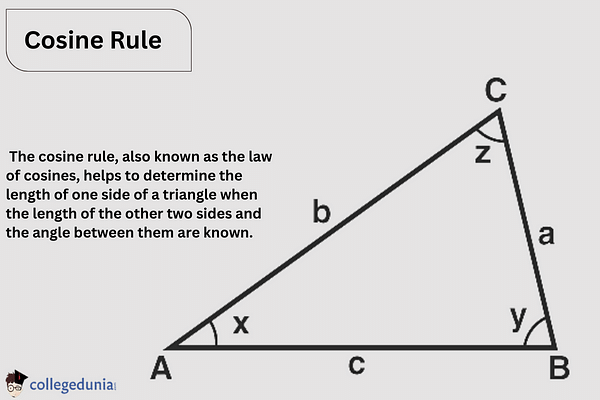
- The cosine rule, also known as the law of cosines, helps to determine the length of one side of a triangle when the length of the other two sides and the angle between them are known.
The Cosine rule further claims that:
| “The square of one side of a triangle is equal to the sum of the squares of the other two sides minus twice the product of those sides and the cosine of the included angle.” |
Cosine rule is a useful tool that has wider applications in trigonometry, navigation, and other fields where triangles are used. The formula can be written in a number of ways, but a common form is:
c2 = a2 + b2 – 2ab cos(C)
Here,
- c = length of the unknown side
- a and b = lengths of the other two sides
- C = angle between a and b.
Also Read: Trigonometric Functions
| Table of Content |
Keyterms: Cosine, Traingle, Angle, Pythagoras theorem, Trigonometry ratio
What is Cosine Rule?
[Click Here for Sample Questions]
The cosine rule is a formula which helps in relating the sides and angles present in a triangle. It further also claims that “the square of one side of a triangle is equal to the sum of the squares of the other two sides minus twice the product of the two sides and the cosine of the angle between them.”
Suppose if a, b and c are lengths of the side of a triangle ABC, then the cosine rule formula states that:
| a2 = b2 + c2 – 2bc cos ∠x b2 = a2 + c2 – 2ac cos ∠y c2 = a2 + b2 – 2ab cos ∠z |
Where,
- ∠x is the angle between sides b and c.
- Similarly, ∠y and ∠z is the angle between ca and ab
Hence, by using the cosine rule we can calculate the length of the side of a triangle.
What is Cosine Rule?
Cosine Formula
The formula required in order to determine the sides of the triangle using cosine rule is given below:
- \(\begin{array}{l}a = \sqrt{b^2 + c^2 – 2~b~c~ cos x}\end{array}\)
- \(\begin{array}{l}b = \sqrt{a^2 + c^2 – 2~a~c~ cos y}\end{array}\)
- \(\begin{array}{l}c = \sqrt{a^2 + b^2 – 2~a~b~cos z}\end{array}\)
Sine Formula
According to the sine law,
a / Sin A= b/ Sin B= c / Sin C
Here,
a,b and c are the triangle’s sides and A, B and C are its respective angles.
It can also be written as:
→ a : b: c = Sin A: Sin B: Sin C
Also check:
Laws of Cosine
[Click Here for Previous Year Questions]
Let's take the example:
Suppose we have the a,b, & c as the length of the side of triangle ABC. Hence, as per the formula:

a2 = b2 + c2 – 2bc cos x
b2 = a2 + c2 – 2ac cos y
c2 = a2 + b2 – 2ab cos z
However to find the angles x, y and z, these formulae can be written as :
- cos x = (b2 + c2 -a2)/2bc
- cos y = (a2 + c2 -b2)/2ac
- cos z = (a2 + b2 – c2)/2ab
Cosine Rule Proof
As per the Cosine Rule, Triangle ABC with side a,b, & c we have,
c2 = a2 + b2 – 2ab cos C
Now let us prove this law.
Let's take a triangle ABC with the vertex of angle B, we draw a perpendicular touching the side AC at point D. This is the height of the triangle denoted by h.
After that, as per the trigonometry ratio, we know the triangle BCD;
→ cos θ = Base/Hypotenuse
i.e.
cos C = CD/a
or we can write;
CD = a cos C ………… (1)
Let's subtract equation 1 from side b on both sides, and then we get;
→ b – CD = b – a cos C
or
→ DA = b – a cos C
Again, as per the trigonometry ratio, we know the triangle BCD:
sin θ Perpendicular/Hypotenuse
i.e.
→ sin C = BD/a
or we can write;
BD = a sin C ……….(2)
By considering Pythagoras' theorem in triangle ADB, we get;
→ Hypotenuse2 = Perpendicular2 + Base2
i.e.
c2 = BD2 + DA2
Let's substitute the value of DA and BD from equations 1 and 2;
→ c2 = (a sin C)2 + (b – a cos C)2
→ c2 = a2 sin2C + b2 – 2ab cos C + a2 cos2 C
→ c2 = a2 (sin2C + cos2 C) + b2 – 2ab cos C
By trigonometric identities, we know;
→ sin2θ + cos2θ = 1
Therefore,
c2 = a2 + b2 – 2ab cos C
Hence, proved.
Solved Example of Cosine Rule
[Click Here for Sample Questions]
Example: What will be the angle of triangle ABC if AB = 42cm, BC = 37cm and AC = 26cm?
Solution: As per the question we have following given things:
a = 37
b = 26 and
c = 42
Formula of cosine rule: a2 = b2 + c2 − 2bc cos A
So,
372 = 262 + 422 − 2(26)(42) cos A
cos A = 262 + 422 − 372 /(2)(26)(42)
After solving the cos A we get the value of cos A as
cosA= 1071/2184
Which is equal to
Cos A= 0.4904
Thus,
A = cos − 1 0.4904 = 60.63o
Trigonometric Functions Video Explanation
Also check:
Things to Remember
- To find the length of sides of triangle ABC, we can write as; a2 = b2 + c2 – 2bc cos α, b2 = a2 + c2 – 2ac cos β and c2 = b2 + a2 – 2ba cos γ
- And if we want to find the angles of ABC, then the cosine rule is applied as; cos α = [b2 + c2 – a2]/2bc, cos β = [a2 + c2 – b2]/2ac and cos γ = [b2 + a2 – c2]/2ab
- The sine rule: a/sin A = b/sin B = c/sin C
- The Cosine rule is also known as the Law of Cosines.
- Cosine Rule is a formula which helps relate the sides and angles of a triangle.
For Latest Updates on Upcoming Board Exams, Click Here: https://t.me/class_10_12_board_updates
Previous Year Questions
- The value of sin251∘+sin239∘ is….(KCET 2010)
- If |tanA+cotA=2, then the value of tan4A+cot4A=...(KCET 2020)
- The value of cos245∘−sin215∘ is….(KCET 2017)
- If cosec θ − cot θ = 2017, then quadrant in which θ lies is… (TS EAMCET - 2017)
- Consider a triangular plot ABC with sides AB = 7m, BC = 5m… (JEE Main - 2019)
- If the sum of all the solutions of the equation… (JEE Main - 2018)
- Let a vertical tower AB have its end A on the level ground. Let… (JEE Main - 2017)
Sample Questions
Ques. What is the Cosine formula? (1 mark)
Ans. The cosine formula is used to find the side of the triangle. However, the formula of cosine is given below
c = √[a2 + b2 – 2ab cos C] ( a,b and c are the sides of the triangle)
Ques. Express sin 12θ + sin 4θ as the product of sines and cosines. (1 mark)
Ans. The sum can be expressed as:
→ 2 sin8θ cos4θ
Ques. Express 2 cos4x sin2x as an algebraic sum of sines or cosines. (1 mark)
Ans. The sum can be expressed as:
→ sin 6x – sin2x
Que. When can we use the cosine rule? (1 mark)
Ans. The cosine rule is used when we need to find all angles when all three sides of the triangle are mentioned. Also, the cosine rule is used to find the third side of the triangle when we know the two sides of the triangle
Ques. What is the sine rule formula? (1 mark)
Ans. As per the sine rule, if x, y, and z are the length of sides of a triangle and X, Y, and Z are the angles, then,
(x/sin X) = (y/sin Y) = (z/ sin Z)
Ques. How is the cosine rule used to find angles? (2 marks)
Ans. The formula to find the angle is:
Cos C = (a2 + b2 – c2)/2ab
Where C is the included angle and a,b and c are the sides of the triangle.
Ques. How to find the length of x in the below figure? (2 marks)
Ans. We know that if we apply the Cosine rule, we get:
x2 = 222 +282 – 2 x 22*28 cos 97
x2 = 1418.143
x = √ 1418.143
Ques. What is the condition of the cosine rule? (2 marks)
Ans. The Cosine Rule is used in the following cases:
- When two sides are given and an included angle (SAS).
- Also when all the three sides are given
Ques. Does Pythagoras' theorem only work in Cosin? (1 mark)
Ans. Pythagoras' theorem tells us that the square of the hypotenuse side is equal to the sum of squares of the other two sides. However, it works for right-angled triangles so that we can check whether a triangle has a right angle or not.
Ques. What is the cosine rule? (1 mark)
Ans. In a mathematical term the cosine rule is a2 = b2 + c2 – 2bc cos x. It means when we square the length of any one side of a triangle and put it as equal to the sum of the squares of the length of the other two sides, After that subtracted by twice their product multiplied by the cosine of their included angle then it becomes the cosine rule.
Ques. Prove the following:
(sin4θ – cos4θ +1) cosec2θ = 2 (3 marks)
Ans. As per the L.H.S:
(sin4θ – cos4θ +1) cosec2θ
Thus,
= [(sin2θ – cos2θ) (sin2θ + cos2θ) + 1] cosec2θ
Now, by applying the identity sin2A + cos2A = 1,
= (sin2θ – cos2θ + 1) cosec2θ
= [sin2θ – (1 – sin2θ) + 1] cosec2θ
= 2 sin2θ cosec2θ
= 2 sin2θ (1/sin2θ)
= 2
= RHS
Ques. Prove the following and determine whether it is LHS =RHS:
(√3 + 1) (3 – cot 30°) = tan360° – 2 sin 60°. (3 marks)
Ans. LHS = (√3 + 1)(3 – cot 30°)
= (√3 + 1)(3 – √3)
= 3√3 – √3.√3 + 3 – √3
= 2√3 – 3 + 3 = 2√3
Now, for the RHS, we have = tan360° – 2 sin 60°
= (√3)3 – 2(√3/2)
= 3√3 – √3 = 2√3
Thus, (√3 + 1) (3 – cot 30°) = tan360° – 2 sin 60°.
Hence proved.
Ques. Where is the cosine rule used? (1 mark)
Ans. The Cosine rule helps to solve a triangle's lengths of each of its sides and all its angles. The sine rule. however, is used when either a) two angles and one side, or b) two sides and a non-included angle are mentioned.
Check-More:



Comments