




TS PGLCET 2026, or Telangana State Post Graduate Law Common Entrance Test, is conducted by Osmania University, Hyderabad, on behalf of TGCHE for admission to 2-year LLM programmes in law colleges across Telangana. The 2026 exam was conducted on May 18, 2026, and the counselling process is now in its final phase. The Phase 3 seat allotment was released on September 27, 2026, and allotted candidates must complete the admission process by September 30, 2026.
-
Phase 3 Allotment: The TS PGLCET 2026 Phase 3 seat allotment result was released on September 27, 2026. Candidates can check their allotment through the official counselling portal.
-
Reporting Deadline: Candidates allotted seats in Phase 3 must report to their respective colleges by September 30, 2026 for original certificate verification and tuition fee payment.
-
Phase 3 Eligibility: Candidates who received a Phase 2 seat but did not report or cancelled their admission are not eligible to participate in the final phase.
-
Counselling Process: Candidates allotted seats must complete the required admission formalities, including tuition fee payment and physical reporting at the allotted college within the specified deadline.
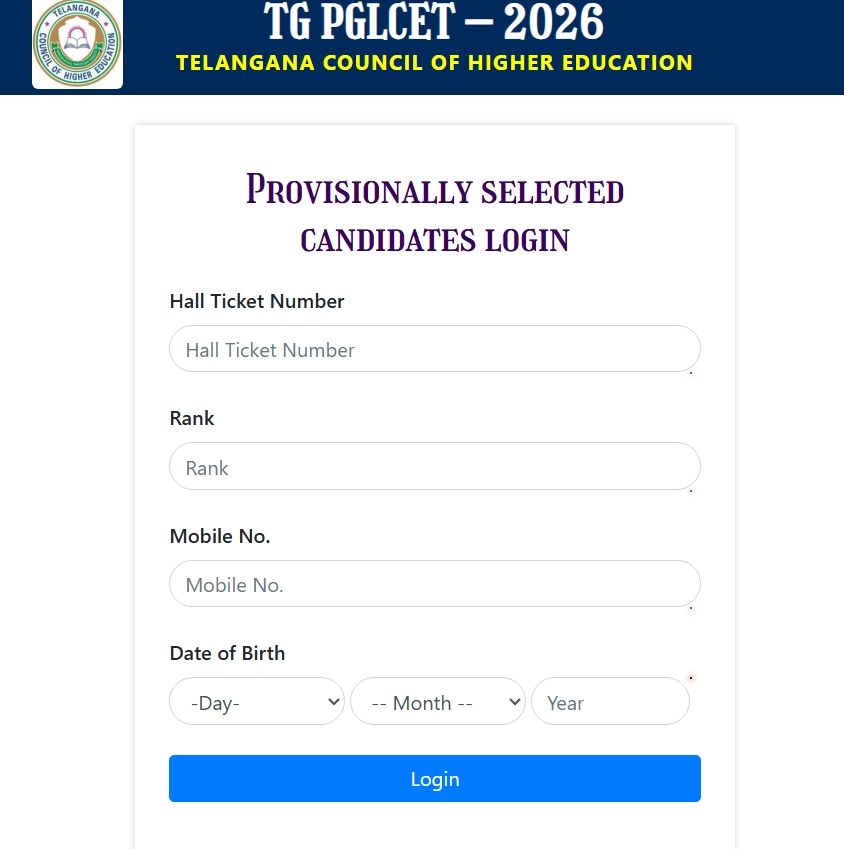
Source: lawcetadm.tgche.ac.in/allot26llmp3
What is TS PGLCET 2027?
TS PGLCET stands for Telangana State Post Graduate Law Common Entrance Test. It is a state-level entrance exam for admission to 2-year LLM (Master of Laws) programmes at universities and law colleges in Telangana. Osmania University, Hyderabad, conducts this exam every year on behalf of TGCHE. The exam is also referred to as TG PGLCET in some official communications.
You should know that TS PGLCET is different from TS LAWCET. TS LAWCET is for admission to LLB (3-year and 5-year) programmes, while TS PGLCET is specifically for LLM admission. Both exams are conducted on the same day but have separate question papers. If you want to pursue a postgraduate law degree in Telangana, TS PGLCET is the exam you need to qualify.
The exam is a Computer-Based Test (CBT) of 120 questions and 90 minutes duration, conducted in English. More than 750 LLM seats are available at 30+ colleges through this test. About 85% of seats go to local (Telangana) candidates and 15% are open to candidates from other states. The official website is lawcet.tgche.ac.in.
| Particulars | Details |
|---|---|
| Exam Name | Telangana State Post Graduate Law Common Entrance Test |
| Short Name | TS PGLCET / TG PGLCET |
| Conducting Body | Osmania University, Hyderabad (on behalf of TGCHE) |
| Exam Level | State-Level (Telangana) |
| Exam Mode | Computer-Based Test (CBT) |
| Medium | English |
| Duration | 90 minutes |
| Total Questions | 120 |
| Total Marks | 120 |
| Marking Scheme | +1 for each correct answer; no negative marking |
| Exam Frequency | Once a year |
| Admission To | LLM (2-year) programmes |
| Total Seats (Approx.) | 750+ seats across 30+ colleges |
| Official Website | lawcet.tgche.ac.in |
Source: TGCHE Official Website
TS PGLCET 2027 Important Dates
The TS PGLCET 2027 official schedule has not been released yet. The notification is expected in February 2027. Based on the 2026 and 2025 exam calendars, you can expect the following tentative schedule. All dates below are estimates and will be confirmed once the official notification is published.
All 2027 dates listed below are expected dates based on previous year trends. Official dates will be published on lawcet.tgche.ac.in after the notification is released in February 2027.
| Event | TS PGLCET 2027 (Expected) | TS PGLCET 2026 (Actual) | TS PGLCET 2025 (Actual) |
|---|---|---|---|
| Official Notification | February 2027 | February 8, 2026 | – |
| Application Start Date | February 2027 | February 10, 2026 | – |
| Last Date Without Late Fee | March/April 2027 | April 1, 2026 | – |
| Last Date With Late Fee | May 2027 | May 13, 2026 | – |
| Admit Card Release | May 2027 | May 2026 | – |
| Exam Date | May 2027 (Expected) | May 18, 2026 | June 6, 2025 |
| Provisional Answer Key | May 2027 | May 23, 2026 | – |
| Final Answer Key and Result | June 2027 | June 4, 2026 | June 25, 2025 |
| Counselling Registration | July/August 2027 | July 27 – August 15, 2026 | September 27, 2025 |
| Phase 1 Verified List | August 2027 | August 16, 2026 | – |
| Phase 1 Web Options | August 2027 | August 17–19, 2026 | – |
| Phase 1 Seat Allotment | August/September 2027 | August 2026 | October 15, 2025 |
TS PGLCET 2027 Eligibility Criteria
Before applying for TS PGLCET 2027, you must make sure you meet the eligibility criteria. The official eligibility will be confirmed when the notification is released, but based on previous years, the requirements are likely to remain the same.
Nationality
- You must be an Indian national to apply for TS PGLCET 2027.
- NRI candidates and persons of Indian origin may be eligible under specific reserved NRI seats, as notified by the admitting institution.
Age Limit
- There is no age limit for TS PGLCET. Any candidate who meets the educational qualification can apply, regardless of age.
Educational Qualification
- You must have passed a 3-year LLB degree (after graduation) or a 5-year integrated LLB degree (after completing 10+2).
- The degree must be from a recognised university or institution approved by the Bar Council of India.
- Candidates appearing in the final year of their LLB degree are also eligible to apply. However, they must submit their original degree certificate and mark sheets at the time of admission into the LLM programme.
Qualifying Marks in the Entrance Test
- General/OBC candidates must score at least 35% marks (42 out of 120) in the TS PGLCET exam to qualify.
- SC and ST candidates have no minimum qualifying marks requirement in the entrance test. They need to appear in the exam to be eligible for counselling.
Local and Non-Local Candidate Status
- 85% of seats are reserved for local candidates (Telangana state residents).
- The remaining 15% of seats are open to non-local candidates from other states.
- Local candidate status is determined as per the rules prescribed by the Government of Telangana. You must have studied for a required number of years in Telangana, or your parents should be employed in Telangana.
Candidates who hold an LLB degree from a foreign university are generally not eligible for TS PGLCET unless specifically permitted by TGCHE. You should confirm this from the official notification before applying.
TS PGLCET 2027 Application Process
The TS PGLCET 2027 application process will be entirely online through the official website. The registration is expected to start in February 2027. You should keep your documents ready in advance so that you can apply as soon as the application form opens.
How to Apply for TS PGLCET 2027 — Step by Step
- Step 1 – Visit the Official Website: Go to lawcet.tgche.ac.in. Click on the TS PGLCET 2027 application link when it becomes available.
- Step 2 – Register: Enter your mobile number and email ID to create your login credentials. You will get an OTP for verification.
- Step 3 – Fill the Application Form: Enter your personal details (name, date of birth, address), academic qualifications (LLB degree details, year of passing), category (General/SC/ST/OBC), and local/non-local status. Fill in all fields carefully — errors are hard to correct later.
- Step 4 – Upload Documents: Upload a recent passport-size photograph and your signature in the required format (JPG/JPEG). The photo and signature must be clearly visible and within the specified file size.
- Step 5 – Pay the Application Fee: Pay the fee online through net banking, credit/debit card, or UPI. Keep the payment receipt as proof.
- Step 6 – Submit and Print: Review all details before final submission. After submitting, download and print the confirmation page for future reference.
TS PGLCET 2027 Application Fee
| Category | Expected Fee (2027) | 2026 Actual Fee |
|---|---|---|
| General / OBC | Rs 1,100 (Expected) | Rs 1,100 |
| SC / ST | Rs 900 (Expected) | Rs 900 |
The application fee is non-refundable once paid. Always double-check your details before making the payment.
Documents to Keep Ready Before Applying
- Scanned passport-size photograph (JPG/JPEG, recent, white background)
- Scanned signature (JPG/JPEG, on white paper)
- LLB degree certificate and mark sheets (all years)
- Category certificate if you belong to SC/ST/OBC/EWS
- Local candidate certificate (required to claim local seat reservation)
- Aadhar card or any valid photo ID
Application Correction Window
TGCHE usually opens a short correction window after the regular application deadline closes. During this period, you can fix minor errors in your submitted application form. No separate fee is charged for corrections in most years. The exact dates for the correction window will be published in the official notification.
TS PGLCET 2027 Exam Pattern
The TS PGLCET exam pattern is simple and consistent over the years. The exam has 120 multiple choice questions (MCQs) divided into two parts. Each correct answer gives 1 mark, and there is no negative marking. This means you should attempt all questions, even if you are not sure of the answer.
| Feature | Details |
|---|---|
| Mode of Exam | Computer-Based Test (CBT) |
| Medium | English |
| Duration | 90 minutes (1.5 hours) |
| Total Questions | 120 |
| Total Marks | 120 |
| Type of Questions | Multiple Choice Questions (MCQs) with 4 options |
| Marks Per Correct Answer | 1 Mark |
| Negative Marking | No |
Subject-wise Question Distribution in TS PGLCET 2027
| Part | Subject | Number of Questions | Marks |
|---|---|---|---|
| Part A | Jurisprudence and Constitutional Law | 40 | 40 |
| Part B | Public International Law | 80 (combined for all 5 subjects) | 80 |
| Mercantile Law | |||
| Labour Law | |||
| Crimes and Torts | |||
| IPR and Other Laws | |||
| Total | 120 | 120 | |
Part A covers Jurisprudence and Constitutional Law and carries 40 marks (33% of the paper). Part B covers five law subjects and carries 80 marks (67%). Since Part B has more questions, you should make sure you are strong in at least 3-4 of the five Part B subjects. There is no sectional time limit — you can move between questions freely during the 90-minute window.
TS PGLCET 2027 Syllabus
The TS PGLCET 2027 syllabus is based on LLB-level subjects. It covers core law topics that you would have studied during your 3-year or 5-year LLB programme. The detailed official syllabus will be published with the 2027 notification, but based on previous years, the syllabus covers the following subjects and topics:
Part A Syllabus: Jurisprudence and Constitutional Law
Jurisprudence tests your understanding of the theoretical and philosophical aspects of law:
- Nature, definition, and purpose of law
- Sources of law: Legislation, Precedent, Custom, Equity
- Schools of Jurisprudence: Natural Law school, Positivist school (Austin, Hart), Historical school (Savigny), Sociological school (Pound), Realist school
- Legal rights and duties; legal persons (corporations, states)
- Concepts of ownership, possession, and property
- Theories of punishment
- Concept of justice (distributive and corrective)
Constitutional Law of India covers the structure and working of the Indian Constitution:
- Preamble — objectives and significance
- Fundamental Rights under Articles 12 to 35
- Directive Principles of State Policy (Articles 36–51)
- Fundamental Duties (Article 51A)
- Parliament, President, and Council of Ministers at the Union level
- State Legislature, Governor, and State Executive
- Judiciary: Supreme Court and High Courts — composition, jurisdiction, and powers
- Federal structure: Centre-State relations (legislative, administrative, financial)
- Emergency provisions (Articles 352, 356, 360)
- Amendment procedure (Article 368) and the basic structure doctrine
- Judicial review and constitutional interpretation
- Landmark Supreme Court judgements
Part B Syllabus: Law Topics
Public International Law:
- Nature, definition, and sources of International Law (treaties, custom, general principles)
- Subjects of International Law: states, international organizations, individuals
- Recognition of states and governments
- State territory: acquisition and loss
- Law of treaties (Vienna Convention on the Law of Treaties, 1969)
- Diplomatic and consular relations
- International organizations: United Nations (UN Charter, Security Council, General Assembly), WTO, ICJ
- International human rights law
- Settlement of international disputes
- Laws of war, armed conflict, and neutrality
Mercantile Law:
- Indian Contract Act, 1872 — essentials of a valid contract, offer, acceptance, consideration, breach and remedies
- Sale of Goods Act, 1930 — conditions and warranties, passing of property, rights of unpaid seller
- Negotiable Instruments Act, 1881 — promissory note, bill of exchange, cheque, dishonour and notice
- Partnership Act, 1932 — formation, rights and liabilities of partners, dissolution
- Companies Act, 2013 — types of companies, incorporation, memorandum and articles, directors
- Consumer Protection Act, 2019
- Arbitration and Conciliation Act, 1996 (basics)
Labour Law:
- Industrial Disputes Act, 1947 — definitions, disputes, strikes and lockouts, lay-off and retrenchment
- Factories Act, 1948 — health, safety, welfare, working hours, child labour provisions
- Trade Unions Act, 1926 — registration, rights and liabilities of trade unions
- Workmen’s Compensation Act, 1923
- Minimum Wages Act, 1948
- Payment of Bonus Act, 1965
- Payment of Gratuity Act, 1972
- Equal Remuneration Act, 1976
- The Four Labour Codes (2019–2020) — an overview of the consolidation of labour laws
Crimes and Torts:
- Indian Penal Code, 1860 — general principles (mens rea, actus reus, stages of crime), specific offences (hurt, murder, theft, fraud, offences against women)
- Bharatiya Nyaya Sanhita (BNS) — the new criminal code replacing the IPC; key changes
- Code of Criminal Procedure, 1973 — arrest, bail, trial procedure, appeals
- Law of Torts — nature of tort, general defences, negligence, nuisance, defamation, trespass, vicarious liability, strict liability (Rylands v Fletcher), absolute liability
- Consumer Protection and product liability as a branch of tort law
Intellectual Property Rights (IPR) and Other Laws:
- Patents Act, 1970 — patentable inventions, grant, infringement, revocation
- Copyright Act, 1957 — original works, rights of copyright holders, infringement, fair use
- Trade Marks Act, 1999 — registration, passing off, infringement
- Designs Act, 2000 (basics)
- Information Technology Act, 2000 — cybercrimes and data protection basics
- Environmental Law — constitutional provisions (Articles 48A, 51A(g)), Environment Protection Act, 1986
- Family Law — Hindu personal law (Hindu Marriage Act, Hindu Succession Act basics); Muslim personal law (marriage, divorce, inheritance basics)
The official TS PGLCET 2027 syllabus will be published with the notification on lawcet.tgche.ac.in. You should always confirm the final syllabus from the official source before starting your preparation.
TS PGLCET 2027 Admit Card
The TS PGLCET 2027 admit card will be released on the official website a few days before the exam. Based on the 2026 timeline, you can expect the admit card in May 2027. In 2026, the TS PGLCET admit card was released about a week before the exam, which was held on May 18, 2026. You will need your registration number and date of birth to download it.
How to Download TS PGLCET 2027 Admit Card
- Go to the official website at lawcet.tgche.ac.in.
- Click on the TS PGLCET 2027 admit card download link.
- Enter your registration number and date of birth.
- Click "Submit" and your hall ticket will appear on screen.
- Download and print the admit card. Keep at least two printed copies.
Details Printed on the TS PGLCET Admit Card
- Candidate’s name and registration number
- Hall ticket number
- Exam date, reporting time, and exam timing
- Exam centre name, address, and city
- Candidate’s photograph and signature
- Important exam-day instructions
What to Carry on Exam Day Along with Admit Card
- Printed TS PGLCET 2027 admit card (hall ticket)
- Any valid government-issued photo ID: Aadhar card, PAN card, voter ID, passport, or driving licence
You will not be allowed to enter the exam hall without your TS PGLCET admit card. Carry it along with a valid photo ID on exam day.
TS PGLCET 2027 Answer Key
After the exam, Osmania University releases the provisional answer key of TS PGLCET on the official website. In 2026, the provisional answer key was released on May 23, 2026 — just 5 days after the exam on May 18. The answer key lets you calculate your expected score and check whether any question was answered incorrectly.
How to Download TS PGLCET Answer Key
- Visit lawcet.tgche.ac.in after the exam date.
- Click on the TS PGLCET 2027 answer key link.
- The answer key is usually available as a PDF with all 120 correct answers listed question-wise.
- Download and match your answers to estimate your score.
How to Raise Objections Against the Answer Key
- If you feel any answer in the provisional key is incorrect, you can raise an objection during the challenge window.
- Log in to the official portal and select the question number you want to challenge.
- Provide your suggested answer with a reference from a standard legal textbook or a relevant legislation.
- Submit your objection before the deadline given by TGCHE.
After reviewing all valid objections, TGCHE releases the final answer key along with the result. In 2026, the final answer key was published on June 4, 2026, on the same day as the result. For TS PGLCET 2027, expect a similar gap of about 10–12 days between the provisional key and the final key plus result.
TS PGLCET 2027 Result
The TS PGLCET 2027 result will be declared on the official website at lawcet.tgche.ac.in. Based on the previous two years, the result is expected in June 2027. In 2026, the result was declared on June 4, 2026; in 2025, it came on June 25, 2025. The result is published along with the final answer key and the merit list.
How to Check TS PGLCET 2027 Result
- Go to the official website at lawcet.tgche.ac.in.
- Click on the TS PGLCET 2027 result link.
- Enter your registration number and date of birth.
- Your marks, rank, and qualifying status will be displayed on screen.
- Download your rank card and save it — you will need it for the counselling process.
What the TS PGLCET Result Contains
- Candidate’s name and registration number
- Marks obtained out of 120
- TS PGLCET rank (overall merit rank)
- Category rank (for SC, ST, OBC, EWS, etc.)
- Local/Non-Local rank
- Qualifying status — Qualified or Not Qualified
TS PGLCET Result — Year-wise Comparison
| Year | Exam Date | Result Date | Status |
|---|---|---|---|
| 2027 | May 2027 (Expected) | June 2027 (Expected) | Not Released |
| 2026 | May 18, 2026 | June 4, 2026 | (Out) |
| 2025 | June 6, 2025 | June 25, 2025 | (Out) |
The qualifying marks for TS PGLCET are 35% (42 out of 120) for General/OBC category candidates. SC and ST candidates have no minimum qualifying marks. Only candidates who qualify in the entrance test are eligible for the counselling and seat allotment process.
TS PGLCET 2027 Cutoff
The TS PGLCET cutoff refers to the minimum marks or rank needed for admission to LLM programmes. There are two types of cutoff: the qualifying cutoff (minimum marks to pass the entrance test) and the admission cutoff (the rank at which seats in specific colleges get filled during counselling).
TS PGLCET Qualifying Cutoff 2027
| Category | Qualifying Marks (out of 120) | Qualifying Percentage |
|---|---|---|
| General / OBC | 42 marks | 35% |
| SC / ST | No minimum marks | No minimum requirement |
TS PGLCET College-wise Admission Cutoff (Previous Year Reference)
The college-wise cutoff ranks depend on the number of seats available and the total number of qualified candidates. The following are approximate previous year closing ranks for reference. The actual 2027 cutoff will be determined during counselling.
| College Name | Location | General Category Closing Rank (Approx.) |
|---|---|---|
| Postgraduate College of Law, Osmania University | Hyderabad | Around 126 |
| Mahatma Gandhi Law College | Hyderabad | Around 146 |
| University College of Law, Kakatiya University | Warangal | Around 200–250 |
| Telangana University Department of Law | Nizamabad | Around 250–350 |
| Palamuru University Law Department | Mahabubnagar | Around 300–400 |
| Keshav Memorial College of Law | Hyderabad | Around 996 |
The above cutoff ranks are based on previous year data and are for reference only. The TS PGLCET 2027 college-wise cutoff will be decided during counselling rounds based on actual seat availability, candidate preferences, and category-wise demand.
University law departments like Osmania University, Kakatiya University, and Telangana University have lower closing ranks and are more competitive. Private colleges have higher closing ranks. If you are targeting university departments, aim for a score above 70 out of 120.
Source: TGCHE Counselling Portal
TS PGLCET 2027 Marks vs Rank
Since TS PGLCET is a 120-mark exam with no negative marking, your raw score directly determines your rank. Candidates with higher marks get a better (lower number) rank. In case two candidates score the same marks, tie-breaking criteria are applied — usually based on age (older candidate gets the higher rank) or LLB aggregate marks.
Expected TS PGLCET 2027 Marks vs Rank (Based on 2025-2026 Trends)
| Marks Range (out of 120) | Expected Rank Range | Remarks |
|---|---|---|
| 90 – 120 | Rank 1 – 50 | Exceptional; top university seats assured |
| 80 – 89 | Rank 51 – 150 | Very good; strong options across top colleges |
| 70 – 79 | Rank 151 – 300 | Good score; most reputed colleges accessible |
| 60 – 69 | Rank 301 – 500 | Above average; second-tier government colleges reachable |
| 50 – 59 | Rank 501 – 750 | Average; limited options, private colleges likely |
| 42 – 49 | Rank 751 – 1000+ | Qualified (General/OBC); very limited choices |
| Below 42 (General/OBC) | Not Qualified | Not eligible for counselling |
What is a Good Score in TS PGLCET 2027?
- A score of 80 or above out of 120 is excellent and should secure admission at top university law departments like Osmania University.
- A score of 65–79 is good and gives you solid choices across government and reputed private colleges.
- A score of 50–64 means you qualify but your college options may be limited to certain private institutions.
- In 2025, qualified candidates scored in the range of 55–70 marks on average.
For SC and ST candidates, any score above zero qualifies, but to get a seat in a good college, a score above 40–50 is recommended based on previous year trends.
TS PGLCET 2027 Counselling
TS PGLCET 2027 counselling will be conducted by Osmania University through the official admission portal at lawcetadm.tgche.ac.in. The entire process is online — from registration and certificate verification to filling seat preferences (web options) and receiving seat allotment. Based on the 2026 schedule, counselling is expected to start in July/August 2027.
TS PGLCET 2027 Counselling Process — Step by Step
- Step 1 – Counselling Registration: After the result is declared, qualified candidates must register separately for counselling at lawcetadm.tgche.ac.in. In 2026, counselling registration was open from July 27 to August 15. You must pay the counselling registration fee during this step.
- Step 2 – Certificate Verification: After registration, a verified list of candidates is published. You must upload your documents online or visit a designated help centre for verification within the given date. In 2026, the Phase 1 verified list was released on August 16, 2026.
- Step 3 – Web Options (Seat Preferences): You fill in your preferred colleges and LLM specialisations in order of preference. In 2026, the Phase 1 web options window was open from August 17 to 19. Think through your preferences carefully — a well-planned preference list improves your chances.
- Step 4 – Seat Allotment Result: Based on your rank, category, and web options, seats are allotted. The allotment result is published on the portal. If allotted a seat you want, proceed to Step 5. Otherwise, wait for the next phase or mop-up round.
- Step 5 – Report to College: If you accept the allotted seat, report to the college within the specified deadline, pay the college fee, and complete document submission for admission.
TS PGLCET 2027 Counselling — Expected Schedule
| Event | TS PGLCET 2027 (Expected) | TS PGLCET 2026 (Actual) |
|---|---|---|
| Counselling Registration Opens | July/August 2027 | July 27, 2026 |
| Counselling Registration Closes | August 2027 | August 15, 2026 |
| Phase 1 Verified List | August 2027 | August 16, 2026 |
| Phase 1 Web Options Window | August 2027 | August 17–19, 2026 |
| Phase 1 Seat Allotment | August/September 2027 | August 2026 |
| Phase 2 / Mop-up Round | September 2027 (Expected) | September 2026 |
Documents Required for TS PGLCET 2027 Counselling
- TS PGLCET 2027 rank card (downloaded from the official website)
- LLB degree certificate and consolidated mark sheet
- Year-wise mark sheets for all years of LLB
- 10th class certificate (for date of birth proof)
- Intermediate (10+2) certificate (for 5-year integrated LLB candidates)
- Residence/domicile certificate for local candidate status
- Category certificate for SC/ST/OBC/EWS candidates
- Transfer certificate from the last institution attended
- Aadhar card
- Passport-size photographs (6–8 copies)
TS PGLCET 2027 counselling details will be officially published after the result is declared. Candidates must check lawcetadm.tgche.ac.in regularly once results are out in June 2027.
Top Colleges Accepting TS PGLCET Score 2027
More than 30 law colleges and university departments in Telangana accept TS PGLCET scores for LLM admission. University colleges are more competitive but generally offer better faculty, library resources, and lower fee structures. Private colleges have higher seat availability but may charge higher tuition fees.
| College Name | Location | Type | Approx. LLM Seats |
|---|---|---|---|
| Postgraduate College of Law, Osmania University | Hyderabad | Government/University | 60 |
| University College of Law, Kakatiya University | Warangal | Government/University | 40 |
| Department of Law, Telangana University | Nizamabad | Government/University | 30 |
| Palamuru University Law Department | Mahabubnagar | Government/University | 30 |
| Satavahana University Law Department | Karimnagar | Government/University | 20 |
| Mahatma Gandhi Law College | Hyderabad | Private | 40 |
| Keshav Memorial College of Law | Hyderabad | Private | 30 |
| St. Mary’s Law College | Hyderabad | Private | 30 |
| Hyderabad Law College | Hyderabad | Private | 30 |
The complete and updated list of participating colleges for TS PGLCET 2027 will be published in the official brochure released by TGCHE with the 2027 notification. The above table is based on previous year data and seat numbers may change.
Osmania University’s Postgraduate College of Law is widely regarded as the top choice for LLM in Telangana. It has a long history, experienced faculty, and a strong alumni network. Getting in requires a rank in the top 120–130 in the General category.
TS PGLCET 2027 Preparation Tips
With the TS PGLCET 2027 exam about 7–8 months away (expected May 2027) and the notification not yet released, now is a great time to start preparing. The exam covers LLB-level subjects, so you already have the foundation. The key is to revise concepts, improve speed, and practise with past papers.
1. Know the Syllabus and Exam Pattern First
- Study the TS PGLCET syllabus before you open any book. Know which subjects fall under Part A and which fall under Part B.
- Part A (40 marks) covers Jurisprudence and Constitutional Law. These two subjects need conceptual depth rather than rote memorisation.
- Part B (80 marks) covers five subjects across 80 questions. Divide your preparation time proportionally — give more time to subjects where you are weak.
2. Strengthen Your Core Subject Knowledge
- Jurisprudence needs clear understanding of legal theories. Focus on the arguments of Austin, Hart, Fuller, Dworkin, Savigny, and Pound — along with the school they belong to.
- Constitutional Law is fact-intensive. Make a quick reference chart for all important Articles, their content, and related landmark judgements. Fundamental Rights and emergency provisions are high-frequency topics.
- Mercantile Law covers many Acts. Make section-wise notes for the Contract Act and Negotiable Instruments Act. These are tested almost every year.
- Labour Law requires you to remember specific sections across many Acts. Short notes with section numbers and key provisions work best.
- Crimes and Torts tests both IPC/BNS sections and tort law principles. Know the definitions of offences, essential ingredients, and key tort law cases.
- IPR is high-scoring if you know the basics of Patents, Copyright, and Trademarks. Do not skip it.
3. Stay Updated on New Legislation
- The Bharatiya Nyaya Sanhita (BNS), Bharatiya Nagarik Suraksha Sanhita (BNSS), and Bharatiya Sakshya Adhiniyam (BSA) have replaced the IPC, CrPC, and Indian Evidence Act respectively. These new codes are likely to feature in the 2027 exam. Know the key structural changes they introduced.
- Follow important Supreme Court constitutional bench judgements from 2024–2026, as questions on recent landmark cases appear frequently in Constitutional Law.
4. Practise Previous Year Question Papers
- Solving TS PGLCET previous year papers from 2022, 2023, 2024, 2025, and 2026 is one of the most effective preparation strategies. They show the difficulty level and the type of questions asked.
- After solving each paper, review wrong answers and identify weak areas. Spend extra time revising those topics.
- Attempt at least 3 full-length mock tests under actual exam conditions (90 minutes, 120 questions) before the real exam.
5. Manage Your Exam Time Well
- You have 90 minutes for 120 questions — that is 45 seconds per question. Do not spend too long on any single question. Move on and come back later.
- Attempt easy questions first. In a CBT exam, you can mark uncertain questions and return to them.
- Since there is no negative marking, fill an answer for every question — even unsure ones. A random guess gives you a 25% chance of getting it right.
6. Recommended Books for TS PGLCET 2027
- Jurisprudence: V.D. Mahajan — Jurisprudence and Legal Theory; N.V. Paranjape — Studies in Jurisprudence and Legal Theory
- Constitutional Law: M.P. Jain — Indian Constitutional Law; D.D. Basu — Shorter Constitution of India
- International Law: S.K. Kapoor — International Law and Human Rights; Malcolm Shaw — International Law
- Mercantile Law: Avtar Singh — Law of Contract; N.D. Kapoor — Elements of Mercantile Law
- Labour Law: S.N. Misra — Labour and Industrial Laws
- Criminal Law: Ratanlal and Dhirajlal — The Indian Penal Code / Bharatiya Nyaya Sanhita
- IPR: P. Narayanan — Intellectual Property Law
FAQs on TS PGLCET 2027
Ques. What is TS PGLCET 2027?
Ans. TS PGLCET 2027 is the Telangana State Post Graduate Law Common Entrance Test for admission to 2-year LLM (Master of Laws) programmes at law colleges and universities in Telangana. It is conducted by Osmania University on behalf of TGCHE. The exam has 120 MCQs of 90 minutes duration covering Jurisprudence, Constitutional Law, International Law, Mercantile Law, Labour Law, Crimes and Torts, and IPR. More than 750 LLM seats across 30+ colleges are filled through this test.
Ques. When will the TS PGLCET 2027 notification be released?
Ans. The TS PGLCET 2027 notification is expected in February 2027. In 2026, the notification was released on February 8, 2026. The official notification will be published on lawcet.tgche.ac.in. You should check the website regularly from January 2027 onwards to stay updated.
Ques. What is the eligibility criteria for TS PGLCET 2027?
Ans. You must have a 3-year LLB or 5-year integrated LLB degree from a recognised university to be eligible for TS PGLCET 2027. Final-year LLB students can also apply. There is no age limit. General/OBC candidates must score at least 35% (42 out of 120) in the entrance test to qualify. SC and ST candidates have no minimum qualifying marks requirement.
Ques. What is the TS PGLCET 2027 exam pattern?
Ans. The TS PGLCET 2027 exam has 120 MCQs in two parts: Part A (40 questions on Jurisprudence and Constitutional Law) and Part B (80 questions on Public International Law, Mercantile Law, Labour Law, Crimes and Torts, and IPR). Each question carries 1 mark with no negative marking. The exam is 90 minutes long in English, conducted in CBT mode.
Ques. What is the TS PGLCET 2027 application fee?
Ans. Based on the 2026 fee structure, the expected TS PGLCET 2027 application fee is Rs 1,100 for General/OBC candidates and Rs 900 for SC/ST candidates. The official fee will be confirmed in the 2027 notification. The fee is paid online and is non-refundable once submitted.
Ques. What is the TS PGLCET qualifying cutoff?
Ans. The qualifying cutoff for TS PGLCET is 35% marks (42 out of 120) for General and OBC category candidates. SC and ST candidates have no minimum qualifying marks — they just need to appear in the exam to be eligible for counselling. Qualifying the exam does not guarantee a seat; the admission cutoff is set during counselling based on ranks and seat availability.
Ques. How many LLM seats are available through TS PGLCET 2027?
Ans. More than 750 LLM seats are available across 30+ law colleges and university departments in Telangana through TS PGLCET 2027. About 85% of these seats are reserved for local (Telangana) candidates and 15% are open to non-local candidates from other states. The exact seat matrix will be confirmed in the official brochure.
Ques. When will TS PGLCET 2027 counselling start?
Ans. TS PGLCET 2027 counselling is expected to start in July/August 2027, after the result is declared in June 2027. In 2026, counselling registration opened on July 27 and Phase 1 web options were completed by August 19, 2026. The counselling is conducted online through lawcetadm.tgche.ac.in.
Ques. Is there negative marking in TS PGLCET 2027?
Ans. No, there is no negative marking in TS PGLCET. You get 1 mark for each correct answer and 0 for a wrong answer. You should attempt all 120 questions — even uncertain ones — to maximise your score.
Ques. What is the difference between TS LAWCET and TS PGLCET?
Ans. TS LAWCET is for admission to LLB (3-year and 5-year) programmes and requires 10+2 or graduation as eligibility. TS PGLCET is for admission to LLM (2-year postgraduate) programmes and requires an LLB degree. Both exams are conducted on the same day by Osmania University but have separate question papers, eligibility criteria, and admission processes.
Ques. Which are the best books to prepare for TS PGLCET 2027?
Ans. For TS PGLCET 2027 preparation, recommended books are V.D. Mahajan’s Jurisprudence and Legal Theory, M.P. Jain’s Indian Constitutional Law, S.K. Kapoor’s International Law, Avtar Singh’s Law of Contract, N.D. Kapoor’s Mercantile Law, and S.N. Misra’s Labour and Industrial Laws. Solving previous year question papers is equally important for understanding the pattern and difficulty level.
Ques. Can final-year LLB students apply for TS PGLCET 2027?
Ans. Yes, candidates appearing in the final year of their LLB degree are eligible to apply for TS PGLCET 2027. However, they must submit their original LLB degree certificate and all mark sheets at the time of admission. If they cannot produce the required documents, their admission may be cancelled.
The information on TS PGLCET 2027 provided above is based on the 2026 and previous year exam patterns and official notifications. The 2027 official notification has not been released yet as of September 2026. All 2027 dates and details are expected projections based on previous year trends. Candidates should always verify dates, eligibility, fee, and other details from the official TGCHE website at lawcet.tgche.ac.in once the 2027 notification is published.



.jpeg?h=112&w=263&mode=stretch)



Comments