



Content Curator
Universal law of gravitation gives the relationship between the force of attraction between any point objects in space states with respect to the product of their masses and the shortest distance between these two objects.
- The universal law of gravitation simply is a physical law responsible to demonstrate the attraction between any two objects with mass in the universe.
- The law was discovered by Sir Isaac Newton in the 17th century and is considered one of the most important and fundamental laws of physics.
- The mathematical form of the universal law of gravitation was deduced by Johannes Kepler. This law explains the universality of gravity. The law was experimentally proven by Henry Cavendish in 1798.
The Gravitational force between the two objects is calculated by the formula:
| F = \(\frac{G×m1×m2}{r^2}\) |
The law states that “every object in the universe can be seen to attract every other object with a force which is directly proportional to the product of their masses and inversely proportional to the square of the distance between them.”
| Table of Content |
Key Terms: Gravitation, Universal law of gravitation, Gravitational formula, Gravitational Constant, Acceleration due to gravity, Mass, Weight, Newton's Laws, Kepler’s Laws
Universal Law of Gravitation
[Click Here for Sample Questions]
Sir Issac Newton, known as the father of modern science revolutionized our understanding of the concept of Gravity, by introducing the Universal law of gravitation in 1665. He came up with the concept of Gravity wherein, he explains that “all objects were attracted to each other when separated by a distance”.
The Universal Law of Gravitation states that:
| “Every single body in the universe attracts every other body with a force which is directly proportional to the product of their masses and inversely proportional to the square of the distance between them.” |
- This law is stated as the “Universal Law of Gravity” since it not only holds true for the attraction between the Earth and other objects but also holds true for all objects in the universe.
- This law also accurately explains the elliptical motion of the planets around the sun pertaining to the fact that the objects exert gravitational force on each other.
- This discovery helped in further understanding how the sun keeps the planets in their orbits and further advanced our understanding of the structure of the universe and how gravity plays an extremely important role in it.
- It is important to note that gravity is the weakest of all basic forces.
Gravitation Detailed Video Explanation
Read More: Difference between Gravitation and Gravity
Characteristics of Gravitational Force
Some Gravitational force characteristics include:
- Gravitational force is a central force of attraction between two objects which acts along the line joining the centres of the interacting bodies.
- It is independent of the nature of the medium.
- Magnitude of Gravitational force is extremely small hence it is the weakest of all basic forces
- The gravitational force between the two particles forms an action-reaction pair.
Graviational Force
Gravitational force is a force of attraction between any two objects in the universe that have mass.
- It is one of the four fundamental forces of nature. For example, it is also responsible for holding the planets in orbit around the sun, and the moon in orbit around the Earth.
- The strength of the gravitational force between two objects depends on the mass of the objects and the distance between them.
- The greater the mass of the objects, the greater the gravitational force between them.
- Similarly, the closer the objects are to each other, the stronger the gravitational force between them.
Read More:
Universal law of Gravitation Formula
[Click Here for Previous Year Questions]
Consider two bodies A and B,
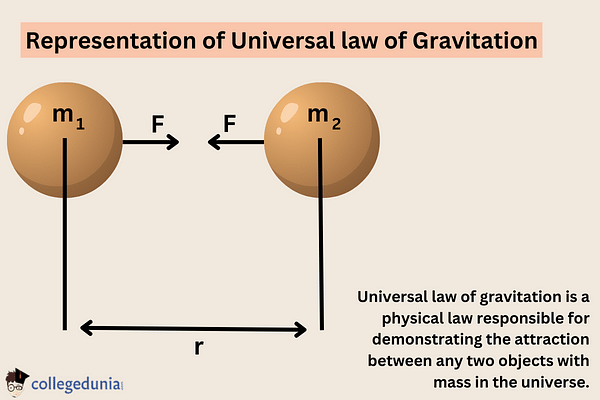
Representation of Universal Law of Gravitational
Where,
- m1 and m2 = the mass of the two objects A and B
- r = the shortest distance between the centers of the two objects
- F = Gravitational force (measured in Newtons(N)).
By the law stated by Newton, we understand that;
→ F ∝ m1×m2 ;
→ F ∝ \(\frac{1}{r^2}\);
→ F ∝ \(\frac{m_1 * m_2}{r^2}\) ;
Therefore, the universal graviation equation is given by:
→ F = \(\frac{G \times \ m_1 \times\ m_2}{r^2}\)
Where, G is the Gravitational Constant
Universal Law of Gravitation Derivation
As per the Force = G × m1 × m2 × [r²]-¹
Or, G = Force × r² × [m1 × m2]-¹ . . . . . (1)
Herein, G = Universal Gravitational Constant
Now, as per the dimensions,
Mass = [M1 L0 T0] . . . . (2)
Radius = [M0 L1 T0] . . . . (3)
Force = [M1 L1 T-2] . . . . . (4)
Upon replacing the equations (2), (3), and (4) in equation (1), we get,
Universal Gravitational Constant = Force × r2 × [m1 × m2]–2
It can also be expressed as, G = [M1 L1 T–2] × [M0 L1 T0]2 × [M1 L0 T0]-1 × [M1 L0 T0]–1 = M–1 L3 T–2.
Hence, the Universal Gravitational Constant is dimensionally expressed as [M–1 L3 T-2].
Gravitational constant (G)
The proportionality constant G termed the Gravitational constant, in the universal law of gravitation has a value equivalent to 6.67259 x 10⁻¹¹N m2/kg2. This precise value was experimentally determined by Henry Cavendish. G is a scalar quantity and this value remains constant in the universe and is not dependent on the nature and the size of the body.
→ (G = 6.67259 x 10⁻¹¹N m2/kg2)
The dimensional formula of G is [M-1 L3 T-2]
Read More: Gravitational potential energy
Universal Gravitation Formula Vectorial Representation
[Click Here for Sample Questions]
Vectorially the Gravitational force is given as:
| \(\overrightarrow{F}\) = \(\frac{G\ \times \ m_1 \ \times \ m_2}{|r|^2}\)\(\widehat{r}\) |
where,
- \(\widehat{r}\) is the unit vector from m1 to m2
- and r = r2 - r1

Vector diagram
Principle of Superposition of Gravitation
This principle states that the resultant gravitational force F acting on a particle due to a number of point masses is equal to the vector sum of the individual forces exerted by the individual masses on the given particle.
\(\overrightarrow{F}\) = \(\overrightarrow{F_{01}}\) + \(\overrightarrow{F_{02}}\) + \(\overrightarrow{F_{03}}\)+ ……. +\(\overrightarrow{F_{0n}}\)
Where \(\overrightarrow{F_{01}}\) , \(\overrightarrow{F_{02}}\) , \(\overrightarrow{F_{03}}\), ……. ,\(\overrightarrow{F_{0n}}\) are all gravitational forces exerted.
Weight and Mass
We often interchange the terms weight and mass, but there is a major difference between the two.
- Mass is purely the amount of matter that the object consists of whereas weight is considered to be the gravitational force applied on an object of a certain mass.
- Weight is the product of the mass and the acceleration due to gravity. (w = mg)
- Hence, Mass and weight are directly proportional to each other.
- Mass always remains the same whereas Weight varies. This is the exact same reason why we weigh differently on different planets.
Acceleration due to gravity (g)
Acceleration due to gravity is defined as the acceleration that is gained by an object due to the gravitational force applied on it.
- It is always in the direction towards the centre of the Earth.
- Acceleration due to gravity has both magnitude and direction. Hence, it is a vector quantity.
- Acceleration due to gravity (g) is different in different parts of the earth. It is highest at the poles and at the center of the earth, it becomes zero.
Read More: The value of g on the moon
The Formula for acceleration due to gravity is
g = \(\frac{GM}{r^2}\)
where,
- M = Mass of the Earth
- G = Gravitational Constant
- r = radius of the Earth
Universality of Gravity
[Click Here for Previous Year Questions]
The universality of gravity is generally refers that every particle in the universe is affected by the force of gravity. This includes all matter and energy, regardless of its composition or state.
- The force of gravity between two objects is directly proportional to their masses and inversely proportional to the square of the distance between them.
- This means that every object with mass exerts a gravitational force on every other object with mass in the universe, no matter how small or far away.
Read More:
Advantages and Disadvantages of Universal law of Gravitation
[Click Here for Sample Questions]
The many advantages and disadvantages of Universal law of Gravitation include:
Advantages of Universal law of Gravitation:
- The law explains as to why all objects fall towards the Earth.
- Explains the tides in the ocean due to the gravitational pull between the moon and the ocean.
- This law also helps in determining the Gravitational force between any planets in the Universe.
- It also helps us to calculate the trajectory of astronomical bodies which further, helps in determining their motion.
- The law helps in predicting the orbits and the time period of artificial satellites.
- It also helps in calculating the occurrences of solar and lunar eclipses.
Disadvantages of Universal Law of Gravitation
- The law cannot be applied when the objects are travelling at the speed of light.
- The law also cannot be applied when very small objects such as atoms or sub-atomic particles are taken into consideration
Things to Remember
- Gravitational force between two objects is independent of the nature and size of the interacting objects.
- The force of Gravitation is directly proportional to the Product of their masses and inversely proportional to the square of the distance between them.
- The Force of Gravitation between two objects is calculated using. F = \(\frac{G*m_1 * m_2}{r^2}\)
- The value of the gravitational constant is equal to 6.67259 x 10⁻¹¹N m2/kg2.
- Acceleration due to gravity is dependent on the radius of the Earth’s surface and hence varies in different parts of the earth.
For Live Updates on Upcoming Board Exams, Click Here: https://t.me/class_10_12_board_updates
Previous Year Questions
- Gravitational field is… (Haryana PMT 2009)
- Three uniform spheres of mass M and radius R earth are kept in such…
- The dimensional formula for the gravitational constant… (BCECE 2005)
- The acceleration due to gravity at a height of 1km above the earth… (NEET 2017)
- The work done in shifting a particle of mass… (UP CPMT 2011)
- A man of 50 kg mass is standing in a gravity-free space at a… (NEET 2010)
- Assuming that the gravitational potential energy of an object… (NEET 2019)
- A body starts to fall freely under gravity. The distance… (Chhattisgarh PMT 2004)
- Two astronauts are floating in gravitational-free space after… (NEET 2017)
- According to Newton, the viscous force acting between liquid layers of...
Sample Questions
Ques. State the Universal Law of Gravitation stated by Newton and mention the formula (2 Marks)
Ans. “Every single body in the universe attracts every other body with a force which is directly proportional to the product of their masses and inversely proportional to the square of the distance between them.”
⇒ F = \(\frac{G*m_1 * m_2}{r^2}\)
Ques. At the centre of the Earth why does a body have no weight? (2 Marks)
Ans. Here, g = 0 at the centre of the Earth, and weight is the product of acceleration due to gravity and the mass of the object, w=mg. Hence w=0 at the centre of the Earth.
Ques. Calculate the Gravitational Force between two objects separated by a distance of 5m with masses of 3kgs and 4kgs. (3 Marks)
Ans. m1 = 3 kgs
m2 = 4 kgs
r = 5m
F = \(\frac{G*m_1 * m_2}{r^2}\)
=6.67259 x 10⁻¹¹Nm²/kg² x 3kg x 4 kg/5m²
F = 3.2037 x 10⁻¹¹ N
Ques. What is the gravitational force if the mass of two bodies is 80 kg and 200 kg and they are separated by a distance of 6m. (4 Marks)
Ans. m1 = 80 kg, m2 = 100 kg,
r = 6m and
G = 6.67259 x 10⁻¹¹ Nm2/kg2
F = \(\frac{G*m_1 * m_2}{r^2}\)
=6.673×10–11× 80×100 / 36
F = 148.28×10⁻¹¹N
Ques. Mention the characteristics of Gravitational Force (3 Marks)
Ans. The characteristics of Gravitational Force are as follows:
- It is an attractive and a central force
- It is the weakest of all basic forces and is one of the most fundamental forces of nature
- It follows the inverse square law
- The magnitude of Gravitational force is very weak
- It is also a non-contact force
- It is universal.
Ques. Why doesn’t the moon crash into the earth? (2 Marks)
Ans. Speed and gravitational forces keeps the moon in constant orbit around the earth. The Moon stays in orbit around the earth due to gravity.
If the rotational velocity of the moon was higher it would have escaped the Earth’s gravitational force and if the velocity of rotation was lower it would have crashed into the Earth due to gravity. This is the reason why the moon doesn’t crash into the earth.
Ques. Two objects of masses m1 and m2 when separated by distance 'r' in air attract each other with force 4N. How is magnitude of force changed when the masses of the object are reduced to one-half? (4 Marks)
Ans. Given F= 4
Hence,
4 = \(\frac{G*m_1 * m_2}{r^2}\) →1
When the masses of the object are reduced to one half,
F1 =G * \(\frac{\frac{m_1 * m_2}{2}}{r^2}\)→2
By dividing 1 by 2,
\(\frac{4}{F1}\) = \(\frac{\frac{G*m_1 * m_2}{r^2}}{\frac{\frac{m_1 * m_2}{2}}{r^2}}\)
\(\frac{4}{F1}\) = \(\frac{4}{1}\)
F1 = \(\frac{4}{4}\)
F1= 1N
Ques. Calculate the gravitational force of attraction between the Earth and a 70 kg man standing at a sea level, a distance of 6.38 x 10⁶ m from the earth’s centre. (3 Marks)
Ans. m1= mass of earth= 5.98 x 1024 kg
m2= mass of man = 70 kg
r= radius of the earth= 6.38 x10⁶ m
F=6.67259 x 10⁻¹¹ x \(\frac{5.98 * 10^{24} * 70}{{(6.38 * 10^6)}^2}\)
F=685N
Ques. Can you screen the effect of gravitation by any material medium? (1 Mark)
Ans. No. The gravitational force does not depend on the nature of the material medium, unlike electrostatic force.
Ques. What is the force of gravity acting on an object of mass 2000 kg at the Earth’s surface? (3 Marks)
Ans. m1= mass of earth= 5.98 x 1024 kg
m2= mass of the object = 2000 kg
r= 6.38 x10⁶ m
F=6.67259 x 10⁻¹¹ x \(\frac{5.98 * 10^{24} * 2000}{{(6.38 *10^6)}^2}\)
F=1.959 x 10⁴ N
Read More:



Comments