



Content Writer-SME
Force causes an object to undergo unnatural motion. In layman's terms, strength is required to normally push or pull an object and that strength is called force. Moreover, push or pull comes from the objects engaging with one another. However, in technical terms, the force can be defined as the push or pull acting on an object containing mass and further enabling it to change its velocity.
In other words, applying force on an object or body directly changes the state of rest or motion of a particular body. In this article we will learn about force, Newton's laws of motion as well as its importance in everyday life.
Also check: Force of Attraction Formula
What is Force?
[Click Here for Sample Questions]
Force is a vector quantity that characterizes an action or the ability to alter the shape or motion of a given object. The characteristic of an object by which it cannot alter its state of rest along a straight line on its own is called inertia. This vector quantity in physics can be measured by a spring balance. The SI unit of Force is Newton and can be represented by an alphabetic letter ‘N’.
The general definition of force in physics can be given as:
| “The push or pull on an object with mass that causes it to change its velocity.” |
The push or pull of an object is considered to be a force, which comes from the objects interacting with one another. Terms like stretch and squeeze can also be used while indicating force. Force, which has a magnitude and a direction, is an external agent that is capable of changing the state of rest or motion of a particular body.

Example of Force in Daily Life
| Common symbols: | F→, F |
| SI unit: | Newton |
| In SI base units: | kg·m/s2 |
| Other units: | dyne, poundal, pound-force, kip, kilo pond |
| Derivations from other quantities: | F = m a |
| Dimension: | LMT-2 |
The video below explains this:
Force Detailed Video Explanation:
Also Read:
Formula for Force
[Click Here for Previous years Questions]
Force can be calculated using the formula of:
| F = ma |
Where F is referred to as the net force,
- m is referred to as the mass of the body and,
- a is referred to as the acceleration of the body.
It is articulated in Newton (N) or Kgm/s2.
Acceleration a is given by
| \(a=\frac{v}{t}\) |
Where
- v = velocity
- t = time taken
Hence, Force can be calculated as:
| \(F=\frac{mv}{t}\) |
Inertia formula is termed as p = mv which can also be calculated as Momentum.
Therefore, Force can be articulated as the rate of change in momentum.
| \(F=\frac{p}{t}=\frac{dp}{dt}\) |
Force formulas are useful in finding out the force, mass, acceleration, momentum, and velocity in any given problem.
Unit of Force
[Click Here for Sample Questions]
- Force is expressed in dyne in the centimeter gram second system of unit (CGS unit).
- In the standard international system of unit (SI unit) force is expressed in Newton (N).
- Other units of force are poundal, pound-force, kip, and kilo pond.
Types of Force
[Click Here for Previous years Questions]
Majorly speaking, Force is of two types:
- Contact Forces
- Non-contact Forces
Contact Force
Contact forces are those forces that act on a body either directly or through a medium.

Contact force
Examples of contact forces are:
- Muscular Force
- Mechanical Force
- Frictional Force
Non-contact Force
Non-contact forces are the forces that act through spaces without making direct contact with the body.
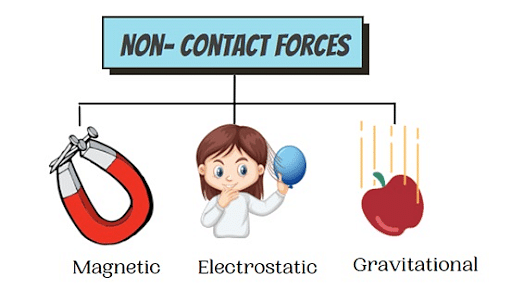
Non-contact forces
Examples of non-contact forces are:
- Gravitational Force
- Electrostatic Force
- Magnetic Force
Newton’s law of Motion
[Click Here for Sample Questions]
Law 1: A body will remain at rest or continue to move with uniform velocity unless an external force is applied to it.
Law 2: When an external force is applied to a body of constant mass the force produces an acceleration, which is directly proportional to the force and inversely proportional to the mass of the body.
\(\overrightarrow{F} = K \frac{d \overrightarrow{p}}{dt} = k m\overrightarrow{a}\)Where \(\overrightarrow{F}\) is the net external force on the body and \(\overrightarrow{a}\)is the acceleration.
Law 3: To every action there is equal and opposite reaction force.
Significance of the three laws of Newton
[Click Here for Previous years Questions]
The concept of force was explained by three laws which were proposed by the great physicist Sir Isaac Newton in the year 1687. The importance of Newton's three laws of motion are as follows:
- The first law refers to the original state of motion of a body. In other words, the concept of inertia was explained through the first law of motion.
- The second law states that if a body is not obeying its original state of motion, a net unbalanced external force must act on the body.
- The third law refers to the nature of force which states that, "For every action there is an equal and opposite reaction".
Also Read:
Things to Remember
- Force can be defined as the push or pull acted on an object containing mass and further enabling it to change its velocity.
- The SI unit of Force is Newton. It can be represented as (N).
- Force can be calculated using the formula: F = ma
- Force is of two types majorly, Contact force and action at a distance force.
- There are three laws of Newton.
Previous Years’ Questions
- The acceleration due to gravity at a height h above the earths surface is… [AP EAPCET]
- A synchronous relay satellite reflects TV signals and transmits TV programmer… [BHU UET]
- A body weighs 72 N on the surface of the earth. What is the gravitational force on… [NEET 2020]
- The dependence of acceleration due to gravity g on the distance r from the centre… [NEET 2010]
- The escape velocity from earth is 11.2 km/s. If a body is to be projected in… [NEET 1993]
- The time period of a satellite of earth is 5 hours. If the separation between… [BITSAT 2019]
- There is a shell of mass M and density of the shell is uniform… [BITSAT 2013]
- If the earth shrinks such that its density becomes 8 times to the present value… [AP EAPCET]
- Four identical particles of equal masses 1kg made to move along the… [JEE Main 2021]
- Acceleration due to gravity is g on the surface of the earth. Then the value of… [JKCET 2004]
- Four identical particles of equal masses 1kg made to move along the… [JEE Main 2021]
- Acceleration due to gravity is g on the surface of the earth… [JKCET 2004]
Sample Question
Ques. A hammer is containing a mass of 500 grams and moving at 50 m/sec strikes a nail. The nail ceases the hammer at 0.01 sec. Calculate the force of the nail on the hammer. (2 marks)
Ans. We are given that m=500 g or 0.5 Kg
From the second law of motion we know that F = m(v-u)/t.
But as per the question, we are already given that u=50m/s, v=0m/s, t=0.01s
By putting the values in the above equation, we will get F = - 2500N.
Hence, the force applied by nail on the hammer is -2500N
Ques. A machine gun containing a mass of 20 kg fires 30 g bullets at the rate of 400 bullets per minute with a speed of 400 m/s. Calculate the force value that must be applied to the gun to keep it in position. (3 marks)
Ans. In this question, we will apply Newton’s second law of motion because we need to calculator force and after every firing gun will pull back. To avoid its backward motion, we need to hold the gun tightly and the force which is required to keep the gun in position needs to be calculated in this question.
M= 20 Kg (Mass of Gun)
m= 0.03 Kg (Mass of Bullet)
400 bullets are to be fired in 60 seconds
In 1 sec 20/3 bullets are fired.
Bullet v = 400m/s
F = 0.03 x 400 x 20/3 = 80 N
Or, F = 80 N
Ques. Would it be appropriate to say that the banking of roads reduces the wear and tear of the tires of automobiles? Explain your answer. (2 marks)
Ans. Yes, it would be highly appropriate to say it. If the roads are not banked, in that case, the centripetal force will be provided by the force of friction between tires and the road. On the other hand, when road is banked, a smaller component of the normal reaction provides the necessary centripetal force, which further reduces wear and tear.
Ques. Why is Newton’s second law of motion not applicable to the motion of a rocket? (2 marks)
Ans. According to Newton’s second law of motion, F = ma is only applicable when the mass of an object remains constant. Since mass in the rocket continuously decreases, F= ma is not applicable.
Ques. When a person who tends to jump high leaves the ground, from where does the force which accelerates the jumper comes? (2 marks)
Ans. After a short run, the high jumper presses the ground firmly, which causes the ground to react and provides the jumper with the necessary upward accelerating force. The necessary force is therefore the result of the ground's reaction to the jumper.
Ques. A beginner shooter accidentally damaged his shoulder while firing a shot from his rifle. What error did he commit? (2 marks)
Ans. We are aware that after shooting, a gun recoils, or moves back. The rifle must be held firmly against the shoulder to prevent shoulder damage. It's possible that the shooter did not hold the rifle tightly on his shoulder, which is why the gun must have hurt his shoulder after it fired.
Ques. If a string breaks unexpectedly while a stone is being whirled in a circle, what will happen to the stone? Explain. (2 marks)
Ans. At the point where the string snaps, the stone bursts out tangentially toward the circle in a straight line. It results from the direction's inertia. The force pushing on the stone stops when the string snaps. When there is no force acting on it, the stone flees in the direction of its instantaneous velocity, which is perpendicular to the circular path.
Ques. How is it that, under the same circumstances, a parachute falls much slower than a stone dropped from a specific height? (2 marks)
Ans. The air resistance, or fluid friction, in the case of a parachute is significantly greater than in the case of a stone because the surface area of a parachute is much larger than the surface area of a stone. Thus, the parachute descends gradually.
Also Read:



Comments