



Education Journalist | Study Abroad Lead
Polygons are two-dimensional geometrical structures that have an equal number of sides. A polygon's sides or edges are straight line segments joined end to end to form a closed shape.
- The point where two line segments intersect is referred to as the vertex or corners, and an angle is generated as a result.
- When a polygon has congruent sides, it is referred to as a regular polygon. The diagram below depicts many sorts of polygons.
| Table of Content |
Key Terms: Polygons, Triangles, Square, Hexagon, Octagon, Interior Angle, Exterior Angle, Regular Polygon
What are Regular Polygons?
[Click Here for Sample Questions]
Regular polygons are those that have all of their sides and interior angles equal. Regular polygons include squares, rhombuses, equilateral triangles, and other such shapes as illustrations. Regular polygons have angles that are congruent as well as sides. That is to say, they are equiangular.
Read More: Area and Volume
Parts of a Regular Polygon
[Click Here for Sample Questions]
A polygon has three parts:
- Sides: A side is a line segment that connects two vertices.
- Vertices: A vertex is a place where two sides meet.
- Angles: Interior and external angles. An interior angle is an angle generated by connecting the sides of a polygon within its enclosed surface.
Properties of Regular Polygons
[Click Here for Sample Questions]
The following are some of the properties of regular polygons:
- A regular polygon's sides are all equal.
- The interior angles are all equal.
- The perimeter of a regular polygon with n sides is obtained by multiplying the number of sides (n) by the length of each side.
- The sum of a simple n-gon or regular polygon inner angles equals (n - 2) × 180°
- The formula to calculate the number of diagonals in a polygon with n sides is (n × (n - 3)) / 2.
- The number of triangles obtained by connecting the diagonals from one of the polygon's corners is n - 2.
- Each interior angle of an n-sided regular polygon is measured as [(n - 2) 180°]/n.
- Each exterior angle of an n-sided regular polygon is measured as 360°/n.
Also Read:
| Related Articles | ||
|---|---|---|
| Properties of Triangle | Quadrilateral and Types | Trapezoid |
Regular Polygons Examples
[Click Here for Sample Questions]
Below are some examples of regular polygons:
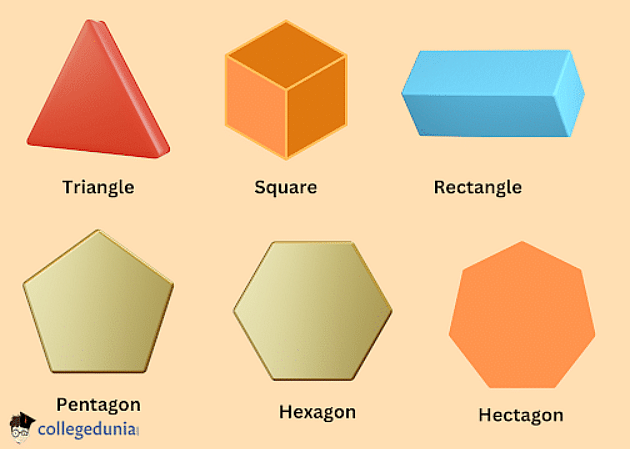
Regular Polygons
Equilateral Triangle
The equilateral triangle is a regular polygon with the least possible sides.

Equilateral Triangle
- The number of sides = 3
- The overall sum of the interior angles is 180°.
- Each interior angle measures 60°.
Square
A quadrilateral with four equal sides is known as a 4-sided regular polygon.

Square
- The number of sides = 4
- The overall sum of the interior angles is 360°.
- Each interior angle measures 90°.
Regular Pentagon
A regular Pentagon is a Pentagon or 5-gon with equal sides.

Regular Pentagon
- The number of sides = 5
- The overall sum of the interior angles is 540°.
- Each interior angle measures 108°.
Regular Hexagon
When all of the sides of a hexagon are equal, it is called a regular hexagon.

Regular Hexagon
- The number of sides = 6
- The overall sum of the interior angles is 720°.
- Each interior angle measures 120°.
Regular Polygon of 7 sides (Hectagon)
A regular polygon with 7 sides is known as a heptagon/hectagon. It is a two-dimensional shape with seven equal sides and seven equal interior angles. The heptagon's interior angles sum up to 900 degrees, and each interior angle measures approximately 128.57 degrees.

Regular Polygon of 7 sides (Hectagon)
- The heptagon is a unique polygon with interesting properties, making it a captivating subject of study in mathematics and geometry.
- The heptagon is among the regular polygons that have rotational symmetry.
- It possesses rotational symmetry with an order of 7, meaning it can be rotated by multiples of 360°/7 and still appear unchanged.
Also Read:
Measurement of Angles in a Regular Polygon
[Click Here for Sample Questions]
The angles of a regular polygon play an important role in understanding its properties and characteristics. The measures of angles in a regular polygon are detailed below:
The combined measurement of the interior angles in a regular polygon
Consider an n-sided regular polygon. The total (sum) of the interior angles in a regular polygon can be calculated as (n - 2) × 180°, given that all sides are equal.
Example-: Sides of a regular polygon are 6.
The total of the interior angles in a 6-sided polygon can be calculated as (n - 2) × 180°
= (6 − 2) × 180°
= 720°
Each interior angle's measurement (degree) in a regular polygon
Each interior angle's measurement (degree) in a regular polygon can be calculated using the formula [(n - 2) × 180°] / n, where 'n' represents the number of sides in the polygon. This formula applies to all regular polygons and helps determine the size of each interior angle in degrees.
For demonstration purposes, consider a regular pentagon with five sides (n=5). Using the formula, the measure of each interior angle would be:
[(5 - 2) × 180°] / 5 = [3 × 180°] / 5 = 540° / 5 = 108°.
Similarly, in a regular hexagon with six sides (n=6), each interior angle would measure as follows:
[(6 - 2) × 180°] / 6 = [4 × 180°] / 6 = 720° / 6 = 120°.
Each exterior angle's measurement (degree) in a regular polygon
Each exterior angle's measurement (degree) in a regular polygon can be calculated using the formula 360° / n, where 'n' represents the number of sides in the polygon. This formula is applicable to all regular polygons and aids in determining the measurement of each exterior angle in degrees.
As an illustration, consider a regular pentagon with five sides (n=5). Using the formula, the measure of each exterior angle would be:
360° / 5 = 72°.
Similarly, for a regular hexagon with six sides (n=6), the measure of each exterior angle would be:
360° / 6 = 60°.
Read More: Pythagoras Theorem
Number of Diagonals of a Regular Polygon
[Click Here for Sample Questions]
The formula (n × (n - 3)) / 2 applies universally to all regular polygons, making it easier to find their total number of diagonals. (n = the number of sides in the polygon). All regular polygons benefit from this formula, as it assists in finding the total number of diagonals they possess.
For illustration purposes, consider a regular pentagon with five sides (n=5). Using the formula, the number of diagonals in the pentagon would be:
(5 × (5 - 3)) / 2 = (5 × 2) / 2 = 5 diagonals.
When considering a regular hexagon that has six sides (n=6), the number of diagonals would be:
(6 × (6 - 3)) / 2 = (6 × 3) / 2 = 9 diagonals.
Number of Triangles of a Regular Polygon
For a regular polygon with n sides, the number of triangles formed by joining the diagonals from one of its corners is n - 2.
For example, in a regular hexagon with six sides (n=6), the number of triangles that can be formed by joining the diagonals from one of its corners would be:
Number of triangles = 6 - 2 = 4 triangles.
Similarly, for a regular pentagon with five sides (n=5), the number of triangles would be:
Number of triangles = 5 - 2 = 3 triangles.
Order of Symmetry of a Regular Polygon
[Click Here for Sample Questions]
The regular polygon's order of symmetry is equivalent to its number of sides (n). Rotational symmetry in a regular polygon enables it to look identical even after rotating around its center by a defined angle. The polygon's angle of rotational symmetry denotes the degree of rotation required for it to match its starting orientation.
- The angle of rotational symmetry in a regular polygon is 360°/n, where 'n' signifies the number of sides.
- Hence, Multiples of 360°/n rotation in a regular polygon do not affect its appearance.
- For example, in a regular pentagon (n=5), the order of symmetry is 5.
- It can be rotated by 360°/5 (which is 72°) and still look the same after each rotation.
- Similarly, in a regular hexagon (n=6), the order of symmetry is 6, as it can be rotated by 360°/6 (which is 60°) and retain its original shape.
Also Read:
| Related Articles | ||
|---|---|---|
| Types of Polygon | Hexagon | Triangle |
Things to Remember
- A regular polygon is a polygon with all its sides and angles equal in measure.
- The number of sides in a regular polygon is known as its "n" or "number of vertices."
- The total (sum) of the interior angles in a regular polygon is given by the formula: (n - 2) × 180 degrees.
- Each interior angle's measurement (degree) in a regular polygon is calculated as (sum of interior angles) / n.
- Each exterior angle's measurement (degree) in a regular polygon is calculated as 360 degrees / n.
- A regular heptagon, a 7-sided polygon, has interior angles totaling 900 degrees.
- The sum of exterior angles of any polygon, including regular polygons, is always 360 degrees.
- The measure of each central angle of a regular polygon is calculated as 360 degrees / n.
- Regular polygons possess both reflectional symmetry and rotational symmetry.
- Regular pentagons, with five equal sides, have interior angles summing up to 540 degrees.
Sample Questions
Ques. What is the sum of interior angles in a regular hexagon? (1 Mark)
Ans. The sum of interior angles in a regular hexagon is (6 - 2) x 180 degrees = 720 degrees.
Ques. If each interior angle of a regular octagon measures 135 degrees, what is the value of "n"? (1 Mark)
Ans. Since each interior angle is 135 degrees, the following formula can be used for the measure of each interior angle: (sum of interior angles) / n = 135.
Therefore, n = (8 - 2) x 180 / 135 = 6.
Ques. What is the measure of each exterior angle in a regular pentagon? (1 Mark)
Ans. The measure of each exterior angle in any polygon is given by 360 degrees / n, where n is the number of sides. For a regular pentagon, the measure of each exterior angle is 360 / 5 = 72 degrees.
Ques. If the side length of a regular triangle is 8 units, what is its perimeter? (1 Mark)
Ans. A regular triangle has 3 sides, and each side is 8 units long. Therefore, the perimeter is 3 x 8 = 24 units.
Ques. Find the area of a regular octagon with a side length of 10 meters. (2 Marks)
Ans. The area of a regular polygon can be calculated using the formula: (side length)2 x (n / 4) * (1 / tan(π/n)). For a regular octagon (n=8) with a side length of 10 meters, the area is (102) x (8 / 4) x (1 / tan(π/8)) ≈ 309.016 meters squared.
Ques. If the measure of each interior angle of a regular heptagon is 128 degrees, what is the measure of each exterior angle? (1 Mark)
Ans. Since the sum of interior angles in a regular heptagon is (7 - 2) x 180 = 900 degrees, the following formula can be used for the measure of each exterior angle: 360 / n = 360 / 7 ≈ 51.43 degrees.
Ques. A regular pentagon and a regular hexagon share the same side length of 6 cm. Which polygon has a greater perimeter? (1 Mark)
Ans. The perimeter of a regular pentagon is 5 x 6 = 30 cm, and the perimeter of a regular hexagon is 6 x 6 = 36 cm. Therefore, the regular hexagon has a greater perimeter.
Ques. What is the measure of the central angle of a regular decagon? (2 Marks)
Ans. In a regular polygon, each central angle has the same measure as each interior angle. Hence, for a regular decagon, the central angle's measure is equivalent to each interior angle's measure, determined as (10 - 2) x 180 / 10 = 144 degrees.
Ques. Explain the concept of rotational symmetry and its relation to regular polygons. (3 Marks)
Ans. Rotational symmetry is when a shape remains unchanged after rotating it by a specific angle around its center.
- Regular polygons display rotational symmetry with an order equivalent to the number of sides (n).
- The original form of a regular polygon is maintained after a 360°/n rotation.
Example: A regular hexagon exhibits rotational symmetry with an order of 6, implying it can be rotated 60°, 120°, 180°, and so on, while still maintaining its appearance. This symmetry property is an important characteristic of regular polygons in geometric applications and design.
Ques. What is the measure of each interior angle in a regular polygon? (2 Marks)
Ans. To find the measure of each interior angle in a regular polygon, divide the sum of interior angles (calculated using the previous formula) by the number of sides (n). The formula for each interior angle is [(n - 2) x 180°]/n. For example, in a regular octagon (n=8), each interior angle would measure [(8 - 2) x 180°]/8 = 135°.
Ques. What are regular polygons, and what are their defining characteristics? (3 Marks)
Ans. Regular polygons are two-dimensional shapes with equal sides and angles. Their defining characteristics include all sides being congruent and all interior angles being equal.
- Regular polygons possess rotational symmetry, which allows them to maintain their appearance after turning.
- Regular polygons, like squares, equilateral triangles, and regular hexagons, serve as typical examples.
- These shapes have consistent angles and sides throughout, making them essential in various geometric applications.
For Latest Updates on Upcoming Board Exams, Click Here: https://t.me/class_10_12_board_updates
Check-Out:



Comments