




The National Testing Agency (NTA) conducted the CUET PG 2026 English (LAQP01) examination on March 12, 2026, during Shift 3 from 4:00 PM to 05:30 PM.
Students who appeared for the exam reported that the overall difficulty level of the paper was moderate. CUET PG 2026 English Question Paper with Solutions PDF is available here for download.The marking scheme is +4 for correct answers and -1 for wrong answers, totaling 300 marks.
CUET PG 2026 English Question Paper with Solutions PDF
| CUET PG 2026 English Question Paper with Answer Key | Download PDF | Check Solutions |
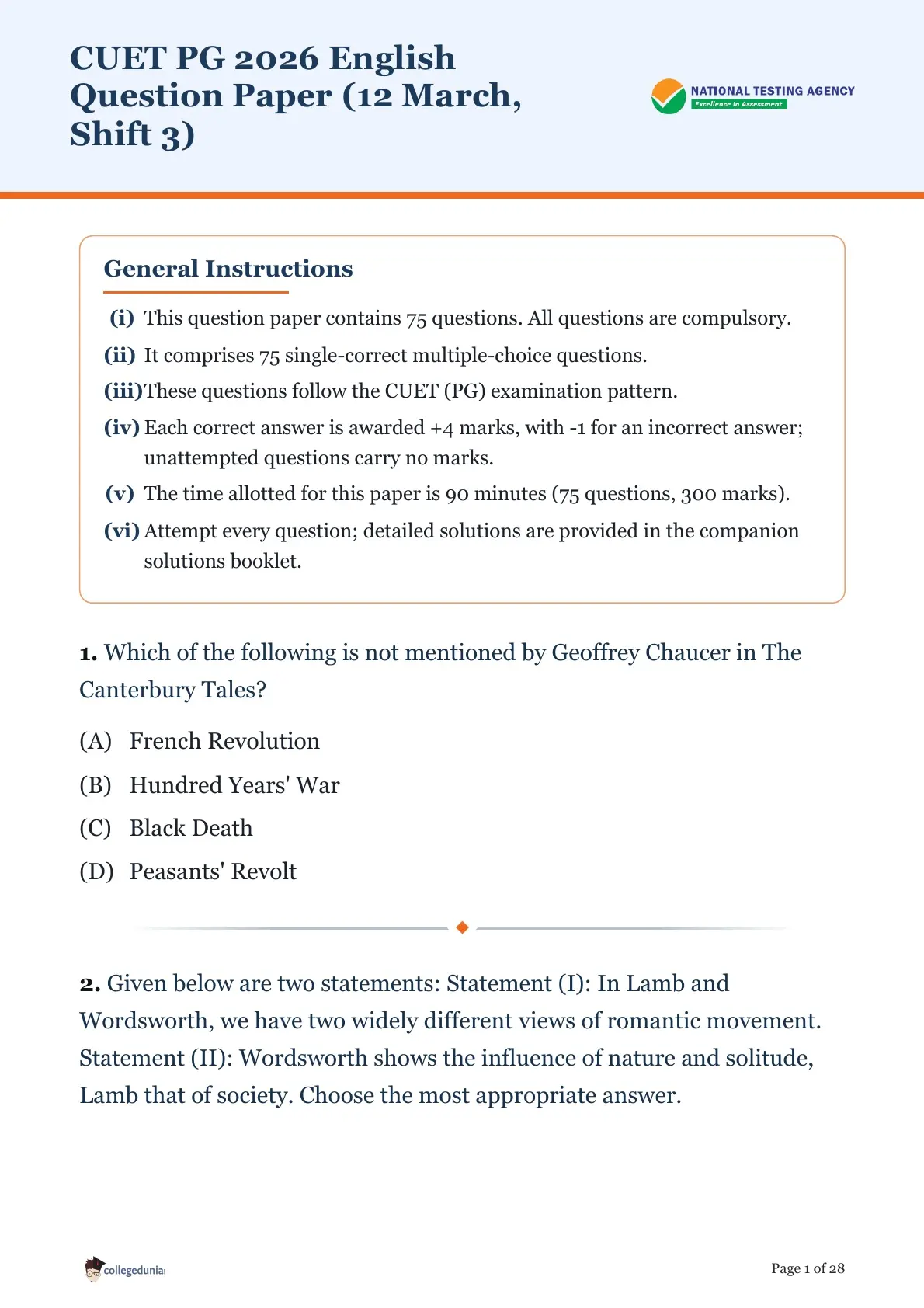
Which of the following is not mentioned by Geoffrey Chaucer in The Canterbury Tales?
Given below are two statements: Statement (I): In Lamb and Wordsworth, we have two widely different views of romantic movement. Statement (II): Wordsworth shows the influence of nature and solitude, Lamb that of society. Choose the most appropriate answer.
Arrange the following ages in chronological order:
A. Romantic Period,
B. Jacobean Age,
C. Age of Chaucer,
D. Victorian Age.
Which of the following statements are correct?
A. Dryden is the greatest literary figure of Modern Age.
B. Dryden is the literary figure of the Restoration Period.
C. In Dryden, we have an excellent reflection of both the good and the evil tendencies of the age in which he lived.
D. Dryden is also considered as the first novelist in any language to make the scene an essential element in the action.
E. In 1815, Dryden married Miss Gordon.
Match List-I with List-II:
Who amongst the following is not a Romantic poet?
Given below are two statements:
Assertion (A): Gandhi thought that the village was the safe, sane unit of human association.
Reason (R): Gandhi was the apostle of decentralisation. Choose the most appropriate answer.
Arrange the following Ages/Periods in the history of English literature in chronological order:
A. The Pre-Raphaelites,
B. The Middle English Period,
C. The Age of Sensibility,
D. The Georgian Period.
Which of the following statements are correct?
A. Henrik Ibsen is known for writing problem plays.
B. Ibsen's Huckleberry Finn talks about various kinds of subcultures.
C. Henrik Ibsen was a Norwegian playwright.
D. Young Man Luther is another work written by Ibsen.
E. Ibsen's A Doll's House was published in 1879.
Match List-I with List-II:
The rhyme scheme of Shakespearean sonnet is:
Given below are two statements:
Assertion (A): Voices in the City, although its canvas is large, the details fuller and diction richer, is nevertheless less satisfying than Cry, the Peacock.
Reason (R): The reason is that Voices in the City is not contained by a single sensibility like Maya's in Cry, the Peacock. Choose the most appropriate answer.
Arrange the following plays chronologically in the order of their publication:
A. Caryl Churchill's Cloud Nine,
B. Harold Pinter's No Man's Land,
C. Samuel Beckett's Waiting for Godot,
D. John Osborne's Look Back in Anger.
Which of the following statements are correct?
A. William Golding's Lord of the Flies was published in 1645.
B. William Golding was awarded Nobel Prize for literature.
C. Robinson Crusoe and Brave New World are William Golding's most notable works.
D. Golding's Lord of the Flies is described as a dystopia.
E. Nineteen Eighty Four is another dystopian work written by William Golding.
Match List-I with List-II:
Printing Press was brought to England by William Caxton in:
Given below are two statements:
Assertion (A): An epic is a long verse narrative on a comic subject, told in an informal style.
Reason (R): An epic is a long verse narrative on a serious subject, told in a formal and elevated style. Choose the most appropriate answer.
Arrange the following works in the chronological order of their publication:
A. The Tempest,
B. The Birthday Party,
C. Betrayal,
D. Prometheus Unbound.
Which of the following statements are correct?
A. Jonathan Swift's Robinson Crusoe is a tragic work.
B. Swift's The Battle of the Books is a satire upon both the parties in controversy.
C. Swift's Tale of a Tub is a satire on humanity.
D. Swift's Gulliver's Travels shows his bitterness against fate and society.
E. Swift's Tale of a Tub is a satire on the churches of the day.
Match List-I with List-II:
Who wrote ``... to weep at every page, not for what he sees, but for what he sees, he sees. For me it's like a book of prayers''?
Given below are two statements:
Assertion (A): In a dramatic monologue, a single person utters a speech that makes up the whole poem.
Reason (R): The speaker in a dramatic monologue interacts with one or more other people, but we know of the author's presence only from the clues in the discourse of the single speaker. Choose the most appropriate answer.
Arrange the following works in the chronological order of their year of publication:
A. The English Teacher,
B. The Financial Expert,
C. Mr. Sampath,
D. Waiting for the Mahatma.
Which Indian poet wrote: ``Why not let me speak in any language I like? The language I speak becomes mine, its distortions, its queerness All mine, mine alone ...''
Which of the following statements are correct?
A. Girish Karnad is known for his comic play Tughlaq.
B. Girish Karnad is an actor, director and a playwright.
C. Tughlaq is a historical play.
D. Tughlaq is written on the life of Sultan Muhammad bin Tughlaq.
E. Tughlaq was banned in Bombay for sometime.
Match List-I with List-II:
Who wrote the following lines: ``My mother only said / Thank God the Scorpion picked on me / and spared my children.''
Given below are two statements:
Assertion (A): Biography and memoir are different.
Reason (R): Biography is written by the subject about himself or herself while memoir is a day-to-day record of the events in one's life written for personal use and satisfaction. Choose the most appropriate answer.
Arrange the following in chronological order of their publication:
A. Vallabhbhai Patel's For a United India: Speeches,
B. Rajendra Prasad's India Divided,
C. J.B. Kripalani's The Gandhian Way,
D. Abul Kalam Azad's India Wins Freedom.
Rabindranath Tagore's Chandalika is a:
Which of the following statements are correct?
A. Blank verse consists of lines of iambic pentameter.
B. In blank verse, all the lines are rhymed.
C. In blank verse, the lines are unrhymed.
D. John Milton used blank verse in his Paradise Lost.
E. Blank verse is called blank because the lines are unrhymed.
Match List-I with List-II:
Bakha is the protagonist of:
Given below are two statements:
Assertion (A): Long narrative romances in prose were written by Greek writers as early as the second and third centuries AD.
Reason (R): Long narrative romances dealt with separated lovers, who, after perilous adventures and hairbreadth escapes, are happily reunited at the end. Choose the most appropriate answer.
Arrange Mulk Raj Anand's following fictional works in the chronological order of their publication:
A. The Old Woman and the Cow,
B. The Sword and the Sickle,
C. Untouchable,
D. Seven Summers.
Who created the fictional world of Malgudi?
Given below are two statements:
Assertion (A): Raymond Williams says that culture is only in fine arts and museums.
Reason (R): Raymond Williams asserts that culture is a whole way of life. Choose the most appropriate answer.
Arrange the following lines in the similar order as these appeared in William Wordsworth's ``Daffodils'':
A. Which is the bliss of solitude,
B. In vacant or in pensive mood,
C. They flash upon the inward eye,
D. For oft, when on my couch I lie.
Identify the type of couplet: ``The grave's a fine and private place, But none, I think, do there embrace.''
Which of the following statements are correct?
A. In Poetics, Aristotle defines poetry as an imitation.
B. Imitation has been coined from the word `imagism'.
C. Imitation is mimesis in Greek.
D. In imitation the speaker is always an urban, witty and tolerant man.
E. Imitation is used to define the nature of literature and other arts.
Match List-I with List-II.
T.S. Eliot's ``Objective Correlative'' means:
Given below are two statements:
Assertion (A): Gender studies are indebted to the social historian Michel Foucault.
Reason (R): Michel Foucault analyzed that all sexual identities, whether perceived to be normal or transgressive, are constructed or reconstructed in various eras of social discourses under the impulse of power drive and power competition.
Choose the most appropriate answer.
Arrange the following essays in the chronological order of their year of publication:
A. ``The Death of the Author'',
B. ``Tradition and Individual Talent'',
C. ``What is an Author?'',
D. ``Gender Trouble''.
William Congreve's The Way of the World and Richard Sheridan's A School for Scandal are:
Which of the following are the short story collections by Manohar Malgonkar?
A. Beyond Love,
B. Rumble-Tumble,
C. A Toast in Warm Wine,
D. The Queen of Beauty,
E. The Marriage of Bela.
Match List-I with List-II. List-I:
What does the process of Translation involve?
Which of the following statements are correct?
A. Saussure distinguished signifier and signified.
B. The link between signifier and signified is arbitrary.
C. Levi-Strauss denied patterns in myth.
D. Roland Barthes coined ``New Historicism''.
E. Simone de Beauvoir described four kinds of masculinity.
The term ``Intertextuality'' was coined by:
Match List-I with List-II.
Who is known for the conceptualization of `Polysystem Theory of Translation'?
Arrange the following books/essays chronologically by the year of publication:
A. Judith Butler's Gender Trouble,
B. Edward Said's Orientalism,
C. Homi K. Bhabha's The Location of Culture,
D. Gayatri C. Spivak's ``Can the Subaltern Speak?''
Which of the following is not true about Walter Benjamin's essay ``The Task of the Translator''?
Which of the following statements are correct?
A. Aristotle wrote Poetics.
B. Longinus wrote On Imitation.
C. Plato's Republic celebrates poets as guides of truth.
D. Horace wrote Ars Poetica. E. Aristotle defined catharsis only for comedy.
The essay ``Politics of Translation'' is authored by:
Match List-I with List-II.
Tomb of Sand, a Booker Prize winning novel, has been translated into English by:
Arrange the following in chronological order:
A. Poststructuralism,
B. Romantic Criticism,
C. Augustan Criticism,
D. Classical Criticism.
From which of the following the burgeoning field of `Translation Studies' received its name?
Which of the following statements are correct?
A. The period from the 1960s to the present can be considered the postmodern period.
B. Postmodernism came immediately after World War I.
C. Well-known authors of the postmodern period are John Barth, Cormac McCarthy, Don DeLillo etc.
D. Samuel Beckett's Jacob's Room is a postmodernist work.
E. Eliot's ``Sailing to Byzantium'' is a postmodernist work.
Who claimed that John Donne and other Metaphysical poets of the earlier seventeenth century ``possessed a mechanism of sensibility which could devour any kind of experience''?
Match List-I with List-II.
In ``The Essay of Dramatic Poesy'', which character does represent John Dryden?
Match List-I with List-II.
Ars Poetica is written by:
Arrange the following works as per their year of publication in chronological order:
A. Ecrits,
B. The Interpretation of Dreams,
C. The Practice and Theory of Individual Psychology,
D. Psychology of the Unconscious.
In Ecocriticism, `Anthropocentricism' means:
Which of the following statements are correct?
A. Graphic narrative is a term first used in 1970s.
B. Initially graphic narratives described works intended for adults.
C. Graphic narratives originated from mosaic and fresco wall paintings first used in ancient Rome.
D. Graphic novels are also identified as sign of decadence.
E. In Graphic novels, extended narratives are told through a series of illustrations.
Who amongst the following has not been awarded the Nobel Prize in Literature?
Ghosts are particularly interesting characters; ghosts who appear in novels or short stories
exist in a way that they do not exist in the real world outside of fiction. We might expect to encounter
ghosts only in fantasy novels, where they can participate in the action just as any other character
can; however, they do appear from time to time in much more realistic literary fiction, in which
case we have to account for their presence.
In mainstream fiction, ghosts take on one of two roles: they are either symbolic or they are
imagined by other characters. In both instances, they are very often manifestations of the memory
or guilt of another character. Some famous examples of literary novels with ghosts are: Beloved by
Toni Morrison, Lincoln at the Bardo by George Saunders and Sing, Unburied, Sing by Jesmyn Ward.
If you encounter a ghost, then your job is to figure out whether the ghost is intended to be a
literal character, or if the author is using the ghost to reveal something important about other
characters' feelings and experiences. If the ghost appears to be an actual character, then treat it as
you would any other character; try to figure out what its motivations are and check to see whether
the character of the ghost changes in any way from the beginning of the story to the end. In either
case, you can evaluate the other characters reactions to the ghost, and that will tell you a great
deal about their frame of mind. Changes in a ghost which a character has been carrying with him
or her will also indicate a change in that character's mental or emotional state.
According to the passage, which of the following statements is not correct?
Which of the following texts containing ghost is not mentioned in the passage?
According to the author in the passage, ghosts are:
Which of the following statements is not true in the context of the given passage?
Which of the following words goes closely in meaning with the word ``manifestation'' in the passage?



Comments