



| Updated On - Aug 11, 2026
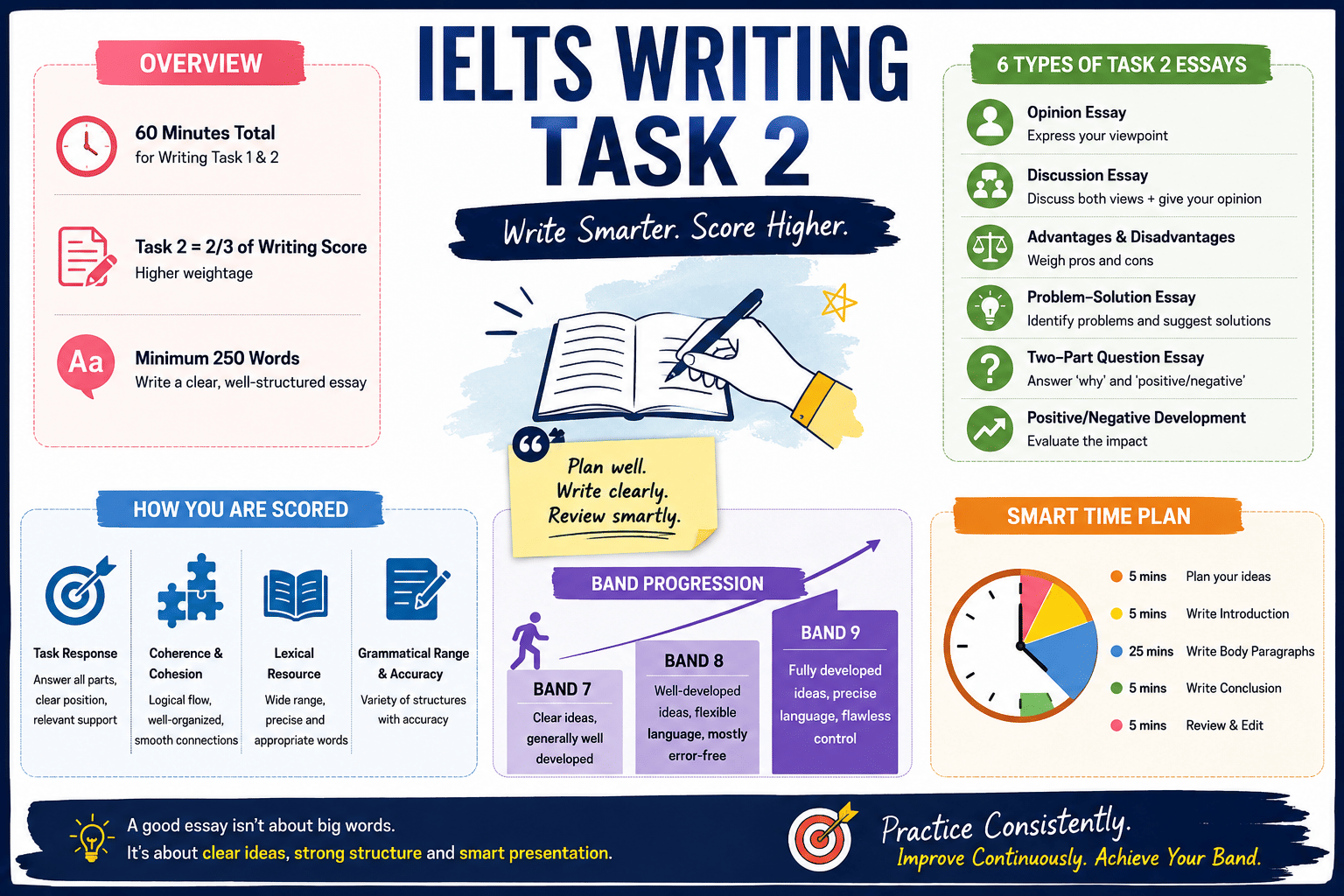
IELTS Writing Task 2 accounts for two-thirds of the Writing score and is evaluated across four criteria: Task Response, Coherence & Cohesion, Lexical Resource, and Grammatical Range & Accuracy. Applicants get 40 minutes to complete the task. Applicants need to divide the time strategically to achieve their aimed IELTS results.
The test includes six common essay formats, which are:
- Opinion
- Discussion
- Advantages & Disadvantages
- Problem-Solution
- Two-Part Question
- Positive or Negative Development.
- IELTS Writing Task 2 Sample Answer 2026
- How IELTS Writing Task 2 Answers Are Scored
- Band 7 vs Band 8 vs Band 9 IELTS Writing Task 2 Answer
- Recent IELTS Writing Task 2 Questions with Answers
4.1 Opinion Essay Sample Answer
4.2 Discussion Essay Sample Answer
4.3 Advantages & Disadvantages Sample Answer
4.4 Problem-Solution Essay Sample Answer
4.5 Two-Part Question Sample Answer
4.6 Positive or Negative Development Sample Answer
- Vocabulary Used in High-Band IELTS Writing Task 2 Answers
- Grammar Used in IELTS Writing Task 2 Band 8/9 Answers
- Common Mistakes to Avoid in IELTS Writing Task 2
- Can You Memorize IELTS Writing Task 2 Answers?
- FAQs
IELTS Writing Task 2 Sample Answer 2026
While writing the answer for IELTS Writing Task 2, applicants must keep in mind how to deal with the given topic. The very first step should be to recognise the question type, whether it is opinion-based, a discussion topic, an agree-or-disagree question, etc.
Applicants have 40 minutes to write a 250-word essay. Applicants must strategise and divide these 40 minutes to get their desired IELTS Scores. Follow the simple tips below:
- Identify the topic first.
- Break your points into 3 parts: introduction, body, and conclusion.
- Spend the first 5 minutes plotting your points.
- Spend 5 minutes writing introductions, 8-10 minutes on the body paragraphs, and the next 5 minutes on the conclusion.
- The total time you should spend on writing the introduction, body, and conclusion is 20-25 minutes so that you have extra time to review your answer and make necessary corrections.
- In the last 5 minutes, you must ensure that your essay is grammatically correct and has at least 2-3 phrases and, if possible, 1-2 idioms. This will help you to get good IELTS scores.
How IELTS Writing Task 2 Answers Are Scored
IELTS examiners assess Task 2 using four equally weighted criteria:
| Criterion | What the examiner looks for |
|---|---|
| Task Response | Answers all parts, gives a clear position, and develops ideas with relevant support |
| Coherence & Cohesion | Logical organisation, clear progression and effective linking of ideas |
| Lexical Resource | Range, accuracy and appropriate use of vocabulary |
| Grammatical Range & Accuracy | Variety of sentence structures and grammatical accuracy |
Important: Task 2 carries more weight than Task 1 in the overall Writing score.
What does a Band 8-9 Task 2 answer do?
- Band 8: Fully addresses the task, develops relevant ideas, uses a wide vocabulary appropriately and has a wide range of grammar with most sentences error-free.
- Band 9: Presents a fully developed position, extends and supports ideas convincingly, and demonstrates very natural and precise vocabulary and grammar.
Band 7 vs Band 8 vs Band 9 IELTS Writing Task 2 Answer
IELTS Writing Task 2 scores are based on four equally weighted criteria: Task Response, Coherence & Cohesion, Lexical Resource, and Grammatical Range & Accuracy. The progression from Band 7 to Band 9 is mainly about greater development, precision, flexibility, and consistency across these criteria.
Here’s an overview of the differences between Band 7, 8, and 9 answers:
| Band 7 | Band 8 | Band 9 |
|---|---|---|
| Content: Clear position and relevant main ideas, but some ideas may lack full development or precision. | Content: Well-developed position with ideas that are extended and supported effectively. | Content: Fully developed position with ideas explored in depth and convincingly supported. |
| Structure: Logical organisation and clear overall progression. Cohesive devices are generally effective but may sometimes be mechanical. | Structure: Ideas are logically sequenced with well-managed cohesion and effective paragraphing. | Structure: Progression is effortless. Cohesion is subtle, and paragraphing is skilfully managed. |
| Vocabulary: Good range with some less common vocabulary. Occasional errors in word choice or collocation may occur. | Vocabulary: Wide, flexible range with generally precise word choice and strong collocation. | Vocabulary: Wide range used with precision, flexibility, and natural control. |
| Grammar: Variety of complex structures. Some errors remain but rarely affect communication. | Grammar: Wide range of structures. The majority of sentences are error-free. | Grammar: Wide range used with full flexibility and accuracy. Errors are extremely rare. |
The difference between these bands is not simply “more difficult vocabulary” or “more complex grammar.” A Band 7 response can already be strong, but Band 8 requires greater consistency in developing arguments, word choice and grammatical accuracy. Band 9 goes further by making the response fully developed, precise, natural and effortless to follow.
For students using sample answers, the most useful comparison is therefore how an argument is developed and supported, followed by vocabulary precision, cohesion and grammatical control, not just the number of advanced words used.
Recent IELTS Writing Task 2 Questions with Answers
| Opinion Essay | |
|---|---|
| Artificial intelligence is increasingly being used in education. Do you think the advantages of using AI in education outweigh the disadvantages? | Check Sample Answer 1 |
| Some people believe that governments should invest more money in public transport rather than building new roads. To what extent do you agree or disagree? | Check Sample Answer 2 |
| Discussion Essay | |
| Some people believe that children should learn how to manage money at school, while others think this should be taught by parents. Discuss both views and give your own opinion. | Check Sample Answer 1 |
| Some people believe that working from home is beneficial for employees, while others think working in an office is better. Discuss both views and give your own opinion. | Check Sample Answer 2 |
| Advantages & Disadvantages Essay | |
| More people are choosing to work remotely rather than travel to an office every day. What are the advantages and disadvantages of this development? | Check Sample Answer 1 |
| Many people now use social media to communicate with friends and family. What are the advantages and disadvantages of this trend? | Check Sample Answer 2 |
| Problem-Solution Essay | |
| Many cities around the world are experiencing increasing traffic congestion. What are the main causes of this problem, and what solutions can be suggested? | Check Sample Answer 1 |
| A growing number of young people are experiencing problems related to excessive use of smartphones and social media. What problems does this cause, and what measures can be taken to address them? | Check Sample Answer 2 |
| Two-Part Question Essay | |
| More people are choosing to change careers several times during their working lives. Why is this happening? Is this a positive or negative development? | Check Sample Answer 1 |
| Many young people prefer to spend money on experiences such as travel and entertainment rather than material possessions. Why is this happening? Is this a positive or negative development? | Check Sample Answer 2 |
| Positive or Negative Development Essay | |
| Artificial intelligence is increasingly being used in workplaces to perform tasks previously done by humans. Is this a positive or negative development? | Check Sample Answer 1 |
| People are increasingly using online platforms to buy products instead of visiting physical stores. Is this a positive or negative development? | Check Sample Answer 2 |
Opinion Essay Sample Answer
Question. Nowadays, most of the information is available on the Internet, whereas in the past, knowledge was stored in books and on paper. Do you think the advantages of this situation outweigh its disadvantages?
Answer. The Internet has transformed the way people access and share information, with digital sources increasingly replacing traditional printed materials. Although this development has created concerns about reliability and information overload, I believe its advantages considerably outweigh its disadvantages.
The primary advantage of online information is its accessibility. People can obtain information on almost any subject within seconds, regardless of their location. This is particularly beneficial for students, researchers, and people living in areas where libraries or educational institutions are limited. In addition, digital information can be updated quickly. Unlike printed books, which may become outdated after publication, online resources can be revised whenever new information becomes available.
Another significant benefit is the variety of information available. Users can access articles, research papers, educational videos, and interactive resources through a single device. This allows individuals to choose learning materials that suit their needs and can make education more flexible. However, the Internet also has disadvantages. Not all online information is accurate, and the enormous volume of available content can make it difficult for users to distinguish reliable sources from misleading ones. Furthermore, excessive dependence on digital devices may reduce people's interest in reading books in depth. Nevertheless, these disadvantages can be reduced through media literacy and careful evaluation of sources. Educational institutions can teach students how to identify credible websites and verify information before using it.
In conclusion, although online information presents certain risks, its accessibility, variety, and ability to remain up to date make it a considerably more useful source of knowledge than traditional printed materials.
Discussion Essay Sample Answer
Question. Some people believe that cheap, fast transportation is required for successful international business, while others believe that good technology is more important. Discuss both views and give your opinion.
Answer. International businesses depend on several factors to operate successfully across borders. While some people consider affordable and efficient transportation essential, others argue that advanced technology is more important. In my view, both are necessary, although technology currently has a greater influence on international business.
On the one hand, efficient transportation is important because companies need to move products, employees, and materials between countries. Affordable air and sea transport can reduce delivery costs and allow businesses to reach international customers more quickly. For example, manufacturers that rely on imported raw materials may face significant losses if transportation is slow or unreliable. Similarly, businesses selling physical products need efficient logistics systems to compete in global markets.
On the other hand, modern technology allows companies to conduct many international activities without physically transporting people. Video-conferencing platforms enable employees in different countries to communicate instantly, while digital payment systems allow businesses to complete international transactions more efficiently. Technology also gives companies access to global customers through e-commerce and digital marketing. As a result, even small businesses can sell their products internationally without establishing physical offices in other countries.
In my opinion, transportation remains essential for businesses that deal with physical goods, but technology has a broader impact. A company can communicate with international clients, manage employees, advertise products and complete transactions digitally, whereas transportation cannot perform these functions.
In conclusion, both transportation and technology contribute to international business success. However, because technology supports communication, marketing, payments and business management across borders, I believe it is the more important factor in the modern global economy.
Advantages & Disadvantages Sample Answer
Question. In many countries, paying for things using mobile phone applications is becoming increasingly common. Does this development have more advantages or more disadvantages?
Answer. Mobile payment applications have become increasingly common as smartphones and digital banking services have developed. Although this trend creates certain security and accessibility concerns, I believe the advantages of mobile payments outweigh the disadvantages.
One major benefit is convenience. People can pay for goods and services within seconds without carrying cash or physical bank cards. Mobile applications also allow users to monitor their spending and keep digital records of transactions. This can make everyday financial management easier, particularly for people who frequently make small payments. Businesses can benefit as well because digital transactions can reduce the need to handle cash and may speed up the payment process.
Another advantage is that mobile payments can support the growth of digital commerce. Consumers can purchase products online or in physical stores using the same device, making transactions more flexible. In developing economies, digital payment systems may also give more people access to formal financial services.
However, there are disadvantages. Mobile payment systems depend heavily on smartphones, electricity, and Internet connectivity. People who are less familiar with digital technology may find these systems difficult to use. There are also concerns about fraud and data security. If a person's phone or payment account is compromised, sensitive financial information could potentially be exposed.
Despite these drawbacks, most of these risks can be reduced through stronger security measures, such as biometric authentication, transaction alerts and two-factor verification. Users can also protect themselves by avoiding suspicious applications and keeping their devices secure.
In conclusion, mobile payments may create security and accessibility challenges, but their convenience, efficiency and contribution to digital commerce make them a largely positive development.
Problem-Solution Essay Sample Answer
Question. Many species of animals and plants are in danger of becoming extinct. What are the causes of this problem, and what can be done to prevent it from happening?
Answer. The extinction of animal and plant species has become a serious environmental concern in many parts of the world. The main causes of this problem are the destruction of natural habitats and human activities such as pollution and illegal hunting. However, governments and individuals can take several measures to protect endangered species.
One major cause of species loss is habitat destruction. Forests and other natural areas are frequently cleared to create agricultural land, roads and urban settlements. As a result, animals lose access to food and safe breeding areas, while plant species may disappear entirely. Another significant factor is human exploitation. Illegal hunting and fishing can dramatically reduce populations of vulnerable species, while pollution can damage ecosystems and make them unsuitable for wildlife.
Governments should therefore strengthen environmental protection laws and ensure that they are properly enforced. More protected areas could be established to preserve important habitats, while strict penalties could discourage illegal hunting and logging. Governments should also regulate industrial activities that produce harmful pollution. International cooperation is particularly important because endangered species and environmental problems often cross national borders.
Individuals can contribute by reducing activities that harm the environment. For example, consumers can reduce unnecessary waste, avoid products linked to illegal wildlife trade and support environmentally responsible businesses. Public awareness campaigns can also encourage people to understand the consequences of destroying natural habitats.
In conclusion, habitat destruction, pollution and the exploitation of wildlife are major causes of species extinction. Stronger environmental regulations, protected habitats, international cooperation and responsible consumer behaviour can collectively help prevent further losses of biodiversity.
Two-Part Question Sample Answer
Question. In some countries, more and more people are becoming interested in finding out about the history of the house or building they live in. What are the reasons for this? How can people research this?
Answer. An increasing number of people are becoming interested in discovering the history of their homes and buildings. This interest can be attributed to people's desire to understand their local heritage and the personal significance attached to their property. There are several reliable ways in which this information can be researched.
One reason for this growing interest is curiosity about the past. People may want to know who previously lived in their house, how the building was used, and how the surrounding area has changed over time. This can give residents a stronger connection with their community. Another reason is that historical information can have practical value. For example, understanding when and why a building was constructed may help owners identify architectural features or determine whether it has historical significance.
There are several ways to investigate a property's history. Local government offices and public archives may contain records showing when a building was constructed, renovated or sold. Historical maps and old newspapers can also provide useful information about the property and the people who lived there. In addition, local libraries and historical societies may hold photographs, documents and other records that are not easily available online. Speaking to long-term residents of the area can also provide valuable information about how a building and its neighbourhood have changed.
In conclusion, people's interest in the history of their homes is largely driven by curiosity, a desire for a connection with local heritage and practical considerations. Property records, archives, libraries, historical documents and conversations with residents can all help people investigate the past of their homes.
Positive or Negative Development Sample Answer
Question. Nowadays, some consumers are less influenced by advertising than in the past. What are the reasons? Is it a positive or negative development?
Answer. Consumers today appear to be less influenced by traditional advertising than previous generations. This change can be attributed to the large amount of information available to consumers and growing awareness of advertising techniques. Overall, I consider this a positive development because it can encourage people to make more informed purchasing decisions.
One reason for this trend is the growth of the Internet. Consumers can now compare prices, read reviews, and watch independent product demonstrations before making a purchase. As a result, they are less dependent on advertisements when deciding whether a product is worth buying. In addition, people have become more familiar with marketing strategies. Many consumers understand that advertisements are designed to present products most favorably, and therefore they may question exaggerated claims rather than accepting them immediately.
This development is largely positive because consumers can make decisions based on a wider range of information. For example, someone purchasing an electronic device can compare technical specifications and read reviews from existing users before choosing a particular model. This can reduce the likelihood of making an unsuitable purchase based solely on an attractive advertisement.
However, reduced influence from advertising may create difficulties for smaller businesses that depend on advertising to introduce new products. Nevertheless, this does not outweigh the benefits to consumers, particularly when businesses can use social media, customer reviews and other digital channels to communicate with potential buyers.
In conclusion, consumers are becoming less influenced by advertising because they have greater access to independent information and better understand marketing techniques. In my view, this is a positive development because it allows consumers to evaluate products more critically before spending their money.
Also read: Check Latest More IELTS Writing Topics with Sample Answers
Vocabulary Used in High-Band IELTS Writing Task 2 Answers
IELTS assesses Lexical Resource based on vocabulary range, accuracy, appropriacy, and ability to use words naturally. At Band 8, candidates are expected to demonstrate a wide vocabulary with skillful use of less common words and awareness of style and collocation. Band 9 requires vocabulary to be used naturally and precisely.
Follow this vocabulary table to understand how to effectively use words in your essay:
| Vocabulary Area | What to Use | IELTS Writing Task 2 Example |
|---|---|---|
| Topic-specific words | Words directly related to the essay topic | carbon emissions, academic performance, job security |
| Collocations | Natural combinations of words | play a crucial role, pose a threat, address an issue |
| Precise vocabulary | Words that express the exact meaning | significant instead of repeatedly using important |
| Less common vocabulary | Appropriate advanced words used accurately | detrimental, prevalent, substantial |
| Paraphrasing | Different expressions with the same meaning | Young people can be written as “younger generations” |
| Word formation | Different forms of the same word | benefit can be written as “beneficial or beneficially” |
The table shows the six vocabulary areas candidates should develop rather than simply memorising difficult words. Topic-specific vocabulary helps make arguments relevant, while collocations and precise word choice improve naturalness. Applicants should prioritise correct usage and context because using an advanced word incorrectly can weaken the overall Lexical Resource score.
Best approach: Learn vocabulary in topic-based groups and collocations, then practise using it in complete sentences.
Grammar Used in IELTS Writing Task 2 Band 8/9 Answers
IELTS Band 8 requires candidates to use a wide range of structures with the majority of sentences error-free, while Band 9 expects full flexibility and accuracy. Therefore, applicants should demonstrate different structures while keeping grammatical errors to a minimum.
Here are some grammar topics that can help you score well in Task 2:
| Grammar Structure | Main Purpose | Example |
|---|---|---|
| Complex sentences | Connect ideas and show relationships | Although technology is useful, excessive use can be harmful. |
| Relative clauses | Add supporting information | Students who study abroad often develop greater independence. |
| Conditionals | Explain possible results | If governments invest in transport, congestion could decrease. |
| Passive voice | Focus on actions/results | Greater investment should be made in public transport. |
| Concession clauses | Present contrasting ideas | While technology offers benefits, it can create new challenges. |
| Cause-and-effect structures | Explain relationships between ideas | This can lead to higher productivity among employees. |
These structures allow applicants to demonstrate grammatical range without making the essay unnecessarily complicated. Complex sentences can connect arguments, conditionals can explain consequences, and concession structures are particularly useful when discussing opposing views. The aim should be to combine different structures naturally while maintaining accuracy.
Best approach: Practise using these structures across different IELTS Writing topics instead of memorising fixed sentences.
Common Mistakes to Avoid in IELTS Writing Task 2
While writing the essay, applicants often get misdirected and get off topic. While writing an essay, applicants must be consistent and stick to their main point and arguments, as this will enrich their content.
Here are some of the other common mistakes and their solutions, applicants make while writing IELTS Writing Task 2:
| Common mistake | Solution |
|---|---|
| Not answering every part | Break the question into separate requirements before writing |
| Unclear opinion | State your position clearly and maintain it throughout |
| Underdeveloped ideas | Explain why/how and add a relevant example |
| Going off-topic | Make sure every paragraph directly addresses the question |
| Memorised vocabulary/phrases | Use natural language that fits the specific topic |
| Too many linking words | Use cohesive devices only when they improve the connection |
| Repeating the same words | Paraphrase naturally and use appropriate synonyms |
| Overly complex sentences | Mix simple and complex structures and prioritise accuracy |
| Writing too much | Stay focused; extremely long answers can leave less time for checking |
| Ignoring proofreading | Reserve a few minutes to check grammar, spelling and punctuation |
Can You Memorize IELTS Writing Task 2 Answers?
Memorising complete essays is not a reliable IELTS preparation strategy because the test requires candidates to respond to the specific question presented on test day. A better approach is to memorise adaptable language, structures and topic vocabulary that can be modified according to the question.
The following topics can help applicants in writing in high-score essay than memorising:
| Prepare | Avoid Memorising |
|---|---|
| Topic vocabulary | Complete essays |
| Useful collocations | Fixed introductions |
| Flexible sentence structures | Fixed conclusions |
| Ways to introduce examples | One essay template for every question |
| Ways to express opinions | Pre-written arguments |
| Idea-development techniques | Large blocks of prepared text |
The table separates transferable preparation from content that may become irrelevant when the question changes. For example, a candidate can remember a structure such as “One major reason for this is that…” but should develop the actual reason according to the question. Similarly, topic vocabulary can be reused, but examples and arguments should be relevant to the specific task.
Best approach: Memorise the language tools, then practise adapting them to unfamiliar questions.
FAQs
Ques. How can I get Band 8 or 9 in IELTS Writing Task 2?
Ans. To achieve Band 8 or 9, focus on fully developing your arguments, maintaining clear progression, using vocabulary precisely, and demonstrating a wide range of grammatical structures accurately. Band 8 and 9 responses also show strong control and consistency across the four assessment criteria.
Ques. Can I use the same IELTS Writing Task 2 template for every question?
Ans. A basic essay structure can be reused, but the content must be adapted to the specific question. Memorising a complete response or using a rigid template can result in irrelevant ideas and may prevent you from addressing all parts of the task effectively.
Ques. Can I memorize IELTS Writing Task 2 sample answers?
Ans. It is better to memorise useful vocabulary, collocations, sentence structures and idea-development techniques rather than complete essays. Your arguments, examples and position should be developed according to the question given in the test.
Ques. What vocabulary is used in Band 8 and 9 IELTS Writing Task 2 answers?
Ans. High-band answers use a wide and precise range of vocabulary, including appropriate topic-specific words, natural collocations and less common expressions. Accuracy and natural usage are more important than using unnecessarily complicated words.
Ques. What grammar is required for Band 8 in IELTS Writing Task 2?
Ans. Band 8 requires a wide range of grammatical structures, with the majority of sentences being error-free. Candidates should demonstrate variety through complex sentences, relative clauses, conditionals, passive structures and other appropriate forms while maintaining accuracy.
Ques. How can I improve my IELTS Writing Task 2 score?
Ans. Start by identifying the exact requirements of each question, then develop clear arguments with explanations and relevant examples. Regularly practise vocabulary and grammar, review your errors, and compare your responses with high-band sample answers.
Ques. How long should I spend on IELTS Writing Task 2?
Ans. Candidates have 60 minutes for the entire IELTS Writing test, including Task 1 and Task 2. Since Task 2 carries greater weight, a commonly used approach is to allocate approximately 40 minutes to Task 2, leaving around 20 minutes for Task 1.
Ques. How do I start an IELTS Writing Task 2 essay?
Ans. Begin by paraphrasing the question and then provide a clear thesis or position that directly addresses the task. The introduction should be concise and should establish what the essay will discuss without adding unnecessary background information.
Ques. How do I write a conclusion for IELTS Writing Task 2?
Ans. A conclusion should briefly summarise the main argument and restate the position when the question requires an opinion. It should not introduce a completely new argument or example.


1787567517.png?tr=w-305,h-145,c-force?h=175&w=350&mode=stretch)



Comments