



| Updated On - Jul 27, 2026
The IELTS exam requires atleast 15-30 days preparation for beginners. The required time for preparation depends on your current hold of language. If you’re fluent with the language, you may sit for the test in next 15-20 days with basic revision.
If you’re appearing for the first time, and have weak hold on English proficiency, you should practice for atleast 30 days before sitting for the exam. The IELTS tests your language skills by 4 different test (Listening, Reading, Speaking, Writing). Applicants must be well versed with the grammatical rules to score well in the IELTS exam.
- How Long Does it Take to Prepare for IELTS in 2026?
- IELTS Preparation Roadmap for 30 days in 2026
- IELTS Study Plans for 15 Days in 2026
- Section-Wise IELTS Preparation 2026
- Daily IELTS Preparation Schedule 2026
- IELTS Preparation Tips for Beginners 2026
- IELTS Preparation Without Coaching in 2026
- IELTS Vocabulary Preparation 2026
- IELTS Grammar Preparation 2026
- IELTS Preparation Mistakes to Avoid in 2026
- FAQs
How Long Does it Take to Prepare for IELTS in 2026?
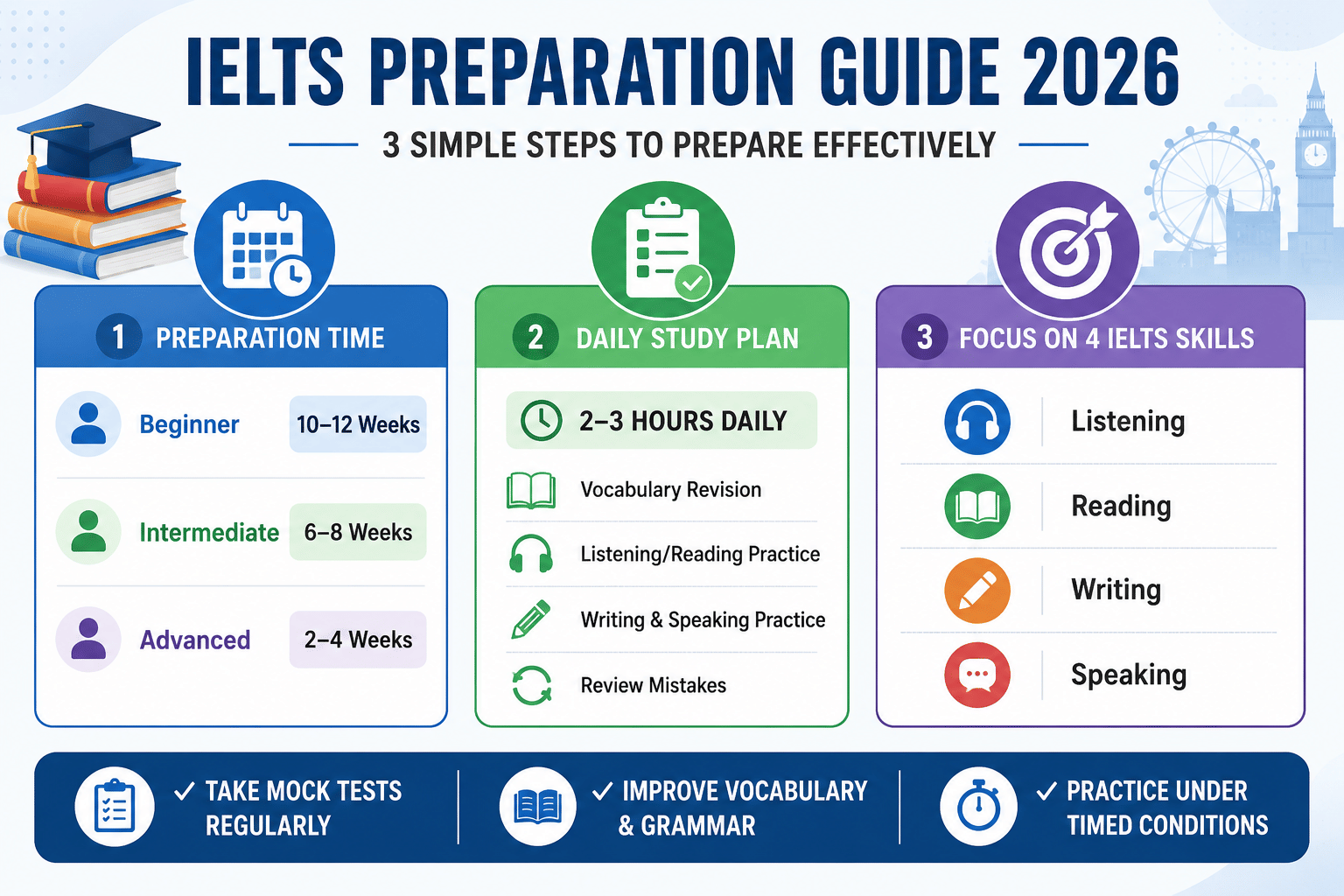
There is no fixed preparation period for IELTS. The required time depends on your current English proficiency, target band score, familiarity with the IELTS syllabus, and the amount of time you can dedicate to practice.
Before beginning your preparation, take an IELTS mock test to identify your strengths and weaknesses and create a realistic study plan. Here’s a breakdown of your required scores and preparation time:
| Current English Level | Target Band Score | Recommended Preparation Time |
|---|---|---|
| Beginner (A2-B1) | 6.0-6.5 | 10-12 Weeks |
| Intermediate (B1-B2) | 6.5-7.0 | 6-8 Weeks |
| Upper Intermediate (B2) | 7.0-7.5 | 4-6 Weeks |
| Advanced (C1+) | 7.5-8.5 | 2-4 Weeks |
IELTS Preparation Roadmap for 30 days in 2026
Applicants who are planning to take IELTS in September have only 30 days for preparation. Applicants need to focus specifically on building a strong vocabulary, advancing their speaking and listening skills, and developing better grammar proficiency.
Here’s a 30-day preparation guide for those appearing in September 2026:
| Week | Focus Area | What You Should Do |
|---|---|---|
| Week 1 | Understand IELTS | Learn the exam format, question types, marking criteria, and take a diagnostic test to identify weak areas. |
| Week 2 | Build Core Skills | Practice Listening and Reading daily, write one Writing task every day, and begin Speaking practice using common topics. |
| Week 3 | Improve Accuracy | Attempt timed practice tests, review Writing using official band descriptors, improve grammar and vocabulary, and analyse mistakes. |
| Week 4 | Exam Simulation | Take 3-4 full-length mock tests, revise weak areas, practice time management, and prepare for the actual test day. |
IELTS Study Plans for 15 Days in 2026
Applicants who are willing to take IELTS on a computer in the next 15 days to take admission during the fall intake in September 2026 can follow these 15-day guidelines to score their desired marks.
The table following are 15 days study plan for IELTS:
| Day | Study Plan |
|---|---|
| Day 1 | Understand the IELTS format and take a diagnostic test. |
| Day 2 | Practice Listening and review incorrect answers. |
| Day 3 | Learn Reading strategies such as skimming and scanning. |
| Day 4 | Practice Reading question types under timed conditions. |
| Day 5 | Practice Writing Task 1. |
| Day 6 | Practice Writing Task 2. |
| Day 7 | Practice Speaking Parts 1 and 2. |
| Day 8 | Practice Speaking Part 3 and improve pronunciation. |
| Day 9 | Take a Listening and Reading mock test. |
| Day 10 | Take a Writing mock test and review using band descriptors. |
| Day 11 | Take a Speaking mock interview. |
| Day 12 | Attempt one complete IELTS mock test. |
| Day 13 | Analyse mistakes and revise weak areas. |
| Day 14 | Take another full-length mock test under exam conditions. |
| Day 15 | Revise vocabulary, grammar, and important strategies before the exam. |
Section-Wise IELTS Preparation 2026
Indian applicants appearing for the IELTS test must know how to prepare for the 4 skills. Most of the applicants find it difficult to answer IELTS Speaking and Listening questions due to accent and vocabulary.
IELTS test primarily tests grammar, speaking skills, and vocabulary. Here’s a breakdown of how to prepare for each section of IELTS:
| IELTS Section | How to Prepare |
|---|---|
| Listening | Familiarise yourself with all four recordings and question types. Practice with authentic sample tests, improve note-taking skills, and listen to different English accents. Always check spelling and grammar while transferring answers. |
| Reading | Practice all Reading question types and improve your skimming and scanning skills. Develop the habit of reading under timed conditions and avoid spending too much time on difficult questions. |
| Writing | Learn the assessment criteria before practising. Focus on organising ideas logically, using a variety of vocabulary and sentence structures, and answering every part of the question clearly. |
| Speaking | Practice all three Speaking parts regularly. Speak naturally instead of memorising answers, improve fluency by speaking every day, and work on pronunciation, grammar, and vocabulary together. |
Daily IELTS Preparation Schedule 2026
Applicants can prepare for the IELTS easily by practicing for 2-3 hours per day. Here’s a daily 2-3 hours schedule to prepare for IELTS:
| Time | Activity | Duration |
|---|---|---|
| 20 Minutes | Learn new vocabulary and revise previous words | 20 mins |
| 35 Minutes | Practice Listening or Reading | 35 mins |
| 40 Minutes | Practice Writing (alternate Task 1 and Task 2) | 40 mins |
| 25 Minutes | Practice speaking aloud or with a partner | 25 mins |
| 20 Minutes | Review mistakes and revise grammar concepts | 20 mins |
IELTS Preparation Tips for Beginners 2026
Applicants appearing for the first time for IELTS may find the exam a bit difficult. Applicants need not panic or stress themselves for the test. They can easily get their desired scores by regularly practising IELTS test papers. Here are some tips for beginners:
- Understand the test before you start: Spend time learning the IELTS format, question types, timing, and marking criteria before attempting practice tests. Knowing what to expect helps you prepare more effectively.
- Take a diagnostic test: A diagnostic test helps you identify your strengths and weaknesses. Use the results to focus more on the sections where you need improvement instead of studying everything equally.
- Build a daily study routine: Consistency is more effective than studying for long hours occasionally. Even 2 hours of focused practice every day can significantly improve your performance over time.
- Practice all four skills: Listening, Reading, Writing, and Speaking contribute to your overall performance. Allocate time to each skill instead of concentrating only on your strongest or weakest section.
- Use IELTS practice materials: This helps you become familiar with the actual exam format and difficulty level.
- Review every mistake: Simply completing practice tests is not enough. Analyse incorrect answers, understand why you made mistakes, and avoid repeating them in future practice sessions.
- Improve your English alongside practice: Read newspapers, listen to English podcasts, watch English news, and speak English regularly. Developing your overall language skills will naturally improve your IELTS performance.
IELTS Preparation Without Coaching in 2026
Applicants who do not want to enroll in any coaching center and want to prepare for the IELTS at home can easily do so by regularly practicing their skills, improving vocabulary, and grammar fluency. Here are some tips you should consider for preparing for IELTS without any coaching:
| Step | What You Should Do |
|---|---|
| Understand the Test | Learn the exam pattern, timing, and assessment criteria before beginning your preparation. |
| Create a Study Plan | Set aside 2-3 hours daily and divide your time equally among the four sections. |
| Practice with Official Materials | Use official sample papers and preparation resources to become familiar with the actual exam format. |
| Take Weekly Mock Tests | Attempt one complete mock test every week under timed conditions to monitor your progress. |
| Analyse Your Mistakes | Review every mock test carefully and identify recurring errors in grammar, vocabulary, and time management. |
| Evaluate Speaking and Writing | Compare your responses with official band descriptors and sample answers to understand where improvements are needed. |
IELTS Vocabulary Preparation 2026
Vocabulary is one of the most important factors of IELTS preparation. A strong vocabulary with idioms and phrases can help in getting good IELTS scores in Speaking and Writing. Here are some easy strategies to build a good vocabulary:
| Strategy | How It Helps |
|---|---|
| Learn Topic-wise Vocabulary | Build vocabulary around common IELTS themes such as education, technology, environment, health, travel, and work. |
| Study Collocations | Learn words that naturally occur together (e.g., make a decision, play a vital role) to improve fluency. |
| Build Word Families | Learn different forms of a word (educate, education, educational, educator) to increase flexibility in Writing and Speaking. |
| Learn Synonyms | Develop the habit of replacing repeated words with appropriate alternatives to improve lexical variety. |
| Keep a Vocabulary Notebook | Record new words along with their meaning, pronunciation, and example sentence to aid long-term retention. |
| Read English Every Day | Reading newspapers, magazines, and academic articles exposes you to vocabulary used in real-life contexts. |
| Use New Words in Practice | Apply newly learned vocabulary while writing essays and answering Speaking questions to improve retention and confidence. |
Also read: Check Idioms for IELTS Exam 2026
IELTS Grammar Preparation 2026
Grammar fluency is quite important as it is a basic test of the IELTS. Applicants must be well-versed in all the grammar rules. All the 4 skills require fluent grammar skills.
Here are some grammar topics that are quite important for IELTS. Follow the table below to learn why these grammar topics are important and how to prepare for them:
| Grammar Topic | Why It Matters | Preparation Tip |
|---|---|---|
| Verb Tenses | Correct tense usage improves clarity and accuracy in Writing and Speaking. | Practice choosing the correct tense based on the time being described. |
| Subject-Verb Agreement | Incorrect agreement can reduce grammatical accuracy. | Check whether singular subjects take singular verbs and plural subjects take plural verbs. |
| Articles (a, an, the) | Proper article usage makes sentences sound natural. | Read regularly and notice how articles are used in different contexts. |
| Complex Sentences | A mix of simple and complex sentences demonstrates grammatical range. | Combine ideas using conjunctions such as although, because, and while. |
| Prepositions | Incorrect prepositions are common mistakes among IELTS candidates. | Learn prepositions in phrases instead of memorising them individually. |
| Passive Voice | Useful in academic writing, especially for describing processes in Task 1. | Practice converting active sentences into passive voice where appropriate. |
| Punctuation | Correct punctuation improves readability and sentence structure. | Review the use of commas, full stops, and apostrophes while proofreading your work. |
Also read: Check IELTS Vocabulary and Grammar 2026
IELTS Preparation Mistakes to Avoid in 2026
Indian applicants often lose marks due to silly mistakes which can be avoided easily. These small mistakes result in greater casualties and affect the IELTS score. The table below lists such common mistakes in the IELTS exam along with the solutions:
| Common Mistake | Solution |
|---|---|
| Starting preparation without understanding the exam format | Spend time learning the test structure, timing, and question types before practising. |
| Ignoring official assessment criteria | Study the official band descriptors for Writing and Speaking before practising. |
| Practising only one or two sections | Divide your study time equally among Listening, Reading, Writing, and Speaking. |
| Memorising Speaking answers | Practice speaking naturally and answer questions using your own ideas. |
| Not taking timed mock tests | Attempt full-length mock tests regularly under actual exam conditions. |
| Ignoring mistakes after practice | Maintain an error log and review every incorrect answer before your next practice session. |
| Using difficult vocabulary incorrectly | Use vocabulary that you understand well and can apply naturally in context. |
| Spending too much time on one Reading question | Move on if you're stuck and return later if time permits. |
| Poor proofreading in Writing | Reserve the last 3-5 minutes to review your response before submitting. |
| Studying only before the exam | Follow a consistent daily study schedule and revise regularly throughout your preparation. |
Also read: How to Get a 9 Score Band in IELTS Speaking in 2026
Preparing for IELTS becomes easier with a structured study plan and consistent practice. Most candidates can achieve their target band score in 2-12 weeks, depending on their current English proficiency and daily preparation. Following a 30-day roadmap, practising all four IELTS sections, improving vocabulary and grammar, and taking regular mock tests can help you perform confidently on exam day.
FAQs
Ques. How should I start preparing for IELTS?
Ans. The official IELTS partners recommend starting your preparation by understanding the IELTS test format, question types, timing, and assessment criteria. Before beginning your study plan, take a practice test to identify your strengths and weaknesses and use official preparation resources to become familiar with the exam.
Ques. Can I prepare for IELTS without coaching?
Ans. Yes. According to the official IELTS website, candidates can prepare independently using official sample tests, preparation guides, videos, webinars, books, and practice resources provided by the IELTS partners.
Ques. How is the IELTS Writing test assessed?
Ans. The IELTS Writing test is assessed using four criteria: Task Achievement (or Task Response), Coherence and Cohesion, Lexical Resource, and Grammatical Range and Accuracy. Each criterion contributes equally to the Writing band score.
Ques. How is the IELTS Speaking test assessed?
Ans. The Speaking test is assessed on Fluency and Coherence, Lexical Resource, Grammatical Range and Accuracy, and Pronunciation. IELTS examiners use official band descriptors to evaluate candidates.
Ans. The Speaking test is assessed on Fluency and Coherence, Lexical Resource, Grammatical Range and Accuracy, and Pronunciation. IELTS examiners use official band descriptors to evaluate candidates.
Ques. Can I write my answers in capital letters in IELTS?
Ans. Yes. According to the official IELTS guidance, candidates may write their answers in capital letters or lowercase letters, provided the answers are clear and legible.
Ques. Can I make notes during the IELTS Listening test?
Ans. Yes. Candidates are allowed to make notes on the question paper while listening to the recordings. These notes are not marked and are only for personal use during the test.
Ques. How is the IELTS Speaking test assessed?



Comments