



| Updated On - Jul 31, 2026
The IELTS Writing section lasts 60 minutes and consists of 2 compulsory tasks. Candidates must complete both tasks within the allotted time, with Task 2 carrying twice the weight of Task 1.
Applicants can perform well in this test with regular practice of the latest IELTS Writing topics with a timer to ace the time limit. Applicants can find the latest Writing topics for both tasks in this article.
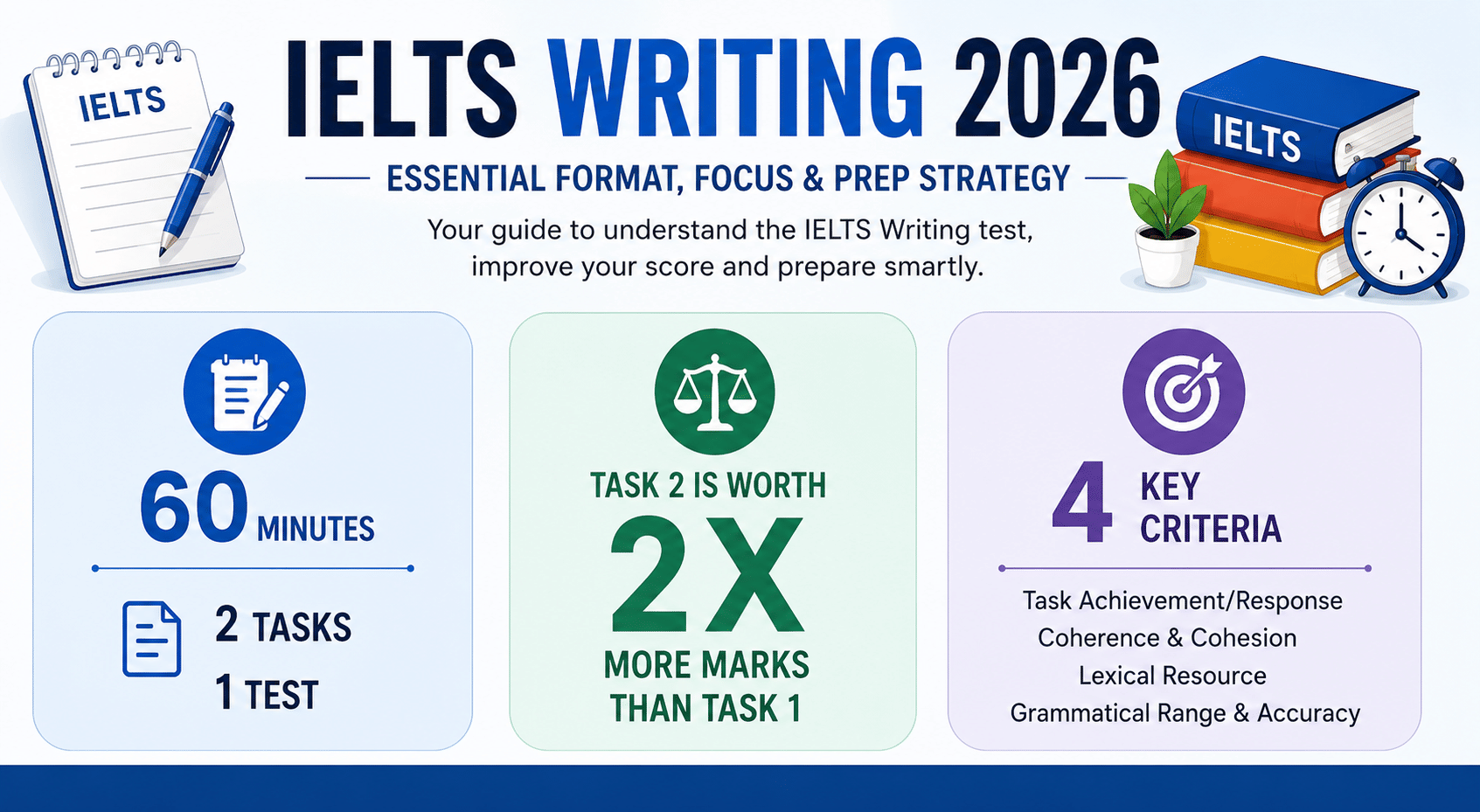
- IELTS Writing Format 2026
- Latest IELTS Writing Task 1 Topics (Academic)
2.1 IELTS Writing Task 1 Sample Answer (Academic)
- Latest IELTS Writing Task 1 Topics (General Training)
3.1 IELTS Writing Task 1 Sample Answer (General Training)
- Latest IELTS Writing Task 2 Topics
4.1 IELTS Writing Task 2 Sample Answer
- IELTS Writing Vocabulary and Linking Words
- Common Mistakes in IELTS Writing
- Time Management Tips
- IELTS Writing Preparation Strategy
- FAQs
IELTS Writing Format 2026
The Writing Task 1 is different in IELTS Academic and General Training. In the Academic test, Task 1 has a graph or similar image which you need to describe in 150words. In General Training, you need to write a letter in 150 words. Task 2 remains the same for both test types.
The table below is an overview of the format of the Writing section:
| Feature | Task 1 | Task 2 |
|---|---|---|
| Time | 20 minutes | 40 minutes |
| Minimum Words | 150 | 250 |
| Weightage | 33% | 67% (Twice Task 1) |
| Academic | Graph, Chart, Table, Map, Process Diagram | Essay |
| General Training | Letter Writing | Essay |
Both tasks are assessed using four criteria:
- Task Achievement/Task Response
- Coherence and Cohesion
- Lexical Resource
- Grammatical Range and Accuracy.
Note: Candidates should write in complete sentences, avoid bullet points, and allocate approximately 20 minutes for Task 1 and 40 minutes for Task 2.
Latest IELTS Writing Task 1 Topics (Academic)
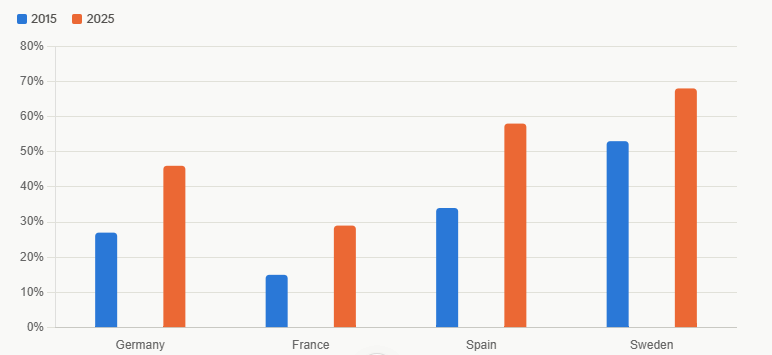
Question 1: Bar GraphThe bar chart below shows the percentage of energy from renewable sources (solar, wind, hydro) as a share of total energy consumption in four European countries, in 2015 and 2025.
Summarise the information by selecting and reporting the main features, and make comparisons where relevant. Write at least 150 words.
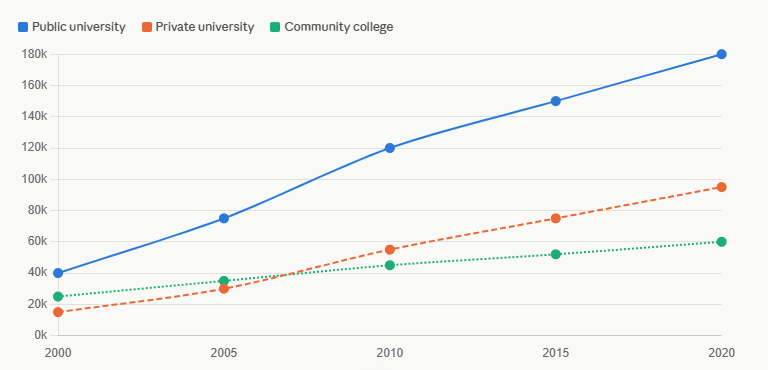
The graph below shows the number of international students (in thousands) enrolled in public universities, private universities, and community colleges in a country, between 2000 and 2020.
Summarise the information by selecting and reporting the main features, and make comparisons where relevant.
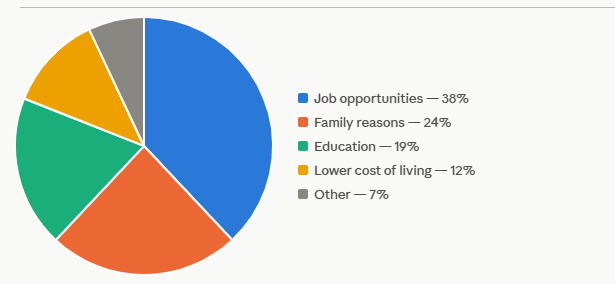
The pie chart below shows the main reasons why people chose to move to a particular city.
Summarise the information by selecting and reporting the main features, and make comparisons where relevant.
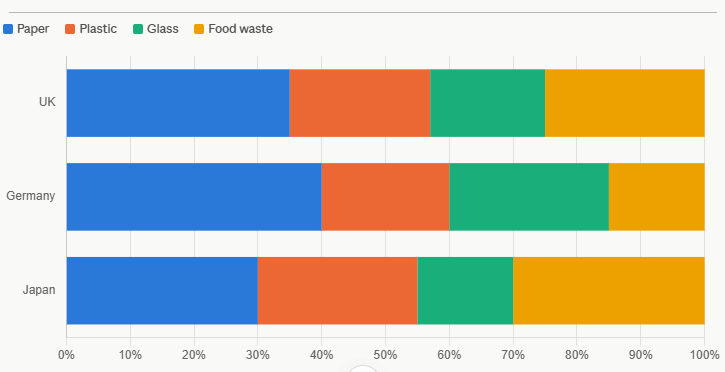
The chart below shows the composition of household recycling by material type (paper, plastic, glass, food waste) in three countries in 2015.
Summarise the information by selecting and reporting the main features, and make comparisons where relevant.
IELTS Writing Task 1 Sample Answer (Academic)
Sample Answer Question 1: Bar Graph
The bar chart compares the share of renewable energy in total energy consumption across four European countries in 2015 and 2025. Overall, all four countries increased their reliance on renewable sources over the decade, with Spain and Sweden consistently leading the group.
In 2015, Sweden had the highest renewable share at 53%, followed by Spain at 34%. Germany stood at 27%, while France recorded the lowest figure, just 15%.
By 2025, this upward trend continued across all countries. Sweden remained the leader, rising to 68%, while Spain saw the largest increase in percentage points, climbing from 34% to 58%. Germany also grew significantly, nearly doubling to 46%, whereas France, despite almost doubling its 2015 figure, still had the lowest share overall at 29%.
In conclusion, although all four nations expanded their renewable energy usage between 2015 and 2025, Sweden and Spain maintained a clear advantage over Germany and France throughout the period.
Latest IELTS Writing Task 1 Topics (General Training)
Work/Employment
- You recently attended a training course for work. Your employer asked for feedback. Write a letter: remind them what the course was about, explain why it was useful, suggest why it may not suit some colleagues.
- You want to join a training course related to your work. Write to your employer: describe the course, explain how it will help, suggest a suitable time.
- You saw an ad for a training course useful for your job. Write to your company: describe the course, explain what they could do to help, say how it will help your job.
- Negotiating a flexible working arrangement with a manager
Accommodation
- You share a college room with another student and face problems. Write to the accommodation officer: describe the situation, explain the problems, say what accommodation you'd prefer.
Complaints/Service Issues
- A valuable parcel sent via courier hasn't arrived. Write to the courier company: give parcel details, explain importance of contents, suggest action.
- Formal complaint regarding a digital service (reported trend, April 2026)
Recommendations
- A friend wants a summer camp sports trainer job. Write to the camp manager recommending them: say how well you know them, describe their qualifications, explain suitability.
Social/Informal
- A friend is visiting your country/city. Write telling them what to do, where to stay, what to pack.
- You're organizing a countryside event. Write to a friend asking for help: describe the event, mention arrangements made, say how they can help.
Community/Local Issues
- Write to a TV channel manager about boring daytime programs, with suggestions.
- Suggesting improvements for a local community service
- Letters about recycling programs, community gardens, or pollution concerns
IELTS Writing Task 1 Sample Answer (General Training)
Topic: You recently attended a training course for work. Your employer has asked for your feedback. Write a letter to your employer.
Dear Mr. Roberts,
I am writing to share my feedback on the project management training course I attended last week, which you kindly arranged for me.
The course covered key areas such as task scheduling, team coordination, and risk assessment. I found it extremely useful, as it introduced practical tools I have already started applying to our current projects, particularly the scheduling software that has helped me organise deadlines more efficiently.
However, I feel the course may not be equally beneficial for all colleagues. Since it focused heavily on advanced techniques, team members who are new to project management might struggle to follow the content without first completing a basic introductory session.
I would be happy to share detailed notes with the team if that would help. Thank you again for this valuable opportunity.
Yours sincerely,
(your name)
Latest IELTS Writing Task 2 Topics
Technology/AI
- Some people believe generative AI will replace most jobs, while others think it will only change how people work. Discuss both views and give your opinion.
- The benefits and drawbacks of technology in daily life (perennial favorite, still appearing)
Work Culture
- Some people think working from home is beneficial. Others believe working in an office is more effective. Discuss both views and give your opinion.
- Some countries are moving toward a four-day working week. Discuss the advantages and disadvantages.
Economy/Society
- Discuss the impact of rising cost of living on families and possible government solutions.
Education
- The role of technology in modern learning vs. traditional education — benefits and drawbacks
Social Media
- Social media is widely used by people of all ages. What are the advantages and disadvantages of this trend?
Travel/Retirement
- In many countries, people move overseas or to a different part of their country after retirement. Discuss why, and the outcomes.
Transportation/Trade
- Some believe cheap, fast transportation is required for successful international business, while others believe good technology is more important. Discuss both views and give your opinion.
IELTS Writing Task 2 Sample Answer
Topic: Some people believe generative AI will replace most jobs, while others think it will only change how people work. Discuss both views and give your opinion.
The rapid advancement of generative artificial intelligence has sparked debate about its impact on employment. While some predict widespread job losses, others argue it will simply transform existing roles rather than eliminate them. This essay will examine both perspectives before presenting my own view.
Those who foresee mass job displacement point to AI's growing ability to perform tasks once considered uniquely human, such as writing, coding, and data analysis. Industries like customer service and content creation have already begun automating routine functions, leading to genuine concerns about redundancy among workers whose skills are easily replicated by algorithms.
On the other hand, many experts argue that AI will act as a tool that reshapes job functions rather than replacing them entirely. Historically, technological shifts, from industrialisation to the internet, have eliminated certain roles while creating new ones. For instance, AI may relieve employees of repetitive administrative work, allowing them to focus on creativity, strategy, and interpersonal skills that machines cannot replicate.
In my opinion, the second view is more convincing. Although some job categories will inevitably shrink, history suggests that technology tends to redistribute labour rather than eliminate it. The real challenge lies not in job loss itself, but in ensuring workers are reskilled to adapt to an AI-integrated economy.
In conclusion, while generative AI will undoubtedly disrupt certain professions, it is more likely to transform the nature of work than to cause mass unemployment, provided workforces are adequately prepared.
IELTS Writing Vocabulary and Linking Words
Using a wide range of vocabulary and cohesive devices is essential for achieving a higher IELTS Writing band. Examiners assess vocabulary based on accuracy and appropriateness, not simply the use of difficult words.
Candidates should use topic-specific IELTS vocabulary, synonyms, collocations, and formal academic expressions naturally throughout their responses.
| Topic | Sample Vocabulary |
|---|---|
| Education | Curriculum, Literacy, Academic Performance |
| Technology | Artificial Intelligence, Automation, Innovation |
| Environment | Sustainability, Biodiversity, Carbon Emissions |
| Health | Healthcare, Obesity, Preventive Measures |
| Economy | Inflation, Employment, Financial Stability |
Linking words help organize ideas logically, but excessive or repetitive use may reduce the Coherence and Cohesion score. Effective writing combines varied sentence structures with precise transitions to improve readability.
| Purpose | Linking Words |
|---|---|
| Addition | Furthermore, Moreover, In addition, Besides |
| Contrast | However, Nevertheless, On the other hand, In contrast |
| Cause & Effect | Therefore, Consequently, As a result, Hence |
| Examples | For example, For instance, Such as |
| Opinion | In my opinion, I believe, From my perspective |
| Sequence | Firstly, Secondly, Finally, Subsequently |
| Conclusion | To conclude, In summary, Overall, In conclusion |
Common Mistakes in IELTS Writing
Many candidates lose marks in IELTS Writing not because of weak English but because they fail to meet the official assessment criteria. Understanding these common mistakes and learning how to avoid them can significantly improve your Writing band score.
Follow the table below to know these common mistakes and their solutions:
| Common Mistake | How to Avoid It |
|---|---|
| Writing below the minimum word count | Check your word count during practice and aim for 160-180 words in Task 1 and 270-300 words in Task 2. |
| Not answering all parts of the question | Underline keywords in the question and create a quick outline before writing. |
| Spending too much time on Task 1 | Follow the recommended timing of 20 minutes for Task 1 and 40 minutes for Task 2. |
| Overusing linking words | Use linking words only where they improve the flow of ideas. |
| Repeating the same vocabulary | Use synonyms, collocations, and topic-specific vocabulary appropriately. |
| Poor paragraph organization | Structure essays with a clear introduction, body paragraphs, and conclusion. |
| Using memorized essays or templates | Adapt your response to the specific prompt and support ideas with relevant examples. |
| Grammar and punctuation errors | Leave the final few minutes to proofread and correct errors. |
| Describing every detail in Task 1 | Focus on the most significant comparisons and overall trends rather than every figure. |
| Using informal language | Use formal vocabulary and avoid contractions or conversational phrases. |
Time Management Tips
Since the IELTS Writing test lasts only 60 minutes, effective time management is essential. Because Task 2 contributes twice as much as Task 1 to the Writing score, candidates should spend approximately 20 minutes on Writing Task 1 and 40 minutes on Task 2.
Follow this time management strategy to ace the Writing task with accuracy and in time:
- Before writing, allocate 3-5 minutes to analyze the question and plan the response.
- Reserve the final 3-5 minutes for proofreading to correct grammar, spelling, and punctuation errors.
- Avoid spending excessive time perfecting the introduction, as strong body paragraphs and complete task coverage have a greater impact on the final band score.
| Activity | Task 1 | Task 2 |
|---|---|---|
| Question Analysis | 2-3 min | 3-5 min |
| Planning | 2-3 min | 5 min |
| Writing | 15 min | 30 min |
| Proofreading | 2 min | 5 min |
Quick Time-Saving Tips
- Complete Task 1 within 20 minutes.
- Prioritize Task 2, as it carries more marks.
- Spend a few minutes planning before writing.
- Keep introductions concise.
- Leave enough time to proofread both tasks
Also read: Check IELTS Preparation Time Guide 2026
IELTS Writing Preparation Strategy
- Understand the exam format: Learn the requirements of Task 1 and Task 2, including word limits, time allocation, and marking criteria before you start practicing.
- Practice different question types: Write responses for graphs, charts, maps, letters, and all five Task 2 essay types to build familiarity with every format.
- Improve vocabulary and grammar: Focus on using topic-specific vocabulary, varied sentence structures, and accurate grammar instead of memorizing difficult words.
- Write under timed conditions: Practice completing Task 1 in 20 minutes and Writing Task 2 in 40 minutes to improve speed and confidence.
- Review your mistakes: Analyze every practice test to identify grammar errors, weak ideas, poor organization, and repeated vocabulary, then work on those areas.
- Study high-scoring sample answers: Read Band 8-9 model responses to understand effective essay structure, coherence, and vocabulary usage.
- Take regular mock tests: Attempt a full IELTS Writing test every week under exam conditions to improve time management and track your progress.
Also read: Check the IELTS Preparation Guide for Indian Applicants 2026
The IELTS Writing test consists of 2 compulsory tasks to be completed in 60 minutes, with Task 2 contributing twice as much as Task 1 to the final Writing band score. Understanding the latest Writing topics, practicing different question types, and writing according to the official assessment criteria can significantly improve your chances of achieving a Band 7+ or higher.
FAQs
Ques. What are the two tasks in the IELTS Writing test?
Ans. The IELTS Writing test consists of two compulsory tasks that must be completed within 60 minutes. In the Academic test, Task 1 requires candidates to describe visual information such as graphs, charts, tables, maps, or diagrams, while Task 2 requires writing an essay in response to a point of view, argument, or problem.
Ques. How many words should I write in IELTS Writing Task 1 and Task 2?
Ans. According to the official IELTS guidelines, candidates should write at least 150 words for Task 1 and at least 250 words for Task 2. Writing fewer than the required minimum may result in a penalty.
Ques. Can I use bullet points in the IELTS Writing test?
Ans. No. IELTS requires candidates to write their answers in complete sentences. Responses written as notes or bullet points are not accepted and may affect the Writing score.
Ques. What types of essays are asked in IELTS Writing Task 2?
Ans. The official IELTS does not classify Task 2 into fixed essay categories. Instead, candidates are expected to respond appropriately to the question prompt, which may ask them to give an opinion, discuss different views, explain causes or solutions, evaluate ideas, or assess advantages and disadvantages.
Ques. Should I memorize essays for the IELTS Writing test?
Ans. No. The official IELTS advises against using formulaic or memorized responses. Essays that do not answer the specific question appropriately may lose marks for Task Response. Candidates should focus on understanding the question and developing relevant ideas.
Ques. What writing style should I use in the IELTS Writing test?
Ans. For the Academic Writing test, candidates should use an academic or semi-formal style. Responses should be clear, well-organized, and written in complete sentences using appropriate vocabulary and grammar.
Ques. What do IELTS examiners look for in a high-scoring IELTS Writing response?
Ans. Examiners evaluate whether candidates fully address the task, organize ideas logically, use a wide range of vocabulary accurately, and demonstrate grammatical variety with a high level of accuracy. These four assessment criteria are equally weighted in the scoring process.



Comments