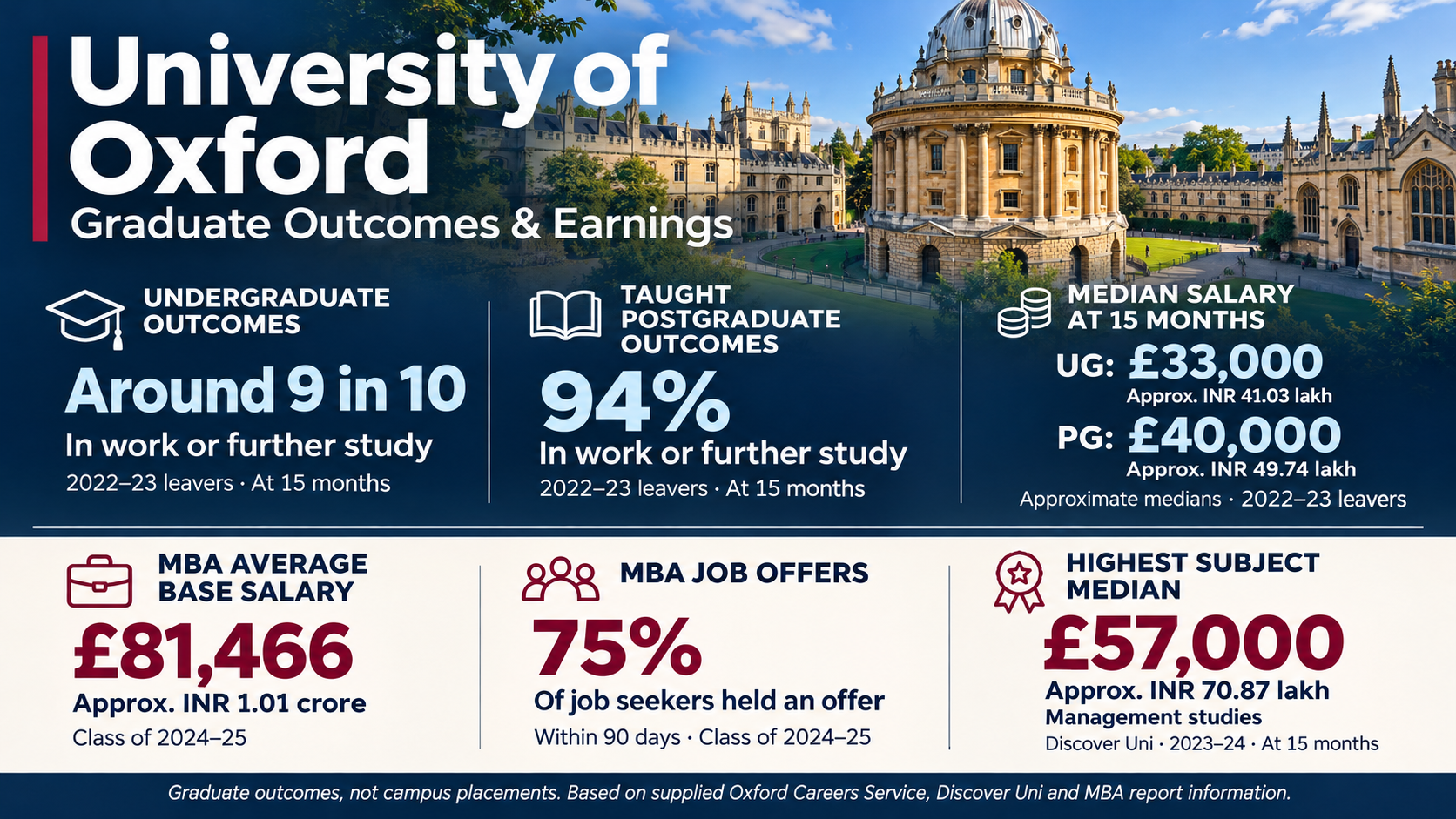
University of Oxford placements data comes from the UK Graduate Outcomes survey. It found around 9 in 10 Oxford undergraduates in work or further study 15 months after graduating in 2022-23. Oxford is a collegiate university in Oxford, England. Its taught postgraduates reached 94 per cent on the same measure.
Oxford reports graduate outcomes, not campus placements. The figures below come from the Oxford Careers Service summary of the survey and the official Discover Uni course pages. The MBA figures come from the Oxford MBA Employment Report for the class of 2024-25, and the visa rules from UK government pages.
- Undergraduates in work or further study (2022-23 leavers): around 9 in 10 at 15 months
- Taught postgraduates in work or further study (2022-23 leavers): 94 per cent
- Median salary 15 months after (2022-23 leavers): around GBP 33,000 (INR 41.03 Lakhs) for undergraduates and GBP 40,000 (INR 49.74 Lakhs) for postgraduates
- MBA average base salary (class of 2024-25): GBP 81,466 (INR 1.01 Crore), with 75 per cent of job seekers holding an offer within 90 days
- Highest subject median on Discover Uni (Management studies, 2023-24): GBP 57,000 (INR 70.87 Lakhs) at 15 months
Currency Note: All INR figures use the xe.com mid-market rate of GBP 1 = INR 124.34 on 12 November 2026.
![]()
Also Check: University of Oxford Admission 2027 for Indian Students
Oxford Placements and Employment Rate 2022-23
Around 9 in 10 Oxford undergraduates were in work or further study 15 months after graduating in 2022-23, and 94 per cent of taught postgraduates were. The Careers Service says these rates sit about 6 percentage points above the Russell Group average. The figures come from the Graduate Outcomes survey, which HESA runs across every UK university about 15 months after students finish.
In the UK, a placement is a work term taken during a degree, not a campus hiring drive. Oxford does not run recruitment rounds or publish a placement percentage. Indian students should read the rates below as employment and study rates, not placement rates.
| Activity 15 months after graduating (2022-23 leavers) |
Undergraduates |
Postgraduates |
| In work or further study |
Around 9 in 10 |
94% (taught) |
| Working |
Around 62% |
79% |
| In further study |
About 25% |
About 15% |
| Self-employed or freelance |
7% |
11% |
| Unemployed |
About 5% |
2% |
- A quarter of undergraduates go straight into further study, so the working share is lower than the headline suggests.
- The figures cover all Oxford leavers who replied; the Careers Service does not split them by domicile, so none is an Indian-student rate.
- Over 80 per cent of graduates said their activity felt meaningful, and 65 per cent of undergraduates said they used what they learned.
- Across all UK graduates of 2023-24, 87 per cent were in work or further study and 7 per cent were unemployed, which gives the sector backdrop.
Source: University of Oxford Careers Service, Insights from the Graduate Outcomes survey, 2022-23 leavers; HESA Graduate Outcomes national results, class of 2023-24, published 4 June 2026.
Note: Oxford publishes rounded figures such as around 9 in 10 rather than exact percentages for 2022-23, and no response rate for that year. Its pooled 2018 to 2020 survey drew over 13,000 responses at a 56 per cent response rate, which shows the typical base.
Also Check: University of Oxford Rankings 2026
Oxford Average Salary After Graduation
Oxford's median salary 15 months after graduating was around GBP 33,000 (INR 41.03 Lakhs) for undergraduates in the 2022-23 Graduate Outcomes survey. Postgraduates reached around GBP 40,000 (INR 49.74 Lakhs). Both sit above the Russell Group averages, according to the Careers Service. A median is the middle salary of those who replied, so half earned more and half earned less.
Oxford publishes these two rounded medians and no single university-wide figure. The table adds the official research-graduate and MBA figures so an Indian applicant can see the full range by level.
| Level at Oxford |
Salary (GBP) |
INR |
Basis and cohort |
| Undergraduate |
Around GBP 33,000 |
INR 41.03 Lakhs |
Median, 15 months after, 2022-23 leavers |
| Taught postgraduate |
Around GBP 40,000 |
INR 49.74 Lakhs |
Median, 15 months after, 2022-23 leavers |
| Research graduate |
GBP 35,700 |
INR 44.39 Lakhs |
Median of 320 who disclosed, 15 months after, 2017-18 leavers |
| Research graduate |
GBP 41,600 |
INR 51.73 Lakhs |
Average of the same 320, 2017-18 leavers |
| MBA |
GBP 81,466 |
INR 1.01 Crore |
Average base salary at 90 days, class of 2024-25, 94 per cent reporting |
- The MBA figure is an average, not a median, because the Employment Report does not publish a median.
- The research-graduate figures are nominal figures from 2017-18, not adjusted for pay growth since.
- None of the rows is split by domicile, so each covers all graduates at that level rather than Indian graduates.
Source: University of Oxford Careers Service, Graduate Outcomes survey insights, 2022-23 leavers. University of Oxford Graduate Admissions, Future prospects page, 2017-18 survey. Saïd Business School, MBA Employment Report, class of 2024-25.
Note: Medians and averages answer different questions. The MBA average of GBP 81,466 (INR 1.01 Crore) sits inside a wide reported range. That range runs from GBP 17,115 (INR 21.28 Lakhs) to GBP 192,288 (INR 2.39 Crore), so a few very high salaries pull the average up. Treat it as the centre of a wide spread, not a typical offer.
Also Check: Study in UK 2027: Fees, Visa, Jobs for Indian Students
Oxford Placements by Course and Salary
Every Oxford course in the table below shows at least 80 per cent of graduates in highly skilled work 15 months after finishing. Economics and Management reached 100 per cent in 2023-24 and Computer Science 90 per cent in the pooled 2022-24 cohort. Discover Uni counts a job as highly skilled when the Office for National Statistics classes it as professional or managerial.
Discover Uni reports earnings by subject rather than by named degree, so the Economics and Management row shows both of its subjects. The table sorts rows by median salary.
| Oxford course (subject for earnings) |
In work or study |
Highly skilled |
Median at 15 months (GBP) |
INR |
Cohort |
| Economics and Management (Management studies) |
90% |
100% |
GBP 57,000 |
INR 70.87 Lakhs |
2023-24 |
| Computer Science |
95% |
90% |
GBP 55,000 |
INR 68.39 Lakhs |
2022-24 |
| Economics and Management (Economics) |
90% |
100% |
GBP 45,000 |
INR 55.95 Lakhs |
2023-24 |
| PPE (Economics) |
88% |
85% |
GBP 45,000 |
INR 55.95 Lakhs |
2023-24 |
| Mathematics |
91% |
85% |
GBP 41,500 |
INR 51.60 Lakhs |
2023-24 |
| PPE (Politics) |
88% |
85% |
GBP 36,000 |
INR 44.76 Lakhs |
2023-24 |
| Engineering (MEng) |
89% |
95% |
GBP 35,500 |
INR 44.14 Lakhs |
2023-24 |
| PPE (Philosophy) |
88% |
85% |
GBP 35,000 |
INR 43.52 Lakhs |
2023-24 |
| Law (Jurisprudence) |
85% |
80% |
GBP 32,000 |
INR 39.79 Lakhs |
2023-24 |
- Each median rests on 10 to 40 respondents, so a handful of replies can move a figure; Computer Science has the smallest base at 10 people.
- Law starts lowest at 15 months, yet its 2016-18 graduates reached a median of GBP 75,500 (INR 93.88 Lakhs) five years on.
- Medicine shows no 15-month data on Discover Uni; its 2016-18 graduates earned a median of GBP 50,000 (INR 62.17 Lakhs) five years after finishing.
- These are undergraduate figures; Discover Uni does not publish master's outcomes, and the pages do not separate international graduates.
Source: Discover Uni (Office for Students), course pages for Oxford University, Graduate Outcomes survey 2023-24 and 2022-24 cohorts, and LEO earnings for 2016-18 graduates.
Key Insight: The 15-month median is the wrong number to anchor on for Oxford. Five years after finishing, 2016-18 Computer science graduates earned a median of GBP 68,500 (INR 85.17 Lakhs) and Engineering graduates GBP 60,500 (INR 75.23 Lakhs). Management studies graduates of 2015-17 reached GBP 75,000 (INR 93.25 Lakhs). Each sits well above the subject's 15-month median.
Also Check: University of Oxford Courses and Fees 2027
Oxford MBA Placements and Salary 2024-25
75 per cent of Oxford MBA graduates seeking a role had an offer within 90 days of finishing. The average base salary was GBP 81,466 (INR 1.01 Crore), up 9.9 per cent on the previous class. The class of 2024-25 had 339 students from 63 nationalities, 97 per cent of them international. Saïd Business School publishes these figures in its MBA Employment Report, with 94 per cent of the class reporting salary.
Financial services took the largest share of the class, while consulting paid the most. Every sector average below is a base salary in GBP for the class of 2024-25.
| Sector (class of 2024-25) |
Share of class |
Average base salary (GBP) |
INR |
| Financial services |
38.6% |
GBP 78,017 |
INR 97.01 Lakhs |
| Consulting |
22.2% |
GBP 90,746 |
INR 1.13 Crore |
| Global industry |
21.5% |
GBP 79,875 |
INR 99.32 Lakhs |
| Technology and e-commerce |
13.3% |
GBP 85,286 |
INR 1.06 Crore |
| Impact |
4.4% |
GBP 58,936 |
INR 73.28 Lakhs |
- A further 8.6 per cent of the class started their own venture, and 88 per cent switched sector, country or function.
- The average bonus was GBP 15,985 (INR 19.88 Lakhs) on top of base salary.
- The report publishes no median salary, no acceptance rate and no Indian-specific figures.
Source: Saïd Business School, University of Oxford, MBA Employment Report, class of 2024-25.
Where graduates work matters as much as the sector. 48 per cent of the class stayed in the United Kingdom at an average base salary of GBP 80,718 (INR 1.00 Crore). North America took 14 per cent at GBP 116,827 (INR 1.45 Crore). Asia took 12 per cent at GBP 40,399 (INR 50.23 Lakhs), the lowest regional average.
- Europe took 9 per cent of the class at GBP 79,914 (INR 99.37 Lakhs).
- Australia and Oceania took 4 per cent at GBP 109,224 (INR 1.36 Crore).
- The Middle East and North Africa took 4 per cent at GBP 88,475 (INR 1.10 Crore).
- Sub-Saharan Africa took 3 per cent at GBP 75,196 (INR 93.50 Lakhs).
- Latin America and the Caribbean took 2 per cent at GBP 53,922 (INR 67.05 Lakhs).
- A further 3 per cent did not report a location.
- The report gives no separate figure for India, so Asia is the closest published region for a returning Indian graduate.
Note: The 90-day offer rate counts only graduates who were seeking a role, and the Asia average covers several countries with different pay levels. The report does not say how many graduates returned to India or what they earned there.
Also Check: UK Higher Education System: A Complete Guide for 2026
Top Recruiters Hiring Oxford Graduates
Saïd Business School names McKinsey, BCG, Bain, JP Morgan, Barclays, BlackRock, Amazon and Unilever among the employers that hired its class of 2024-25. The MBA Employment Report lists employers by sector as examples and does not rank them or publish hiring counts. The Oxford pages read for this article carry no equivalent employer list for undergraduate or master's graduates.
The table groups the named employers by the sector the report assigns them.
| Sector (Oxford MBA class of 2024-25) |
Employers named in the report |
| Consulting |
Bain, BCG, McKinsey, Deloitte, Roland Berger |
| Financial services |
JP Morgan, Barclays, BlackRock, Citi UK, Revolut |
| Global industry |
Unilever, Toyota, Nike, ExxonMobil, Mercedes-Benz |
| Technology and e-commerce |
Amazon, ByteDance and TikTok, PlayStation, Kyndryl |
| Impact |
Tony Blair Institute for Global Change, CIFF |
- These are MBA employers only; a master's or undergraduate applicant should not read them as Oxford-wide recruiters.
- The report names them as hiring at least one graduate from the class, not as recruiting every year.
- For other degrees, Oxford's Careers Service lists finance, consulting, law, technology, research, public service and the creative industries as the main destinations, without naming firms.
Source: Saïd Business School, University of Oxford, MBA Employment Report, class of 2024-25; University of Oxford Careers Service, Insights from the Graduate Outcomes survey, 2022-23 leavers.
Oxford's graduate admissions pages say the Careers Service runs 9 careers fairs a year featuring hundreds of employers. It also lists more than 250 employer and adviser events and around 4,000 vacancies on its CareerConnect platform each year. Those are activity counts, not hiring figures.
Also Check: UK Scholarships for Indian Students 2026-27: Full Guide
Internships and Work Experience at Oxford
Oxford's Summer Internship Programme offers full-time placements of 2 to 12 weeks during the summer vacation, open only to current matriculated Oxford undergraduates and postgraduates. Each internship comes with a stipend or help with travel or accommodation, and UK placements at for-profit companies pay at least the national living wage. Oxford's graduate admissions pages describe hundreds of these paid or funded internships each year without giving an exact count.
The Careers Service describes these internships as optional and publishes no participation rate. The routes below are the ones Oxford describes on its own pages.
- Summer Internship Programme: 2 to 12 weeks full-time, with international placements opening for applications in January to February and UK placements in February to March.
- Host organisations: private companies, international organisations, NGOs and research institutions, with past hosts in Germany, Brazil, India and the UK named on the programme page.
- Micro-internships: unpaid projects of up to 5 days, one per term, with travel and lunch costs reimbursed by the host.
- Who cannot apply: MBA, Executive MBA and visiting students are excluded from Internship Office programmes.
International students on a Student visa can take these internships within their visa conditions. Oxford's visa pages show the standard permission as 20 hours per week in term time, with more than 20 hours allowed in vacations once the employer has confirmed the dates.
Tip for Indian Students: Apply to the international round of the Summer Internship Programme in January. A stipend-funded 2 to 12 week placement is the main structured work experience the Careers Service offers before the Graduate visa clock starts.
Oxford Career Services for International Students
The Oxford Careers Service is open to every current student and runs 9 careers fairs and more than 250 events a year, according to Oxford's graduate admissions pages. CareerConnect, its online platform, carries around 4,000 vacancies a year. The service publishes no separate outcome figures for international students.
- CareerConnect, the online platform that lists vacancies and events, which needs a student login.
- The Internship Office, which runs the Summer Internship Programme and micro-internships described above.
- Employer-led events and skills sessions across the academic year.
- Saïd Business School provides separate careers support for MBA students, who are outside the Internship Office programmes.
Oxford's alumni network of about 400,000 people in roughly 170 regional groups across more than 90 countries is listed on the same pages. These are services and counts, not employment outcomes.
Also Check: Study in UK For Indian Students After 12th
Post-Study Work After Oxford for Indian Students
The Graduate visa lets Oxford graduates stay and work in most jobs. It lasts 2 years for applications made on or before 31 December 2026 and 18 months for applications from 1 January 2027. PhD graduates get 3 years. Applicants must be in the UK on a Student visa, and Oxford must have told the Home Office that they completed the course.
- Application fee: GBP 937 (INR 1.17 Lakhs), paid once.
- Healthcare surcharge: usually GBP 1,035 (INR 1.29 Lakhs) for each year of the visa.
- During the degree, Oxford's visa pages show the standard Student visa permission as 20 hours per week in term time.
- Skilled Worker visa afterwards: the standard salary is at least GBP 41,700 (INR 51.85 Lakhs) per year, as gov.uk states.
- A lower Skilled Worker salary of GBP 33,400 (INR 41.53 Lakhs) applies only in the cases gov.uk lists.
Oxford's postgraduate median of around GBP 40,000 (INR 49.74 Lakhs) at 15 months sits below the standard threshold but above the lower one. Rules change often, so check gov.uk on the day you apply.
Also Check:
Overall, the University of Oxford offers strong employment outcomes, with around 9 in 10 undergraduates and 94% of taught postgraduate students in work or further study 15 months after graduation. Their median salaries were GBP 33,000 (INR 41.03 Lakhs) and GBP 40,000 (INR 49.74 Lakhs), respectively.
However, students should remember that these figures are rounded and course-wise master's employment data is not available. Before accepting an offer, compare your course fees with the relevant Discover Uni subject data and check the Graduate visa rules applicable to your intake.
FAQs
Ques. What is the graduate employment rate at University of Oxford?
Ans. Around 9 in 10 Oxford undergraduates and 94 per cent of taught postgraduates were in work or further study 15 months after graduating in 2022-23. The figures come from the Careers Service summary of the Graduate Outcomes survey. About 62 per cent of undergraduates and 79 per cent of postgraduates were working.
Ques. What is the average salary of an Oxford graduate?
Ans. The median salary 15 months after graduating was around GBP 33,000 (INR 41.03 Lakhs) for undergraduates in the 2022-23 survey. Postgraduates reached around GBP 40,000 (INR 49.74 Lakhs). Oxford MBA graduates of 2024-25 reported an average base salary of GBP 81,466 (INR 1.01 Crore).
Ques. Does Oxford University have placements for Indian students?
Ans. Oxford does not run campus placement drives. It offers the Summer Internship Programme of 2 to 12 weeks with a stipend or travel help to all current matriculated students; visiting students are excluded. Unpaid micro-internships of up to 5 days run each term.
Ques. Which companies hire Oxford MBA graduates?
Ans. The MBA Employment Report for the class of 2024-25 names McKinsey, BCG, Bain, Deloitte, JP Morgan, Barclays, BlackRock, Amazon, Unilever and Toyota among employers of the class. It lists them by sector as examples and does not rank them.
Ques. What is the Oxford Computer Science graduate salary?
Ans. Discover Uni shows a median of GBP 55,000 (INR 68.39 Lakhs) 15 months after graduating for Oxford Computer science graduates of 2022-24. Five years after finishing, 2016-18 graduates earned a median of GBP 68,500 (INR 85.17 Lakhs).
Ques. What is the Oxford MBA placement rate and salary?
Ans. 75 per cent of job-seeking Oxford MBA graduates had an offer within 90 days of finishing in the class of 2024-25. The average base salary was GBP 81,466 (INR 1.01 Crore) and the average bonus GBP 15,985 (INR 19.88 Lakhs). Some 94 per cent of the class reported salary.
























Comments