





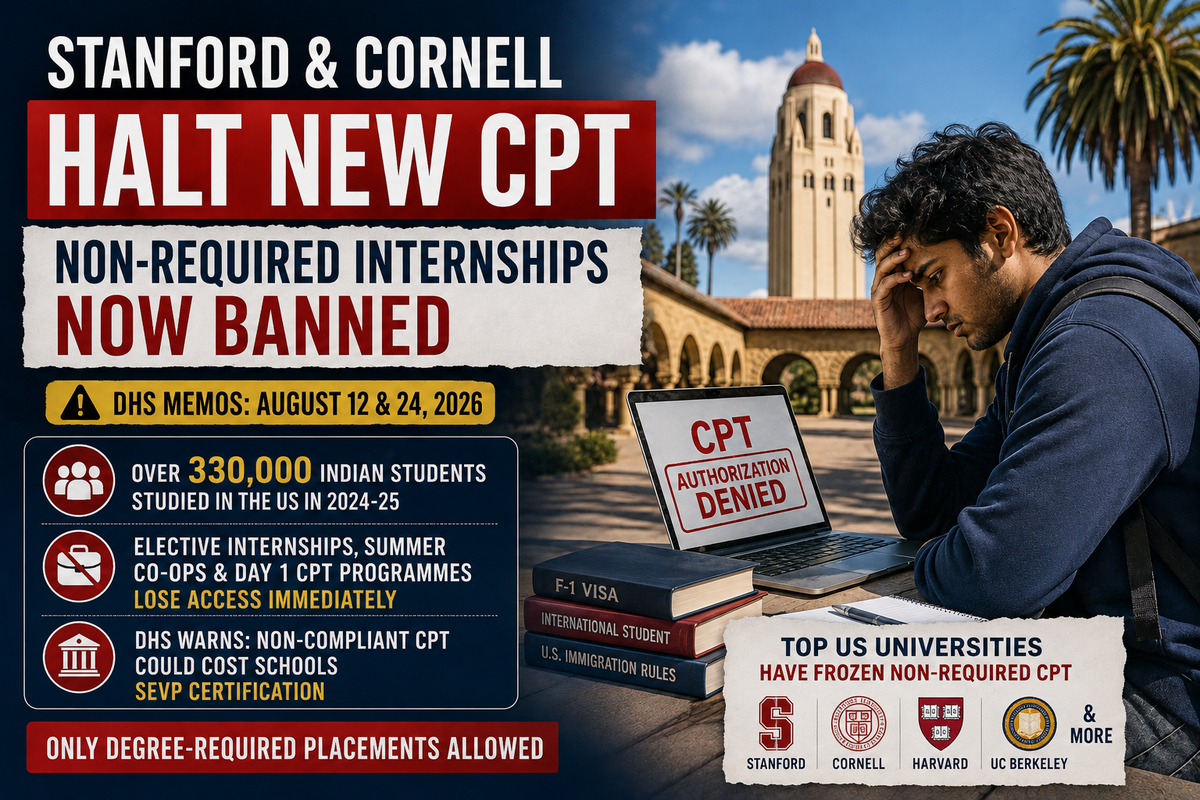
Stanford University and Cornell University have halted new Curricular Practical Training (CPT) authorisations for international students on F-1 visas. The pause hits Indian STEM graduates who rely on paid internships to fund tuition and secure full-time job offers. Both schools followed Department of Homeland Security memos dated August 12 and August 24, 2026. CPT now applies only when the internship is a formal degree requirement, not an elective add-on.
- Over 330,000 Indian students studied in the US in 2024-25, the largest F-1 cohort, and most use CPT to offset the $70,000-plus annual cost of a US degree.
- Students on elective internships, summer co-ops, and Day 1 CPT programmes lose access immediately; only degree-required placements stay cleared.
- DHS warned schools that approving non-compliant CPT could cost them SEVP certification, the licence to enrol any international student.
The freeze lands two months after Immigration and Customs Enforcement (ICE) threatened to pull SEVP certification from schools stretching CPT rules. Stanford, Cornell, Harvard, Yale, Princeton, UPenn, UC Berkeley, UCLA, Boston University, and USC have all frozen non-required CPT. Indian students targeting Fall 2027 need to check how each programme defines its internship clause.
Also Read: What is Curricular Practical Training (CPT)?
What the DHS CPT Memos Changed
The Student and Exchange Visitor Program (SEVP) issued two memos in August 2026. The first on August 12 warned Designated School Officials of personal liability for improper CPT sign-offs. The second on August 24 tightened the test for valid CPT.
Under the new reading, CPT is legal only if its absence would make earning the degree impossible. An elective internship, a summer work placement, or a Day 1 CPT credit no longer qualifies. A DHS spokesperson told The PIE News: "nothing about these regulations has changed...under President Trump, abuse of this generous system will no longer be tolerated."
Important Distinction: OPT (Optional Practical Training) and the 24-month STEM OPT extension are untouched by these memos. The crackdown targets only CPT, used during a degree, not post-completion work rights.
Which US Universities Have Frozen CPT
| University | CPT Action Taken | What Still Works |
|---|---|---|
| Stanford | Bechtel Center paused new CPT sign-offs for non-required work | Degree-required co-ops only |
| Cornell | Froze elective CPT across graduate schools | Required field placements only |
| Harvard | No CPT except where work is a formal graduation requirement | Formal programme requirements |
| UC Berkeley | Stopped Course Credit CPT applications | Degree-Requirement CPT |
| UCLA | Dashew Center paused all CPT authorisations | Under review |
| USC, BU, UPenn, Yale, Princeton, Michigan | Froze non-required CPT | Programme-required placements |
The American Association of Universities (AAU) has filed suit against DHS to block the new reading. The AAU v. DHS complaint calls the shift a reversal of two decades of settled practice.
How Indian F-1 Students Lose Out
Indian students form the largest slice of US F-1 enrolment, with 330,000-plus students in 2024-25 per Open Doors. Most pursue STEM master’s degrees at private universities where tuition runs $55,000 to $85,000 per year, or roughly ₹46 lakh to ₹71 lakh at ₹83.4 per USD (November 2026).
A standard CPT summer internship pays $7,000 to $12,000 a month in tech hubs. That is ₹5.8 lakh to ₹10 lakh per month, enough to cover a semester’s tuition. Losing a summer CPT pushes families back into the education loan market or forces a withdrawal mid-programme.
What it means for Indian Students: A paid CPT summer at Google or Meta is the standard pipeline into a full-time H-1B offer. With CPT frozen at Stanford and Cornell, Indian grads enter the OPT lottery without a return-offer in hand, cutting their odds of a work-visa sponsor by half.
How Should Indian Students Respond?
The pause does not cancel degrees, and on-campus work at up to 20 hours a week stays legal. Students should move to protect their internship pipeline before Spring 2027 placements lock.
- Check your programme handbook for the exact clause marking internship as a required credit. Only a formal "required" tag unlocks CPT at Stanford’s Bechtel Center or Cornell’s OISS.
- Email your DSO before applying for any off-campus role. A pre-approval letter is now mandatory at both schools.
- Prioritise degree-required co-op tracks if switching programmes is still an option before Spring 2027 registration closes.
- Hold your I-20 and avoid international travel until CPT status is confirmed, since re-entry needs a clean work-authorisation record.
- Track the AAU v. DHS lawsuit; a federal injunction could restore elective CPT before Summer 2027.
Indian applicants holding offers from Stanford or Cornell for Fall 2027 should re-read the funding plan assuming no paid summer CPT. The AAU lawsuit may reverse the freeze, but the earliest plausible ruling is Spring 2027. Families should budget a full second-year tuition cushion of ₹25 lakh to ₹35 lakh before the January 2027 I-20 acceptance window closes.
Keep an Eye On: Spring 2027 CPT registration at Stanford’s Bechtel Center and Cornell OISS opens the first week of January 2027 IST. Watch the AAU v. DHS court schedule for a possible injunction hearing in February or March 2027.
interested in this College ?
Follow & Share this college to get information about admission.



Comments