



Education Journalist | Study Abroad Lead
Trigonometry deals with the relationships in triangles, offering solutions to practical applications like height and distance calculations. Trigonometric identities are mathematical equations involving trigonometric functions (sine, cosine, tangent).
- They hold true for all values of the variables involved.
- These identities in trigonometry simplify expressions, solve equations, and prove theorems.
- Sine, cosine, and tangent are fundamental trigonometric functions, complemented by cotangent, secant, and cosecant.
- Derived from the 6 trigonometric functions, trigonometric identities give insights into relationships between angles and sides in triangles.
- It simplifies complex equations involving trigonometric functions for real-world applications.
| Table of Content |
Key Terms: Trigonometric Identities, Cosine, Sine, Tangent, Cotangent, Secant, Cosecant, Trigonometric Functions, ratios, angles, sides
What are Trigonometric Identities?
[Click Here for Sample Questions]
A trigonometric identity is an equation involving the trigonometric ratios of an angle, valid for all values of the angle.
- It involves six fundamental trigonometric ratios: sine, cosine, tangent, cosecant, secant, and cotangent.
- These ratios are defined using the sides of a right triangle.
- Trigonometric identities hold true for all values within the defined domain, ensuring validity for the variables involved.
- These identities establish relationships among sine, cosine, tangent, and other trigonometric functions.
- All fundamental trigonometric identities stem from the six trigonometric ratios.
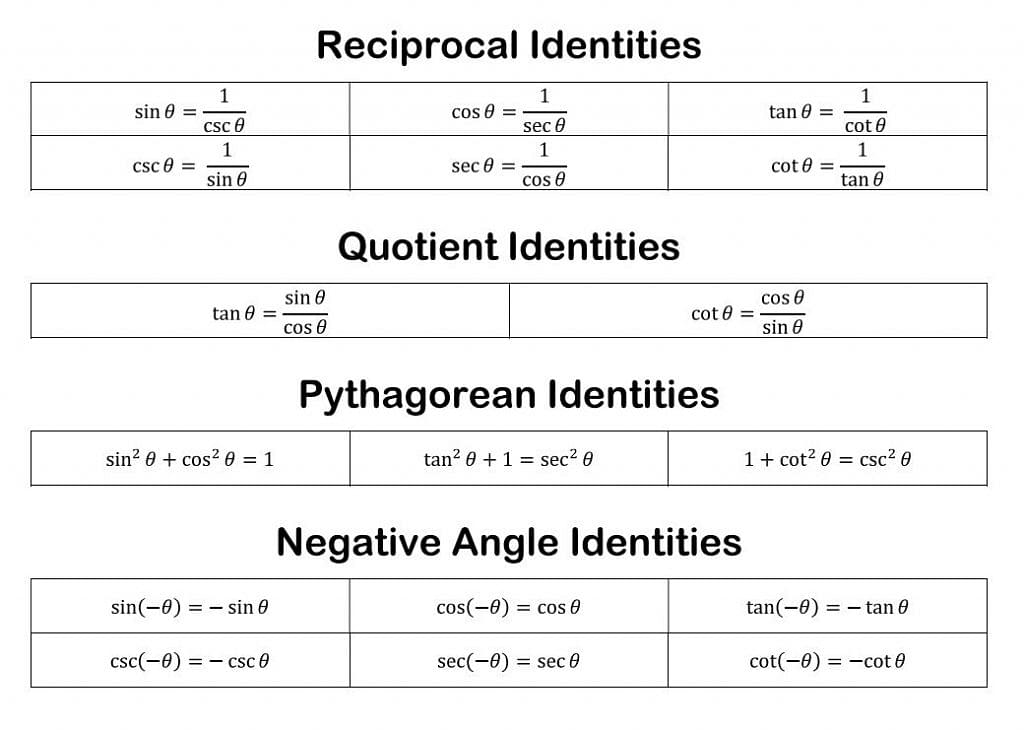
Trigonometric Identities cheat sheet
Also Read:
Trigonometric Identities List
[Click Here for Sample Questions]
The list of trigonometric identities is as follows –
- Reciprocal Identities
- Pythagorean Identities
- Ratio Identities
- Opposite Angle Identities
- Complementary Angles Identities
- Supplementary Angles Identities
- Sum and Difference of Angles Identities
- Double Angle Identities
- Half Angle Identities
- Product-Sum Identities
- Trigonometric Identities of Products
Reciprocal Identities
In trigonometry, reciprocal identities are equations that involve the reciprocals of the trigonometric functions. The reciprocal identities are:
- sin(x) = 1/csc(x) or csc(x) = 1/sin(x)
- cos(x) = 1/sec(x) or sec(x) = 1/cos(x)
- tan(x) = 1/cot(x) or cot(x) = 1/tan(x)
| These identities can be derived from the definitions of the trigonometric functions. For example, sin(x) = y/r where y is the opposite side of a right triangle and r is the hypotenuse. Taking the reciprocal of both sides of this equation, we get: 1/sin(x) = r/y We have csc(x) = 1/sin(x). The reciprocal identities can be used to simplify trigonometric expressions. |

Reciprocal identities
Pythagorean Identities
The Pythagorean identities relate the sine, cosine, and tangent of an angle. The three basic Pythagorean identities are:
- sin2(x) + cos2(x) = 1
- 1 + tan2(x) = sec2(x)
- 1 + cot22(x) = csc22(x)
| The first Pythagorean identity, sin2(x) + cos2(x) = 1 can be derived from the Pythagorean theorem, which states that in a right triangle, the square of the hypotenuse is equal to the sum of the squares of the other two sides. In a right triangle, the sine of an angle is equal to the opposite side divided by the hypotenuse, and the cosine of an angle is equal to the adjacent side divided by the hypotenuse. Therefore, the Pythagorean theorem can be written as: (opposite/hypotenuse)2 + (adjacent/hypotenuse)2 = 1 Squaring both sides of this equation, we get: sin2(x) + cos2(x) = 1 |
Ratio Trigonometric Identities
In trigonometry, ratio identities are equations that involve the ratios of the trigonometric functions.
The ratio identities are:
- tan(x) = sin(x)/cos(x)
- cot(x) = cos(x)/sin(x)
| The identity tan(x) = sin(x)/cos(x) can be derived from the definitions of sine and cosine: sin(x) = y/r cos(x) = x/r
Dividing the first equation by the second equation, we get: sin(x)/cos(x) = y/r / x/r This simplifies to tan(x) = sin(x)/cos(x). |
Trigonometric Identities of Opposite Angles
Trigonometric identities of opposite angles are equations that relate the trigonometric values of angles and their negative counterparts.
- sin(-x) = -sin(x)
- cos(-x) = cos(x)
- tan(-x) = -tan(x)
- cot(-x) = -cot(x)
- sec(-x) = sec(x)
- csc(-x) = -csc(x)
| Proof of sin(-x) = -sin(x): Consider the point (x, y) on the unit circle that corresponds to the angle x. The sine of x is defined as the y-coordinate of this point, i.e., sin(x) = y/r, where r is the radius of the unit circle. Now, consider the point (x, -y) on the unit circle that corresponds to the angle -x. The sine of -x is also defined as the y-coordinate of this point, i.e., sin(-x) = -y/r. Since the unit circle is symmetrical about the x-axis, the y-coordinates of points corresponding to opposite angles have the same magnitude but opposite signs. Therefore, sin(-x) = -sin(x).
Trigonometric Identities of Opposite Angles |

Trigonometric Identities of Supplementary Angles
The trigonometric identities of supplementary angles are:
- sin(180° - x) = sin x
- cos(180° - x) = -cos x
- sec(180° - x) = -sec x
- csc(180° - x) = csc x
- tan(180° - x) = -tan x
- cot(180° - x) = -cot x
These identities can be derived from the definitions of the trigonometric functions and the unit circle.
| Derivation of sin(180° - x) = sin x Consider a point P on the unit circle that is x degrees counterclockwise from the positive x-axis. Let A be the foot of the perpendicular from P to the x-axis, and let B be the foot of the perpendicular from P to the y-axis. The coordinates of point P are (cos x, sin x). The coordinates of point A are (cos x, 0). The coordinates of point B are (0, sin x). The angle between the positive x-axis and the line segment AP is 180° - x. The sine of this angle is the y-coordinate of point A, which is 0. The sine of this angle is also the y-coordinate of point P, which is sin x. Therefore, sin(180° - x) = sin x. |
Complementary Angles Trigonometric Identities
Complementary angles are two angles that sum to 90 degrees. For example, 30 degrees and 60 degrees are complementary angles.
There are three main trigonometric identities for complementary angles:
- Sin (90 – x) = Cos x
- Cos (90 – x) = Sin x
- Tan (90 – x) = Cot x
- Cot (90 – x) = Tan x
- Sec (90 – x) = Csc x
- Csc (90 – x) = Sec x
| Derivation of the Identities Sine is defined as the opposite side over the hypotenuse, and cosine is defined as the adjacent side over the hypotenuse. In a right triangle, the opposite side of an angle is also the adjacent side of its complementary angle, and the hypotenuse is the same for both angles. Therefore, sin(x) = opposite/hypotenuse and cos(90 - x) = adjacent/hypotenuse Since the opposite side and hypotenuse are the same for both angles, we can set these two equations equal to each other to get: sin(x) = cos(90 - x) |
Sum and Difference of Angles Trigonometric Identities
The sum and difference of angles trigonometric identities are a set of formulas that relate the trigonometric functions of the sum or difference of two angles to the trigonometric functions of the individual angles.
- sin(A + B) = sin(A)cos(B) + cos(A)sin(B)
- sin(A - B) = sin(A)cos(B) - cos(A)sin(B)
- cos(A + B) = cos(A)cos(B) - sin(A)sin(B)
- cos(A - B) = cos(A)cos(B) + sin(A)sin(B)
- tan(A + B) = (tan(A) + tan(B)) / (1 - tan(A)tan(B))
- tan(A - B) = (tan(A) - tan(B)) / (1 + tan(A)tan(B))
| Derivation of the Sum of Angles Identities The sum of angle identities can be derived using the angle addition formulas for sine and cosine. The angle addition formula for sine states that: sin(A + B) = sin(A)cos(B) + cos(A)sin(B) The angle addition formula for cosine states that: cos(A + B) = cos(A)cos(B) - sin(A)sin(B) |
Double Angle Identities
The double angle identities for sine, cosine, and tangent are:
- sin(2α) = 2sin(α)cos(α)
- cos(2α) = cos²(α) - sin²(α) = 2 cos2α – 1 = 1 – 2sin2α
- tan(2α) = (2tan(α)) / (1 - tan²(α))
Half Angle Identities
The half-angle identities for sine, cosine, and tangent are:
- Sine: sin(α/2) = ±√((1 - cosα)/2)
- Cosine: cos(α/2) = ±√((1 + cosα)/2)
- Tangent: tan(α/2) = ±√((1 - cosα)/(1 + cosα))
Product-Sum Identities
The product-to-sum identities for sine and cosine are:
- sin(α)cos(β) = (1/2)[sin(α + β) + sin(α - β)]
- cos(α)cos(β) = (1/2)[cos(α + β) + cos(α - β)]
- cos(α)sin(β) = (1/2)[sin(α + β) - sin(α - β)]
- sin(α)sin(β) = -(1/2)[cos(α + β) - cos(α - β)]
Trigonometric Identities of Products
Trigonometric identities of products, also known as product-to-sum identities, are a set of formulas that express the product of two trigonometric functions as a sum or difference of two other trigonometric functions. These identities are useful for simplifying trigonometric expressions and evaluating the values of trigonometric functions.
- sin(α)cos(β) = (1/2)[sin(α + β) + sin(α - β)]
- cos(α)cos(β) = (1/2)[cos(α + β) + cos(α - β)]
- cos(α)sin(β) = (1/2)[sin(α + β) - sin(α - β)]
- sin(α)sin(β) = (1/2)[cos(α - β) - cos(α + β)]
Also Read: Sin2x Formula
Solved Examples on Trigonometric Identities
[Click Here for Sample Questions]
Example: Prove that tan(x) = sin(x)/cos(x).
Solution: We know that:
tan(x) = opposite / adjacent
Using the Pythagorean theorem to express the opposite and adjacent sides in terms of sine and cosine, we get:
opposite = sin(x) * hypotenuse
adjacent = cos(x) * hypotenuse
Substituting these expressions into the definition of tangent, we get:
tan(x) = (sin(x) * hypotenuse) / (cos(x) * hypotenuse)
Simplifying, we get:
tan(x) = sin(x) / cos(x)
Hence proved.
Example: A right triangle has a hypotenuse of 10 meters and an angle opposite to the hypotenuse of 30 degrees. Find the length of the leg adjacent to the 30-degree angle.
Solution: The sine function is defined as the opposite leg over the hypotenuse.
In this case, the opposite leg is 5 meters (since the hypotenuse is 10 meters and the angle opposite to the hypotenuse is 30 degrees).
Therefore,
sin(30°) = 5 meters / 10 meters
Solving for the length of the leg adjacent to the 30-degree angle, we get:
length of adjacent leg = hypotenuse * cos(30°)
Substituting in the values we know, we get:
length of adjacent leg = 10 meters * cos(30°)
Therefore, the length of the leg adjacent to the 30-degree angle is 8.66 meters.
Also Read: Derivatives of Inverse Tan Functions
Sine and Cosine Rule
[Click Here for Sample Questions]
The sine and cosine rules are two important formulas in trigonometry that relate the sides and angles of triangles. They are used to solve a variety of problems, such as finding missing side lengths or angles.
Sine Rule
The sine rule, also known as the law of sines, states that the ratio of the sine of an angle in a triangle to the side opposite that angle is equal to the ratio of the sine of another angle to the side opposite that angle. This can be expressed as:
\(\frac{\sin A}{a} = \frac{\sin B}{b} = \frac{\sin C}{c}\)
- where A, B, and C are the angles of the triangle,
- and a, b, and c are the sides opposite those angles.
Cosine Rule
The cosine rule, also known as the law of cosines, states that the square of any side of a triangle is equal to the sum of the squares of the other two sides minus twice the product of those two sides multiplied by the cosine of the angle between them. This can be expressed as:
\(a^2 = b^2 + c^2 - 2bc \cos A\)
- where a, b, and c are the sides of the triangle,
- and A is the angle opposite side a.
The choice of which rule to use depends on the information that is given. If two sides and the angle between them are given, the cosine rule can be used to find the third side. If two angles and a side are known, the sine rule can be used to find the third side.

Sine and Cosine Rule
Things to Remember
- Trigonometric identities are equations that involve trigonometric functions.
- They are true for all values of the angles involved.
- There are six basic trigonometric identities: the sine identity, the cosine identity, the tangent identity, the cotangent identity, the secant identity, and the cosecant identity.
- Trigonometric identities can be used to simplify trigonometric expressions. This can be useful when solving trigonometric equations or problems.
- Trigonometric identities can also be used to prove other trigonometric identities.
- There are a number of different ways to prove trigonometric identities. Some common methods include using the Pythagorean theorem, the sum-to-product and product-to-sum formulas, and DeMoivre's theorem.
Also Read:
Sample Questions
Ques. In a right-angled triangle ABC, which is right-angled at B, we have AB = 12, and BC = 5. Then find sin A and tan A, cos C and cot C (5 marks)
Ans. AC2=((AB)2 +(BC)2 )
=((12)2 +52 )
=(144 + 25 )
=169
=13
When we consider the t-ratios of∠A we have
Base AB = 12
Perpendicular BC = 5
Hypotenuse AC = 13
sinA= Perpendicular/Hypotenuse= 5/13
tanA= Perpendicular/Base= 5/12
When we consider t-ratios of ∠C, we have
Base BC = 5
Perpendicular AB = 12
Hypotenuse AC = 13
cosC = Base/Hypotenuse = 5/13
cotC = Base/Perpendicular = 5/12
Ques. What do you mean by Trigonometry? (1 mark)
Ans. Trigonometry in mathematics deals with the relationship between the sides of a triangle with its angles. There are 6 trigonometric functions that help in finding the relation between sides and angles.
Ques. What is the primary function of trigonometry? (1 mark)
Ans. Trigonometry helps in finding the angles and missing sides of a triangle with the help of trigonometric ratios.
The 3 primary functions of trigonometry are Sine, Cosine, and Tangent Function.
Ques. What are the six basic trigonometric functions? (2 marks)
Ans. There are 6 trigonometric functions which are:
- Sine A = Opposite side/Hypotenuse
- Cos A = Adjacent side / Hypotenuse
- Tan A = Opposite side / Adjacent side
- Cot A = Adjacent side / Opposite side
- Sec A = Hypotenuse / Adjacent side
- Cosec A = Hypotenuse / Opposite side
Ques. Give the trigonometric identities formula. (5 marks)
Ans. The most common trigonometric identities:
Pythagorean identity:
sin2(x) + cos2(x) = 1
This identity states that the sum of the squares of the sine and cosine of an angle is always equal to 1.
Angle addition identities:
- sin(x + y) = sin(x)cos(y) + cos(x)sin(y)
- cos(x + y) = cos(x)cos(y) - sin(x)sin(y)
- tan(x + y) = (tan(x) + tan(y))/(1 - tan(x)tan(y))
Angle double-angle identities:
- sin(2x) = 2sin(x)cos(x)
- cos(2x) = cos2(x) - sin2(x) = 2cos2(x) - 1 = 1 - 2sin2(x)
- tan(2x) = (2tan(x))/(1 - tan2(x))
Sum to product identities
- cos(x) + cos(y) = 2cos((x + y)/2)cos((x - y)/2)
- cos(x) - cos(y) = -2sin((x + y)/2)sin((x - y)/2)
- sin(x) + sin(y) = 2sin((x + y)/2)cos((x - y)/2)
- sin(x) - sin(y) = 2cos((x + y)/2)sin((x - y)/2)
These identities allow you to express the sum or difference of two trigonometric functions as the product of two other trigonometric functions.
Ques. Create the table for trigonometric identities. (5 marks)
Ans. The table is as follows –
| Identity | Formula | Description |
|---|---|---|
| Pythagorean Identity | sin2(x) + cos2(x) = 1 | The sum of the squares of the sine and cosine of an angle is always equal to 1. |
| Addition Identities | sin(x + y) = sin(x)cos(y) + cos(x)sin(y) | cos(x + y) = cos(x)cos(y) - sin(x)sin(y) |
| Double-Angle Identities | sin(2x) = 2sin(x)cos(x) | cos(2x) = cos2(x) - sin2(x) = 2cos2(x) - 1 = 1 - 2sin2(x) |
| Half-Angle Identities | sin(x/2) = ±√((1 - cos(x))/2) | cos(x/2) = ±√((1 + cos(x))/2) |
| Product-to-Sum Identities | sin(x)sin(y) = (1/2)(cos(x - y) - cos(x + y)) | cos(x)cos(y) = (1/2)(cos(x - y) + cos(x + y)) |
| Sum-to-Product Identities | cos(x) + cos(y) = 2cos((x + y)/2)cos((x - y)/2) | cos(x) - cos(y) = -2sin((x + y)/2)sin((x - y)/2) |
Ques. Prove that the angle addition identity, sin(x + y) = sin(x)cos(y) + cos(x)sin(y), is true. (3 marks)
Ans. We can prove the angle addition identity by using the sum-to-product identities. The sum-to-product identities are two identities that relate the sum and difference of two trigonometric functions to their product.
The sum-to-product identity for sine is:
sin(x + y) = 2sin((x + y)/2)cos((x - y)/2)
The sum-to-product identity for cosine is cos(x + y) = 2cos((x + y)/2)cos((x - y)/2)) - 1
Substituting these identities into the expression for sin(x + y), we get:
sin(x + y) = 2sin((x + y)/2)cos((x - y)/2)
Therefore, the angle addition identity is true.
For Latest Updates on Upcoming Board Exams, Click Here: https://t.me/class_10_12_board_updates
Also Check:



Comments