



Content Curator
Sin squared x is the same as sin x whole squared. Simply, it is then represented as:
= Sin X = perpendicular/hypotenuse = p/h
When squared, it can shown as:
| Sin2X = (p/h)2 |
Therefore, the formula of Sin square X can be represented the way mentioned above. After this square has been doubled, the representation can be expressed in a different manner as well. Thus, when doubled, it can be shown as: 2 Sin2X = 2(p/h)2.
The Sin squared x formula can also be explained using these identities. Identity is a mathematical formula that is the same as a = a, x = x, and n = n, and it resembles Pythagoras' theorem for a right triangle, which is, X2 = Y2 + Z2.
Check Also: NCERT Solutions for Class 11 Mathematics Trigonometric Functions
| Table of Content |
Key Terms: Sin, Sin Squared X, Triangle, Pythagoras Theorem, Cosine, Secant, Cosecant, Tangent, Cotangent, Perpendicular, Hypotenuse, Integrals, Trigonometric Ratio, Trigonometry
What is Sin Squared X Formula?
[Click Here for Sample Questions]
Trigonometry is a field of higher mathematics concerned with the ratios of triangle sides and their representation in symbols such as sine, cosine, secant, cosecant, tangent, and cotangent. The sides of a right-angled triangle are represented by these symbols in a certain ratio.
- Sine or Sin is one of these trigonometric ratios.
- After that, an angle is written to complete the representation of a specific value of a two-sided ratio.
- Thus, Sin Squared X can also be expressed as “Sin X Whole Squared”.
Typically, there are two sin squared x formulas:
- Derived from the Pythagorean Identities: It is used to prove trigonometric identities.
- Derived from the Double-angle Formula of the Cosine Function: It is used in solving the integrals.

Sine in Trigonometry
When the Sine is squared, it becomes:
Sin X = perpendicular/hypotenuse = p/h
→ Sin2x = (\(\frac{p}{h}\))2
As a result, the Sin square X formula looks like this.
→ Sin2x = (\(\frac{p}{h}\))2
when doubled,
→ 2Sin2x = 2 (\(\frac{p}{h}\)) 2
To get a value, 2 is simply multiplied by the square of this ratio. The value of X can be anything in this case. When the value of X changes, so does the value of Sin X.
Let's have a look at another example. When the angle is doubled, it becomes 2X. Thus,
The ratio will become Sin 2X if the angle is 2X. When it is squared, the result is different and can be represented as follows.
→ Sin22x = (Sin 2x)2
By using trigonometric identities, we know that,
→ Sin2x + Cos2x = 1
Sin2x = 1 - Cos2x is obtained by subtracting Cos2x from both sides. As a result, one of the sin-squared x formulas is as follows:
→ Sin2x = 1-Cos2x
Cos 2x = 1 - 2 Sin2x is one of the double angle formulas for the cosine function. When we solve this for Sin2x, we get the following:
→ Sin2x = \(\frac{1-Cos 2x}{2}\)
Sin squared X formulas are as follows
- Sin2x=1-Cos2x
- Sin2x=\(\frac{1-Cos 2x}{2}\)
The graph of Sin2x, or (sin (x))2 is usually denoted as,
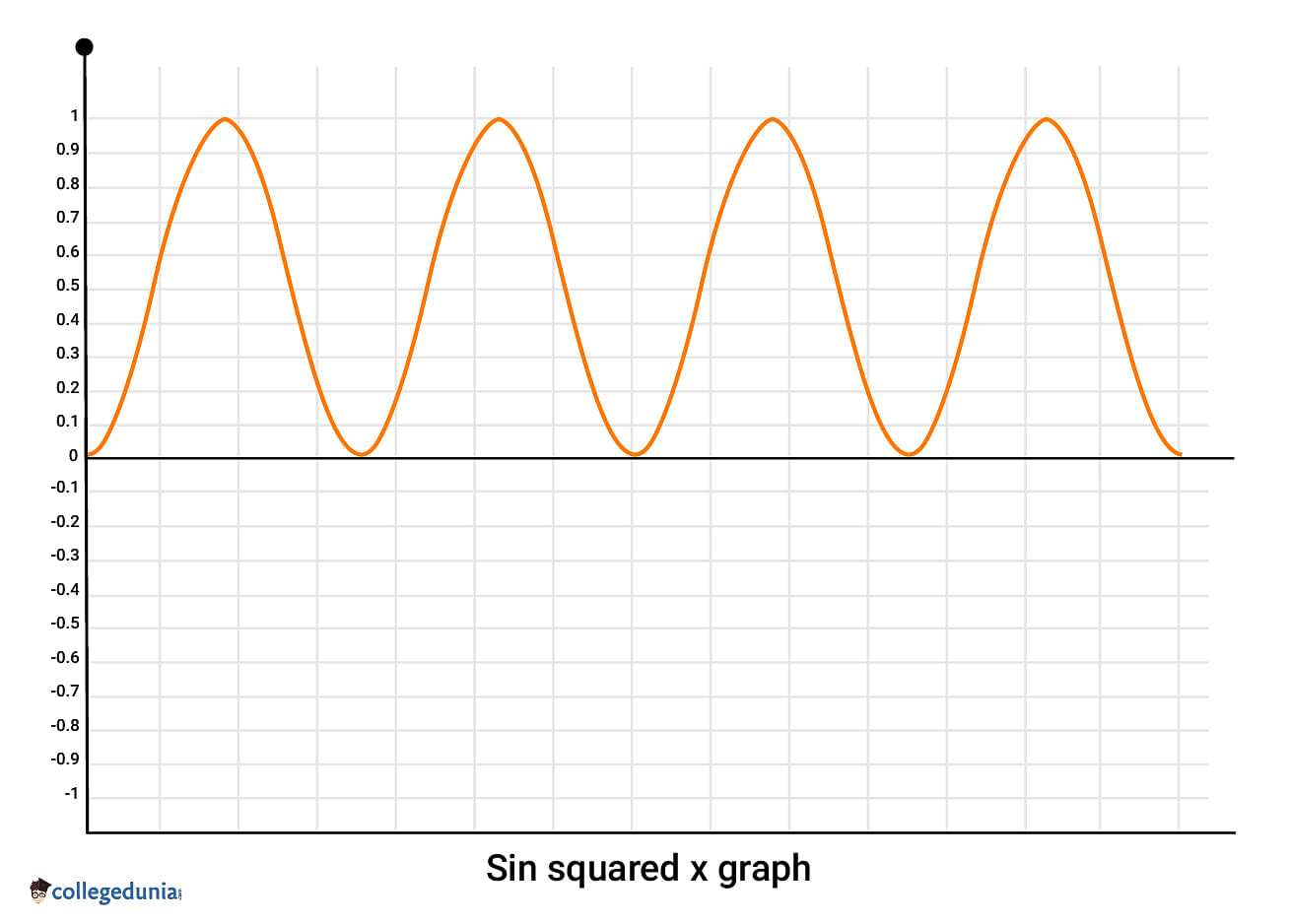
Sin squared x Graph
Check More:
Examples of Sin Squared X Formula
[Click Here for Previous Year Questions]
Ques. What is the integral of sin square x?
Ans. In order to determine the integral of sin2x, we will use its formula sin2x = (1 - cos2x)/2 for simplification.
∫ sin2x dx = ∫[(1 – cos2x)/2] dx
= (1/2) ∫dx - (1/2) ∫cos2x dx
= x/2 – (1/4) sin2x + C [This is due to the fact that the integral of cos2x is (1/2) sin2x]
Ques. Prove the following: (sin4θ – cos4θ +1) cosec2θ = 2.
Ans. L.H.S. = (sin4θ – cos4θ +1) cosec2θ
Thus, it can be shown that
= [(sin2θ – cos2θ) (sin2θ + cos2θ) + 1] cosec2θ
Now, by using the identity, sin2A + cos2A = 1,
= (sin2θ – cos2θ + 1) cosec2θ
= [sin2θ – (1 – sin2θ) + 1] cosec2θ
= 2 sin2θ cosec2θ
= 2 sin2θ (1/sin2θ)
= 2 = RHS
Trigonometric Functions Detailed Video Explanation
Read Also: Euclid’s Division Lemma
Conditions of Sin Squared X Formula
[Click Here for Sample Questions]
The following are the conditions that should be satisfied for a Sin squared x formula.
- Because the square of a negative number is always positive, it must be non-negative.
- Cannot be more than 1 because sin x is always between -1 and 1.
This function appears to be a skewed and compressed sine or cosine wave.
Also Read:
Things to Remember
- Sin squared x is the same as is sin x whole squared.
- Identity can be defined as a mathematical formula same as a = a, x = x, and n = n, resembling Pythagoras' theorem for a right triangle, X2 = Y2 + Z2.
- The two formulas of Sin Squared X are Sin2x = 1-Cos2x and Sin2x = \(\frac{1-Cos 2x}{2}\).
- One of the Sin Squared X formulas is derived from the Pythagorean Identities, meaning it is used to prove trigonometric identities.
- The other Sin Squared X formula helps derive the value from the Double-angle Formula of the Cosine Function, meaning that is used in solving integrals.
For Latest Updates on Upcoming Board Exams, Click Here: https://t.me/class_10_12_board_updates
Previous Year Questions
- Let a vertical tower AB have its end A… (JEE Main 2017)
- If 0≤x<π/2, then the number of values of x... (JEE Main 2019)
- If the angles of elevation of the top of a tower from… (JEE Main 2015)
- Let P = {θ: sinθ − cosθ =√2 cosθ} and… (JEE Main 2016)
- ABCD is a trapezium such that AB and CD are parallel… (JEE Main 2013)
- The general solution of sin 3x + sinx… (AMUEEE 2013)
- Consider a triangular plot ABC with sides AB = 7m… (JEE Main 2019)
- If the angles A,B, and C of a triangle are in an… (JEE Advanced - 2010)
- The number of solutions of 2 sinx + cosx = 3 is… (WBJEE 2011)
Sample Questions
Ques. If cos a = 3/5, what is the value of sin a? (3 marks)
Ans. We know that,
a= 1 - a
=1- (\(\frac{3}{5}\))2
= \(\frac{9}{25}\)
= \(\frac{16}{25}\)
sin a= \(\sqrt{\frac{16}{25}}\)
= \(\frac{4}{5}\)
Ques. Find x and sin x if cos x = 5/13. (2 marks)
Ans. We know that,
cos x= \(\frac{5}{13}\)
x=1-x
=1- (\(\frac{5}{13}\))2
=1-\(\frac{25}{169}\)
=144/169
Hence, sin x= \(\frac{12}{13}\)
Ques. Using the sin squared x formula, prove the following trigonometric identity: x - x = x – x. (2 marks)
Ans. Here, we are going to use the formula x= 1-x to prove this equation.
→ x-x= x (1-x )
= xx
= (1 – x)x
Thus,
= x – x
Ques. Find the value of ∫x dx. (2 marks)
Ans. Using the formula, x=(1-cos 2x) /2
So, ∫x dx= ∫(1-cos 2x)/2 dx
=\(\frac{1}{2}\)∫(1-cos 2x) dx
=\(\frac{1}{2}\)(x-2x)/2 ) )+c
=\(\frac{x}{2}\)-(sin 2x/4))+c
= ∫dx=\(\frac{x}{2}\)-2x/4)+c
Ques. Prove 2x+3sin x = 0. (2 marks)
Ans. This equation can be written as
2 (1-x)+3 sin x=0
2x-3 sin x-2=0
Hence, sin x= -(\(\frac{1}{2}\)) or sin x=2
Therefore, sin x= -(\(\frac{1}{2}\)) =sin (7 π/6)
Hence, the solution can be written as,
x= n π+ (-1)n(7 π/6) , where n∈Z
Ques. Solve sin 2x-sin 4x+sin 6x = 0. (2 marks)
Ans. This equation can be written as,
sin 6x + sin 2x – sin 4x = 0
Also, 2sin 4x cos 2x-sin 4x = 0
That is, sin 4x(2cos 2x-1) = 0
Therefore, sin 4x = 0 or cos 2x = \(\frac{1}{2}\)
i.e., sin 4x = 0 or cos 2x = cos\(\frac{\pi}{3}\)
Hence, 4x = nπ or nπ ± \(\frac{\pi}{3}\), where n∈Z
i.e.,
x = \(\frac{n \pi}{4}\) or x = nπ ± \(\frac{\pi}{6}\), where n∈Z
Ques. What is a sinusoidal graph, exactly? Is it only sine waves? Or are cosine, tangent, secant, and other sine-like functions also considered sinusoidal? (3 marks)
Ans. A sinusoidal graph is a stretched or squeezed sine wave that has been moved. Cosines are automatically included because they are simply a shifted sine. Sinusoidal graphs do not exist for tangents and secants.
Here are some examples of sinusoidal graphs, often known as sine waves:

Ques. What is the definition of a unit circle? (3 marks)
Ans. A unit circle is a circle of radius one that is centred at the origin (0, 0) in the Cartesian coordinate system in trigonometry.
A circle with a radius of one is known as a unit circle.
Make an angle of with the positive half of the x-axis by intersecting a line through the origin with the unit circle. Cos(θ) and sin(θ) are the x- and y-coordinates of this point of intersection, respectively. Because the length of the hypotenuse of the unit circle is always 1, this definition is consistent with the right-angled triangle definition of sine and cosine when 0°< θ < 90°.
Ques. What is Discrete sine transform? (3 marks)
Ans. Discrete sine transform is a term that refers to a transformation that is not continuous.
The discrete sine transform (DST), like the discrete Fourier transform (DFT), is a Fourier-related transform that uses a purely real matrix. It's the imaginary sections of a DFT of nearly twice the length, operating on real data with odd symmetry (since the Fourier transform of a real and odd function is imaginary and odd), where the input and/or output data are shifted by half a sample in some forms.
There is a family of transforms made up of sine and sine hyperbolic functions. The natural vibration of thin square plates with varying boundary conditions is used to create these transforms.
Ques. What is Euler's Formula? (3 marks)
Ans. Euler's formula is a complex analysis mathematical formula that provides the essential link between trigonometric functions and complex exponential functions. It is named after Leonhard Euler. According to Euler's formula, for each real number x: eix = cos x + i sin x
where,
- e is the natural logarithm's base
- I is the imaginary unit
- cos and sin are the trigonometric functions
Cos x is a term used to describe a complex exponential function ("cosine plus I sine").
Ques. Assume cos A = 3/5 with A being in quadrant I. Thus, determine the value of sin 2A. (4 marks)
Ans. With Pythagorean identity, we can show that:
sin2A + cos2A = 1
sin2A = 1 - cos2A
sin A = ±√(1 − cos2A)
= ±√(1 − (3/5)2)
= ±√(16/25)
== ± 4/5
Now because A is in quadrant I, sin A is positive. Accordingly,
sin A = 4/5
From sin2x formula, sin2x = 2 sin x cos x.
From that, we can say,
sin2A = 2 sin A cos A
= 2 (4/5) (3/5)
= 24/25
Also Read:



Comments