




CBSE Class 10 Exam Pattern 2027 follows a 100-mark structure for major subjects with 80 marks for the theory paper and 20 marks for Internal Assessment. The theory paper is expected to include around 20% MCQs, 50% competency-based questions, and 30% short and long answer questions.
- The CBSE Class 10 theory examination is conducted for 3 hours with no negative marking for incorrect answers.
- The CBSE Class 10 Exam pattern includes MCQs, very short answers, short answers, long answers, and case or source-based questions.
- In the CBSE Class 10 exam pattern, the internal assessment has 20 marks, which includes Periodic Test, Multiple Assessments, Portfolio, and Subject Enrichment Activity.
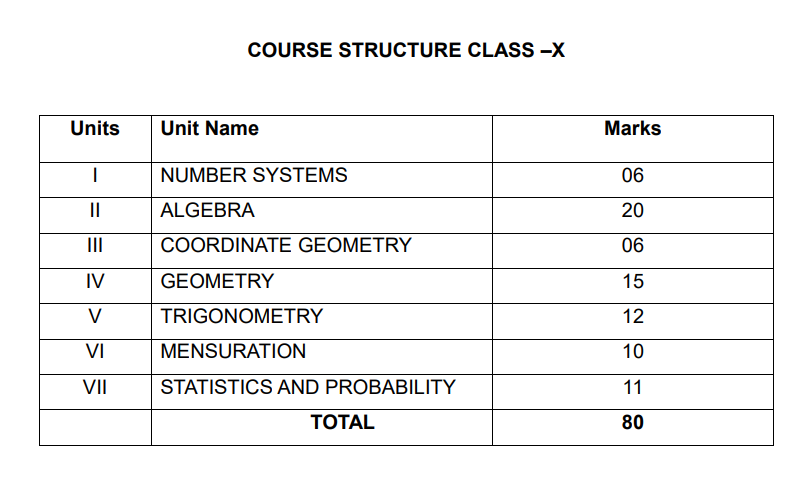
- Mathematics has 80 theory marks across seven units, with Algebra carrying the highest weightage of 20 marks.
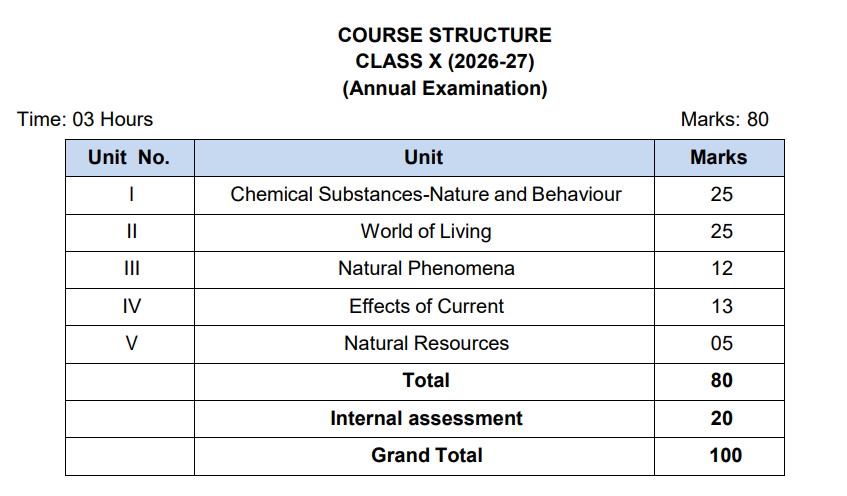
- Science has 80 theory marks with Chemical Substances and World of Living carrying 25 marks each.
- Social Science distributes 20 marks each among History, Geography, Political Science and Economics.
- English and Hindi have 80-mark theory papers in CBSE Class 10 with marks divided across Reading, Writing, Grammar and Literature components.
Related Links:
- CBSE Class 10 Syllabus: Subject-wise Syllabus PDF, Books, and Preparation
- CBSE Class 10 Paper Analysis (Maths): Expected Paper Analysis, Difficulty Level & Weightage
- CBSE Class 10 Mock Test (Available): Attempt Free Subject-wise test, CBSE Class 10 PYQs
Key Summary
- CBSE Class 10 Exam 2027 will be held in offline pen and paper mode with a 3 hour duration for the theory examination.
- The CBSE Class 10 Exam 2027 paper is expected to include 20% MCQs, 50% competency based questions and 30% short/long answers.
- Hindi Course A and B differ in Literature and Creative Writing weightage with 30 and 28 marks for Literature respectively.
- English and Hindi papers assess Reading, Writing and Grammar and Literature with marks distributed across these components.
CBSE Class 10 Exam Pattern 2027 Overview
CBSE Class 10 Exam Pattern 2027 includes an Internal Assessment, which is conducted once and carried forward to both phases. Only the theory paper can be re-attempted in Phase 2 of the CBSE Class 10 Exam.
- Students generally appear for 5 compulsory subjects with an optional 6th subject but the percentage is usually based on the best 5 subjects.
- The CBSE Class 10 Exam Pattern may have a different number of questions across subjects. Maths has around 38 questions while Science has around 39 questions.
| Particulars | Details |
|---|---|
| Mode of Exam | Offline (Pen & Paper) |
| Duration (Theory) | 3 hours |
| Total Marks per Subject | 100 |
| Theory Marks | 80 (major academic subjects) |
| Internal Assessment / Practical | 20 (major subjects); varies for skill subjects (often 50-50) |
| Passing Marks | 33% in each subject |
| Negative Marking | None |
| Question Paper Composition |
|
| Internal Assessment Components | Periodic Tests, Multiple Assessments, Portfolio, Subject Enrichment Activities |
Also Check:
- CBSE Class 10 Notes: Chapter-Wise Notes, Revised Syllabus & NCERT Solutions
- NCERT Solutions for Class 10 Maths: Chapter-wise Solutions and Important Topics
Ques. What is the exam pattern for CBSE Class 10 in 2027?
Ans. The CBSE Class 10 Exam Pattern 2027 will generally follow the 80 marks theory + 20 marks Internal Assessment pattern. The board paper will cover the complete Class 10 syllabus, with more focus on competency-based and application-oriented questions.
CBSE Class 10 Exam Pattern: Changes Over the Years
CBSE Class 10 Exam Pattern has changed in terms of exam frequency, assessment structure, and question types over the years.
-
2021-22: CBSE conducted Class 10 exams under a two-term system during the COVID-19 period.
- 2023-25: The single board examination system was restored with increased focus on competency-based questions.
- 2026: CBSE introduced two board examinations with Phase 1 as the mandatory examination and Phase 2 as an improvement opportunity.
- 2026-27: The CBSE Class 10 Exam Pattern 2027 continues the 80-mark theory and 20-mark Internal Assessment structure.
| Aspect | Pre-2020 | 2023–25 | 2026 Onwards |
|---|---|---|---|
| Exam Pattern | Single annual exam | Single annual exam | Two phases: compulsory + optional improvement |
| Total Marks | 80 + 20 marks | 80 + 20 marks | 80 + 20 marks |
| Competency-Based Questions | Minimal | 40–50% | 50% (approx. 40 marks) |
| Question Types | Mostly descriptive | Increasing objective questions | ≈20% MCQs, ≈30% descriptive |
| Paper Structure | Mixed sections | Mixed/evolving | Subject-wise sections |
| Improvement Option | Not applicable | Not applicable | Better score of the two phases retained |
| Assessment Focus | Recall and rote learning | Application-based learning | Application, analysis, and real-life problem-solving |
Also Check:
Ques. Is the CBSE exam pattern changed for Class 10?
Ans. The CBSE Class 10 exam pattern has not undergone any major change for the 2027 Board Exam. Students will continue to have 80 marks for the Theory paper and 20 marks for Internal Assessment. The paper will also include competency-based and application-oriented questions.
Official CBSE Class 10 Subject-wise Syllabus PDF Download
| Subject | Official PDF Download |
|---|---|
| Mathematics: Standard (Code 041) / Basic (Code 241) | Download CBSE Class 10 Maths Syllabus PDF |
| Social Science (Code 087) | Download CBSE Class 10 Social Science Syllabus PDF |
| Science (Code 086) | Download CBSE Class 10 Science Syllabus PDF |
| English Language and Literature (Code 184) | Download CBSE Class 10 English Syllabus PDF |
| Hindi A (Code 002) / Hindi B (Code 085) | Download CBSE Class 10 Hindi Syllabus PDF |
CBSE Class 10 Exam Pattern 2027: Theory and Internal Assessment Marks
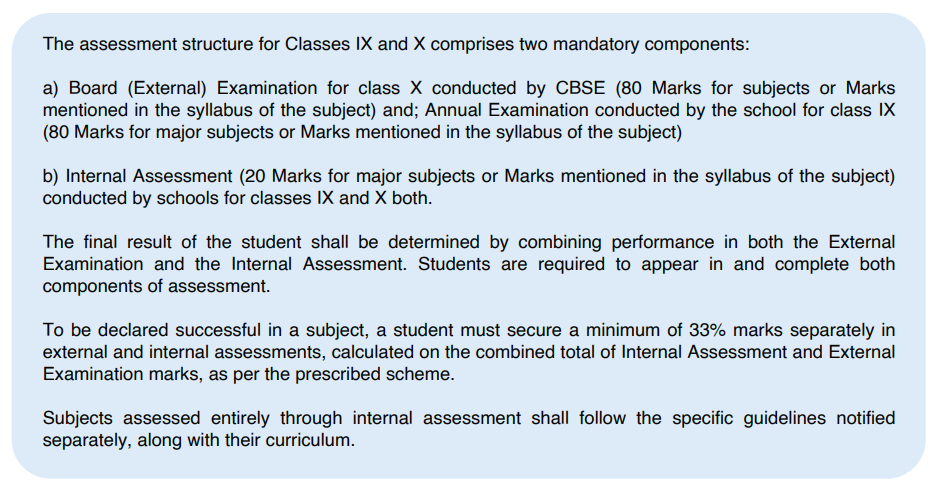
CBSE Class 10 exam pattern has an 80-mark External Examination for major subjects along with 20 marks for Internal Assessment.
- The final result is calculated by combining the marks scored in the External Examination and Internal Assessment in CBSE Class 10 Exam.
- The students need to score at least 33% marks individually in both Internal Assessment and External Examination to pass in a subject.
| Subject Type | Theory Marks | Internal Assessment/ Practical | Total |
|---|---|---|---|
| Major academic subjects (Maths, Science, Social Science, English, Hindi) | 80 | 20 | 100 |
| Skill-based subjects (AI, IT, Financial Literacy, Cybersecurity) | 50 | 50 (Practical) | 100 |
Source: CBSE Official Website
Also Check:
- CBSE Class 10 Exam Passing Marks: Check Subject-Wise Marks, Grading System
- CBSE Class 10 Exam Grading System: 9-Point Scale A1 to E, CGPA Calculation and Percentage Formula
Ques. How much internal marks are given in CBSE Class 10 Exam?
Ans. CBSE Class 10 students are awarded 20 marks for Internal Assessment in each subject, along with 80 marks for the Board Examination. Students need to meet the prescribed assessment requirements for the final result.
CBSE Class 10 Exam Pattern 2027: Overall Question Type Distribution (All Subjects)
CBSE Class 10 Exam Pattern 2027 for theory papers is expected to give 50% weightage, which is around 40 marks, to competency-based questions.
- These competency-based questions include case study-based and source-based questions in the CBSE Class 10 exam pattern.
- In the CBSE Class 10 Exam Pattern 2027, Objective MCQs account for 20% of the 80 mark theory paper while short and long answer questions make up the remaining 30%.
| Question Category | Weightage in Paper | Question Types Included |
|---|---|---|
| Competency-Based Questions | 50% | MCQs, Case-Based, Source Based, Assertion-Reasoning |
| Objective Type Questions | 20% | Standalone MCQs, Fill-in-the-blanks type |
| Constructed Response (Descriptive) | 30% | Short Answer (2–3 marks), Long Answer (5 marks) |
Also Check:
This video by the channel “Prem Sharma” discusses information on the CBSE Class 10 Exam Pattern 2027. It discusses how the CBSE Class 10 Exam Pattern 2027 is expected to follow the recent NEP-based assessment approach for question paper design.
Ques. Will the 2027 Board be easy for CBSE Class 10?
Ans. The difficulty level of the CBSE Class 10 Board Exam 2027 cannot be confirmed in advance. Students should prepare for a mix of knowledge-based, application-based, and competency-based questions.
CBSE Class 10 Maths Exam Pattern 2027
CBSE Class 10 Maths Exam Pattern 2027 carries 80 marks in the theory paper with 38 questions divided across five sections.
- Section A carries 20 marks through MCQs and assertion-reasoning questions in the CBSE Class 10 Maths paper.
- CBSE Class 10 Maths Basic (241) and Standard (041) papers follow the same 80+20 marks structure but Basic Maths focuses more on lower cognitive levels.
| Section | Type | Questions | Marks Each | Total |
|---|---|---|---|---|
| A | MCQs (including Assertion-Reasoning) | 20 | 1 | 20 |
| B | Very Short Answer | 5 | 2 | 10 |
| C | Short Answer | 6 | 3 | 18 |
| D | Long Answer | 4 | 5 | 20 |
| E | Case-Based Integrated Questions | 3 | 4 | 12 |
| Total | 38 | 80 |
CBSE Class 10 Exam Pattern 2027: Maths Unit-Wise Marks Distribution
| Unit No. | Unit Name | Marks | Approx. No. of Questions |
|---|---|---|---|
| I | Number Systems | 6 | 3 - 4 |
| II | Algebra | 20 | 7 - 9 |
| III | Coordinate Geometry | 6 | 2 - 3 |
| IV | Geometry | 15 | 6 - 8 |
| V | Trigonometry | 12 | 5 - 6 |
| VI | Mensuration | 10 | 4 - 5 |
| VII | Statistics and Probability | 11 | 4 - 5 |
| Total | 80 | 38 |
Source: CBSE Official Website
Also Check:
Ques. What is the CBSE Class 10 Maths syllabus for 2027?
Ans. The CBSE Class 10 Maths syllabus for the 2027 Board Exam includes Number Systems, Algebra, Coordinate Geometry, Geometry, Trigonometry, Mensuration, Statistics and Probability. The syllabus is divided into the following units
- Number Systems: Real Numbers
- Algebra: Polynomials, Pair of Linear Equations, Quadratic Equations, Arithmetic Progressions
- Coordinate Geometry: Distance Formula, Section Formula, Area of Triangle
- Geometry: Triangles, Circles
- Trigonometry: Introduction to Trigonometry and its Applications
- Mensuration: Areas Related to Circles, Surface Areas and Volumes
- Statistics and Probability: Statistics and Probability
The CBSE Class 10 Maths 2026-27 curriculum is applicable to the 2027 Board Exam. Students should follow the official CBSE syllabus for the exact topics and assessment details.
CBSE Class 10 Science Exam Pattern 2027
CBSE Class 10 Science Exam Pattern 2027 carries 80 marks in the theory paper with 39 questions in the question paper.
- Chemical Substances and World of Living carry 25 marks each in the CBSE Class 10 Science theory paper.
- The CBSE Class 10 Science Internal Assessment carries 20 marks including practical work while Biology has around 30 marks in the theory paper.
| Section | Type | Questions | Marks Each | Total |
|---|---|---|---|---|
| A | MCQs + Assertion-Reasoning | 20 | 1 | 20 |
| B | Short Answer - Type I | 6 | 2 | 12 |
| C | Short Answer - Type II | 7 | 3 | 21 |
| D | Long Answer | 3 | 5 | 15 |
| E | Case-Based Integrated Questions | 3 | 4 | 12 |
| Total | 39 | 80 |
CBSE Class 10 Exam Pattern 2027: Science Unit-Wise Marks Distribution
| Unit No. | Unit Name | Marks | Approx. No. of Questions |
|---|---|---|---|
| I | Chemical Substances – Nature and Behaviour | 25 | 10 - 13 |
| II | World of Living | 25 | 10 - 14 |
| III | Natural Phenomena | 12 | 4 - 6 |
| IV | Effects of Current | 13 | 5 - 7 |
| V | Natural Resources | 5 | 2 - 3 |
| Total | 80 | 39 |
Source: CBSE Official Website
Also Check:
Ques. Is Science easy for weak students?
Ans. Yes. CBSE Class 10 Exam Science can be manageable for weak students with NCERT-based preparation, regular revision, and consistent question practice. Focus should be given to understanding concepts before memorising answers.
CBSE Class 10 Social Science Exam Pattern 2027
CBSE Class 10 Social Science Exam Pattern 2027 carries 80 marks in theory, with 20 marks each for History, Geography, Political Science, and Economics. Map work carries 5 marks in the theory paper, with 2 marks from History and 3 marks from Geography.
| Section | Type | Questions | Marks Each | Total |
|---|---|---|---|---|
| A | MCQs | 20 | 1 | 20 |
| B | Very Short Answer | 4 | 2 | 8 |
| C | Short Answer | 5 | 3 | 15 |
| D | Long Answer | 4 | 5 | 20 |
| E | Source-Based + Map Questions | 2 Sets | - | 17 |
| Total | 80 |
CBSE Class 10 Exam Pattern 2027: Social Science Unit-Wise Marks Distribution
| Unit Name | Marks | Approx. No. of Questions |
|---|---|---|
| History (India & the Contemporary World – II) | 20 | 8 - 11 |
| Geography (Contemporary India – II) | 20 | 8 - 11 |
| Political Science (Democratic Politics – II) | 20 | 8 - 10 |
| Economics (Understanding Economic Development) | 20 | 8 - 10 |
| Total | 80 | 37 - 41 |
Source: CBSE Official Website
Also Check:
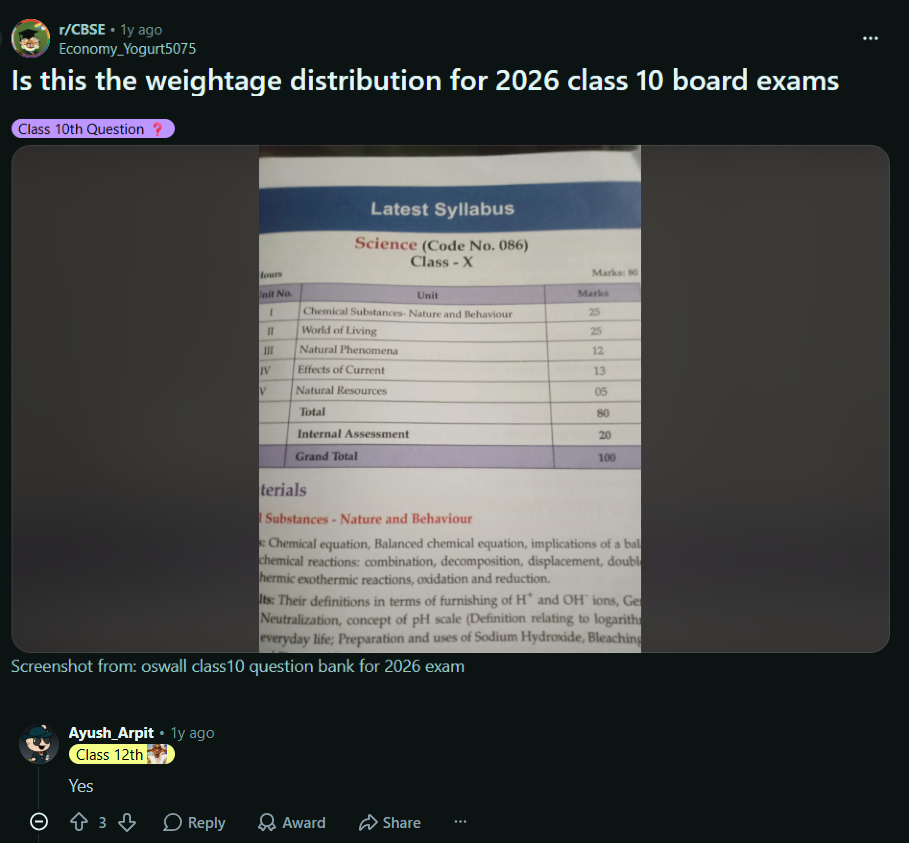
According to a Reddit discussion, CBSE Class 10 Science weightage was discussed based on the latest syllabus with Chemical Substances and World of Living carrying 25 marks each. The discussion also showed Natural Phenomena at 12 marks, Effects of Current at 13 marks, and Natural Resources at 5 marks along with 20 marks for Internal Assessment.
Source: Reddit
Ques. How many chapters are there in the SST Class 10 exam in 2027?
Ans. The CBSE Class 10 SST syllabus for 2027 has 20 chapters/topics across History, Geography, Political Science, and Economics. However, some portions are assessed through projects or periodic assessments rather than the Board Exam.
CBSE Class 10 English Language & Literature Exam Pattern 2027
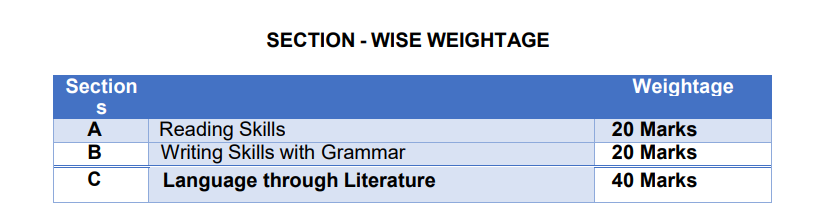
CBSE Class 10 English Language & Literature Exam Pattern 2027 gives 40 marks to Literature which is equal to the combined weight of Reading and Writing Grammar.
- The 20 mark Internal Assessment focuses on Listening and Speaking Skills rather than only written projects.
- Internal choices are provided in both short answer and long answer Literature questions.
| Section | Type | Questions |
|---|---|---|
| A - Reading | Unseen Passage 1 (Factual) + Passage 2 (Discursive/Literary) | 20 |
| B - Writing & Grammar | Formal Letter / Notice / Advertisement + Analytical Paragraph + Grammar | 20 |
| C - Literature | Extract from First Flight (Prose + Poetry) + Extract from Footprints Without Feet + Short/Long answers | 40 |
| Total | 80 |
Source: CBSE Official Website
CBSE Class 10 Exam Pattern 2027: English Language and Literature Unit-Wise Marks Distribution
| Section | Unit Name | Marks |
|---|---|---|
| A – Reading | Discursive passage (400–450 words) | 10 |
| Case-based factual passage with visual input (200–250 words) | 10 | |
| B – Writing & Grammar | Grammar (Determiners, Tenses, Modals, Subject-Verb Concord, Reported Speech) – 10 out of 12 | 10 |
| Formal Letter (100–120 words) – 1 out of 2 | 5 | |
| Analytical Paragraph (Map/Chart/Graph) – 1 out of 2 | 5 | |
| C – Literature | Reference to Context (Prose/Drama extract + Poetry extract) | 10 |
| Short Answer – First Flight (4 out of 5 × 3 marks) | 12 | |
| Short Answer – Footprints Without Feet (2 out of 3 × 3 marks) | 6 | |
| Long Answer – First Flight (1 out of 2 × 6 marks) | 6 | |
| Long Answer – Footprints Without Feet (1 out of 2 × 6 marks) | 6 |
Source: CBSE Official Website
Also Check:
Ques. Will the CBSE Class 10 syllabus change in 2027?
Ans. The CBSE Class 10 syllabus for the 2026-27 session has been released. Any further changes will be notified by CBSE officially. Students should follow the latest CBSE 2026-27 curriculum for the 2027 board exam.
CBSE Class 10 Hindi Course A and Hindi Course B Exam Pattern 2027
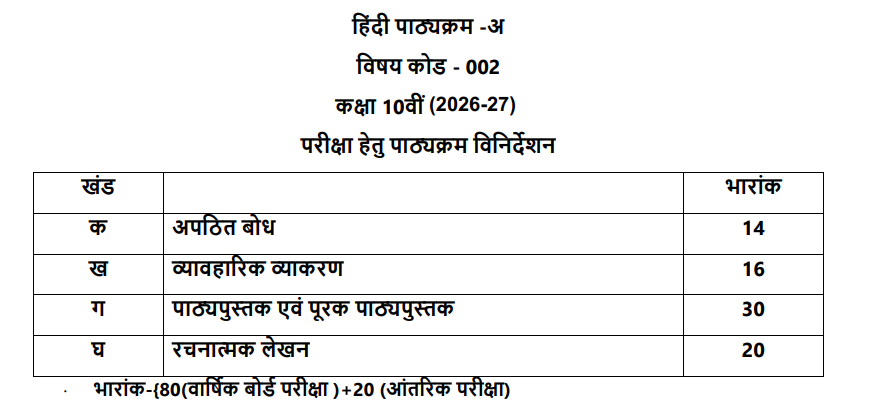
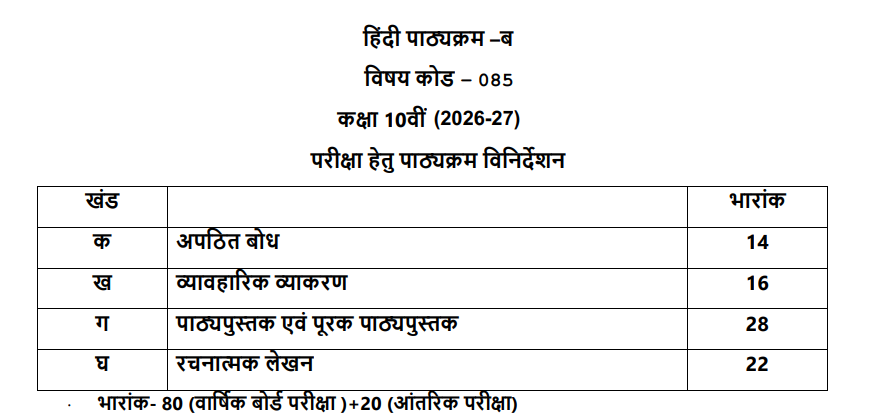
CBSE Class 10 Hindi Course A and Hindi Course B Exam Pattern 2027 gives 30 marks to Literature in Hindi A and 28 marks in Hindi B. Hindi Course A covers Kshitij and Kritika while Hindi Course B includes Sparsh and Sanchayan for the Literature section in CBSE Class 10 Exam.
| Section | Hindi Course A | Hindi Course B |
|---|---|---|
| क – अपठित बोध (Unseen Comprehension) | 14 | 14 |
| ख – व्यावहारिक व्याकरण (Applied Grammar) | 16 | 16 |
| ग – पाठ्यपुस्तक एवं पूरक पाठ्यपुस्तक (Textbook + Supplementary) | 30 | 28 |
| घ – रचनात्मक लेखन (Creative Writing) | 20 | 22 |
| Total | 80 | 80 |
Source: CBSE Official Website
Source: CBSE Official Website
Also Check:
Ques. Which is harder in CBSE Class 10 Exam Hindi Course A or B?
Ans. Hindi Course A is generally considered more difficult than Hindi Course B because it has a stronger focus on literature, language skills, and analytical questions. However, the difficulty depends on the student's preparation and language proficiency.
CBSE Class 10 Internal Assessment Pattern 2027
CBSE Class 10 Internal Assessment Pattern 2027 is divided into four 5 mark components: Periodic Test, Multiple Assessment, Portfolio and Subject Enrichment.
- For passing a CBSE Class 10 subject, students must secure at least 33% separately in the External Examination and Internal Assessment.
| Component | Marks | Details |
|---|---|---|
| Periodic Tests / Periodic Assessment | 5 | 3 tests conducted in the year; best of 2 counted. Pen-and-paper tests (usually 40 marks, 1½ hours). |
| Multiple Assessments | 5 | Quizzes, oral tests, group discussions, presentations, concept maps, role plays, peer/self-assessment, etc. |
| Portfolio | 5 | Classwork, homework notebooks, assignments, reflections, journals, and overall achievements/participation. |
| Subject Enrichment Activities | 5 | Subject-specific activities |
| Total Internal Assessment | 20 | Submitted by school to CBSE |
Also Check:
Ques. Is internal marks added in Class 10 percentage?
Ans. Yes. Internal Assessment marks are added to the Theory marks to calculate the final subject marks. For major subjects, the assessment is generally based on 80 marks Theory + 20 marks Internal Assessment.
CBSE Class 10 Exam Pattern 2027: Competency-Based Questions
CBSE Class 10 Exam Pattern 2027 gives 40 of 80 theory marks to competency-based questions, making up 50% of the paper.
- The competency-based questions include case studies, source analysis and assertion-reasoning questions focused on application.
- The CBSE Class 10 Exam theory papers have no negative marking with internal choices in short, long and case based questions.
| Type | Format | Example |
|---|---|---|
| Case-Based / Case Study | Short real-life scenario or data followed by 3–4 sub-questions | High (often 12 marks in Section E) |
| Source-Based Questions | Analysis of documents, maps, cartoons, extracts or data tables | Common in Social Science |
| Assertion-Reasoning (A-R) | Two statements (Assertion + Reason) to evaluate relationship | Usually 1 mark each (part of MCQ section) |
| Application-Based MCQs | MCQs testing application rather than direct recall | Integrated in objective section |
| Data / Experiment-Based | Interpretation of graphs, experiments or real-world situations | Frequent in Science & Maths |
Also Check:
Ques. How many percent competency-based questions are there in CBSE Class 10 Exam Pattern 2027?
Ans. CBSE Class 10 Board Exam Pattern 2027 is expected to continue the competency-focused assessment. However, CBSE has not yet specified a separate percentage for competency-based questions for the 2027 Board Exam. The 2026-27 curriculum states that students will be assessed through questions requiring application, analysis, evaluation and synthesis.
CBSE Class 10 Exam Pattern 2027 Frequently Asked Questions (FAQs)
Ques. What are the new passing criteria for Class 10 CBSE in 2026 and 2027?
Ans. CBSE Class 10 students need to secure at least 33% marks in each subject, combining theory and internal assessment. The same passing requirement applies to the 2026 and 2027 Board Exams.
Ques. Will the CBSE Class 10 syllabus change in 2027?
Ans. The CBSE Class 10 syllabus for the 2026-27 academic session has already been released for the 2027 Board Exam. Students should follow this official curriculum. Any further changes will be notified by CBSE.
Ques. Will the 2027 Class 10 Board Exam be easy?
Ans. The difficulty level of CBSE Class 10 Board Exam 2027 cannot be confirmed in advance. Students should expect a mix of knowledge-based, application-based, and competency-based questions.
Ques. What are the passing criteria for Class 10 CBSE in 2026 and 2027?
Ans. CBSE Class 10 students need to secure at least 33% marks separately in Theory and Internal Assessment/Practical, wherever separate components are prescribed. Students must meet the required marks in both components to pass the subject.
Ques. What is the blueprint for Class 10 CBSE in 2027?
Ans. CBSE does not have one common blueprint for all Class 10 subjects. The question paper pattern and weightage vary by subject. Students should refer to the official Sample Question Papers and marking schemes released by CBSE for the relevant session.



Comments