



Education Journalist | Study Abroad Lead
Angle is derived from the Latin word “Angulus” which means corner. It is formed when two rays of lines are joined at a common point which is known as angle. The symbol ‘∠’ is represented for an angle.
- The angle is usually measured in degrees or radians. The degree is usually measured by a protractor and radians are used in calculus.
- There are many uses of angles such as in geometry, engineering, architecture, geography, and astronomy.
- The angels play an important role in the construction of cities, roads, dams, types of machinery, buildings, and in finding locations on earth using geographic coordinate systems.
| Table of Content |
Key terms: Angles, Radians, Degree, Acute angle, Obtuse angle, Right angle, Reflex angle
What is an Angle?
[Click Here for Sample Questions]
The angle is defined as the corners where the two rays of lines are joined at a common point. They are measured in degrees or radians. The SI unit of angle is Radian which is mostly used in Calculus.
The angles are represented by Greek letters such as θ, α, β, etc.

Angle
Read More: Trigonometric Functions Important Questions
Types of Angles
[Click Here for Previous Year Questions]
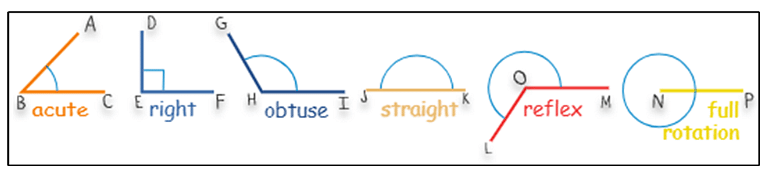
There are the following types of angles in geometry which are named as:
- Acute Angle: These are the angles which measure less than 90.
- The measure lies between 0° to 90. In the figure below, the angle formed by the intersection of AB and CB at B forms an angle ∠ABC
- It measures 45°, thus ∠ABC is called an Acute angle.
- Right Angle: An angle that measures exactly 90° is called a right angle.
- The angle measures exactly equal to 90°.
- In the figure below, line D intersects line FE at E and forms an angle ABC which measures 90°.
- Obtuse Angle: These are the angles that measure greater than 90 and less than 180°.
- The measure lies between 90° to 180°.
- In the figure below the angle formed by the intersection of GH and IH at H forms an angle ∠GHI which measures 120° thus ∠GHI is called an Obtuse angle.
- Straight Angle: The angle that measures exactly 180° and is similar to a straight line is called a Straight angle. In the figure given below, the line JK is called the Straight angle.
- Reflex Angle: The angle that measures greater than 180° and less than 360° is known as the Reflex angle. In the figure given below, ∠LOM is called a Reflex angle.
- Full Rotation: The complete rotation of an angle that is equal to 360° degrees is known as Full Rotation. In the figure given below, where NP is formed by the full rotation.
Types of Angles
| Type of Angles | Description |
|---|---|
| Acute Angle | < 90° |
| Obtuse Angle | > 90° |
| Right Angle | = 90° |
| Straight Angle | =180° |
| Reflex Angle | >180° |
| Full rotation/complete angle | =360° |
Interior and Exterior Angles
[Click Here for Sample Questions]
Interior Angles: These are the angles in a polygon, triangle, quadrilateral, pentagon, hexagon, etc. The sum of the interior angle in any n-shape is determined by using the following formula:
Sum of interior angles = 180 (n−2).
One interior angle of a regular polygon with n-sides is determined using the formula,

Pentagon
Exterior Angles: These are formed outside the polygon, triangle, quadrilateral, pentagon, hexagon etc. between any side and line extended from adjacent sides.
The sum of exterior angles for any polygon is 360°

Hexagon
Read More: Heights and Distances
Positive and Negative Angles
[Click Here for Previous Year Questions]
Positive and negative angles are explained below:
- Positive Angle: These are the angles that are measured counterclockwise (opposite to the direction in which the clock turns) starting from the angle base.
- Negative Angle: These are the angles that are measured in the clockwise direction starting from the angle base.
Parts of Angles
[Click Here for Sample Questions]
These are the following parts of the angles:
- Arm: These are two sides of the angle that are joined at a common point.
- Angle: The angle is defined as the corners where the two rays of lines are joined at a common point.
- Vertex: These are the points located at the corner where the two rays meet.

Parts of Triangle
Measurement
[Click Here for Previous Year Questions]
The measurement of angle is done using degrees or radians
- In degrees: These are represented by ° (read as a degree). It comes from Babylonians, who used a base 60 (Sexagesimal) number system.
- In Radians: The SI unit of the angle is radian, which is mostly used in Calculus.
- It is denoted by ‘rad’.
- The length of an arc of a unit circle is numerically equal to the measurement in radians of the angle that it subtends.
There are 2π radians in a complete circle
360 = 2π; radian
Therefore, 1 radian = 180°/π
- Gradian
These are called a gon or a grade. These are denoted by ‘grad’. It is an angle that is equal to 1 gradian if the rotation from the initial to the terminal side is 1/400 of the full rotation.
Solved Examples on Angles
[Click Here for Sample Questions]
Example 1: Find the missing angle x in the figure.

Here, ∠x + 35° = 90°
∠x = (90 – 35) ° = 55°
Example 2: Solve for x.

5x – 70 = 105 (alternate angles)
5x = 175
Therefore, x = 35°
Read More:
| Relevant Concepts | ||
|---|---|---|
| Angle Formula | Types of Angle | Right Angle Formula |
| How to Convert Degrees to Radians? | Degree And Radian Measure Formula | Trigonometry Functions of Sum and Difference of Angles |
Things to Remember
- An acute angle which measures less than 90°
- An obtuse angle which measures greater than 90 and less than 180°
- An angle which measures exactly 90° is called a right angle
- An angle which measures exactly 180° and is similar to a straight line is called a Straight angle.
- The angle that measures greater than 180° and less than 360° is known as the Reflex angle.
- The complete rotation of an angle that is equal to 360° degrees is known as Full Rotation.
Previous Year Questions
- Nascent hydrogen consists of..
- In which of the following reactions the hydrogen peroxide acts as a reducing agent?..[JEE MAIN 2023]
- Major product of the following reaction is..[JEE MAIN 2023]
- The total current supplied to the circuit by the battery is...[AIEEE 2004]
- The reading of voltmeter in the circuit shown is….[Rajasthan PMT 2023]
- The oxidation of toluene to benzaldehyde by chromyl chloride is called...[NEET UG 1996]
- An aggregate fruit is one which develops from..[NEET UG 2014]
- The order of stability of the following carbocations..[JEE MAIN 2013]
- Complete hydrolysis of cellulose gives...[BITSAT 2012]
- Which one among the following metals is the weakest reducing agent?..[JEE MAIN 2023]
Sample Questions
Ques: Find the complement of 80° and the supplement of 140°. (3 marks)
Ans: Angles that add up to 90 degrees are known as complementary angles.
Because (90° - 80° = 10°), the complement of 80° is 10°.
As a result, both the angles are complementary.
Angles that add up to 180 degrees are known as supplementary angles.
Because (180° - 140° = 40°), the 140° addition equals 40°. 140° + 40° equals 180°. As a result, both the angles are supplementary.
Ques : Find the supplementary of the angle 60 degrees (2 marks)
Ans : The angle given is 60 degrees, hence we need to find the supplementary angle that adds up to 180 degrees.
Let the supplementary angle be x
Now, x + 60 degree = 180 degrees
x=180 degree – 60 degree = 120 degree
Hence, the supplementary angle is 120 degrees.
Ques : What kind of angle is 45°? (1 mark)
Ans : Since it is lower than 90° and measures between 0° to 90, these are known as acute angles.
Ques: What kind of angle is 245°? (1 mark)
Ans: Since it measures greater than 180° and less than 360° so, these are known as reflex angles.
Ques: What is a Zero angle? (1 mark)
Ans: When the angle is zero, both arms overlap on one another without forming any angle.
Ques: What is a full rotation angle? (2 marks)
Ans: It measures an angle that is equal to 360 degrees, it is called a full rotation angle. A full rotation angle occurs when the other arm makes a complete rotation and returns to the base.
Ques: What is the value of an angle equal to 80 degrees, in radians? (2 marks)
Ans: 80 degrees can be expressed in radians as π/3.Since, 80 degrees equals to π, therefore, 80 degrees = π/180 x 80 = π/3 (in radians)
Ques: What are angles, its types and its SI unit? (3 marks)
Ans: The angle is defined as the corners where the two rays of lines are joined at a common point. They are measured in degrees or radians. The SI unit of angle is Radian which is mostly used in Calculus.
There are following types of angles:
- An acute angle which measures less than 90°
- An obtuse angle which measures greater than 90 and less than 180°
- An angle which measures exactly 90° is called right angle
- The angle which measures exactly 180° and is similar to a straight line is called a Straight angle.
- The angle which measures greater than 180° and less than 360° is known as Reflex angle.
- The complete rotation of angle that is equal to 360° degrees is known as Full Rotation.
Ques: In Figure given below, the lines PQ and RS intersect each other at point O. If ∠ POR: ∠ ROQ = 5: 7, Find all the angles? (3 marks)
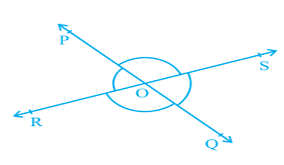
Ans. ∠ POR +∠ ROQ = 180° (Linear pair of angles)
But ∠ POR: ∠ ROQ = 5: 7 (Given)
Therefore, ∠ POR = 5/12 × 180° = 75°
Similarly, ∠ ROQ =7/12 × 180° = 105°
Now, ∠ POS = ∠ROQ = 105° (Vertically opposite angles)
and ∠ SOQ = ∠POR = 75° (Vertically opposite angles)
For Latest Updates on Upcoming Board Exams, Click Here: https://t.me/class_10_12_board_updates
Check-Out:



Comments